Page:Cyclopedia of Western Australia, volume 1.pdf/42
of laterite. There are thus three forms of laterite: an aluminous, a ferruginous, and a siliceous, the composition being liable to vary considerably over a small area, it being governed largely by the nature of the underlying rocks. The laterites pass gradually into the underlying rocks without any sharp line of demarcation. The ferruginous and siliceous laterites are much commoner than the aluminous variety. This arises from the fact that the former types are better able to resist disintegrating influences; they thus not only remain themselves, but act as a protecting cover for the rocks beneath. The lateritic deposits occur as disconnected outliers which once formed part of a continuous deposit. It is difficult to escape the conviction that the laterites are of some geological antiquity, of which possibly the thickness and state of consolidation may be some measure. On such geological evidence as is available the laterites seem to be of earlier age than Late Tertiary, though there is but little doubt that similar deposits are forming at the present time in the State.
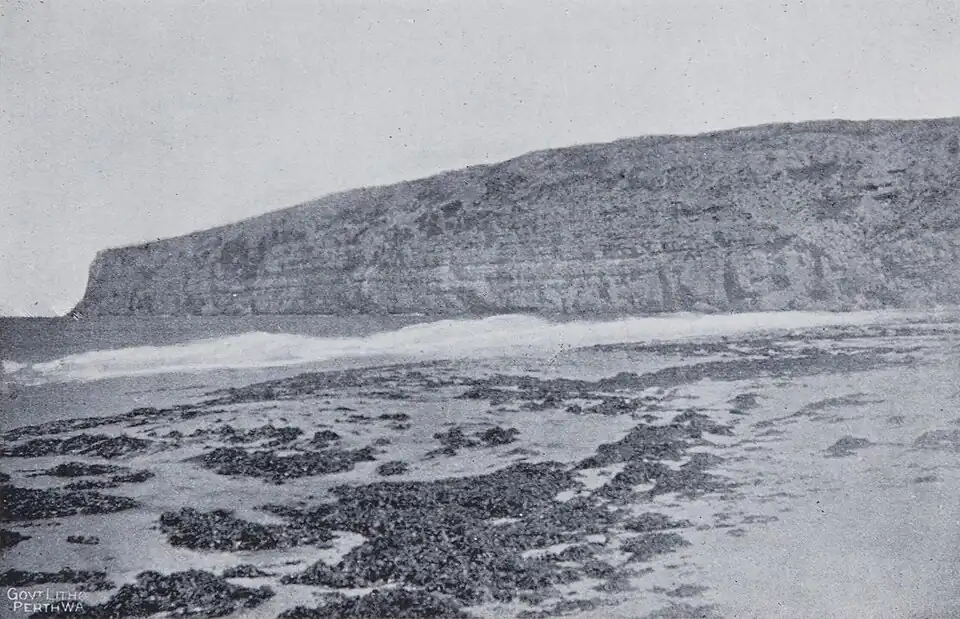
Limestone Cliffs, near Twilight Cove, Eyre
ECONOMIC GEOLOGY.
Gold.—The auriferous deposits of Western Australia, which up to the end of 1910 have been responsible for the production of 23,077,599.63 oz. of fine gold, when viewed in the light of their geological relationships, are divisible into three distinct classes:—(a) Veins and lodes; (b) alluvial deposits; and (c) residual deposits.
The metal itself has been found to occur under several different conditions, viz., (a) native metal; (b) compounds with tellurium and other elements; and (c) in association with other minerals.
Since the first discoveries the gold yield of the State has increased very rapidly. In 1886 an output of 270 fine oz. followed the discovery of the Kimberley goldfield. Since that date the production gradually increased until the year 1903, when it reached 1,962,360.83 oz., from which the yield steadily declined to 1,470,632.02 fine oz. The total gold yield, however, up to the close of 1910 was 23,077,599.63 fine oz., valued at £98,027,412.
The alluvial gold won in Western Australia is, so far as is disclosed by official figures, 254,864.52 fine oz. The yield reached its zenith in 1898, when 66,849.27 fine oz. were recorded, while in 1910 it totalled 5,725.85 oz. Ultimately the alluvial deposits will become exhausted, though it is more than likely that fresh discoveries may yet be made and thus add to the yield from other sources.
The auriferous deposits of the State occur in areas generally as more or less parallel belts of relatively narrow lateral dimensions, though in certain localities they occur as small isolated areas or patches. These narrow, well-defined belts have a general north-west and