Page:Cyclopedia of Western Australia, volume 1.pdf/36
plateau is granite and gneiss, the remainder being formed of the metamorphic rocks. The major portion of the surface of the plateau occupied by these granitic rocks forms broad expanses of flat or rolling country from which occasionally rise huge agglomerates of immense boulders of fantastic-shaped "tors." The schists and allied rocks which constitute the auriferous belts of the State occur as broad bands or patches in the granite, and present a characteristic type of scenery. The various auriferous zones, so far as we know them, are arranged in very long bands of varying width, the limits of which are marked by tolerably well-defined parallels in a general north-west and south-east direction. This marked linear arrangement is not only confined to the metalliferous zones themselves, but to their component beds and veins. The outcrops of these more or less parallel elongated strips are due to the folding of the strata which originated during the efforts of the crust of the earth to adjust itself to the contraction resulting from the gradual cooling of the interior.
There are probably few parts of the Australian continent which can boast of a finer development of these older rocks than Western Australia. They consist of rocks of very different types; many of them are in a crystalline condition and form coarse crystalline schists and gneiss, as well as basic rocks, which have been more or less crushed, foliated, and completely converted into greenstone schists. The basic rocks comprise gabbro, dolerite, epidiorite, pyroxenite, hypersthenite, amphibolite, etc. In some localities these basic rocks can be seen passing by scarcely perceptible gradations into hornblende schists and allied rocks. Some of these older rocks are of sedimentary origin and are practically unaltered; others are quartz and mica schists, and in certain localities are cleaved conglomerates, some of the pebbles in which consist of a pre-existing conglomerate from a much older series of which no trace has yet been found. The less altered members of these ancient sediments make their appearance in many portions of the State. The rocks consist of a great variety of types of indurated slates, quartzites, and conglomerates, together with igneous rocks, some of which there are good grounds for believing to have been originally lavas and ashes.
A remarkable and very noticeable feature of these older rocks are those bands of laminated cherts and jaspers, which often contain oxide of iron to such an extent as to warrant their being classed as iron-ores. These extend as roughly parallel bands, sometimes several miles in length, in the form of attenuated lenses, which, owing to their serrated ridges, stand out in bold relief, thus acquiring a conspicuousness all out of proportion to their real stratigraphical importance. These bands are often intersected by numerous faults, which in some districts are of considerable economic importance, for it is along these fault lines that rich shoots of gold often occur.
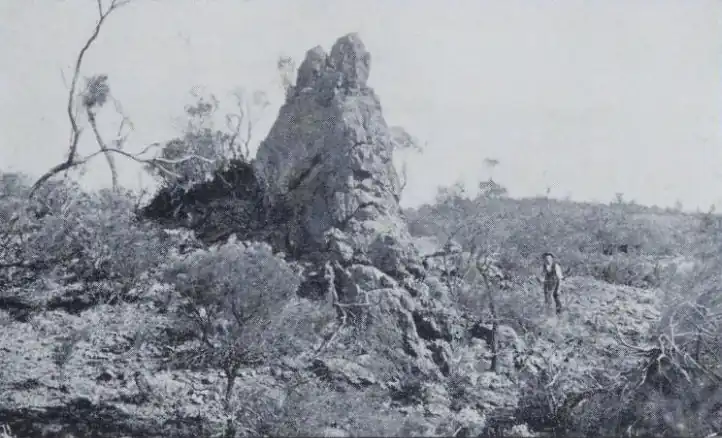
Outcrop of Laminated Quartzite.
These older rocks are invaded by masses and veins of granite and allied rocks, which in many parts of the State occupy very large areas, sometimes embracing hundreds of square miles. The old granitic rocks are traversed by many large icelike quartz reefs, which rise to considerable altitudes above the surface like a wall, and which can in some cases be traced across country with more or less interruption for miles. These older granitic rocks are of some considerable importance by reason of the fact that they form the matrices of tin and allied deposits in the State.
These old Pre-Cambrian rocks are remarkable for the variety of useful and valuable minerals they contain. The plateau in which these older rocks occur has been remarkably quiescent since early geological times, and having had such a peaceful history the areas may be said to possess almost limitless mining possibilities.
Cambrian.—Strata of undoubted Cambrian age are known to occur in the Kimberley district, and were discovered by Mr. E. T. Hardman in 1883-4. In the course of his explorations this observer gathered a suite of fossils which were critically examined by Mr. R. Etheridge, Mr. W. H. Foord, and Dr. Hy. Woodward. Among the disjecta membra were the head and spine of a trilobite belonging to the characteristic Cambrian family Olenellus, O. Forresti, and numerous pteropods, Salterella Hardmani. These came from a locality which, unfortunately, cannot now be identified. The strata with which these fossils were associated consist of limestones, sandstones, quartzites, clay slates, and