Page:Cyclopedia of Western Australia, volume 1.pdf/118
T. Dance (captain of the "Sulphur"), 5,000 acres; William Dixon, 2,268 acres; Sir James Hume, 2,666 acres; George Leake, 14,887 acres; Colonel Peter A. Lautour, 10,000 acres; Dr. John Whattley, 1,500 acres; John Septimus Roe, 3,100 acres; Lieutenant-Governor Stirling, 4,000 acres; William Shaw, 1,000 acres; Lionel Samson, 4,696 acres; and Charles Ridley, 1,750 acres. All these grants were close to the Swan River, many of them with river frontage. The reasons for this were that the soil seemed more promising and the river afforded an easy method of transit. Other assignments on account of capital invested that were made during 1829 were C. H. Fremantle (captain of the "Challenger"), 5,000 acres in the interior; Thomas Bannister, 2,000 on Canning River; Henry Camfield, 1,000 on Swan River; M. C. Carew, 100 on the Helena; John A. Dutton, 3,600 on the Canning; P. H. Dod, 2,000 on the Swan; John O. Davis, 7,026 on the Canning; R. Dawson, 1,280 on the Canning; James Drummond (the botanist), 1,000 on the Swan and 100 on the Helena; Joshua Gregory, 1,000 on the Swan; John Hobbs, 4,000 on the Canning; William Lamb, 8,119 on the Swan; Colonel Lautour, 100 on the Helena; R. Warded, 1,000 on the Swan; Daniel Scott, 4,000 on the Swan; William K. Shenton, 100 acres on the Helena; W. H. Mackie and F. and F. C. Irwin, 200 on the Swan; and P. Pogers, 4,000 acres on Canning River. According to the official statistics 525,000 acres were granted by the end of the year, including the original grant of 100,000 acres to Captain Stirling and the 250,000 conditionally granted to Mr. Peel, who arrived with his immigrants about the middle of December.
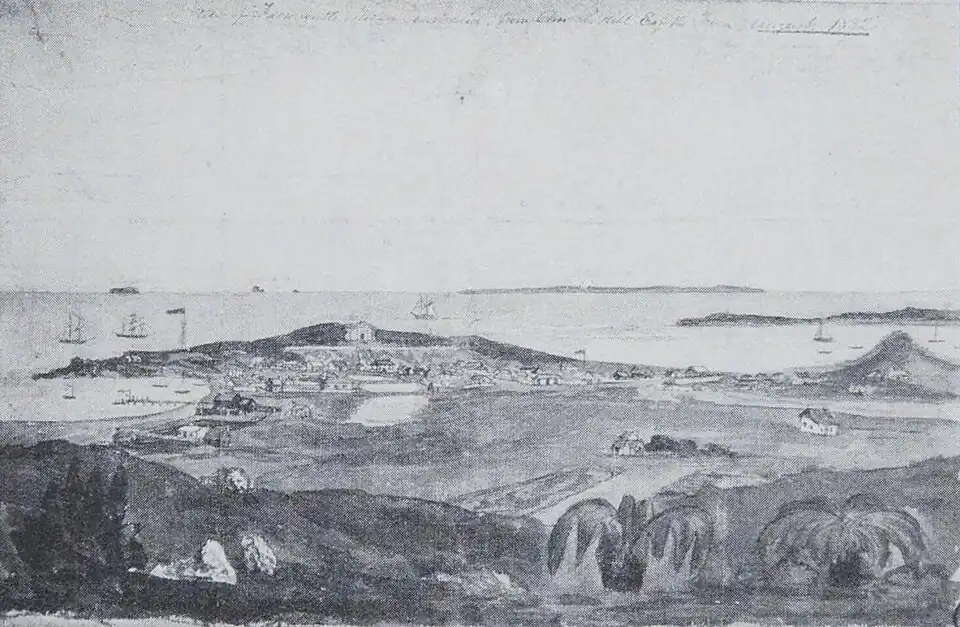
Fremantle, 1832 (From Original Sketch by R. Morrell).
But all these vast areas of land were at that time virgin forest, and though the possessors were potentially rich, they were actually suffering all the privations and discomforts incident to settlement in a new country. They were even without homes, with the exception of such rude shelters as they could make for themselves, and they had practically no means of subsistence beyond the supplies they had brought, and such further provisions as ships expected to arrive from time to time might bring. Their condition was certainly not one to be envied. Though many of them were of first-class family and descended from the best English stock they were in great measure unprepared for the trials they had to face, and were not inured to the privations that must necessarily befall those who hope to wrest a livelihood from the wilds of Nature. Their difficulties were greatly increased by the fact that they arrived at the height of the winter season, and were prevented by the cold and rain from making much headway for some considerable time. But all their trials were borne with stout hearts, and they struggled manfully forward, strong in their determination to succeed. The state of the settlement during the first few weeks of its existence may be fairly well estimated from the despatch forwarded by the Lieutenant-Governor to the Secretary of State on September 9, 1829. "Exposure to the winds and rain of a boisterous winter," he says, "has been the most serious evil we have encountered, but that and other privations incident to such an undertaking have been borne with cheerfulness and overcome with proper spirit by all the individuals forming the civil and military establishment. Among the settlers since arrived some disappointment has arisen in consequence of their being in general but little accustomed to encounter hardships, and in all cases too sanguine in the expectations they have entertained respecting the country. But as the weather has improved they have been enabled to extend their explorations and attain more comfort, and I believe there is now existing among them a cheerful confidence in the qualities of the country and a general belief in its future prosperity. … Up to the present period no event of a nature wholly unexpected or very important has occurred in the prosecution of the service, except that the western coast of New Holland was taken possession of in His Majesty's name by Captain Fremantle, and that the settlement has subsequently been commenced and proceeded in. The progress made in the erection of storehouses and temporary buildings for the civil establishment, in landing the stores and provisions, and in exploring the country has been very considerable when viewed with reference to the season