Doing the cubing we obtain
 .
.
Now we know that we may neglect small quantities of the second and third orders; since, when  and
and  are both made indefinitely small,
  and
and  will become indefinitely smaller by comparison. So, regarding them as negligible, we have left:
 .
.
But  ; and, subtracting this, we have:
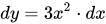 ,
,
and
 .
.
Case 3.
Try differentiating  . Starting as before by letting both
  and
and  grow a bit, we have:
 .
.
Working out the raising to the fourth power, we get
 .
.
Then striking out the terms containing all the higher powers of , as being negligible by comparison, we have
 .
.
Subtracting the original , we have left
 ,
,
and
 .
.