Numerical example.
Suppose  and ∴
and ∴  . Then let
  grow till it becomes
  (that is, let
  ). Then the enlarged
  will be
  . But if we agree that we may ignore small quantities of the second order,
  may be rejected as compared with
  ; so we may round off the enlarged to
  . has grown from to ; the bit added on is
  , which is therefore
  .
.
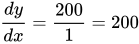 . According to the algebra-working of the previous paragraph, we find
  . And so it is; for and
  .
.
But, you will say, we neglected a whole unit.
Well, try again, making  a still smaller bit.
Try  . Then
  , and
, and
 .
.
Now the last figure is only one-millionth part of the , and is utterly negligible; so we may take  without the little decimal at the end. And this makes
  ; and
; and 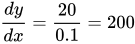 , which is still the same as
  .
.
Case 2.
Try differentiating  in the same way.
We let grow to  , while grows to
  .
.
Then we have
 .
.