where  is a constant angle that comes in by integration.
Or, preferably, this may be written
 , which is the solution.
Example 6. 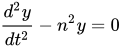 .
.
Here we have obviously to deal with a function  which is such that its second differential coefficient is proportional to itself. The only function we know that has this property is the exponential function (see p. 143), and we may be certain therefore that the solution of the equation will be of that form.
Proceeding as before, by multiplying through by  , and integrating, we get
 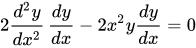 , and, as
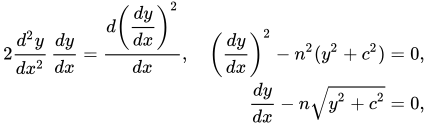
where  is a constant, and
 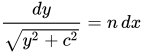 .
Now, if
.
Now, if
 ,
,

and
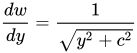 .
.
Hence, integrating, this gives us


Now
 ;
;
whence
