Example 5.
Let 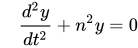 .
.
In this case we have a differential equation of the second degree, in which  appears in the form of a second differential coefficient, as well as in person.
Transposing, we have 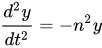 .
.
It appears from this that we have to do with a function such that its second differential coefficient is proportional to itself, but with reversed sign. In Chapter XV. we found that there was such a function–namely, the sine (or the cosine also) which possessed this property. So, without further ado, we may infer that the solution will be of the form  . However, let us go to work.
Multiply both sides of the original equation by  and integrate, giving us
 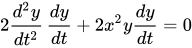 , and, as
 ,
,
 being a constant. Then, taking the square roots,

But it can be shown that (see p. 171)
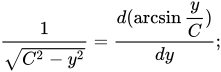
whence, passing from angles to sines,
