PARTIAL DIFFERENTIATION
177
The first is obtained by supposing  constant, the second is obtained by supposing
  constant; then
 .
.
Example (2). Let  . Then, treating first and then as constant, we get in the usual way
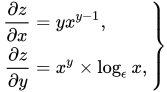
so that  .
.
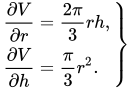
Example (3). A cone having height  and radius of base
  has volume
  . If its height remains constant, while changes, the ratio of change of volume, with respect to radius, is different from ratio of change of volume with respect to height which would occur if the height were varied and the radius kept constant, for
The variation when both the radius and the height change is given by 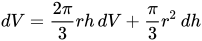 .
.
Example (4). In the following example  and
and  denote two arbitrary functions of any form whatsoever. For example, they may be sine-functions, or exponentials, or mere algebraic functions of the two