of the experiment (i.e. when  ) it is
  hotter than the surrounding objects, and if the time-constant of its cooling is
  minutes (that is, if it takes minutes for its excess of temperature to fall to
  part of ), then we can calculate to what it will have fallen in any given time
  . For instance, let be
  minutes. Then
 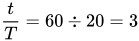 , and we shall have to find the value of
  , and then multiply the original by this. The table shows that is
  . So that at the end of minutes the excess of temperature will have fallen to
  .
.
Further Examples.
(1) The strength of an electric current in a conductor at a time secs. after the application of the electromotive force producing it is given by the expression
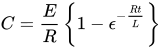 .
.
The time constant is  .
.
If  ,
,  ,
,  ; then when is very large the term
 becomes
  , and
, and 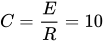 ; also
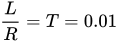 .
.
Its value at any time may be written:
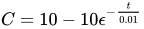 ,
,