ON TRUE COMPOUND INTEREST
137
a time. Suppose we divided the year into  parts, and reckon a one-per-cent. interest for each tenth of the year. We now have
  operations lasting over the ten years; or
 £
£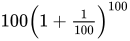 ;
;
which works out to £ .
.  s.
s.
Even this is not final. Let the ten years be divided into  periods, each of
  of a year; the interest being
  per cent. for each such period; then
£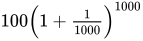 ;
;
which works out to £ .
.  s.
s.  d.
d.
Go even more minutely, and divide the ten years into  parts, each
  of a year, with interest at of
  per cent. Then
£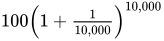 ;
;
which amounts to £.  s.
s.  d.
d.
Finally, it will be seen that what we are trying to find is in reality the ultimate value of the expression  , which, as we see, is greater than
  ; and which, as we take
  larger and larger, grows closer and closer to a particular limiting value. However big you make , the value of this expression grows nearer and nearer to the figure

a number never to be forgotten.
Let us take geometrical illustrations of these things. In Fig. 36,  stands for the original value.
  is
is