so that  , and the partial fractions are:
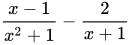 .
.
Take as another example the fraction
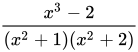 .
.
We get

In this case the determination of  ,
,  ,
,  ,
,  is not so easy. It will be simpler to proceed as follows: Since the given fraction and the fraction found by adding the partial fractions are equal, and have identical denominators, the numerators must also be identically the same. In such a case, and for such algebraical expressions as those with which we are dealing here, the coefficients of the same powers of
  are equal and of same sign.
Hence, since

we have  ;
;  (the coefficient of
  in the left expression being zero);
  ; and
; and  . Here are four equations, from which we readily obtain
  ;
;  ;
;  ;
;  ; so that the partial fractions are
 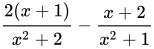 .
.