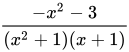
If  , we get:
 ; whence
  .
.
So then the partial fractions are:
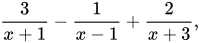 ,
,
which is far easier to differentiate with respect to  than the complicated expression from which it is derived.
Case II. If some of the factors of the denominator contain terms in  , and are not conveniently put into factors, then the corresponding numerator may contain a term in , as well as a simple number; and hence it becomes necessary to represent this unknown numerator not by the symbol
  but by
  ; the rest of the calculation being made as before.
Try, for instance:
Putting  , we get
  ; and
; and  ;
;
hence
 ;
;
and
 .
.
Putting  , we get
  ;
;
hence
 or
or  ;
;
and
 ,
,