Page:American Journal of Mathematics Vol. 2 (1879).pdf/27
expressing the equality between the moment of the internal stresses of any section, and that of the external bending forces will be
![{\displaystyle 2\iint _{b}^{z_{1}}\iint _{a}^{y'}N{z_{2}}dzdy=-2x\iint _{b}^{z_{1}}\iint _{a}^{y'}\left[f'_{y}(y,z)F'_{2}(y,z)\right]z_{2}dzdy+2c\iint _{b}^{z_{1}}\iint _{a}^{y'}z^{2}dzdy={\frac {1}{2}}M}](../_assets_/eb734a37dd21ce173a46342d1cc64c92/86c2aad7074bf642762b9528c9c0398d4885e589.svg)
In this equation is written for convenience for , and represents the maximum value of Of course is the value of for the neutral surface, and is the value of for the vertical axis of symmetry.


The lower limits and are taken so that the integration will cover one-fourth of the section, and the resulting moment in the second member will, therefore, be one-half the whole bending moment. Since the axis of is parallel to the axis of symmetry of section, and since the external forces act parallel to it, the integral the sum of the external forces which produce the bending, while these integrals are supposed to cover the whole section.
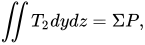
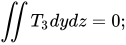
Now but, considering that part of the section on one side of that axis of symmetry which is parallel to the axis of , for every positive value of between the limits of and there is also a negative value on the other side of the neutral surface. Hence and the first term of the second member of equation (18) may be omitted. Again, applying the integrals to the whole surface, is simply the statical moment of the surface about an axis passing through its centre of gravity, consequently it is equal to zero, and the last term of the second member of equation (18) may be omitted. Hence

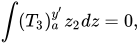

Equation (20) shows that, if for any section the bending moment remains the same, the shearing force also will remain constant, which was to be proved.
If equation (20) be differentiated in respect to x, there results