Burr, On the Theory of Flexure.
17
The equations of condition for equilibrium in these cases, from equations 2, will be the three following:
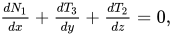 |
 ........(3) ........(3)
|

|

|
or
 |
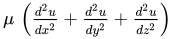 |
 |
...(4)
|
| |
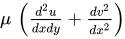 |
|
| |
 |

|
Three other equations of condition result from the conditions that 
 and
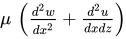
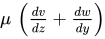
and  each equal zero. These give in connection with equations (1)
 |
|
......(5)
|
 |
|
......(6)
|
 |
|
......(7)
|
These equations, as it will afterwards be seen, aid in the determination of the displacements 
 and
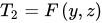
and  The last two of equations (3) may be integrated at once, and will give
 |
|
..........(8)
|
 |
|
..........(9)
|
In which  and
and  signify any arbitrary functions of
  and
and  whatever; they correspond to the "constants" of integration and must be written because the intensities of the internal stresses are, in general, each functions of
  and
and 
Denoting by  and
and  the partial derivatives of
  and
and  respectively, in respect to the variables indicated, the first of equations (3) may be integrated, and will give
![{\displaystyle N_{1}=-x\,[f'_{y}\,(y,z)+F'_{z}\,(y,z)]+\Psi \,(y,z)}](../_assets_/eb734a37dd21ce173a46342d1cc64c92/738002dec9d200006dfb42226e043d4d1f6e3356.svg) |
....(10)
|
The quantity  is any arbitrary function of and
  and it will now be shown that in general it is independent of and as well as of and that many of the cases of pure flexure it may be put equal to zero.