Ladd, The Pascal Hexagram.
9
always one vertex within the conic and two without, it follows that 
 points are always within the conic and
  without, and that of the
 lines cut the conic in two real and in two imaginary points.
It now appears that the lines and points of the Brianchon figure can be produced without considering the Brianchon hexagon. Since the points 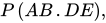
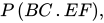
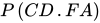 are on a line,
  their poles,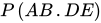

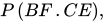
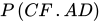
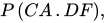 meet in a point [the same as the point
  ], the pole of
  From the
  points thus obtained may be produced all the other lines and points of the figure.
3. If 

 be the sides of a triangle and


 the lines of a quadrilateral such that the triangles


 are homologous with
  their respective axes of homology being


 then the intersections of


 are collinear. For, the equations of the axes may be written


 and we shall then have for lines through their respective intersections with sides of the quadrilateral
which form all four one and the same line. The quadrilateral  is also such that its four triangles are each homologous with and in fact in such a way that
  and
and  have lines joining all three corresponding vertices coïncident. Take the triangles
  and
and  we have

 and the equations show that these lines meet in a point. Let us apply this property to the Pascal hexagram. We shall say, with Veronese, (p. 27), that the triangle formed by joining opposite vertices of a hexagon belongs to the Pascal obtained by taking the vertices in the same order; for instance, the triangle whose sides are

 belongs to the four Pascals

 The points
|
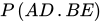 |
are on |
the line |

|
|
 |
" |
" |

|
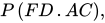 |
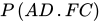 |
" |
" |

|



