8
Ladd, The Pascal Hexagram.
 &c., meet in a single point
  through which passes also an
  line; and all the pairs of points of the same notation,

 &c., together with the
  point of the same notation, lie in a line
  through an
  There are
  lines three through each
  point, and points three on each line (p. 52).
The  points &c., also lie in twos on
  lines
lines 
 &c., respectively, which pass by fours through the points
  A similar relation holds between the
  lines (p. 60).
Veronese gives many relations of harmonicism and of involution, which I omit. For instance, he shows that the pairs of points 

 &c., of same notation, which lie all on a common
  line, form a system of points in involution, whose double points are the
  point of same notation and the point of the line.
1. Since the point  is conjugate to the point
  with respect to the conic
  and the pole of the line
  with respect to the same conic, it follows that the point
  is on the line is on the line
 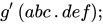 it is also on the line
  hence it is at their intersection. In general, lines and
  lines of the same notation intersect in points. Since in the Brianchon figure the lines consist of ten pairs of lines conjugate with respect to it may be shown in the same way that points and
  points of the same notation, as
  and
and 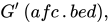 lie on lines, as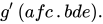
2. Since  is a quadrilateral inscribed in a conic, the intersections of its diagonals,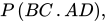
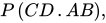
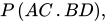 are the vertices of a triangle self-conjugate to the conic and the line joining
 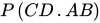 to
to 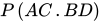 is the polar of
 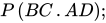 but
but  is also the polar of hence these two lines coïncide. In the same way it may be shown that the point of intersection of
  and
and  coïncides with and, in general, that the triangle whose vertices are the points obtained from four of the six points on the conic coïncides with the triangle whose sides are the
  lines obtained from the tangents at the same four points. There are
  combinations of four letters out of six, hence there are of these self-conjugate triangles. Since a self-conjugate triangle has