Page:A Source Book in Mathematics.djvu/664
lines by an equation; for example, if the arc is , the versine , then we shall have


,
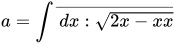
and if y is the ordinate of the cycloid, then
,

which equation perfectly expresses the relation between the ordinate and the abscissa , and from it all the properties of the cycloid can be demonstrated; and the analytic calculus is extended in this way to those lines which hitherto have been excluded for no greater cause than that they were believed unsuited[1] to it; also the Wallisian interpolations and innumerable other things are derived from this source.

..........
It befell me, up to the present a tyro in these matters, that, from a single aspect of a certain demonstration concerning the magnitude of a spherical surface, a great light suddenly appeared. For I saw that in general a figure formed by perpendiculars to a curve, and the lines applied ordinatewise to the axis (in the circle, the radii), is proportional to the surface of that solid which is generated by the rotation of the figure about the axis. Wonderfully delighted by which theorem, since I did not know that such a thing was known to others, I straightway devised the triangle which in all curves I call the characteristic [triangle], the sides of which would be indivisible (or, to speak more accurately, infinitely small) or differential quantities; whence immediately, with no trouble, I established countless theorems, some of which I after- ward observed in the works of Gregory and Barrow.
..........
Finally I discovered the supplement of algebra for transcendental quantities, of course, my calculus of indefinitely small quantities, which, the differential as well as [that] of either summations or quadratures, I call, and aptly enough if I am not mistaken, the analysis of indivisibles and infinites, which having been once revealed, whatever of this kind I had formerly wondered about seems only child’s play and a jest.
- ↑ [The Latin is "incapaces," literally, "incapable of."]