Page:A Source Book in Mathematics.djvu/663
equation for the line sought, from which I look for the tangent to the line according to my method of tangents published in the Acta, October, 1684, which does not preclude[1] transcendentals. Thence, comparing what I discover with the given property of the tangents to the curve, I find, not only the assumptions, the letters a, b, c, etc., but also the special nature of the transcendental.
..........
Let the ordinate be , the abscissa , let the interval between the perpendicular and the ordinate...be ; it is manifest at once by my method that


,

..........
which differential equation being turned into a summation becomes
;
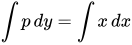
But from what I have set forth in the method of tangents, it is manifest that
;
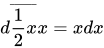
therefore, conversely,
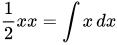
(for as powers and roots in common calculation, so with us sums and differences or ∫ and , are reciprocals). Therefore we have

.
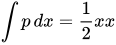
Q. E. D.
Now I prefer to employ and similar [symbols], rather than letters for them, because the is a certain modification of the , and so by the aid of this it turns out that, since the work must be done through the letter alone, the calculus obviously proceeds with its own[2] powers and differentials, and the transcendental relations are expressed between and another [quantity]. For

which reason, likewise, it is permissible to express transcendental
- ↑ [The Latin word is "moratur" which means, literally, "it does not linger," or "it does not take into consideration." But as the method given really does include the case of transcendentals, accuracy of translation must be sacrificed in the interest of truth.]
- ↑ [That is the powers and differentials of the .]