Page:A Source Book in Mathematics.djvu/660
with respect to the , then the tangent is perpendicular to the axis, or it is the ordinate itself. If and [are] equal, the tangent makes half a right angle with the axis. If, with increasing ordinates , their increments or differences also increase (or if, the ’s being positive, the ’s, the differences of the differences are also positive, or [the ’s being] negative, [the ’s are also] negative), the curve turns [its] convexity toward the axis; otherwise [its] concavity.[1] Where indeed the increment is maximum or minimum, or where the increments from decreasing become increasing, or the contrary, there is a point of opposite flexion, and the concavity and convexity are interchanged, provided that the ordinates too do not become decreasing from increasing or the contrary, for then the concavity or convexity would remain; but it is impossible that the amounts of change[2] should continue to increase or decrease while the ordinates become decreasing from increasing or the contrary. And so a point of flexion occurs when, neither nor being 0, yet is O. Whence, furthermore, problems of opposite flexion have, not two equal roots, like problems of maximum, but three.


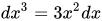
Powers:[3]
..........
,

for example,
;
,
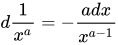
for example, if
,

.

Roots:
.
![{\displaystyle d{\sqrt[{b}]{x^{a}}}={\frac {a}{b}}{\sqrt[{b}]{x^{a-b}}}dx}](../_assets_/eb734a37dd21ce173a46342d1cc64c92/3b12fc83952d2c30c332d76e37d2c92ed5223827.svg)
- ↑ [In the original the words concavity and convexity are interchanged, but farther on in the article the statement is made correctly.]
- ↑ [The word that Leibniz uses is "crementa."]
- ↑ [There are several mistakes in this paragraph and the following one but, as they are obviously printer’s errors, they have been corrected by the translator.]