Page:A Source Book in Mathematics.djvu/659
Multiplication:
,

or by placing
,

.

. . . . . . . . . .
Yet it must be noticed that the converse is not always given by a differential equation, except with a certain caution, of which [I shall speak] elsewhere.
Next, division:
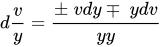
(or being placed equal to )


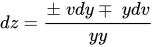
Until this sign may be correctly written, whenever in the calculus its differential is simply substituted for the letter, the same sign is of course to be used, and [is] to be written for , and [is] to written for , as is apparent from the addition and subtraction done just above; but when an exact value is sought, or when the relation of the to is considered, then [it is necessary] to show whether the value of the is a positive quantity, or less than nothing, or as I should say, negative; as will happen later, when the tangent is drawn from the point , not toward A, but in the opposite direction or below , that is, when the ordinates decrease with the increasing abscissas . And because the ordinates sometimes increase, sometimes decrease, will be sometimes a positive, sometimes a negative quantity; and in the former case the tangent is drawn toward , in the latter is drawn in the opposite direction. Yet neither happens in the intermediate [position] at , at which moment the ’s neither increase nor decrease, but are at rest; and therefore becomes equal to , where nothing represents a quantity [which] may be either positive or negative, for equals ; and at that place the , obviously the ordinate , is maxi- mum (or if the convexity turns toward the axis, minimum) and the tangent to the curve at is drawn neither above , where it approaches the axis in the direction of , nor below in the contrary direction, but is parallel to the axis. If is infinite


