206
A HISTORY OF MATHEMATICS.
notation  by all the English writers previous to 1704, excepting Newton and Cheyne, in the sense of an infinitely small increment.[35] Strange to say, even in the Commercium Epistolicum the words moment and fluent appear to be used as synonymous.
After showing by examples how to solve the first problem, Newton proceeds to the demonstration of his solution:—
"The moments of flowing quantities (that is, their indefinitely small parts, by the accession of which, in infinitely small portions of time, they are continually increased) are as the velocities of their flowing or increasing.
"Wherefore, if the moment of any one (as x) be represented by the product of its celerity into an infinitely small quantity 0 (i.e. by  ), the moments of the others, v, y, z, will be represented by
  ,
,  ,
,  ; because
  , ,
, ,  , and
, and  are to each other as {{nowrap|
 , ,
, ,  , and
, and  .
.
"Now since the moments, as and , are the indefinitely little accessions of the flowing quantities x and y, by which those quantities are increased through the several indefinitely little intervals of time, it follows that those quantities, x and y, after any indefinitely small interval of time, become  and
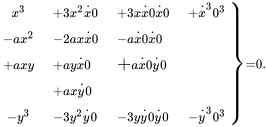
and  , and therefore the equation, which at all times indifferently expresses the relation of the flowing quantities, will as well express the relation between and , as between x and y; so that and may be substituted in the same equation for those quantities, instead of x and y. Thus let any equation
  be given, and substitute for x, and for y, and there will arise