Old Westland/Chapter 8
Chapter VIII
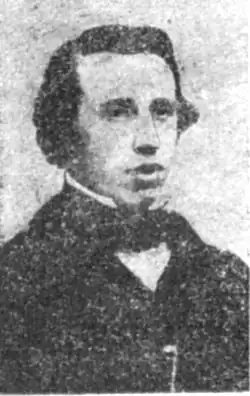
Henry Whitcombe
Apart from its importance as marking Mackay’s purchase from the natives, 1860 is also notable for the fact that this year Reuben Waite, pioneer storekeeper of the West Coast, established himself at Westport. How and why he came to do so is admirably described by Mr. Justice O’Regan, an outstanding authority on West Coast history, in an article contributed to “Te Wai Pounamu,” an earlier publication of the writer’s, wherein he states, inter alia:
“The earliest discovery of alluvial gold in New Zealand was made at Collingwood in the year 1856, and we first hear of Mr. Reuben Waite at Collingwood, where he kept a store. He was an Englishman by birth, and I have heard him say that he served his time to the trade of stonemason. He arrived first in Australia, and came to New Zealand from Victoria, but I am unable to state when he arrived in this country.
“Waite wrote a small pamphlet in 1869 entitled ‘A Narrative of the Discovery of the West Coast Goldfields,’ edited by W. H. L. Leach, printed at the office of the Nelson Examiner, and published by J. Hounsell, bookseller and stationer, of Nelson, and I possess a copy thereof presented to me by the late Mr. Turnbull, founder of the Turnbull Library. He states that in or about the month of May, 1860, he was on the Collingwood goldfields when a party of Maoris came overland from the Buller River by travelling up the coast, and thence by the Aorere to Collingwood, bringing with them a parcel of gold which they said they had obtained some twenty miles up the Buller. The author adds that the gold was a splendid sample, and that upon seeing it, he conceived the idea of organising a prospecting expedition to the West Coast. Here let me state that I have reason to believe it was in the month of April, 1860, that the party of Maoris brought the gold to Collingwood, and Waite himself does not appear to be exact about the date when he fixes it at in or about the month of May. The Maoris had gone to the West Coast in search of gold, because they had acquired at Collingwood a knowledge of the somewhat primitive methods of gold digging in vogue in those days, and, as many of them were familiar with the West Coast, they were struck by the resemblance of the gold-bearing gravel or ‘wash,’ as it was called, to that which they had seen in their travels farther south. It is interesting to remark in passing that the Englishman, William Hammond Hargreaves, was likewise so much impressed by the similarity of the gold-bearing gravels in the ‘placer’ diggings in California to that which he had seen in New South Wales, that he made the journey back to Australia and discovered payable gold on the Turon in February, 1851.
“According to Waite’s account, he experienced very little encouragement from the people of Nelson to whom he mentioned his project. Indeed, he states that they laughed at the undertaking, and described him and his companion, Mr. Saunders Rogers, as ‘madmen from Victoria.’ However, he called a meeting of gold-diggers and laid his plan before them, and ultimately a party was formed who chartered the ketch Jane, and engaged Captain Jacobsen to take the party to the Buller. Apparently not more than seventeen persons embarked from Collingwood. The little vessel grounded at Farewell Spit, but was ultimately got off successfully, and the party entered the Buller safely two days later. Waite does not give us the exact date, but it was certainly in the month of June, 1860. Several of the party, including Waite himself, attempted to ascend the Buller in the ship’s boat with the object of reaching the spot described by the Maoris, but after four days ‘battling with the current’ the journey was abandoned. On Waite’s return to the river mouth with his companions he learnt that certain Maoris had discovered payable gold in the Waimangaroa, and he was shown a small nugget. Waite immediately embarked for Nelson for the purpose of bringing fresh supplies, and he appears to have experienced rough weather, because sixteen days elapsed before the little craft reached her destination. He placed a number of nuggets in a jeweller’s window at Nelson, and some interest appears to have been excited amongst the people there. In due course Waite returned to the Buller and opened a store there.
“The existence of gold in the Buller had been discovered by Mr. John Rochfort, surveyor, who obtained several small pieces of the precious metal at the Old Diggings in November, 1859. This spot is opposite the site of the wayside accommodation house known at Berlin’s. The Maoris who brought the sample to Collingwood, however, were the first to obtain gold in payable quantities on the West Coast, and from the time of their finding it in 1860 gold was obtained continuously. It is thus abundantly evident that payable gold was got on the West Coast several years before the discovery of the Greenstone Diggings, also made by the Maoris in 1864.
“From the present site of Westport, diggers penetrated in various directions, and as early as 1862 payable gold was discovered at Lyell by Maoris. Waite’s store at Westport appears to have been the chief source of supplies for those venturesome and forgotten pioneers, but owing to the discovery of gold in Otago, attention was diverted from the West Coast until January, 1862, when the steamer Tasmanian Maid (Captain Whitwell) came to the Buller from Dunedin with a great number of diggers on board.”
Reverting from this second interlude, it is necessary to observe that after Mackay’s departure the Canterbury Provincial Government proceeded but slowly with the exploration of Westland, and the year 1861 was uneventful. In view of what transpired in 1862, however, it is necessary to outline briefly the reasons which forced the Provincial Government into offering a reward of £1,000 for the discovery of a payable goldfield.
To do so adequately let it first be noted that the discovery of gold by Hargreaves in New South Wales in 1851 gave a great impetus to the quest for the metal royal, which extended not only to other parts of Australia but also to this Dominion, prospectors crossing the Tasman and trying their luck in many parts. The first definite result of these activities was that Charles Ring, in 1852, located auriferous quartz at Kapanga Creek, Coromandel, and applied for the reward of £500 which had been offered by a group of Auckland men for the discovery of payable gold. About a hundred men rushed the field, Colonel Wynyard, who was then Lieutenant-Governor, having made arrangements with the Maoris to permit the search for gold on their lands. Operations, however, did not meet with immediate success, and many miners left to follow rushes which occurred at Collingwood, in 1857, where William Lightband had discovered rich alluvial deposits, the first in New Zealand, and at Tuapeka (Lawrence), Otago, where in 1861 Gabriel Read made known to Major Richardson, then Superintendent of that Province, that, “for ten hours’ work with a butcher’s knife and a pan, he was enabled to collect 7 ozs. of gold.” As soon as the news of this fabulous find became generally known a mighty rush set in, thousands upon thousands of gold miners swarming all over Otago, and winning from 1861 to 1863 gold to the value of almost £5,000,000.
This great discovery, together with the fact that as early as 1857 gold to the value of £40,000 had been won in Auckland and Nelson, forced the Provincial Government to take action, and, as has been stated, to offer the reward of £1,000 for the discovery of a payable field in Canterbury.
In the hope of obtaining this reward a party of prospectors, Messrs. Smart, French, Cook, Ferguson, Day and Everest, started out from Christchurch in September, 1862, and traversed the eastern side of the Divide, but obtained no gold whatsoever. Later, Smart, French and Day crossed over to Lake Brunner, and in January, 1863, when travelling down the Taramakau River, Day picked up a piece of water-worn gold as big as a shilling, probably the first obtained in this part of Westland. Proceeding to the Greenstone Creek, where they found Maoris at work, they obtained good prospects, but a shortage of food hampered their operations. About this time R. A. Sherrin, a noted prospector, also visited Westland and reported finding gold in many places.
The operations of the prospectors thus being of an encouraging nature, the Provincial Government in 1863 decided to dispatch surveyors to Lake Brunner for the purpose of cutting tracks in the vicinity, and down the Taramakau River to the sea, their object being to assist in every way the various parties who were prospecting in the neighbourhood. Messrs. Howitt, Drake and Dobson were the officers in charge. The governing authority also decided to detail another of their surveyors, Henry Whitcombe, to proceed to the West Coast by way of the pass that today bears his name. This ill-starred explorer was accompanied by a Swiss named Lauper, whose diary of the exploration was translated and published in the Canterbury Provincial Gazette of July 6th, 1863. The following account of this expedition is taken therefrom:
On April 13th Henry Whitcombe and Jacob Lauper, accompanied by two other men, together with horses and a cart containing 200 lbs. of biscuits, tea, sugar, a quarter of mutton, tents, ropes, hatchets, rat traps, etc., left Christchurch with a view to discovering a practicable pass from the head waters of the Rakaia to the West Coast, proceeding by way of the Woolshed Hill, situated about four miles above the confluence of the Rakaia and Wilberforce Rivers. As the country began to get rough Whitcombe decided to leave the cart and some of the biscuits behind, and when they drew close to the ranges the two men were instructed to go back to Christchurch, get the horses shod, return to a camping ground near the Taramakau Saddle, and await the arrival of Whitcombe and Lauper, who went on with the exploration, carrying a small stock of provisions and agreeing to subsist on two biscuits each a day, it being considered that they would reach the coast in two weeks’ time.
For the first ten days the weather was all that could be desired, then it suddenly changed, rain and snow falling heavily, which apart from delaying their progress, saturated their biscuits which became a mass of wet dough. Having left their tent behind, they were exposed to the full fury of the elements and suffered very severely.
On the 24th they reached some rocks in the river, which it was necessary to cross; “here the boulders were of enormous size, and there was a deep whirlpool where the water boiled, hissed and foamed like a witch’s cauldron.” This appeared impossible to cross, the sides being perpendicular; but to return was even more difficult, as a great depth of snow must have fallen on the pass since they had crossed over. Lauper, however, had had experience of difficulties amongst his native Swiss mountains, and, seeing the point of a rock projecting over the surface of the water, he fastened a rope to a small rock, which he placed in the water on the opposite side, then threw the other end on the projecting point, and lowered himself carefully down with his hands. He descended up to the chin in the whirlpool, but, as he could find no bottom, he drew himself back on to the rock. Perceiving a small hollow in the side of the rock, about a foot above the water, where he could just place half the length of his finger, he determined with the aid of that to get across, and directed Whitcombe to push the rope on top over the side wall. Then, though up to the neck in water, he managed to reach the side and the little notch in the wall, let go the rope and hold fast. He had no trouble in crossing over; being deep the water supported him, so that he could hold himself up with one finger. He got to the next rock with ease, and then scrambled into the bush, where he cut three long saplings, by the aid of which, and with the assistance of Lauper, Whitcombe managed to overcome that perilous descent, the least mistake in which would have meant almost instantaneous death.
The next day they came to a place where the river fell straight down over a high rock, spreading out broad and deep at the bottom. They scrambled on, but managed to advance in ten hours, with the hardest work, only about two hundred yards. The rain continuing, it was impossible to light a fire that night and their food by this time was sodden, sour and unpalatable. They slept close together to keep themselves warm, and Lauper noted that Whitcombe trembled very much. Three days later Lauper observed some splendid looking wash dirt and tried out two handfuls in the lid of the billy, getting the colour freely. He then tried more, obtaining in all two grains of fine gold, Whitcombe exclaiming, “That will do, Jacob, we will claim the reward.” The weather continued bad and it was very cold. The following day they could hear the roar of the sea and pushed on, but could not reach the coast and were forced to camp again in the bush. Next morning they were early astir and in crossing a low hill Lauper slid about ten feet into the bed of the river. Whilst in the act of doing so, the bag in which he carried the biscuits caught in the branch of a tree, which tore it in two, and they lost half of their small store—a misfortune which had happened once before. They then reached a swampy place and had to make a circuit of many miles through dense scrub, which scratched and tore their hands and faces. Weary to death they lay down and were half frozen with cold that night, for they had not the energy to make a fire. The next day the same difficulties were met with, and they vainly endeavoured to reach the sea coast, but night overtook them. They could, however, see the shore distinctly—it was not more than a dozen miles away.
The rain still poured down incessantly, and though they had but one handful of dough left—not enough for one man—they decided to finish it as they hoped to find a Maori on the beach, who had on a previous occasion supplied Lauper (who was then accompanied by the surveyor Drake) with eels and potatoes. They were too cold to sleep, and early next morning continued their journey through the dense scrub without a morsel of food of any kind. They reached the beach about four that afternoon, Lauper recognising the place as the mouth of the Hokitika River. They were very weary and hungry, but in good spirits, thinking their sufferings were nearly at an end.
They made a large fire and dried their blankets for the first time for thirteen days—the period occupied in travelling from the head of the Rakaia. They had been wet through all that time, and during the journey had failed to catch either an eel, a bird or even a rat. Next day as no Maoris were to be found they proceeded north along the beach to the Arahura River, which Lauper in his diary calls the Brunner River. Here again they found no natives, the pa being deserted, and all the food they could find was a handful of small potatoes and a little Maori cabbage. While this poor fare was being cooked Whitcombe, utterly exhausted, fell asleep, and when he awoke he remarked, “You have lost a good deal of flesh, Jacob. How do I look? I feel very weak and very hungry.”
Lauper did his best to cheer him up but it was evident he was in a very bad way. They then ate their last meal together . . . . Whitcombe insisted on proceeding, being very anxious to reach the Taramakau, which was only nine miles away. It was with the utmost difficulty that they crossed the Arahura, both holding on to a strong stick, Maori fashion, so being of mutual assistance one to the other. Having crossed when the tide was out the going on the beach was good and shortly after midnight they reached their objective. The next morning they could see the pa on the opposite side, but no sign of life. After waiting for some time, hoping against hope that the Maoris would put in an appearance, Whitcombe said: “You perceive, Jacob, there is no one to give us any assistance; we must get across somehow, or we will starve to death.”
Lauper stated that the river was not fordable, but Whitcombe insisted on attempting to cross. He proposed building a raft, but this idea was discarded when they found two old canoes which they lashed together. They pushed out into the stream and the current, which was very swift, whirled them rapidly towards the sea. The canoes, filling quickly, began to sink. Whitcombe took off his coat and prepared to swim ashore, telling Lauper to leave the canoes or he would be drowned. He then made a great leap into the stream and Lauper saw him swimming with powerful strokes towards the south bank, which was still nearest to that portion of the river where the canoes had filled and capsized. Lauper, meantime, was in a desperate plight. A poor swimmer at any time, he could do nothing but hold fast to the canoes which were soon swept into the breakers and tossed about in all directions. After a very severe buffeting he was washed ashore by a huge wave and managed to hold on to a pile of driftwood until the water receded. Exhausted he lay there all night, and in the morning found that he was about a mile south of the river they had attempted to cross. Travelling along the beach with great difficulty, he found the coat Whitcombe had thrown into the river, a parcel of tobacco, some blankets and the canoes. A little further on he saw a pair of boots showing above the sand, and approaching closer was horrified to observe the body of his companion.
Henry Whitcombe was dead . . . . the first known victim of the treacherous Taramakau, the river responsible for the lives of innumerable diggers, who, in endeavouring to pass through its snow-fed waters, met with a similar fate. These unfortunate, and in many cases fool-hardy men, were, in the vernacular of the day, said to have died the National Death, so great was the toll of the roaring rivers of the land wherein they wooed fickle fortune and lost their all.
With his hands Lauper dug a shallow grave above high water mark, and there reverently laid to rest the first Government official to lay down his life, in the execution of his duty, in Westland.