Old Westland/Chapter 5
Chapter V
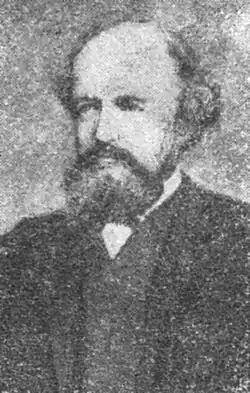
Thomas Brunner
The year 1848 did not open auspiciously for Brunner, who was still resting at the Mawhera Pa. He was thoroughly run down and his teeth at this time became a source of great trouble to him, his face becoming so badly swollen that he could not eat for some days. Recovering somewhat, he walked twenty miles south to Okitika for a kit of dried fish a Maori had given him. This was a very welcome addition to the scanty store of food he had managed to get together to be used on the return to Nelson, via the Mawhera (Grey) River.
The weather being favourable, Brunner on January 25th set out on this historic journey, a journey which was to prove momentous in the history of Westland, as it was marked by his discovery of the famous coal seam near the site of the town which to-day bears his name.
The discovery is thus graphically described by the traveller in his journal:—
“This morning we freighted our canoes with provisions, clothes, and fishing apparatus. I considered myself on board the admiral’s canoe, which was the largest and first to start, having in company three others. The names of the canoes that ascended the river with me were Te Wairakou, with myself and nine natives; Te Maikai, with my four natives and Aperahama; Te Paiekau, with two natives carrying nets, etc., for fishing; and Te Matamata, with four natives; so I think I am well equipped, considering I had nothing to give the natives for all their trouble, except good wishes.
“There was much crying when I left, and apparently some good feeling towards me. They told me to return amongst them and share what they had, and, although tobacco is very much valued among them, they offered me two sticks, the half of all their stock.
“It is really an exciting scene to see four canoes poling and paddling up a fine stream on a clear day. We came up about five miles of the river, and camped at an old fishing station, prettily placed on an island called ‘Moutapu,’ which rises about 100 feet above the level of the river. At this point the river is confined between two low black birch hills, part of the coast range.
“The level land of the coast reaches to this point—all timbered, chiefly with rata, on either side of the river.
“About a mile above Moutapu is a seam of coal, apparently of very fine quality, which presents itself under a stratum of mica slate. The coal is very hard and brittle, very bright and sparkling, burns freely, and is free from smell. The seam is some feet deep and level with the river’s edge, but at least 100 feet below the surface of the earth.”
On the 27th the party proceeded up the Mawhera to the point where it joins with the river now known as the Arnold, and here they remained for two days, this being a particularly good fishing ground. On the 29th they ascended the Arnold, reaching the lake which now bears Brunner’s name, in the evening. This lake the explorer describes as “a fine sheet of water, about six or seven miles square, near the middle of which is an island where we camped.”
This island is where the Maoris kept their prisoners and was the scene of the last cannibalistic feast on the West Coast. From time to time, in later years, many greenstone ornaments and weapons have been found here, and old-time Coast natives asserted that much fighting had taken place in the vicinity.
On January 30th, Brunner made the following entry in his diary: “This is the lake frequented by the natives on their way to the East Coast. This is a memorable day for me, having just put my last bit of tobacco in my pipe. I am afraid time, or rather wet weather, will seem long as I now have no amusement left. . . . There is a fresh water mussel, called Kaichau, abounding in this lake which we also found in Rotoroa, which, when boiled with the roots of the raupo, or bullrush, makes a palatable dish, and is the favourite meal of the celebrated savage Rauparaha.”
On the following day the return journey to the Mawhera River was made, and on February 1st Brunner said good-bye to the Coast natives and with his original party set out for Nelson. He travelled up the Mawhera-iti, or Little Grey, and, crossing the Waimunga Saddle, dropped down into the valley of the Inangahua, following this river down to its confluence with the Buller, which was reached just four weeks later.
April was ushered in by very bad weather and the river they were traversing soon became very high. On the 3rd the rain continued to pour down, and at midday a stream came rolling down the cliffs at the foot of which the travellers were camped, totally destroying the shelter they had erected. So rapid was the rise of the river that they were compelled to build a ladder and so reach a ledge some twenty feet higher up the cliff. Here they found shelter from the wind but none from the rain, and it was with the greatest difficulty that they managed to keep their food from being spoiled.
They were compelled to remain in this uncomfortable position until the 10th, by which time their supplies were consumed and they were forced to proceed in the hope of procuring sustenance of some kind. Later in the afternoon they managed to obtain a small supply of fern root, but on the day following they had no food whatever. On the 12th and 13th they managed to net a quantity of grayling, and, the weather clearing, good progress was made on the 14th.
On the 15th Brunner became seriously ill, his entry for that day being as follows: “This morning I could not stir, having lost the use of my side, and although I had never before been a hindrance to the natives, always carrying my full share of the loads and helping to get firewood, etc., yet I had the mortification of hearing Epiki propose to Ekehu that they should proceed and leave me, saying that I appeared too ill to recover soon, if ever, and that the place where they were was devoid of food, but Ekehu refused to leave me; Epiki and his wife then moving onwards. I received great kindness from Ekehu and his wife for the week I was compelled to remain here, the woman attending me kindly and Ekehu working hard to obtain food for us, always pressing on me the best. He frequently told me he would never return to Nelson without me.”
The next three days were fine, but food was desperately scarce. Ekehu, it is recorded, was able to snare three thrushes and find a small quantity of fern root only. On the 20th Brunner was able to drag himself about, but was still without the use of his side. Two days later he states: “Although I could only stand on one leg, yet I resolved to try and proceed. Ekehu had scoured the country but could find nothing eatable within reach, and he would not leave me for a night, so he carried my bed clothes forward for some distance and partly by carrying and partly by leading assisted me along.”
For the next three days this dauntless man, more dead than alive, battled on without food; then Ekehu found two fern trees, the roots of which they cooked in a Maori oven and ate. Shortly after this they came across Epiki and his wife, who were also starving and scouring the country for food.
At this stage Brunner was very far through, will power alone driving him on, for he could not now travel without assistance and to add to his misery heavy rain fell almost continuously and he was wet through all the time. Yet still he battled on. At length they reached a stream called by the natives Muri-ira, which they attempted to ford but it was too deep and rapid for them in their weakened state. No material with which to construct a raft being available, they were obliged to ascend the river four miles before they could cross. On reaching the other side they found firewood to be plentiful and building a huge fire they sat round it in the rain. No shelter of any sort was nearby, nor had they any food.
On Sunday, the 28th, they reached the banks of the Buller once more and here they again put in the night without food or shelter. On the last day of April they arrived at their old camp at the Matukituki which was still standing, and, collecting a great supply of fern root, they made, with the utmost dispatch, a meal of it. Here they remained for three weeks, Brunner being desperately ill again, and as he says, “unable to proceed through inability.” So bad was he that his left eye and hand as well as his side were affected. To add to his trials he “was seized with a violent vomiting,” which he attributed to the badness of the living and continued exposure to the cold weather. On May 20th he resumed his struggle onward, covering a little ground and coming up with Epiki and his wife, who meantime had caught some wekas which provided at long last a good supper. Two days later there was a fall of snow and they were forced to take shelter.
On the 24th they reached a camp they had occupied the year before and here a very serious misfortune overtook Brunner. Being wet through they had hung their clothes, etc., up to dry and during the night a kit belonging to the explorer fell into the fire and was burnt. This contained all his sketches, several skins of birds, some curiosities, and two letters which he carried for the Messrs. Deans (the original settlers on the Canterbury Plains) in case he should cross over to the East Coast. During the early part of June it snowed every day, the weather generally being very bad and progress slow. It was also very cold and this seriously affected Epiki and his wife who suffered from cramp and were forced to rest at intervals. Proceeding slowly on they reached Lake Rotoroa on the evening of the 5th and found the canoe they had left there the year previously in excellent condition. The night was spent in their old camp, and the following day they crossed the lake without any difficulty. On the evening of the 7th they erected two shelters. These were made of black birch, “one of which,” states Brunner, “fell down and struck my lame side while I was sleeping by the fire and hurt me very much.” For the next three days there was continuous snow and rain, and they had no food at all. On the 12th they struggled on to their old quarters at Lake Roto-iti, where they saw six sheep and the tracks of a large flock which very much astonished them. It was still snowing heavily. On the following day they with great difficulty crossed the Roto-iti River which was in heavy flood. On the 14th they managed to catch fourteen woodhens and all were able to enjoy a good meal again.
An old survey camp which had fallen was reached on the 15th. “Ekehu and his wife much wished to stop here,” writes Brunner, “as Epiki and his wife were behind. I said that I should push on and endeavour to spend the night at Fraser’s, at all events on the side of the Motueka, and when I mentioned tea and bread the woman agreed to follow me. I pushed on to prevent hearing the grumbling of Ekehu about sore feet, for after dark we were sorely pricked by the ground thorn, and reached Fraser’s at ten o’clock at night. He rose and gave me a real hearty welcome, and a smoke of good tobacco. So I thanked God that I had once more reached the abode of civilised man, of which I had many fears during my illness, the thought of which preyed on my mind. It is a period of nearly five hundred and sixty days since I wished Fraser good-bye on the banks of the Roto-iti River and my seeing him at his house this evening. I have never during this time heard a word of English save the broken gibberish of Ekehu and the echo of my own voice, and I rather feel astonished to find I could both understand and speak English as well as ever, for during many wet days, I had never spoken a word of my own language, nor conversed even in Maori, of which I was well tired.” From Fraser’s it was a comparatively simple matter for the little expedition to reach the rising settlement of Nelson from which they had been absent for over eighteen months.
Brunner in his report to the New Zealand Government made a strong appeal for the natives scattered along the West Coast, who were isolated and cut off by natural barriers from the rest of their countrymen. They had received no assistance from the Government or the two missionary bodies who were doing their best for the native race in other parts of the colony. He further suggested the introduction of goats which he considered would do well, and greatly assist in solving the food problem, none knowing better than he the difficulty of subsisting on the meagre natural production of the wild and broken country that he had been the first to explore.
To-day, thousands of tourists, passing through the City of Nelson en route to Westland’s Scenic Wonderland, speed along well-constructed highways, traversing some of the most magnificent seascape, forest and mountain scenery in the world, and reach in a few hours the Waiho, where is situated the famous Franz Josef Glacier and near the termination point of Brunner’s “southing.” Because of the luxurious comfort enjoyed during this never-to-be-forgotten motor drive, some may be prone to disparage the explorer’s achievement of nearly a century ago. But it should ever be remembered that the forest through which he walked (or crawled when the undergrowth became too thick) was then in its primeval condition, with innumerable spurs and gullies to be reconnoitred, with flooded rivers (which held him up for weeks on end) to be crossed, and miles of howling black birch country, utterly devoid of natural food of any sort, to be traversed. Remember, too, that at times he was starving, and so weakened by constant exposure to the weather, that he fell ill, and had it not been for the devotion of the Maori Ekehu and his wife, would have died. Yet even when all these things are taken into consideration, the actual extent of the privations suffered by Thomas Brunner could only have been known in reality to the adventurous explorers who followed, and to the fearless gold miners, who travelled, years later, over much of the same ground in their frenzied search for the metal royal.
Brunner’s services were recognized in the colony and in London, the Royal Geographical Society’s medal being awarded to him; and who was more entitled to receive this distinction than he who proudly stated in his diary that he believed he had overcome the two greatest difficulties to be met with by bushmen in New Zealand, “the capability of walking barefoot and of subsisting on fern root”?
The intrepid Brunner blazed the trail and in so doing gave to the world the first authentic information pertaining to Old Westland, incidentally adding his name to the scroll of fame as a great explorer.
Brunner was subsequently appointed Chief Surveyor for the Province of Nelson. He died in 1874, aged 50 years, his early death being the direct result of the hardships and privations endured while exploring the Coast.
Charles Heaphy, Brunner’s companion during the expedition of 1846, removed to Auckland after his return to Nelson, and served with distinction in the Maori Wars, during which campaign he rose to the rank of major, and was decorated for conspicuous gallantry, being awarded the V.C. Upon the cessation of hostilities he received the appointment of Chief Surveyor for the Auckland Province, and for several years represented Parnell in the House of Representatives, besides being the holder of various public offices. Broken in health he ultimately retired from public life and settled in Brisbane, where he died in 1881.