Old Westland/Chapter 4
Chapter IV
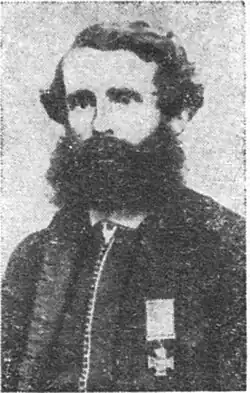
Charles Heaphy
The settlement of Nelson was founded early in 1842, and some four years later Messrs. Thomas Brunner and Charles Heaphy, who were connected with the New Zealand Land Company, set out to explore the country we now know as Westland, with a view “to report on its resources and potentialities as a field for further settlement.” They left Nelson on March 17th, 1846, with the Arahura River, in the heart of the greenstone country, as their objective. They were accompanied on this important expedition by a Maori named Ekehu who had previously visited the locality, and had been engaged as guide.
They proceeded by way of the coastal route, and when they reached West Wanganui, to the south of Cape Farewell, the Maori Chief Niho attempted to stop them from proceeding further unless they paid him for the privilege of so doing. Having no money whatsoever they resorted to strategy, and enticed him to cross the harbour in a canoe, where they left him alone on the beach lamenting, and continued on their way.
When they reached Cape Foulwind, just south of the Buller River, they examined the hull of a vessel of about four hundred tons, and learned from the Maoris living nearby, that many bales of wool had come ashore from this ill-fated ship, and that the crew who had landed safely had been captured and eaten. Subsequent enquiries proved this early wreck to be that of the Rifleman—a wool ship which had left Hobart, Tasmania, in 1825, and had not been heard of again.
At length, sixty-five days after leaving Nelson, they reached the Mawhera River (Bright Running Water), to which Brunner gave the name of Grey in honour of Sir George Grey, at that time Governor of the infant colony. During this journey they suffered many privations, being forced to subsist for the most part on the natural production of the land. Apart from the problems of obtaining adequate food supplies, the explorers had other great difficulties to contend with, for in those days, as has already been shown, the whole countryside from the snowline almost to the sea was covered with heavy forest, and Maori tracks were few and far between.
Brunner and Heaphy, who were the first known white men to set foot within the Mawhera Pa (an isolated Maori settlement situated near the site of the town of Greymouth), were hospitably received by the natives, and after resting, proceeded south to the Taramakau River.
[Authorities differ with regard to the spelling of the word Taramakau. In The Times Atlas the name of this river is spelt Teremakau. Mr. Justice Chapman spelt it Taramakau. S. P. Smith, “History and Traditions of the Taranaki Coast,” p. 166, says: “Teremakau, not Taramakau.” Elsdon Best, “Pounamu or Greenstone,” Dominion Museum Bulletin, 4, pp. 156-196, says: “Taramakau, not Teremakau, as usually spelt.” Westland authorities, too, consider there are no “e’s” in Taramakau, an old-time draughtsman once remarking to the writer, that if there was any doubt about the spelling of the word, it was much stronger looking, and more in keeping with the characteristics of the river in question when spelt in the manner adopted throughout this work.]
Here dwelt the native greenstone-workers, skilled in the manufacture of those wonderful weapons and ornaments peculiar to the Maori race, and so laboriously fashioned from the boulders of pounamu found in the adjacent streams. From Taramakau, the party pushed on to the Arahura, but upon arrival discovered that all the inhabitants of the pa had gone inland on a bird-snaring expedition.
There was therefore no alternative but to return to the Taramakau, and so back to Mawhera. The following day found the explorers and their native companion at the last-named pa, and here they rested until June 8th, when preparations were made for the long and arduous return journey to Nelson.
Emaciated by hunger, and almost prostrated by the privations and hardships they had undergone, the little party eventually reached West Wanganui, where they picked up stores which had been sent overland. After a stay here they returned to Nelson, arriving home on August 18th, 1846, after an absence of nearly six months.
In their report on the possibilities of the Coast, the explorers stated “that it was unfavourable for settlement, and that for the most part its rivers were unfit for vessels to enter.”
Thus Old Westland for the second time received a bad report. Cook stated it was “an inhospitable shore—unworthy of observation” and Brunner and Heaphy condemned it as aforesaid. Yet beneath the surface of this wild land of forest and flood, lay that which was to “turn a howling wilderness into a busy haunt of men”—for there, gold—gold beyond the dreams of avarice, awaited the taking.
Prior to undertaking the expedition just described, Brunner and Heaphy, accompanied by William Fox (afterwards Sir William, Premier of New Zealand, but at that time Agent for the New Zealand Land Company at Nelson), set out to “ascertain the nature and extent of the tract of country lying on the banks of the river flowing from Lakes Roto-iti and Rotoroa to the West Coast, and to learn whether a practicable route existed across that part of the Island.” After reaching the head waters of the river in question, which we now know as the Buller, the party obtained much useful data at great personal risk. On one occasion Sir William Fox, when crossing the river, almost lost his life, being washed off his feet. He was burdened with a very heavy swag and reached the shore with the greatest difficulty. The party, after suffering many hardships, were forced to return to Nelson.
On December 3rd, 1846, Brunner again started on his travels, unaccompanied this time by any European, but with a party of four Maoris, two men named Ekehu and Epiki, and their wives. His object was to explore the Buller River to the sea from where he had turned back with Messrs. Heaphy and Fox the previous February, and to seek an opening to the eastwards from the lake country or from the West Coast. It was evident that their journey would necessarily be a protracted one, though it was not expected that it would occupy eighty weeks; and the slight preparation made for the undertaking is not the least remarkable feature of this expedition when it is considered that there was no chance of obtaining fresh supplies, and that the greater part of the country to be traversed was wholly uninhabited.
The total outfit of food and clothing for the whole party of five persons cost only £33 9s. 4d., a small sum considering the magnitude of the undertaking. Of course the journey had to be made on foot, and every member of the party was his (or her) own beast of burden. The actual provisions taken were, 10 lbs. of flour, a few biscuits, and a small quantity of tea, sugar, salt and pepper. The bulk of the load consisted of clothing, two guns and ammunition.
From the explorer’s diary, which was published in 1848, the following story of this outstanding accomplishment in the history of exploration in New Zealand, has been culled: The journey was commenced in easy stages and a man employed to assist in conveying the goods as far as Stratford’s sheep station in the Motueka Valley, which was reached on December 8th. This was at that time the most remote spot at which any European resided, and Brunner remained there until the 11th to obtain the services of a mule to pack the food and equipment as far as Lake Roto-iti, which was duly reached on the 13th. Here leave was taken of Fraser, the shepherd who accompanied them to that point, and of all civilised life. The route was now the same as that taken by Messrs. Fox, Heaphy and Brunner in the early part of the year and Lake Rotoroa was reached on the 18th. Here the party suffered very severely from dysentery for some days and remained in the neighbourhood until the 30th, preparing fern root which would be their principal item of food for some time. The day following they set out for the Matukituki, and New Year’s Day, 1847, saw them battling onward. Despite incessant rain and great privations, they reached the foot of that valley on January 16th. At this point the Buller, having received the waters of both Lakes Roto-iti and Rotoroa, and also several tributary streams, becomes a deep and rapid river.
It was here that Mr. Fox had been swept away the preceding year in attempting to ford it, and Brunner and his party found the greatest difficulty in crossing also. Bad weather now set in and it rained continuously, with the result that all their food was spoiled. They were compelled to retrace their steps to the Matukituki, to prepare fresh fern root, for such was the character of the black birch country through which they were passing that it provided not the slightest sustenance. They again reached their former shelter on February 3rd, and collected and prepared fern root until the 18th, when they once more proceeded on their way.
Mr. Brunner states that at this stage his load consisted of a gun, 7 lbs. of shot, 8 lbs. of tobacco, two tomahawks, 2 pairs of boots, five shirts, four pairs of trousers, a rug, a blanket, and at least 30 lbs. of fern root. With such heavy swags it was impossible to make rapid headway through a thick bush interspersed with lawyer vines, and two miles a day was considered good going. On March 1st the last handful of flour was used to thicken soup. On the day following one of the Maori women fell ill and this greatly retarded the progress of the party. To make matters worse, Brunner himself suffered the most excruciating pain for some time, as did also one of the Maoris. These seizures were attributed to the fern root diet upon which they were now forced to live. These delays so affected their progress that their provisions were now almost exhausted and they were reduced to one meal of fern root each twenty-four hours.
In the black birch country through which they struggled no food of any kind could be obtained save an occasional eel caught in the river. At length, on April 6th, after enduring great hardships, the travellers reached better and less broken country, where they obtained an abundant supply of native birds. They were now able to enjoy the luxury of two meals each day. Their way now lay through a valley of rich wooded land, and on the 10th they reached the mouth of a good-sized river flowing down a large valley which opened to the southward.
By the 20th the termination of the valley was reached and the party again entered a mountain gorge. From this time until they reached the coast on June 4th their sufferings were intense. The country through which they were passing was the worst of its kind, and the scarcity of food was so great that Brunner was compelled to shoot and eat his favourite dog, being afterwards known to the Maoris as Kai Kuri (dog eater). . . . In an entry a few days later Brunner tells us that on one occasion he was without food for almost three days. The incessant rain experienced at this juncture added greatly to their misery, scarcely a day passing without a terrific downpour taking place; and it is on record that it rained solidly for several days in succession.
The trials and tribulations of the travellers did not end here, however, for the natives whom they expected to find at a pa on the coast were away and had left no food behind them. Instead of enjoying the good meal of potatoes they had looked forward to they were compelled to eat seaweed which did not agree with them. Two days later the natives returned with fresh supplies of food and all was well. Brunner rested here until June 15th, and then set out for the Arahura Pa, which was about one hundred miles further south. This pa was reached without any great difficulty, and after resting here for some time, they returned to the Taramakau, where they remained until the following spring.
It was not until October 12th that Brunner, rested and refreshed, resumed his journey. Writing on that date he states: “With a right good will I mounted my load on my back and after many shakes of the hand, and much rubbing noses, I left the Taramakau natives, and once more felt myself moving with my inclinations. I had the company of three chiefs here, Te-kau-hauke, Tipiha and Paeture and his daughter, just in my opinion a nice little party. We soon reached the Arahura and put up for the night which proved to be a rainy one.”
On the 15th they set out for Okitika (Hokitika), a river of considerable size, at the mouth of which there was formerly a large pa. Here they remained for some days, and then again proceeded south.
The following significant entry appears on the 21st of the same month. “I believe that I may now assert that I have overcome the two greatest difficulties to be met with by bushmen in New Zealand, viz., the capability of walking barefoot, and subsisting on fern root. The first, the want of shoes had been a dread to me for some time, often fearing I should be left a barefooted cripple in some desolate black birch forest on this deserted coast, but now I can trudge along barefoot, or with a pair of native sandals, called by the Maoris parairai, which are made of leaves of the ti, or flax tree. I can make a sure footing in crossing rivers, ascending or descending precipices, in fact I feel I am just commencing to make exploring easy work. A good pair of sandals will last about two days’ hard work, and take about twenty minutes to make.”
Just prior to reaching the Okarito Pa they passed the wreck of a large sealing boat, which was a quarter mile inshore from high water mark. Brunner noted that “the growth of the bushes and the appearance of the wreck show that the sea is fast receding from this coast.” Okarito was originally a very large pa principally used as a base for bird snaring and fishing, and was regarded as of great importance as a food producing centre. “That it abounds in eels,” says Brunner, “I had full proof of, during my visit here, our diet being nothing else, and was served out in liberal quantities, to dogs as well as Christians, three times a day. There are six natives living here,” he continues, “two men and four women. They are of the Wesleyan Church, and apparently very punctual and zealous in their worship.”
After a sojourn of six days they constructed a raft of the blossom sticks of flax and so crossed the lagoon, walking on a further four miles to another stream. There they were obliged to erect a shelter, very bad weather setting in.
On the last day of October they were still sheltering and the natives proposed returning to Okarito for divine service on the Sunday. To this Brunner agreed, knowing, he states, “that we should get a good dinner and more comfortable lodging there.” The explorer here comments most interestingly on the religious fervency of the Maoris: “I am much astonished,” he mentions, “to find that even in these distant parts so much should be said by the natives belonging to the Church of England, and the Wesleyans, relative to their form of religion. Although in some places there are only six or eight natives, yet they have two places of worship and two schools; and are always quarrelling about religion, each party asserting its way to be the proper service to God. There are some few who have been christened by the Revd. C. L. Reay and a few by Mr. Aldred, the Ministers of the two Churches in Nelson.”
On November 9th Brunner was “again southing,” passing through country which he described as worthless. On the 14th they reached a small Maori settlement called Porangirangi, where there was a potato garden, and the travellers, “assured of a good meal, stopped for the night and the Sabbath.” On the 16th the night was spent in another native settlement, Parika, where, states Brunner, “we received the welcome of strangers, in a bountiful supply of fern root, preserved wekas and fish.”
The hospitality of the natives at Parika was enjoyed for the next two days, during which sufficient eels were caught and dried to provide food for one week as the country ahead was said to be devoid of sustenance of any sort. On the 19th, when approaching the Waiho, Brunner met with a most unfortunate accident. Rounding a small headland he was washed from a rock by a heavy sea, both his feet being badly crushed and his right ankle severely sprained. Finding it impossible to proceed he attempted to return to Parika, but was prevented from so doing that day by his lameness and the incoming tide making beach travelling impossible. On the following day, however, they were successful and Brunner dressed his broken feet with weka oil and bandaged and bathed his ankle, which was now very badly swollen. Here, suffering intensely, he was compelled to remain until December 10th. During this time the weather was very bad, continuous rain being experienced. As a result of this the rivers became flooded, natives reporting the Waiho as unfordable.
Brunner, who at this time was seriously ill, made the following entry on December 11th: “Yesterday I resolved to return to Mawhera, and rejoin my own Maoris, and endeavour once more to see a white face and hear my native tongue, so I retraced my steps to Porangirangi. I was induced to make Parika (Paringa, as we know it) the terminus of my southing for several reasons: my lameness had made me anxious to return to Nelson, the summer season was fast approaching to a close and I dreaded the idea of another long winter. The country I was passing through was quite worthless, and certainly so in respect to Nelson, and I had a wish of returning by a fresh route and of seeing more of the country. I also resolved to try getting back by the Mawhera if I should abandon the idea of crossing the island from the Taramakau to Port Levy. Had I urged the natives to proceed further south with me, I could not get their services to assist me with a canoe up the Mawhera, so that being here without resources I was very much at the mercy of the natives. When I told Te Raipo of my resolution of returning he was very glad and said that having only one white man was too big a responsibility on his hands; if there were two he would not care, as, if any accident occurred, one might live to tell the fate of the other. ‘But,’ he said, ‘if you died it would be said that I had killed you for the sake of eating or plunder.’ . . .”
Travelling back in fine weather and by easy stages, Brunner reached the Arahura on December 22nd where he notes he “feasted on new potatoes, a treat—having lived lately on fish.” The day following he walked to the Taramakau, and on Christmas Eve reached the Mawhera Pa, where many natives had gathered to celebrate fittingly the religious services pertaining to this great occasion.