Old Westland/Chapter 20
Chapter XX
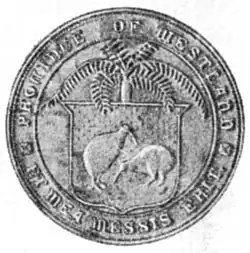
Provincial Seal
The year 1870 marked a new phase in gold mining. This was brought about by the discovery of auriferous quartz reefs in the Inangahua district. Prior to this alluvial gold to the value of over £500,000 had been won, and it was when further prospecting was being carried out that the first reef was struck at Murray Creek. Here many famous mines were located, including the Wealth of Nations, Keep-it-Dark, Energetic, and Golden Fleece, all of which yielded fabulous returns. Two years later that intrepid explorer, P. Q. Caples (who has already been referred to in Chapter IX), located further reefs at Boatmans, he being the first to prospect this district. When it came to pegging off a claim Caples was most unfortunate in his selection, the area he took up proving almost worthless, while the holdings to the north and south of him, the well-known Fiery Cross and Just-in-Time, yielded the most handsome returns for a long period of years.
Of this section of the story of the Golden West R. C. Reid says: “The discovery caused intense excitement throughout every part of the Coast, which soon extended to other parts of the Colony and overseas. Men of the greatest experience in quartz mining in Victoria and at the Thames in the North Island, wandered thitherwards. The town of Reefton was laid out and wonderful prices were quickly obtained for sections. The utmost difficulties had to be overcome in the opening up of the earliest mines, and in getting crushing machinery on to several of the claims. After a year or two good returns were obtained from three or four of the principal mines, and the field became fairly established. The population steadily increased, and all the signs of prosperity became manifest: large hotels and stores were erected, and the lucky owners of them coined money. Then the old, old story, often related of Sandhurst, Pleasant Creek, Inglewood, Gympie, Grahamstown, and other quartzopoles followed. The scrip mania set in, and every man and woman in the neighbourhood speculated to a greater or smaller extent. Crowds congregated every night, more particularly on Saturday nights, in the main street and not a sound was heard but scrip, scrip, scrip, everywhere. What tales of luck, both good and bad, could be told of those days when the scrip epidemic was in full rage in Reefton.
“The temptation to speculate became positively irresistible, when it was no unusual occurrence to witness the most veritable ‘new chum,’ with possibly a better acquaintance with pewter quarts than golden quartz, converting a few five-pound notes into as many hundreds ere the sun had risen and set. Instances of this kind were not far to seek. A quarter-share in the once famous Hopeful claim changed hands for what is known in sporting circles as a ‘pony’ (£50), and a few months after the purchase the holder of the share was receiving dividends of hundreds of pounds every month. Again followed, as invariably happens, times of depression, and some of the self-same shares were shortly afterwards forfeited for a sixpenny call. And such has been the history of Reefton since its opening, subject to great fluctuation.”
The reefs in the Inangahua district extend over a vast area of country, and gold is still steadily being won, the yield from 1877 to 1938 being 1,729,278 ounces valued at £7,397,291.
The year 1872 opened in a most disastrous manner, a tremendous flood taking place in the Grey River in February, which swept half of the business portion of the town over the bar and carried away the protection works and wharf which had been constructed by the Borough Council, the then “port authority.” Fortunately at this time Sir William Fox, then Premier, was visiting Westport, and on learning of the extensive damage came down post haste to Greymouth, where he authorized the building of a flood protection wall, from where now stands Cobden Bridge to Tainui Street, which, through the years, has saved the town from a similar disaster on many occasions.
The passing of the year 1873 marked the conclusion of Old Westland’s first decade as a goldfield. During this time over 3,000,000 ounces valued at £12,000,000 were exported from the West Coast, and the field was still producing at the rate of 200,000 ounces annually.
On December 1st, 1873, Westland was declared a separate province; this, then, was the year of its emancipation. The election of a Superintendent and members was held amidst scenes of great enthusiasm and general rejoicing in the January following, details of which have been noted on page 218.
The formal opening of the Grey-Brunner Railway was carried out by His Honour the Superintendent of the Province, J. A. Bonar, on April 15th, 1876. This was indeed a red letter day in the history of the province, for it marked the completion of the first section of the network which now covers Westland, and links up with the South Island Main Trunk system at Rolleston, some 14 miles from Christchurch.
Originally this line was known as the “serpentine railway” on account of the way it twisted and turned. As a matter of fact, there were many “old man” stumps en route, and these were not removed but gone round, the result being innumerable curves of very doubtful radius. This railway was constructed primarily for the purpose of conveying coal from the Brunner mine (which after a varied and chequered career had been taken over by Messrs. Martin Kennedy) to Greymouth. Here permanent harbour works were being constructed, to enable coal to be exported in sufficient quantities to compete with importations from Newcastle, N.S.W. To further assist in the good work Messrs. Kennedy purchased a fleet of small vessels and a number of hulks, thus establishing depots at all the principal ports of the Colony. This ambitious project met with instantaneous success and the Brunner mine became the largest producer of coal in the Dominion. It is of importance to state that harbour improvements at Greymouth were carried out by the Borough Council until 1884, when the Greymouth Harbour Board came into being.
Meanwhile Brunnerton had become a thriving centre, other mines having been opened in the vicinity, many men finding employment there. Steadily increasing in importance, Westland’s principal coal-producing centre was proclaimed a borough in 1887. Nine years later, in 1896, there occurred the terrible disaster by which 65 men and boys were entombed. . . . .
Throughout the years the fields continued to grow in importance, and many new mines were developed in the Grey-Inangahua districts. In 1901 the State Mines came into existence, and 20 years later certain areas were worked by the co-operative system. The total output from the two districts, from the inception of the Brunner mine in 1864 to 1937, is as follows: Greymouth 16,554,417 tons, Reefton 1,012,406 tons; grand total 17,566,823 tons.
Apart from the opening of the Grey-Brunner Railway, the year 1876 is also important as it marks the last big gold rush staged in Old Westland; for then Kumara, birthplace of the New Zealand Liberal Party, came into existence. True, some years later, in 1882, a rush took place to the township we now know as Rimu, and a little later Seddon’s Terrace was the scene of some activity. On both fields good gold was obtained, and though highly payable they did not approach in magnitude the discoveries which preceded them. Kumara, on the other hand, was for years the most prosperous alluvial goldfield in the Colony.
Of this famous goldmining centre, W. J. M. Larnach (“Handbook of New Zealand Mines, 1887”) says: “The township of Kumara with its broad, quiet streets, gives little idea of a busy digging town, but the mining population is to be found a mile or two away at Dillman’s Town, and the operations are carried on in the neighbourhood of that centre, and at Larrikins, Dunedin Flat, and other localities thereabout. Before Kumara became a goldfield, 1,000 acres of land had been set aside as an Education Reserve, and a large part of the town was built thereon, a considerable revenue being derived from rents and charges against mining privileges granted over the reserve. It was not long, however, before the rents, which in the heyday of the first excitement were readily offered for building leases, began to prove too onerous for the quieter course of business which supervened, and much agitation and negotiation followed for the purpose of procuring a modification of the terms on which the leases were held. The question was at length set at rest by the Kumara Education Reserve Act of 1879, which brought the area in question under the operation of the mining laws and regulations, many of the leaseholds being converted into freeholds.”
It is of historical importance to note that Kumara was not discovered as the result of intensive prospecting—but more by accident than design, for when a party of would-be “moonlighters” were excavating before putting in the necessary foundations for an illicit whisky still they discovered highly payable wash dirt, and at once abandoned the venture in hand for the more profitable (and lawful) occupation of gold digging. This romantic occurrence took place on the south bank of the Taramakau River, not far from where all that remains of the once prosperous Dillman’s Town now stands. It was naturally a secluded spot—far from the madding crowd removed, and here the fortunate discoverers opened up a claim, which they hoped to work quietly and thus avoid the inevitable rush to the new El Dorado.
But, alas, they were not to remain long in seclusion, for a prospector travelling along the Taramakau saw them engaged in developing their claim, and actually overheard discussions pertaining to its richness. Losing no time, he set out for Stafford Town, the then centre of a highly productive field. Here resided Richard John Seddon, at this time a mining advocate and storekeeper, who was informed of the incident under discussion, and in due course he pegged out, applied for, and was granted a claim at the new diggings.
Following this about 4,000 men thronged the field, which was situated midway between Hokitika and Greymouth, and there was intense competition between the merchants of the two towns anent the supplying of necessary requisites for the establishment of a new mining centre. Hokitika already had a road constructed to the new field, and Greymouth a tramway to Paroa, some seven or eight miles away. Apart from this the northern merchants had to solve the problem of crossing the Taramakau River, a stupendous obstacle. But where there’s a will there’s a way (those old timers were seldom beaten), and in no time a one-horse tram was running from Paroa to the northern bank of the Taramakau, which was crossed by means of a “bird-cage,” i.e. a box slung on wire, with pulleys running on an overhead wire rope, and propelled by means of steam winches. By this ingenious method passengers and goods were quickly conveyed to the southern bank, from where a tramway had been constructed through the heart of the forest to Kumara.
Discussing Old Westland’s last major rush, “Waratah,” in “Tales of the Golden West,” states, inter alia: “Before long the news of the discovery got round, and a proper rush set in, and the silent forest of majestic trees and tangle of undergrowth were replaced by a mining township. Seddon being camped on 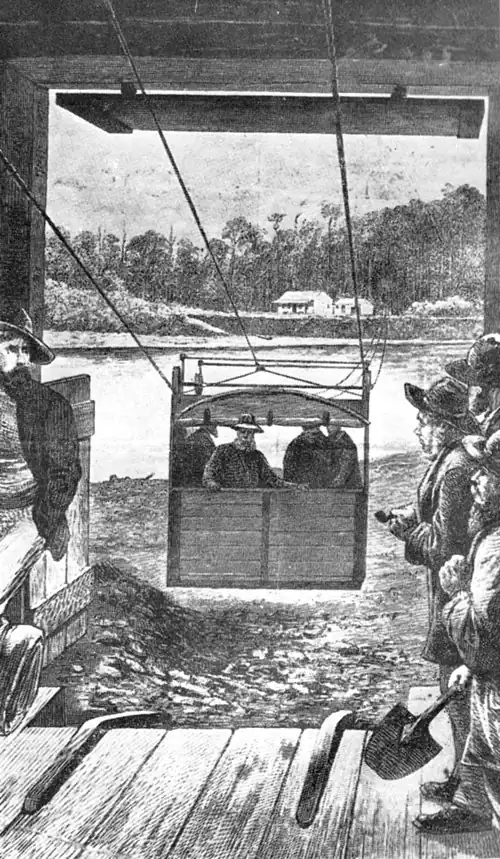
The Cage, Taramakau.
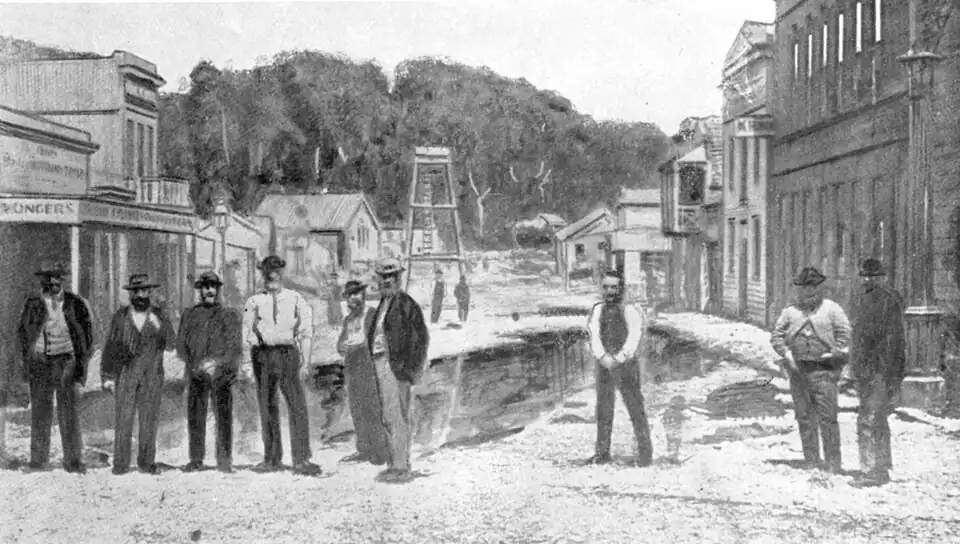
Tainui Street, Greymouth, 1866.
The township at its inception was duly christened with the usual formalities by the Superintendent of the Province, the Honourable J. A. Bonar, Esq., and, rapidly developing, was proclaimed a borough in 1877, with, as has been noted, Richard John Seddon as its first Mayor. After the first stampede it quickly settled down, and with Government assistance many water races were constructed, which completely commanded the gold-bearing areas, the result being that the field had a long life, and for a number of years enjoyed great prosperity.
Although Kumara staged Old Westland’s last spectacular stampede and, in addition, marked the end of what is known as its golden era, it must not be assumed that the Province as a gold producer then petered out. Far from it. Here are some startling official figures, supplied by the Mines Department, which need no explanation: Total amount of gold won in Westland (1864-1938), 6,644,601 ounces, valued at £25,941,735; average value produced over 75 years, £359,223 per annum, which means that gold to the value of almost £1,000 has been won each and every day the field has been in existence. Westland will continue to produce the metal royal for many, many years. The confidence of its pioneer legislators when they adopted the prophetic motto adorning the provincial seal, “Et mea messis erit” (“And my harvest is to come”), has been fully justified. Even to-day the deeper leads have not been tapped—the best is yet to be.