Old Westland/Chapter 17
supporting a bustling, tireless population of many thousands. All along the beaches to Greymouth and up the Grey River, and thence to the Taramakau the busy hives of workers could be seen.”
Taken as a whole these diggers were splendid men, most of them in the morning of their manhood. The hardships and privations to be endured (and they were many) were simply regarded as part of their job, which was to obtain an adequate share of the “wasted wealth in wild profusion strewn” throughout the length and breadth of Old Westland.
True, many of them when doing well threw their money about, and, as noted by Reid, the hotels, and likewise the dance halls, as well as the shanties in the smaller centres, did a roaring trade. Certainly successful diggers vied with each other in their methods of entertaining, for when one made it a champagne supper (with pint bottles at £2 a time) another would, in the vernacular of to-day, “throw a real party,” with double the amount of champagne plus sandwiches, the filling of each being intermingled with a finely-shredded £5 note. The writer vouches for this statement, having been personally acquainted with the digger responsible for this particular party, who lived to a ripe old age, the filling in question in no way impairing the digestive organs.
There were other ways, too, of disposing of £5 notes, one of the most popular methods being to use them to light their pipes with, in place of the usual paper spills so much in evidence in those days. Such wanton waste has been a feature of all goldfields. Men the world over, when faced up to fabulous quantities of the metal royal, become gold crazed and invariably love to parade their wealth before all mankind. As an extreme example of this form of madness it is on record that a goldfields storekeeper in Victoria actually had his horse shod with golden shoes, the weight of each of the four being over seven ounces.
The diggers as a class also spent a deal of money on personal adornment. Expensive rings, tie pins and watch chains of gold and greenstone were regarded as an outward and visible sign of prosperity. Their style of dress, too, was most picturesque, the vogue being to wear a Crimean shirt and white moleskin trousers, which were held in position by a crimson silk sash, the bottoms of the trousers being pushed into knee-high boots. A black sombrero, very high-crowned and very wide in the brim, with a crimson silk cord round the band was the correct headwear, the whole get-up being most elaborate. With a population that was almost entirely male, it is hard to understand why these rugged men were so fastidious as to their attire. Yet they were so, and in this respect Solomon in all his glory did not have much in his favour.
At this time great excitement was caused by the discoveries made at the Five Mile (Kanieri). These diggings were rich indeed and soon 1,000 men were on the field. A month later the population was 5,000 and many stores and hotels were erected, the town at one period being almost as large as Hokitika.
Commenting on the phenomenal rise of the population at Kanieri, and elsewhere throughout the goldfields, due to the influx from Australia, the West Coast Times remarked that in May there was a novel increase at Hokitika, Mrs. J. McCarthy and a Mrs. Smith having given birth to children. “Hokitika McCarthy wouldn’t sound badly,” stated Westland’s first newspaper; “the first child born at the Dunstan was called ‘Clutha’.” In assuming that the McCarthy offspring was Westland’s first born, the Times was incorrect, Dr. Ryley, who was in a position to know, stating that Mrs. Smith’s child was born on Friday, May 21st, while Mrs. McCarthy’s did not make its appearance until Monday, May 24th.
Then came news that gold had been found in the Grey River and a rush set in to the Twelve Mile, which quickly extended to Red Jack’s, No Town and Nelson Creek. These diggings being situated in the Nelson Province, Mr. John Blackett was appointed Warden. No Town proved to be one of the richest fields of all and presently 10,000 men were located throughout the district. These diggings were very hard to reach, the only means of access being by roughly defined tracks through the bush, which proved particularly bad going for pack horses, dogs being utilised to carry loads up to 30 pounds in weight.
As a result of these discoveries John Rochfort was instructed in July to lay off the town of Greymouth. While the survey was being carried out there was a great rush for sections close to Reuben Waite’s store, which was on the Maori Reserve. The whole of the river frontages were quickly taken up, many on Mawhera Quay bringing as high as £12 per foot. Substantial buildings, including stores and two-storey hotels, were quickly erected, despite the fact that timber cost £2 10s. per hundred square feet. Provisions also became very dear, flour selling at £150 per ton. The population was estimated at this time to be 3,000, and W. H. Revell was transferred from Hokitika to open a Warden’s Court. Larnach notes that “it was currently reported and believed at this time that many of the claims at Maori Gully and Red Jack’s were yielding a pound weight of gold per man a day.”
On this becoming known still more men poured into Greymouth, which was now the established centre of the new field. With this increase in the population the food shortage became even more acute, so acute indeed that it was found necessary to dispatch four vessels from Hokitika with supplies, which eased the position somewhat.
While these wonderful returns were being obtained in the Grey district the southern fields were also yielding up the precious metal in amazing quantities. Hokitika was also going ahead by leaps and bounds, with an ever-increasing population. A hospital had been built, the post office completed, and a contract had been let for piling 12 chains of the wharf. The export duty on gold shipped from there for July was £3,000, and the import duties nearly £4,000.
It is of importance to note that on the 30th of this month the Reverend J. Buller of the Wesleyan Church conducted the first religious service held in Westland in the Corinthian Hall, Hokitika.
In the same year the first Roman Catholic missionaries reached Hokitika, arrangements soon being made for the building of St. Mary’s, which was opened for divine service on Christmas Eve, 1865. This was the first church to be completed in Westland. The Wesleyan Church was the next, being built facing Tancred Street and opened for service early in 1866. The Anglican Church followed the visit of Bishop Harper in 1865, who made the necessary arrangements for the building of All Saints’, which was opened for divine service by Archdeacon Harper on October 21st, 1866. The Presbyterian Church, which was built in Stafford Street, was opened on the first Sunday in February, 1867.
The winter of 1865 was very severe, continuous rain bringing about many floods which caused a complete cessation of work. In consequence of this many diggers abandoned the goldfields while able to do so, for a little later exceptionally heavy seas caused the bars at Hokitika and Greymouth to silt completely up, and as the roads were impassable Westland was entirely cut off from the outside world.
In September, the weather having somewhat improved, activities were renewed and the Auckland Lead, midway between Hokitika and Greymouth, was opened up. Here some of the claims yielded as much as £100 per week to each man, and from one of the richest 64 ounces was obtained in one day.
On the 3rd of this month the gold buyer Walmsley was stuck up between No Town and the Twelve Mile and robbed of gold and notes to the value of £4,000. In recording this incident Preshaw, under whose direction Walmsley was operating, states, inter alia: “Walmsley was stuck up by five armed men masked, and robbed of 824 ounces of gold, and £1,000 in notes, total value £4,000. He left No Town early in the day accompanied by a packer named O’Brien, the gold being divided, the latter having 800 ounces. When half way he was suddenly surrounded by the robbers and pulled off his horse before he could attempt to draw his revolver. O’Brien, who was some yards ahead, galloped to the Twelve Mile and thus saved his 800 ounces. Reporting the matter to the Nelson Police stationed there, they set out after the robbers but failed to capture them. A few days afterwards four men were arrested, but nothing could be proved against them. This is the only case of robbery under arms which occurred on the West Coast goldfields, the result of which was that banks doing business at No Town decided to close their offices there and let the diggers bring their gold to Greymouth,” which was rapidly growing in importance and had now a newspaper, the Grey River Argus, which made its first appearance on November 17th, 1865. Towards the end of the year Okarito became the Mecca of the diggers of the West Coast and soon a terrific rush set in to what was known as the Five Mile Beach.
Larnach thus describes this episode: “Hundreds of diggers were taken from Hokitika by the steamer Bruce, which did the journey in twelve hours, and was generally crowded with excited passengers, who willingly paid £5 for that short distance. R. C. Reid, who went to the field as a gold buyer for the Union Bank, accosted a party of four, who were paddocking wash dirt, and asked if they had any gold to sell. One of the party enquired, ‘How much money have you, mate?’ To which Reid replied, ‘As much as you require.’ On reaching the tent he was presented with a couple of ‘billies,’ both nearly brimful of the finest gold dust, the result of six weeks’ work. When weighed it was found that Reid was a couple of hundred pounds short, although he carried £2,000 in notes with him.”
Just prior to Christmas the West Cost goldfields were proclaimed a separate judicial district, Mr. Justice Gresson holding the first sitting of the Supreme Court in Hokitika in the following January. About this time many men flocked to Lake Brunner where Albert Hunt stated he had unearthed rich ground; favourable reports, too, had come from the Buller and the Lyell, and thousands of men were hastening there. The year closed in a most sensational manner, for on the beach just south of Greymouth claims yielded gold in greater quantities than had previously been found. So rich was the wash here that £3 was paid for a pannikin full of it for exhibition purposes. Similar leads were discovered at the Taramakau, Arahura and Three Mile (Hokitika). During this year the export of gold from the West Coast fields was 302,034 ounces, valued at £1,174,000. 
Westland’s first and only Provincial Council.

Digger on the tramp.
While it is completely outside the scope of this work to cover the political history of Old Westland, which is an intriguing book-length story in itself, still it is essential to briefly note that the beginning of 1866 saw the birth of a movement designed to bring about the separation of Westland from Canterbury, and the establishment of the former as a separate province. In this connection it is not the intention of the writer to set out the pros and cons of the arguments used in the agitation which followed; recriminations would serve no useful purpose, it being sufficient to say that the Canterbury Provincial Council (no doubt impressed by the endeavours of the separationists) raised Westland’s representation on that body from two members (who were elected on October 25th, 1865) to five members, in July, 1866. Yet even this gesture did not appease Westland’s stalwarts, who still clamoured loud and long for the right of self determination.
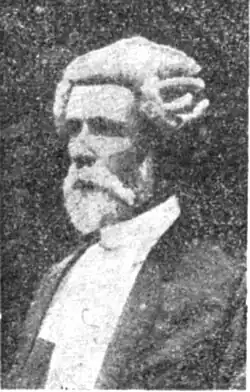
Sir Arthur Guinness
As a result of this agitation the General Government, in 1868, enacted legislation by which the government of Westland was taken out of the hands of the Canterbury Provincial Council, and placed under the jurisdiction of the General Government and a body to be elected and known as the Westland County Council. This was the beginning of the end, and five years later, on December 1st, 1873, the Province of Westland came into being.
The election of the new Provincial Council, which took place on January 9th, 1874, resulted as follows:–Superintendent, J. A. Bonar; members, for Hokitika J. White, F. Tabart, W. Todd; for Greymouth H. H. Lahman, C. Woodcock, E. Wickes; for Arahura R. J. Seddon, M. Houlahan; for Kanieri E. T. Robinson, S. Mitchell; for Paroa A. R. Guinness, P. Dungan; for Ross H. Cuming, J. McGaffin; for Okarito R. Canavan. This, the first and only Provincial Council of Westland, had but a short life, for on November 1st, 1876, the Abolition Act came into force, and the Provinces of New Zealand ceased to exist as self-governing bodies, and thus did Westland attain the status enjoyed to-day.
Messrs. Bonar and Lahman in due course became life members of the Upper House, both of whom were Legislative Councillors for some years. A. R. Guinness became M.H.R. for Grey in 1884 and sat continuously until the time of his death in 1913; he was elected Chairman of Committees in the House of Representatives in 1893, and to the position of Speaker in 1903, which office he held until his death. In recognition of long and faithful service he was knighted.