Old Westland/Chapter 14
Chapter XIV
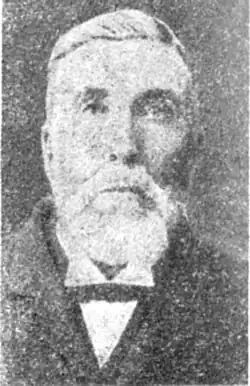
Captain Leech
“On November 5th, I made another start in the Nelson, at 6.30 am. Later in the day it came on to blow so hard that we had to put back, and anchored under Tonga Island. We made another start on the afternoon of the 6th, and that evening we met the Wallaby, a new steamer from Sydney, built to the order of N. Edwards and Company. This boat came down in the nick of time for the West Coast rush. She coined money for her owners; in fact paid for herself in a few trips.
“On the following morning a heavy sea found its way into the cabin, and on going on deck I saw we were putting into Wanganui Inlet, it being too rough for us to proceed. We sheltered there until noon, when the wind having lulled, and the sea gone down, we set out for and reached the Grey at 10.30 p.m.
“The Bank of New Zealand were quite alive to the importance of sending a man down to occupy the field, as they saw we were making preparations for so doing, and one of their staff, a young fellow named Walmsley, was a fellow passenger on this occasion.
“On our arrival we found the residents of the Grey in a state of great excitement, a new goldfield having been discovered at the Totara River, about forty miles southwards. It is necessary to mention here that the Grey River divides the provinces of Canterbury and Nelson. The diggings are on the Canterbury side.
“On November 10th, I made a start for the Totara on foot. My swag containing a pair of blankets, gold scales, etc., I put on Sweeney’s waggon, a light American affair, the only one of its kind on the Coast. It was heavy walking along the beach. At the Taramakau I met Walmsley and Revell, the Government Agent; they were on their way to the rush. Lunched at an eating house, which had been erected since my last visit, kept by Mrs. King (one of the first white women on the Coast). We slept in a Maori whare (building) and all being very tired we were soon in the arms of ‘Morpheus.’
“The rain poured down on the following day and we could not stir out, so put in the time playing euchre and whist. Up betimes next morning and crossed the river soon after ::hws|break|breakfast}} breakfast, but found we could not get along the beach owing to it being high tide. We came across an old whare in which I lay down, but not to sleep—that was impossible—sandflies (a little black fly which bites hard and raises a lump like a mosquito) being here in thousands. Walmsley and Revell went on, driving a packhorse before them, on which they had a tent, provisions, etc. When the tide was about half out I started in company with two or three others; we soon met seven or eight Maoris on horseback returning from the Totara. They said there were five hundred men on the ground, and that they were returning to the Greenstone; my own impression was to take up some of the claims left by the pakeha, and this eventually turned out to be the case. We jogged along until we came to the Arahura, where we camped. We were informed that to catch the low tide we must turn out early. This we certainly did, arising at 0.30 a.m. We found when on the tramp that Morey, the driver of the waggon, had mistaken the time, thinking it was 4.30 a.m, It turned out just as well he did so as, by starting at that hour, we had a splendid beach to travel over. We arrived at the Okatika River at five o'clock (November 13th). Here we found a calico store and another building close to it, built of brushwood, flax, etc., the only two buildings on the north side of the river. The store was kept by Messrs. Hudson and Price. The other building was occupied by Ramsay and party. As the river was very wide, deep, and in parts swift, a ferry boat was formed from a large tree scooped out, all in one piece, and half-a-crown a head was charged for crossing. On the south side we found several tents and four stores. While we were resting here the rain came down in torrents, and as many diggers came up from the Totara River en route to the Grey we decided to accompany them. That night Morey, a man named Murrell and I camped at the Arahura. The small tarpaulin I always carried we rigged above us, with boughs at the back and sides. We then made a large fire, boiled the billy and had tea. The rain then came down in torrents and put out the fire. Our blankets were soon wet through. Murrell and I were seated on a box containing my gold scales. There we sat shivering, without ‘a drap of the cratur,’ and in this plight did we remain till 1 a.m., by which time the rain ceased. Murrell was between Morey and myself, and had decidedly the best of it, for he would snooze away, first leaning his head on my shoulder, and then on Morey’s. At dawn a fresh fire was lighted, the billy boiled and some coffee made. Bush rats were about us in hundreds; the ground all around us being some inches deep in water. This was without exception the most miserable night I ever spent, and to make matters worse we, when ready to proceed on our way, discovered a whare within fifty yards of our camping place which would have afforded us first-class shelter from the elements.
“We reached the Taramakau the following evening. Here I met Sergeant Broham for the first time. He was in McGregor’s tent writing his usual weekly report. He was squatted on the ground, and writing on his knees, the rain drops coming through the roof and on to his paper; writing under difficulties and no mistake. On reaching the Saltwater next day we found it flooded and had to camp for the night, so one of our party went back to the Taramakau for some flour and some ‘wai pero’ (strong water, i.e. gin). The next day we reached the Grey.
“The following morning when on the beach I noticed a Maori picking up something and putting it into a kit (basket). I was inquisitive enough to ask him what he was about, and found he was collecting eggs, the eggs of a small bird called tara, or sea swallow. I picked up a few which we fried for tea; they were excellent. I may here state that I was called by the Maoris ‘Fish Oh,’ which was the nearest approach they could make to Preshaw. By the diggers I was known as the ‘Banker with the Cabbage-tree Hat.’
“A few days after this, on my return from one of my trips to the Greenstone, I was fortunate enough to come across about three dozen of these birds’ eggs. These I put in my ‘cabbage-tree’ hat, and rode along till I came to a tent. Hailing the owner thereof I said, ‘What have you for dinner?’ ‘Bacon, damper and tea,’ was the reply. ‘All right,’ I said, ‘you provide the bacon and I'll provide the eggs.’ ‘Eggs, be d———d!’ was the reply. ‘Well, here they are, old man. Give me the frying pan and I’ll fry them,’ which I did and in less than five minutes we were both sitting down to a sumptuous repast.”
Anent the hardships suffered at this period by the pioneer prospectors, Preshaw says: “The greatest scourges on the opening of the Coast were sandflies and mosquitoes. They were quite unbearable. The only remedy the diggers could adopt to rid themselves of these pests was to rub the face and hands with bacon, which was by no means pleasant. With the increased facilities for communication with one point and another, it would appear strange to narrate in detail the numerous difficulties and hardships the pioneers of Westland had to contend against. When boats or bridges were things unknown, scarcely a day passed without hearing, ‘Poor so-and-so is drowned’ in some creek or river. The wonder is that the number drowned was not greater. Many stout, hardy fellows were missed; lost in the bush and perished by starvation, drowned, or killed by accident—for at that time there were no bushrangers on the Coast, gold not being plentiful enough to induce these demons of society to locate themselves in such a wilderness. A typical case of drowning occurred to-day (November 22nd, 1864), when a young man named Shillingford perished in the Taramakau. He had arrived by the last trip of the Nelson, and was on his way to the Greenstone, travelling alone. He had mistaken the ford and got into deep water and was carried down about one hundred yards into an eddy, which sucked him under. The sad news cast quite a gloom over the town. He was well known in Otago, where he had made money, and had come to the Coast with the intention of starting in business. Since my arrival there has been on an average one death per week through drowning, at this ford. On the day following an inquest was held on the body of Shillingford by Mr. John Rochfort.”
On November 24th, Preshaw states: “I went to the Greenstone in company with Horsington and De Silva, and put up at a shanty kept by a man named Tracy. Our lodging,” he continues, “was on the cold ground. We had some old sacking under us, and my blankets, which I had brought up with me, over us. I, as usual, managed to get the middle berth. The day following, though Sunday, was business day, and I visited the few storekeepers in the town. Not being satisfied with this I found out one or two parties who had large parcels of gold, went to their tents, purchased it from them and issued some deposit receipts. Having no office and no safe, I had to carry a pair of saddle bags with me (to hold the gold) wherever I went, which was anything but agreeable.
“On November 28th, Harry Abbott, (another pioneer packer) arrived from the Grey, and there being nothing more for me to do I packed up and went with him to the Hohunu, a creek five miles from the Greenstone, which empties itself into the Taramakau. Here I got a canoe which took me to that river, and got out at a place called the Devil’s Elbow. This was a sharp turn in the river, where great skill had to be shown in handling the canoe, for a capsize in that spot meant sudden death, for under the high bluff was deep water, with numerous whirlpools. I did not care to risk it, so got out with my swag. From the bank it appeared as if nothing could save the canoe from being dashed to pieces against the bluff. She shot down the rapids at the rate of ten miles an hour, when, by the skilful handling of the man at the stern, she turned in a twinkling. I got in again and in a few minutes was safely landed at the mouth of the Taramakau.
“Learning at this township that the Nelson was in, and being most anxious to send my gold by her, I looked around for a pack-horse but could not get one; they had all left about an hour before. I was determined not to be beaten, so after getting something to eat and drink made a start ‘on shank’s pony’ for the Grey, a distance of ten miles along the beach. I had a heavy coat on, a revolver by my side—and last, but not least—a bag containing 350 ozs. of gold dust; high tide and the wind and rain right in my face. Fortunately for me a storekeeper named Everest was going down and was kind enough to carry my swag occasionally. Had he not been with me I must have broken down long before I reached my goal; as it was, two or three times I had to lie down on the shingle to rest, till feeling cold, I would jump up and make a fresh start. Owing to the tide being high and the night dark we both had tumbles over logs, stumps, etc. Everest had one nasty fall and cut his lip severely. We called at Meyer’s store (Saltwater) where we had a pannikin of tea each, which freshened us up. I reached Horsington’s store (Blaketown) at eleven o’clock as ‘done up’ as ever I was in my life. I roused up Jones (Horsington’s right-hand man) who pulled off my clothes and rubbed me down with a rough towel. I then had some bread and cheese and a bottle of ale, and then went to bed. I got up at nine o’clock next morning as fresh as a lark, sent my gold by the steamer, and went out hunting for eggs in the afternoon—but had no luck.”
It is of historical importance to note that this shipment of gold from the Grey, by the S.S. Nelson, on November 29th, 1864, was the first from Westland.
Banking on the diggings was no sinecure, and the fact that Preshaw carried 350 ozs. of gold dust (almost a stone and a half avoirdupois weight), over ten miles of beach, not in daylight, but at night, when the tide was high and the going extremely bad, is proof of this. It must also be remembered that a river and sundry creeks had to be forded, and at high tide, too, which made them even more dangerous than usual. That this man knew of the hazards of the journey is certain; he had written and warned others of them. Yet this knowledge did not deter him from giving his principals the service he deemed it his duty to render. When the banking history of New Zealand is written the indomitable Preshaw will surely occupy an honourable place therein.
Interrupting Preshaw’s narrative momentarily, once more in an endeavour to preserve the chronological sequence of this work, it is necessary to state here that December, 1864, was one of the most momentous months in Old Westland’s history. From its commencement men simply poured into its rapidly opening goldfields, and in consequence of this other financial institutions became interested, and Peter McTavish of the Union Bank of Australia arrived at the Grey for the purpose of opening a branch. The Totara diggings, too, greatly improved, and on December 1st, Revell visited them on a tour of inspection; he was accompanied by the gold-buyer, Walmsley. On making enquiries it was apparent that all the miners were doing well. Three permanent stores had been erected by Messrs. Murphy, Sweeney, and “Daddy Maxwell,” a well-known character throughout the Coast. On this occasion Walmsley purchased 300 ozs. of gold, the field generally giving every indication of producing the metal royal in great quantities as soon as it was properly opened up.
Continuing Preshaw’s story, he states: “On December 3rd, not being able to get a horse, I started for the Greenstone again on foot, travelling being most disagreeable, the Hohuna having to be crossed no less than twenty-two times, in many places the water being over my knees. As usual I took up my quarters at Tracy’s shanty. On the following day, business being slack and there being much drinking going on and many rowdies about, I left early and returned to the Grey.”
On December 6th, he writes as follows: “The Nelson arrived. She brought over seventy passengers, Messrs. Cassius and Comiskey among the number, and what pleased me most, a horse for me, which did not arrive before it was wanted. On the day following, Captain Leech, of the Nelson, started overland to have a look at the Okatika River.
“On the eighth the first rush to the ‘Six Mile’ (Waimea) occurred, and the next day Walmsley and I started in company for the Greenstone. I had my little horse (Nobby), a new saddle and bridle, and was in fact quite smart-looking. When we got to the second ford of the Taramakau, we found the river too high to cross with safety, so made up our minds to visit the Six Mile, which is all the attraction just now. Walmsley said he knew the fords, so off we started. The first place he went into was so deep that he had to swim for it. I followed. Nobby being new to the business did not like it; when getting into deep water he reared up, and, I believe, would have fallen on me had I not slipped off and struck out for the bank; fortunately there was no current, so I got out all right. The folk in the township had been watching to see how we would get on. As soon as they saw me in the water they sent a canoe to the rescue, but before it was half way over the river I was out—Nobby close at my heels. We had a row with the ferryman, who saw us coming, yet allowed us to take the wrong ford. I was in a pretty plight, wet through, and had a couple of thousand pounds in bank notes in the breast of my shirt. These, of course, were wet, and my revolver also. I sent the ferryman to McGregor’s (store) for some dry clothes, and in the meantime took off my wet ones, which I hung round a fire to dry. I could not stand this long. The sandflies soon found me out, so I had to put on my wet clothes till the dry ones came. The notes I put round the fire and they soon dried; the revolver I took to pieces, dried, and oiled; purchased some brandy from a shanty nearby, and went over to McGregor’s, where I stayed for the night.
“A few days later I again made a trip to the Greenstone. Walmsley and I went up at the latter end of each week, usually on Saturday, remaining over Sunday, which, as I have before stated, was the business day. On this occasion I was at the Taramakau when Walmsley called en route for Greenstone. I got ready to accompany him, for I made it a rule to travel, if possible, in company; the Taramakau being such a treacherous river it was unsafe for one to travel alone. At this time I had my safe (a little thing which two men could carry), in McGregor’s store, under his bed, which was immediately behind the bar; the tent was a calico one. I had my safe here for two reasons; in the first place Taramakau was in a central position as regards the then existing diggings, viz., Greenstone, Totara and the Six Mile, and again the police tent occupied by Sergeant Broham and Constable Cooper was erected here, Constable O'Donnell being at the Grey.