Old Westland/Chapter 13
Chapter XIII
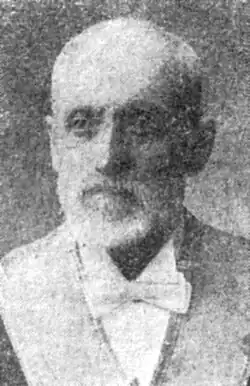
John Hudson
During September, 1864, the influx to Westland continued, and on the 12th of that month, Revell, reporting to the Provincial Council, stated that the diggers were earning from £2 to £5 per man per day, and that all was as it should be throughout the field; he, however, warned men from coming until a greater area of ground was proved, and more stores established, as supplies were still hard to obtain regularly.
About this time the Kapitea Creek, eleven miles south of the Grey, was rushed, and here Hudson and Price set up their first store. The gold, however, soon “petered out” and in a few days the field was almost deserted. Very bad weather then set in, during which it rained continuously for three weeks, making it impossible for anyone to leave the locality. During this enforced period of idleness Hudson had many conversations with a celebrated prospector known as Jimmie Liddle, with whom, as soon as the weather cleared, he proceeded south, and on October 1st, 1864, they arrived at what was then known as Okatika and here they erected a store, the framework being constructed of saplings, over which calico was drawn, the size over all being 12 x 20 feet, and thus came into being the first building in the town of Hokitika, now the capital of Westland.
As has been shown, the Maori name for this river, on the northern bank of which this town now stands, was Okatika, but this being somewhat hard to pronounce, old timers, who were prone, in their own words, “to do things regardless,” added the aspirate “H,” substituted an “i” for an “a,” and so coined the word Hokitika, which they considered more euphonious. Maori tradition hath it that the meaning of the word is “retreat,” the story being that on one occasion, when the Ngai Tahu tribe were about to attack the pa which was defended by the resident (Ngatiwairangi) tribe, the Chiefs of the former were drowned when attempting to cross the river, and their followers, finding themselves without leaders, were forced to retire, the place afterwards being called Okatika, meaning retreat.
Messrs. Hudson and Price, their store being erected, proceeded to stock it—supplies being drawn from Reuben Waite. As a matter of fact, from information they had they were quite prepared to await the result of a proposed prospecting trip to be carried out by Jimmie Liddle and his mate, Donnelly, who seemed sure that gold was to be found a few miles further south.
This expedition in due course set out, being “tuckered” (supplied with food, etc.) by Messrs. Hudson and Price. During their absence diggers continued to arrive and camped around the store, until there was quite a number of men in the vicinity all waiting for something to turn up. As a result of this influx Hudson and Price did a roaring trade, and much liquor was consumed. Thus three weeks passed. Then at long last the prospectors returned, reporting to the assembled diggers that “no gold had been discovered.” “This news,” states Hudson, in the course of his story, “was a great damper to all, but from a wink I received from Jimmie Liddle I knew all was well. Many of the other men would not accept the report as true, the prospectors appearing too jolly for men returning disappointed.
“In consequence of this every move they made was closely watched. A meal was then prepared for Liddle and in passing through the store to get this he managed to show me a good sized bag of gold. Shortly after this Price returned from a fishing trip, and I at once dispatched him to the Grey to obtain all the provisions procurable. Two Maoris, who had been south with Liddle, accompanied him. It was their mission to inform all the natives in the district of the new field, and they did their job well. From Waite Price obtained all the goods he required, and after engaging the services of two packers, De Silva and Rae, he returned to Hokitika, making good time.
“In his absence I had had trouble with the diggers about the store, who had endeavoured to get hold of the prospectors, of whom they were most suspicious. The idea was to make them drunk, hoping that when in that condition they would talk; this theory however did not work out, for before they were intoxicated my liquor ran out, and just as well, for the diggers were now in a nasty mood and threatened to kill Liddle and Donnelly. As it was a free fight took place, which lasted some time, the prospectors, aided by some friends, winning this battle with ease. Peace being restored, Liddle and Donnelly came into the store and informed me that they had ‘struck it rich’ in the Totara, and in a branch creek known afterwards as Donnellys. The following afternoon, as the result of the news spread by the Maoris, the vanguard of the rush hove in sight. It comprised about one hundred natives—men, women and children.
“These were mostly from the Greenstone. Shortly afterwards over two hundred Europeans also arrived. With the advent of these people the prospectors at once made ready to proceed south to open the new field. As showing the rapidity with which the news of a new discovery travels,” continues Hudson, “no less than five storekeepers reached my place on the day following. They were: Messrs. Sweeney, Murphy, Cochrane, Waite and Ward, who were all on their way to the Totara. Waite’s bullock dray, however, was unable to cross the river with their goods and they found it necessary to send to the Grey for a boat. This had belonged to the Gipsy, wrecked a year previously, and it was brought overland by way of the beach.
“I thought it advisable to erect a store at the new diggings myself and engaged James Morton to look after my business at Hokitika, which he did until 1865, when I again took over. The rush, however, was not of a sensational character, and with the exception of good returns from three or four claims, not much gold was obtained, there being a wild stampede back to the Greenstone for the purpose of jumping the best of the claims that had been abandoned.”
It was ever thus on the goldfields, a digger with a claim averaging £10 per week (and £10 per week was a lot of money then) would hear of a new field thirty miles away, where Dame Rumour (always a lying jade with regard to gold) had it that so rich was the wash there that a fortune could be won in a day. To this wild unauthenticated whisper, which originated goodness only knows where, the most experienced digger would give heed, and at a moment’s notice would join the mad rush to the new El Dorado, throwing away substance for shadow, almost always to his everlasting regret. Truly, the lure of gold passeth all understanding.
And yet these old timers were lovable men, loyal to one another and true to the highest traditions of our race. In proof of this assertion here is a story (one of many) told to the writer in 1905 by John Hudson himself. At that time we were both in the service of the Public Works Department on the construction of the Hokitika-Ross Railway, and this grand old pioneer would tell me of Old Westland and of the spirit of its people.
“When in November, ’64, the Totara River was rushed,” said Hudson, “a number of diggers, comprising Blanchard’s party, set about opening up a claim; to do so it was necessary to clear the heavy bush on the surface, and in felling a large tree one of their number was struck by the butt which smashed his thigh and pinned him to the ground. The few men present had no chance of lifting the tree to release their unfortunate mate, so some of the party set out for assistance and in response to their call over one hundred men were soon at the scene of the accident. With very great difficulty, and with the most primitive tools the tree was at length removed from the injured man. How to get him out of the forest and down to the beach was then the problem which confronted them. At length it was decided to make a box, place him therein and so convey him down the river. To do this it was necessary to split slabs out of a tree, a big job which many willing hands made short work of. The box constructed and lined with moss and fern over which oil sheets and blankets were placed, the long journey was commenced and after untold hardship and much suffering was successfully accomplished, and the beach reached.
“That night the injured man was placed in Murphy’s store and two days later the party arrived at my place at Hokitika. Here a large tree was felled and four wheels for a very primitive waggon were cut from the trunk. A man named Ramsay, afterwards a saddler in Hokitika, very ingeniously fashioned harness by which the box was slung (in the same manner as an old time coach) from the frame of the waggon. This made travelling much easier for the patient who by this time was pretty far through, but as game as they are made. Travelling by the beach route with the greatest difficulty and danger, the Taramakau and other rivers were successfully crossed and two days later the Grey was reached. Fortunately the steamer Nelson was there and the sufferer was placed on board and taken to Nelson where he entered the hospital and made a slow but steady recovery.
“Not satisfied with all they had done the diggers passed the hat round, collecting a large sum of money. With part of this they paid their mate’s fare, handing him the balance to pay his way, and so be under compliment to none. Were the old timers not real men?”
As previously stated John Hudson resumed charge of his store at Hokitika early in 1865. Here he carried on until the following year, when he purchased the Albion Hotel, a thriving hostelry in that then wonder city. Two years later he sold out and became proprietor of the Cleveland which he conducted for thirty years, until 1897, when he retired from the licensing trade, and joined the Government service as a road and bridge inspector.
“Honest John” Hudson, pioneer prospector, storekeeper, licensee and Government servant, was a man of many parts, who died in 1919, aged 78 years, and rests in the burial ground of Hokitika, the town he founded seventy-five years ago.
As will be seen from the increased number of men who rushed the Totara River and Donnelly’s Creek diggings, Westland was now attracting more attention, and in consequence more men. Quite a pretentious centre of activity had sprung up at Blaketown, where as early as November, ’64, there were ten stores, many shanties and eating houses, as well as commodious livery stables which hired out horses at exorbitant rates. These were in great demand, particularly when it was whispered that “the best field ever” had been discovered some thirty miles away. Everyone would want to get there in a hurry and competition would be very keen, for now an air of confidence prevailed and it was considered certain that a big strike would be made at any moment.
With the stage thus set for the dawning of Westland’s golden era it was meet that on October 26th, 1864, G. O. Preshaw, pioneer goldbuyer of the province, should arrive at the Grey by the S.S. Nelson. He was attached to the staff of the Bank of New South Wales, and had had considerable experience on the Australian goldfields prior to coming to New Zealand. A keen observer and a humorist in the full sense of the word, his contribution, long since out of print, to literature pertaining to the golden days of Westland, entitled, “Banking Under Difficulties or Life on the Goldfields,” is a most valuable one, and is, in fact, the only authentic record existent of the days immediately prior to the great rush. This being so, the next few pages are devoted entirely to his description of Westland from the date of his arrival to the coming of the Christmas Party to Hokitika on December 20th, 1864.
As showing what manner of man this banker was, it is illuminating to note that he opens his preface by stating that “The old days when the title page of a book was almost as good, or at any rate as explanatory, as a preface have departed. Now you may learn nothing from the name. Who has not heard of that agricultural society who sent for ‘Edgeworth’s Essay on Bulls,’ only to find that the ‘bulls’ were Irish, and principally verbal.” He then proceeds as follows: “The extraordinary vicissitudes of travel—the rough way of living and the hardships that the pioneers encountered in the early days of the Westland diggings, have never—at least to my mind—been fully set forth. In those days, as a rule, people were hand, not head workers. Now the past is to them but a dream. The writer of the following pages kept a diary, and the scenes described are therefore presented as they appeared to him at the time.”
Coming now to Preshaw’s story, the following extracts are taken from this rare and interesting book:
“October 21st, 1864, gold having been discovered in payable quantities on the West Coast of the South Island, I was ordered to take a run by the steamer Nelson (from Nelson), leaving on the above date, to have a look at the place and report upon it. On the day following our departure we duly arrived at the Buller (Westport) and a miserable looking place it was, there being only two buildings, both stores or shanties, kept respectively by Messrs. Martin and Hodges. We found a good many Maoris camped about and were amused at seeing a Maori woman washing her baby, a little thing a few months old, which she took down to the river, and dipped several times, the child taking it kindly, and although the water was very cold it cried but little; she then slung it on her back without even drying it and trotted away. A number of Maoris were busy writing letters to send by us to their friends at the Grey River. I saw one or two of these, which were most creditable productions both as regards spelling and writing.
“On October 25th we sailed for the Grey, which is sixty miles south of the Buller. We ran down in eight hours. The tide not being favourable when we arrived we anchored in the roadstead until it suited. When Captain Leech thought there was sufficient water on the bar, he went to the masthead and piloted his vessel in. The Grey bar is a shifting one; at one time the run in will be a straight one; at another a long way to the north or south, in which case the vessel has to run broadside on to the breakers between the sandspit and the beach. Constable O’Donnell was a fellow passenger on this trip, and he joined Sergeant Broham and Constable Cooper, who were camped at the Grey.
“The few residents turned out to meet us, among whom was Reuben Waite, the earliest settler on the Coast. There was only his store at the landing place, but about a mile to the south there were two others kept by Messrs. Blake and Horsington. The diggings were at the Greenstone, some twenty or thirty miles to the south. I hired a horse and got a packer named De Silva, a foreigner, a talkative, consequential little fellow, to accompany me thither. The day was anything but an inviting one, the rain coming down in torrents. The first ten miles of our journey lay along the beach, the sea being very rough, the breakers rolling in with great force. My guide did not seem to mind but rode right through them. Six miles from the Grey we came to a river, the Paroa, generally known as the Saltwater Creek. This we crossed and four miles further on reached the Taramakau; here there were two stores.
“Our journey now lay inland from the mouth of the river which had to be crossed four times. The Maoris camped about advised us to stay where we were, saying that a ‘fresh’ would be down and that it then would be impossible to cross. De Silva, however, knew better and I trusted entirely to his judgment in the matter, and off we went; we got over the first ford all right, but found on reaching the second that we could not get across, the river having risen very rapidly. De Silva then came to the conclusion that the best thing we could do was to hurry back, which we did, and just managed to re-cross the first ford, the river having risen over a foot in half an hour. And a good thing we did, for sure enough a heavy fresh did come down which prevented traffic for some days. Had we succeeded in getting over the second ford the chances are that we should have had to remain in the river-bed, between the second and third crossing, until the fresh went down.
“We had no alternative, so rode back to the Grey. There being no prospect of my getting to the Greenstone for a week at least, and having collected all the information I could about the place, I thought it advisable to return to Nelson, which I did. My report, on the whole, being a favourable one, it was determined to send me back by return steamer with a view of opening up in business on the West Coast.”