Old Westland/Chapter 12
Chapter XII
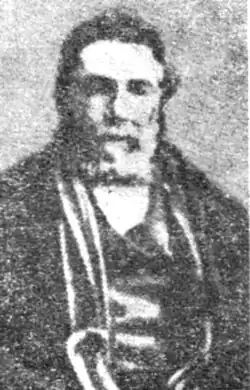
Reuben Waite
“There were a great many men around the fire waiting for me, and when I made my appearance they began asking questions. I may as well state here, that all the Maoris, men and women, were then close by, and ready to give me any assistance. There is no need to tell what they were armed with, but there would have been bloodshed that night had the diggers interfered with me, as some of them had taken the potatoes out of the pits of the natives at the Taramakau. The first question put to me by the aforesaid Dutchman was: ‘Vell, vot did you corse dis rush for?’ I answered that I did not cause the rush. That, when in Nelson to get a small vessel to bring me to the Grey, I called them together and told them that I was only going prospecting—that I did not lead them to believe that they were going to a goldfield, but that according to letters I had received, I thought there was gold in the country, which I still believed, and that a proper trial would prove it. The next question was put to me by a Cockney—I am sure he was, for he murdered the letter ‘h’: “Well, Mr. Waite,’ he asked, ‘’ow wud yer like to come ’ere without money an ’ave to starve as we ’ave to do?’ My answer to him was I had not asked him to come; he had pleased himself. The Dutchman then said: ‘Vel, poys, ve vill take vot ve vants from Vait’s store—an’ ve vill hang him.’ Just at that moment an Irishman whispered in my ear: ‘Cheer up, my boy, don’t be frightened, you have more friends than enemies in this crowd.’ With that I felt safe, but I was still annoyed by the discontented, and most of them brought back what provisions they had, with their picks and shovels, tin dishes, etc., and I gave them full value for them.

Canterbury-West Coast Road, 1866, changing horses at the Bealey Hotel.
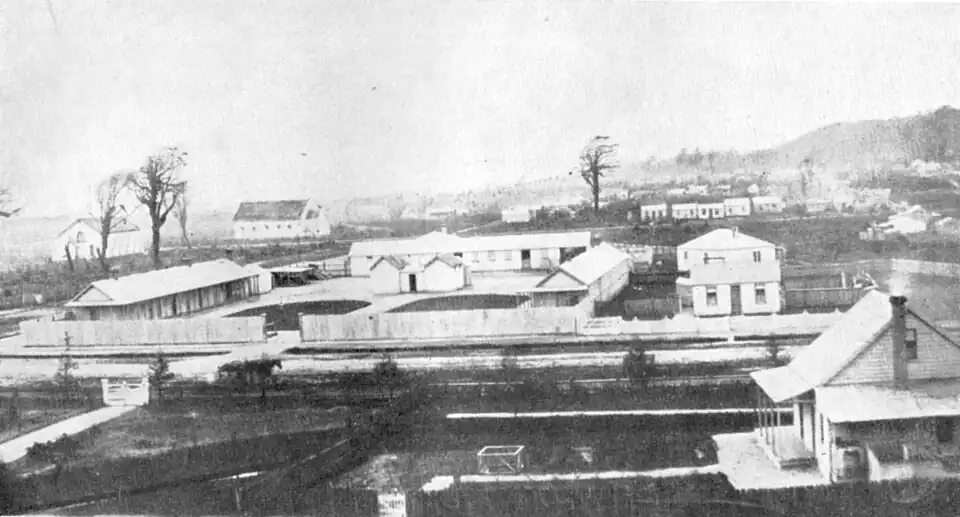
The Camp, Hokitika, 1865
“The men who were waiting for the steamer then came into the store and seeing the gold could scarcely believe their eyes, but when I showed the 50 ozs. I had bought from the natives, they wanted to know why I had not shown them that before. My answer was that they would not have believed me if I had shown it to them. Then came a rush for stores again and those who had been among the grumblers I charged an extra price as they had compelled me to take back their stores and tools.
“From that time commenced the great rush to the Golden West Coast, which up to the present time (1869) has brought out of the earth 40 tons of gold, for which I was to be hanged because those first arrivals chose to call the expedition a ‘duffer rush.’ After this gold began to come down freely, and all were satisfied; in fact, I believe the Greenstone was as good as any diggings afterwards found on the Coast. I have seen many of the crowd since who were in the circle to hang me, but I have not seen the Dutchman. Perhaps he did not forget the case of gin and kept out of the road. But the worst had to come, for in consequence of the disappointment I have narrated about the rush, I had ordered no more goods to be sent down. By the second arrival of the steamer there came more diggers, but no provisions, which we soon ran short of and I had to curtail the supplies of many, especially those who had been so hard on me. These I put on half rations until the Nelson returned once again. When she did arrive she brought my bullocks and dray, and with two horses and a mule I had purchased from Mr. A. D. Dobson, C.E., who had just completed the survey of the Coast, I sent goods to the mouth of the Taramakau, and up that stream to its junction with the Hohonu by canoe, a distance of about nine miles, from where they were carried by the diggers to the Greenstone Creek. I then opened a branch store at the Hohonu.
“After this I returned to Nelson by the first opportunity for the purpose of obtaining goods, and also to make arrangements for transport. I was greatly astonished on arriving to find myself an object of notoriety. It appeared that a report had reached there that I had been hanged at the Grey, during the little adventure above described. So great was the excitement of many people who were glad to see me return safe and sound, with a good parcel of gold, that I was unable to get away from them at the wharf for some time.”
Waite Street, Greymouth, perpetuates for all time the name of the pioneer storekeeper of Westland, and the founder of that town, where he resided for a period of ten years, and Marion Street nearby honours Mrs. Waite. In his old age he fell on evil days, and unsuccessfully petitioned Parliament for recognition of his services in pioneering the West Coast goldfields. He died in the public hospital, Nelson, in 1885, and was buried in the Whakapuaka Cemetery.
With regard to the contract Waite had received from the Nelson Provincial Government to procure 40 tons of coal from the Brunner seam, which Von Haast had pronounced to be of excellent quality in 1860, Matthew Batty in charge of a party of Maoris proceeded to the site of the seam, and there was hewn and loaded into canoes the required quantity of coal. This was then conveyed down the river to the Grey, where on July 28th, 1864, twenty-seven tons were placed aboard the S.S. Nelson, and shipped from what we now know as Port Greymouth. This was the first cargo of coal from the West Coast. It is noteworthy, too, that from this date the Nelson ran a regular service to and from Greymouth, steaming both ways with Brunner coal, which soon commanded a market greater than it was able to supply. It is of historical interest, too, that at this time Captain Leech, for many years afterwards harbour master at Westport, was then in command of the Nelson.
On the day following the arrival of Reuben Waite, that is on June 23rd, 1864, his brother-in-law, Isaac Blake, the second storekeeper to reach Westland, arrived at the Grey. He came by the schooner Mary which sailed in without mishap; he was accompanied by a further 40 diggers from the Buller. These men at once proceeded to the Greenstone where they soon struck it rich. Blake, on the other hand, having landed his goods on the south side of the river, at once set about erecting a store and eating house on the beach, where to-day is situated the prosperous suburb of Greymouth, known as Blaketown. It is necessary to mention here that many writers are under the impression that the original name of Greymouth was Blaketown. This is of course incorrect. The Grey River was so named, as has been shown, by Thomas Brunner in 1846, and the infant township was, in its very early days, referred to as “The Grey.” John Rochfort when surveying it in 1865 gave it the name of Greymouth.
There were many “characters” on the Westland goldfields, and among them Isaac Blake was outstanding. Here is a description of this celebrity, culled from the files of the West Coast Times, Westland’s first newspaper: “A short, thick-set, muscular man, strong of will and resolute of purpose with a weakness for Nelson ale, and massive greenstone pendants to his watch chain, was Blake. A man who was more at home on a vessel’s deck than behind a counter, and could handle a steer-oar better than a steel pen. In short, like the redoubtable old king, ‘whose mark for Rex was a single X, and whose drink was ditto, double,’ Blake ‘scorned the fetters of four and twenty letters,’ and it saved him a vast deal of trouble. Yet a shrewd character was Isaac Blake.
“The first time we visited the town which bore his name we crowded into the kitchen of his little slab store and regaled ourselves on a half-crown’s worth of ships’ biscuit and butter, prefaced by a thin rasher of bacon and a couple of high-coloured malodorous eggs, the whole dignified by the name of dinner, and, being somewhat pushed for room, we remarked upon the fact, and suggested that our host should get more commodious premises. ‘Aye, aye,’ was the response, ‘if the Coast goes ahead, I’ll get some congregated iron from Nelson.’ No orthœpist but an able dealer, he did not believe in parting with his goods unless he received full value in return. A poet of the period, who had possibly been refused drinks on account, thus gave vent to his spleen:—
‘Old Blake is the mercantile lion,
The King of the beasts of the port,
Your putting-tricks you may try on,
But he’s not the one to be caught.’
“But though an unlettered man, naturally rough, and not made any smoother by years of hard buffeting by men as rude as himself, Blake still possessed a little of the poetry of childhood. The love of the beautiful that is implanted in all youthful breasts was not altogether dead in his, and when the above lines were warbled to him by a half intoxicated customer, he shouted for all hands, and vowed that that pioneer, the writer of ‘that ere song,’ should never want a fifty of flour while he remained on the Coast.”
Blaketown had its day, and its glory departed. “How’s trade?” Blake was asked one morning, shortly after Greymouth was a township. “There aint bin a fight this week” was the answer. It was brief, and to the uninitiated ambiguous, but to those who knew it told a sad tale of ruin and decay.
By this time gold was being found everywhere along the sea beach between the Grey and the Taramakau, and diggers were steadily coming in from the Buller, Nelson and Christchurch, and even at this early date some 40 horses, a mule and a bullock dray were constantly employed in the carriage of provisions and mining implements between the Grey and the Greenstone. As near as could be ascertained there were now 100 men working in the vicinity of Hunt’s claim, and as a result of this, there came into existence Westland’s first “shanty” (i.e., grog shop). This was opened by a man named Tracy, who drew supplies from Reuben Waite. Be it noted that in those days all storekeepers sold liquor, and further, that as a general rule only the very best was stocked.
The news of the continued discoveries of gold soon spread to Christchurch, causing some embarrassment to the Provincial Council, who were still not enthusiastic regarding the finding of the metal royal in the western portion of the province. As has been shown, the Oakes brothers had reported its existence some seven years previously, this information being suppressed, the idea of an influx of diggers being abhorrent to the powers that were. A typical illustration of the feeling then pertaining was expressed by the Lyttelton Times, in a leading article on July 30th, 1864, which read as follows:—“If a goldfield is, after all, to be forced on Canterbury, without the consent and contrary to the expressed desire of the settlers, they must nevertheless submit to fate, and should the natural feelings of discontent swelling up in their prudent bosoms when Fortune’s golden favours are thrust into their hands, be somewhat hard to subdue, the consolation exists that the goldfield has turned up in the remotest corner of the province.” While the above article no doubt expressed the feelings of the then administrators of Canterbury, the age old lure of gold was too strong for the rank and file of the community, who lost no time in setting out for what they regarded as a land of promise, where fortunes could be won in a day, and as far as Christchurch was concerned, the long delayed rush to the Golden West became a reality.
The beginning of August, 1864, was marked by the arrival of more men, among whom were John R. Hudson and his partner, James Price, who reached Westland by way of the Taramakau Saddle on the 7th of the month mentioned. Hudson and Price were very well equipped, utilising two pack horses to convey their provisions and mining implements across the divide. All went well until they reached the Taramakau Saddle, where one of the horses lost its footing and fell, landing on a narrow ledge some fifty feet below. As it was this horse that carried their tent, blankets and food, it was essential that one of them should recover these very necessary articles. Hudson, descending the face of the cliff, and cutting the gear clear from the pack saddle, then decided it would be better to roll the horse into the ravine below than to leave it where it was, as it would certainly die of starvation. Having done this he proceeded to the floor of the ravine for the purpose of shooting the animal, and so putting it out of its misery, but to his surprise he found it uninjured and munching at the scrub, not a bit the worse for its fall of over one hundred and fifty feet.
From this point they found great difficulty in getting the horses along, the rocks over which they were forced to travel cutting and bruising their hoofs in such an appalling manner as to render progress almost impossible. Finally they had to cut the saddle straps to make shoes in the shape of sandals which they lashed on with cord. In this manner they continued their journey, but made little headway owing to the time taken up in the constant fixing of the leather sandals which were by this time very much the worse for wear. At length they arrived in the precincts of flax bushes, which abound on the banks of the rivers and creeks of Westland. All the leather now being used, they had to substitute bags, clothing or anything that could be spared.
About this time they met a large party of men returning from the Coast—they were making their way back to Canterbury. Later they met several other parties doing likewise, one and all of whom gave Westland a fearful name, and begged them to turn back, saying, “There was no gold—no food and nothing but starvation to look forward to.” Three days later they reached the “natural paddock” at Lake Brunner. Here they rested a day to give themselves and their horses a spell. While here, another well-known pioneer, Dick Ward, arrived; he was bringing across a horse, a mule and a donkey for transport purposes. The following morning he and Hudson started for the Greenstone in an endeavour to obtain some horseshoe nails. After many difficulties they reached their destination, finding that great dissatisfaction existed among the diggers, the majority of them proclaiming the rush a duffer. Horseshoe nails were not to be had for love or money, and it was necessary to push on to Blaketown where they were obtained at an exorbitant price. Hudson remained here, erecting a flax whare, while Ward at once set out for Lake Brunner with the horseshoe nails. Making good progress he soon reached his objective, and after shoeing the horses he and Price got on the road to Blaketown. On the way down the donkey was drowned, and subsequently thrown up on the beach, the body being an object of great curiosity to the Maoris who travelled many miles to see it, having never seen-such an animal before.
Hudson and Price upon completion of the flax whare decided to purchase stores from 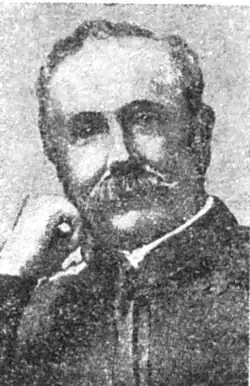
Thomas Broham
Reuben Waite and set up in business on their own account. They came to this decision because of the fact that an ever-increasing number of diggers were now arriving, for the most part from Canterbury, and that stores were few and far between. The Provincial Council, too, owing to this influx, resolved to appoint the necessary officials to take charge of the field and Sergeant Thomas Broham, of the police force, was instructed to proceed thereto without delay, Constable Cooper receiving orders to accompany him. W. H. Revell, who was at this time returning to the Grey, acted as guide for these two officers, the party travelling by the alpine route via Lake Brunner, arriving at Greenstone on August 21st, 1864. Prior to reaching the diggings they met Albert Hunt at the Taipo who had left Greenstone and was on his way to Christchurch to claim the £1,000 reward for having discovered a payable goldfield. Apart from this, Hunt had had serious trouble with other diggers, a battle royal taking place at Tracys, in which Hunt was outnumbered, having no friends nearby at the time. He, however, adopting the principle that attack was the best defence, got busy with a long-handled shovel, with such good effect that he knocked the ringleader out, this action so intimidating the crowd that in the confusion he got clean away.
After an inspection of the Greenstone field Revell, Broham and Cooper went on to the Grey, where the police officers established headquarters, they being the first representatives of the law to reach Old Westland.