Old Westland/Chapter 11
Chapter XI
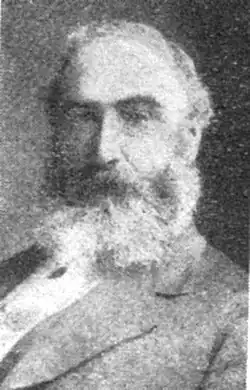
W. H. Revell
The year 1864 was momentous in Old Westland’s history—a prelude in reality to the golden drama soon to be enacted. It was fitting, therefore, that William Horton Revell, the outstanding personality of the West Coast Goldfields, should first step into the limelight. “Big” Revell, as his friends loved to call him, had been appointed to succeed Charles Townsend, as the Canterbury Provincial Government Agent at the Grey. Prior to this appointment he had been Inspector of Police at Timaru, and on resigning that position was made a Justice of the Peace.
Born in the North of Ireland in September, 1829, he arrived in Westland in the heyday of his manhood. His was a commanding presence. Over six feet in height and built on generous lines, he was a natural leader of men. Irish to a degree he possessed an inexhaustible fund of humour, which stood him in good stead in settling many a hectic argument. His brother, John C. Revell, who had been appointed his assistant, accompanied him to the Grey.
On January 4th, 1864, they left Port Cooper for Nelson, per S.S. Nelson, and on their arrival there transhipped to the schooner Mary, reaching their destination on January 24th, after an uneventful run down the coast. John Rochfort and his survey party were passengers by the same vessel. Three days after Revell’s arrival, a party of prospectors from the Taramakau reached the depot. They were in want of provisions, which were supplied, and from a member of this party, named Hughes, Revell purchased 1 oz. 16 dwt. of gold at the rate of £3 10s. per ounce. This by many writers is held to be the first sale in Westland, but is incorrect, Charles Townsend having bought small parcels from other prospectors.
On February 8th, Revell, accompanied by two survey hands, set out for Christchurch, and travelled via the Taramakau, Hohonu and Lake Brunner. The journey occupied fourteen days, the party being detained by a very heavy flood in the lake, which rose six feet, after two days’ solid rain. This was reported by the Maoris to be the heaviest flood ever seen in the Grey, the water completely overflowing its banks, two chains of which were washed out to sea. As a result of this the Government depot, which had been erected three chains from the river, was left in a precarious position, and John Revell deemed it wise to build another store at the head of what was afterwards known as Revell’s Lagoon.
On March 29th, W. H. Revell returned by the alpine route, a number of prospectors from the Buller having arrived during his absence. On April 9th, Tarapuhi, Chief of the Mawhera Pa, died. He had been an exceptionally good friend to the early explorers, and had always supplied them with food and given them shelter. It was Tarapuhi, it will be remembered, who came to the assistance of James Mackay in 1860, when travelling up the Grey River. He was buried in a cave near the Mawhera Pa.
A few days later, Maoris reported to Revell that four white men, who had been prospecting at the junction of the Greenstone Creek with the Taramakau, had struck gold. There was at this time a native camp at this point which was known as the Hohonu, and the resident Maoris had thus learned of the discovery. Regarding this particular locality it has already been stated that Albert Hunt had been engaged in prospecting there for some time, with the result that he had got together about 20 ozs. of gold, despite the fact that he had the most primitive contrivances for saving the royal metal.
At Maori Point, three miles up the Greenstone Creek, above the junction of the Little Hohonu, Hunt, assisted by his Maori mate, pegged out a claim, and thus came into being the first gold mining area in Old Westland. Here, beneath from two to six feet of soil, lay three to four feet of very rich wash dirt, from which a large quantity of gold was extracted. It is noteworthy that at the time of this find Hunt was the only European in this district, which was very rough and broken and so thickly covered with underscrub as to be almost impenetrable.
Hunt and his Maori friends continued to prospect in the vicinity of his claim and discovered coarse gold over a wide area and fine gold right down to high water mark. Hunt at this time was earning £2 per day, and though food supplies were very meagre he managed to subsist for some time on fern root plus a few potatoes. With the advent of the depot at the Grey the food problem ceased to exist, for then supplies could be packed along the beach from that river to the Taramakau, and thence by canoe to within three miles of these diggings.
Hunt later received a reward of £200 from the Canterbury Provincial Government, who had originally offered £1,000 for the discovery of a payable field, but who reconsidered their decision and paid the intrepid prospector a mere £200.
Messrs. Smart and French also claimed the reward, or some recognition of their services in finding gold in many parts, but without avail.
Reviewing this payment it is most interesting to record the fact that the men who discovered other payable fields were treated in a much more liberal manner. To instance this, Hargreaves, who discovered gold in New South Wales, received a bonus of no less than £15,000 from the people of that State, and later a further £5,000 from the Victorian authorities, who also rewarded James Esmond to the extent of £1,000. In our own country Gabriel Read was paid £1,000 for his discovery at the gully which to-day bears his name. Yet Hunt received but £200 from a responsible authority for the discovery of a field which has to date yielded gold to the value of twenty-six million pounds and is still producing.
During the month of May prospecting was carried on by a slowly increasing number of men, all of whom were doing fairly well, but no real strike had yet been made. June witnessed continued activity and the arrival of further diggers. Then came a bolt from the blue, for on the 20th of this month James Hammett arrived from Christchurch with dispatches for Messrs. Dobson, Rochfort and Revell, the latter being instructed to sell off his supplies, close the depot and return to headquarters by September—in a word, to abandon Westland.
Needless to say these instructions caused consternation, and Revell, determined to place the true position before the Provincial Government, decided to make a personal tour of inspection of the Greenstone diggings. Accordingly he and Hammett set out for, and duly reached, Maori Point, where they saw Albert Hunt and his native mate obtain 4½ ozs. of coarse shotty gold in one day. Maori parties nearby were obtaining similar results, and in addition to this had unearthed a huge block of greenstone, for which this district was famous. It is of interest to note that this place was known to the Maoris as Pounamu, and, as the name suggests, was the locality in which greenstone was found most abundantly. It is paradoxical, too, that greenstone, so prized by the Maori, and gold, valued above all else by the pakeha, were both first found at the same place—at Pounamu.
Revell, now satisfied beyond all doubt of the existence of gold in incredible quantities, decided to proceed to Christchurch and to place this startling information before the Provincial Council, confident that on the receipt of this great news his instructions to sell off his stores would be cancelled.
With this object in view he and Hammett set out on June 19th, and the weather being favourable, good time was made in crossing the Alps. On arrival, Revell reported the Greenstone discovery forthwith, displaying to astonished members of the Council one pound weight of gold which had been won in that locality. This tangible evidence of the richness of the field he had packed across the divide in his swag. Despite his report and his plea to be allowed to remain, the Provincial Government insisted on his carrying out the instructions he had received. They held that Canterbury West was worthless, and try as he would Revell could not shift them from this opinion—though he knew that that land of forest and flood was a veritable treasure-trove and that gold in unbelievable quantities was there and but waited the harvesting.
Despairing of moving the Council he managed at last to interest a few business people, under whose jurisdiction a public meeting was held in Cathedral Square. Revell addressed those present, exhibiting his gold. Christchurch would have been only 14 years old then and the Square very different from what it is today. And there stood William Horton Revell—a magnificent specimen of manhood, full-bearded, weather beaten, strong. In simple language he told those present all he knew—told them of a virgin country, “with wasted wealth in wild profusion strewn,” told them where the gold he displayed had come from, and that there was more for the taking. He asked them to pass a resolution calling upon the Provincial Council to reconsider his recall, that he might assist in the development of the new El Dorado. Those present, deeply impressed with his earnestness, did so, the resolution later being given effect to, and Revell was instructed to carry on.
Old timers loved to tell this story, holding that when the history of New Zealand comes to be written, this incident must be chronicled in letters of gold. Here, they contended, was a man who then knew that gold was to be found in Old Westland in fabulous quantities, and who would have been quite within his rights had he sold off his stores as instructed, and proceeded to harvest the golden grain on his own account. But no, “he saw his duty plain and straight, and went for it there and then,” and in so doing reached a level of self sacrificing service seldom attained. He was known to his friends, and they were legion, as “Big” Revell, and never was a title more appropriately bestowed, for his was the guiding hand at the commencement of Old Westland’s golden era. True at times he ruled, though wisely and well, with a rod of iron; true, too, that he “tuckered” many a down and out digger, giving the unfortunate one the chance required to make good. By one and all Revell was regarded as a real man. There is no greater distinction on a goldfield.
Meantime news of Hunt’s discovery had reached the Buller, where it will be remembered John Rochfort had discovered gold in 1859; and here many parties were working with varying success. About this time the prospectors Smart and French also located payable ground in the Grey District, and the former wrote to Reuben Waite, storekeeper (who it has been shown had established himself at the Buller), stating, inter alia: “I consider the Grey field far before the Buller, for we get gold everywhere we try . . . . In a paddock on the bank of the Grey River a party got seven ounces for eight days’ work. . . .” As a result of this communication many diggers set out for the new field, most of them proceeding direct to the Greenstone. On July 22nd, the S.S. Nelson arrived at the Grey, and consequently was the first steamer to enter that port. This little vessel, just out from England, had been chartered by Waite and carried seventy diggers and a maximum cargo of stores and provisions of every kind. Waite was thus the pioneer storekeeper of Old Westland and the founder of the town of Greymouth. The story of his arrival and of what followed is best given in his own words. Here they are:
“We started from Nelson in the good steamship Nelson in the middle of June, 1864, with a cargo of provisions and every requisite necessary for the diggers, who took no tools or provisions with them as the venture was regarded only as a prospecting trip. From my long experience I knew exactly what was wanted on the goldfields, and the diggers were satisfied to pay my price for anything required. The Nelson Provincial Government, finding I was going to the Grey, gave me a contract to procure 40 tons of coal from the seam discovered by Brunner. On arrival at our destination we entered the river in fine style, and steamed up to the landing opposite to what is now known as Mawhera Quay. Here we landed the goods, which were, of course, left exposed on the beach, as all hands set off prospecting. Some Maoris I had brought with me set cheerfully to work, and with plenty of help I soon managed to erect a temporary store.” (The exact location of this building is the corner of Mawhera Quay and Waite Street, so named by John Rochfort when he surveyed Greymouth in 1865.) “In the meantime,” continues Waite, “the goods were going out as fast as I could possibly sell them, aye, before I could get them out of the vessel the diggers were jumping down the hold for them.
“At the Mawhera Pa there were only Maori women; the men were all at the diggings, and when they saw the steamer they did not know what to make of it; it was the first they had seen. As stated the Maori men had all gone to get gold, which made the white men all the more anxious to go, and before long I was left almost alone, everyone having gone to the Taramakau River, where the natives were digging, and with the exception of my storeman and Matthew Batty, a miner who came down with me to get the coal, there were no other white men left at the Grey.
“About a week later some Maoris came from the Greenstone and brought with them a parcel of about 50 ozs. of the finest gold I have ever seen. I was glad indeed to purchase it from them. These natives then informed me that the men who had gone to the Taramakau were coming back again to kill me, and soon after this two white men returned and advised me to get out of the way, as the rest of the party were close at hand and were going to ransack my store and hang me. From what I could learn they had not been to the Greenstone at all, but only to the Taramakau, the Maoris having led them astray. In this connection the natives, having heard that a large number of pakehas had arrived by a steamer at the Grey, decided to leave their claims at the Greenstone, and commence working in the Taramakau River, at a place where they could not earn their salt, for the purpose of leading the diggers to suppose that gold had been got in that quarter. Here let me add that shortly afterwards I was informed that the Maoris had completely blocked up the track to the Greenstone, and thus it was that the new arrivals went wrong. I cannot vouch for the truth of this; it was told to me by a half-caste and it is exceedingly probable.
“Despite what I had been told I decided to stand my ground, and the Maoris promised to help me if interfered with. Next day the whole crowd came down and camped near the store, cursing and swearing at me. There was a Dutchman who had most to say and who stole a case of gin that night. This man came into the store and said I was wanted outside. He had been round the diggers’ tents trying to incite them against me, and although the case had assumed a serious aspect I could hardly refrain from laughing at the horrible attempt at the English language made by this man, especially owing to the state of excitement into which he had worked himself, imagining he was a deeply injured individual. I had neither arms nor ammunition of any kind, for up to that time they were not wanted on the West Coast.
“I went to the fire, a large one, which by the way, was fed with coal which Matthew Batty and his Maoris had brought down the river from the Brunner seam for the Nelson Provincial Government. It was rather an exciting moment, as stepping outside the store, the thought struck me that my life hung on a thread—that the weight of a feather would probably turn the scale either way. I was there standing accused, though wrongly, of having wilfully brought a number of my fellow countrymen to an outlandish district to suffer want and ruin. I knew that nothing but self possession would avail me, so I made the most of my position and put my trust in Providence. I shall never forget the impression of that scene as it first met my gaze. The bright glare of the huge coal fire, the motley group of roughly attired figures around it, some silent and thoughtful, others fierce and clamorous, with every species of anger and revenge visible on their countenances—the solemn and monotonous roar of the breakers, together with the surrounding mountain scenery in all its pristine grandeur, formed a romantic picture rude and wild in the extreme.”