NEW GENERAL INVESTIGATIONS
OF
CURVED SURFACES
[1825]
Although the real purpose of this work is the deduction of new theorems concerning its subject, nevertheless we shall first develop what is already known, partly for the sake of consistency and completeness, and partly because our method of treatment is different from that which has been used heretofore. We shall even begin by advancing certain properties concerning plane curves from the same principles.
In order to compare in a convenient manner the different directions of straight lines in a plane with each other, we imagine a circle with unit radius described in the plane about an arbitrary centre. The position of the radius of this circle, drawn parallel to a straight line given in advance, represents then the position of that line. And the angle which two straight lines make with each other is measured by the angle between the two radii representing them, or by the arc included between their extremities. Of course, where precise definition is necessary, it is specified at the outset, for every straight line, in what sense it is regarded as drawn. Without such a distinction the direction of a straight line would always correspond to two opposite radii.
In the auxiliary circle we take an arbitrary radius as the first, or its terminal point in the circumference as the origin, and determine the positive sense of measuring the arcs from this point (whether from left to right or the contrary); in the opposite direction the arcs are regarded then as negative. Thus every direction of a straight line is expressed in degrees, etc., or also by a number which expresses them in parts of the radius.
Such lines as differ in direction by  or by a multiple of have, therefore, precisely the same direction, and may, generally speaking, be regarded as the same. However, in such cases where the manner of describing a variable angle is taken into consideration, it may be necessary to distinguish carefully angles differing by
If, for example, we have decided to measure the arcs from left to right, and if to two straight lines 
 correspond the two directions
 then
then  is the angle between those two straight lines. And it is easily seen that, since falls between
  and
and  the positive or negative value indicates at once that lies on the right or the left of as seen from the point of intersection. This will be determined generally by the sign of
If  is a part of a curved line, and if to the tangents at
 correspond respectively the directions
 by which letters shall be denoted also the corresponding points on the auxiliary circles, and if
 be their distances along the arc from the origin, then the magnitude of the arc
  or
or  is called the amplitude of
The comparison of the amplitude of the arc with its length gives us the notion of curvature. Let  be any point on the arc
  and let
 be the same with reference to it that
  and are with reference to
  and
and  If now
  or
or  be proportional to the part
  of the arc, then we shall say that is uniformly curved throughout its whole length, and we shall call

the measure of curvature, or simply the curvature. We easily see that this happens only when is actually the arc of a circle, and that then, according to our definition, its curvature will be  if
if  denotes the radius. Since we always regard as positive, the upper or the lower sign will hold according as the centre lies to the right or to the left of the arc ( being regarded as the initial point, as the end point, and the directions on the auxiliary circle being measured from left to right). Changing one of these conditions changes the sign, changing two restores it again.
On the contrary, if be not proportional to  then we call the arc non-uniformly curved and the quotient
may then be called its mean curvature. Curvature, on the contrary, always presupposes that the point is determined, and is defined as the mean curvature of an element at this point; it is therefore equal to

We see, therefore, that arc, amplitude, and curvature sustain a similar relation to each other as time, motion, and velocity, or as volume, mass, and density. The reciprocal of the curvature, namely,

is called the radius of curvature at the point  And, in keeping with the above conventions, the curve at this point is called concave toward the right and convex toward the left, if the value of the curvature or of the radius of curvature happens to be positive; but, if it happens to be negative, the contrary is true.
If we refer the position of a point in the plane to two perpendicular axes of coordinates to which correspond the directions  and
and  in such a manner that the first coordinate represents the distance of the point from the second axis, measured in the direction of the first axis; whereas the second coordinate represents the distance from the first axis, measured in the direction of the second axis; if, further, the indeterminates
 represent the coordinates of a point on the curved line,
  the length of the line measured from an arbitrary origin to this point,
  the direction of the tangent at this point, and the radius of curvature; then we shall have
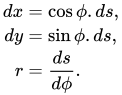
If the nature of the curved line is defined by the equation  where
where  is a function of
  and if we set

then on the curved line

Hence

and therefore
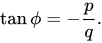
We have also

If, therefore, we set, according to a well known theorem,
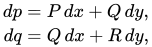
then we have

therefore

or, since

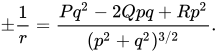
The ambiguous sign in the last formula might at first seem out of place, but upon closer consideration it is found to be quite in order. In fact, since this expression depends simply upon the partial differentials of  and since the function itself merely defines the nature of the curve without at the same time fixing the sense in which it is supposed to be described, the question, whether the curve is convex toward the right or left, must remain undetermined until the sense is determined by some other means. The case is similar in the determination of by means of the tangent, to single values of which correspond two angles differing by
  The sense in which the curve is described can be specified in the following different ways.
I. By means of the sign of the change in  If
If  increases, then
  must be positive. Hence the upper signs will hold if
  has a negative value, and the lower signs if has a positive value. When decreases, the contrary is true.
II. By means of the sign of the change in  If increases, the upper signs must be taken when
  is positive, the lower when is negative. The contrary is true when decreases.
III. By means of the sign of the value which the function takes for points not on the curve. Let 
 be the variations of when we go out from the curve toward the right, at right angles to the tangent, that is, in the direction
  and let the length of this normal be
  Then, evidently, we have
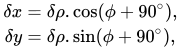
or
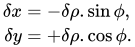
Since now, when  is infinitely small,
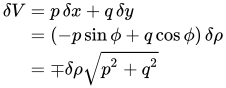
and since on the curve itself vanishes, the upper signs will hold if on passing through the curve from left to right, changes from positive to negative, and the contrary. If we combine this with what is said at the end of Art. 2, it follows that the curve is always convex toward that side on which receives the same sign as

For example, if the curve is a circle, and if we set

then we have
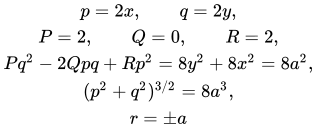
and the curve will be convex toward that side for which
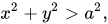
as it should be.
The side toward which the curve is convex, or, what is the same thing, the signs in the above formulæ, will remain unchanged by moving along the curve, so long as

does not change its sign. Since is a continuous function, such a change can take place only when this ratio passes through the value zero. But this necessarily presupposes that and become zero at the same time. At such a point the radius of curvature becomes infinite or the curvature vanishes. Then, generally speaking, since here

will change its sign, we have here a point of inflexion.
The case where the nature of the curve is expressed by setting equal to a given function of namely,  is included in the foregoing, if we set

If we put

then we have

therefore
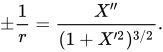
Since is negative here, the upper sign holds for increasing values of We can therefore say, briefly, that for a positive  the curve is concave toward the same side toward which the -axis lies with reference to the -axis; while for a negative the curve is convex toward this side.
If we regard as functions of  these formulæ become still more elegant. Let us set
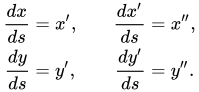
Then we shall have
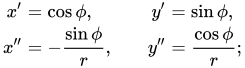
or

or also

so that

represents the curvature, and

the radius of curvature.
We shall now proceed to the consideration of curved surfaces. In order to represent the directions of straight lines in space considered in its three dimensions, we imagine a sphere of unit radius described about an arbitrary centre. Accordingly, a point on this sphere will represent the direction of all straight lines parallel to the radius whose extremity is at this point. As the positions of all points in space are determined by the perpendicular distances  from three mutually perpendicular planes, the directions of the three principal axes, which are normal to these principal planes, shall be represented on the auxiliary sphere by the three points

 These points are, therefore, always
  apart, and at once indicate the sense in which the coordinates are supposed to increase. We shall here state several well known theorems, of which constant use will be made.
1) The angle between two intersecting straight lines is measured by the arc [of the great circle] between the points on the sphere which represent their directions.
2) The orientation of every plane can be represented on the sphere by means of the great circle in which the sphere is cut by the plane through the centre parallel to the first plane.
3) The angle between two planes is equal to the angle between the great circles which represent their orientations, and is therefore also measured by the angle between the poles of the great circles.
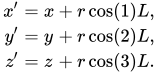
4) If 


 are the coordinates of two points, the distance between them, and
  the point on the sphere which represents the direction of the straight line drawn from the first point to the second, then
5) It follows immediately from this that we always have

[and] also, if  is any other point on the sphere,

We shall add here another theorem, which has appeared nowhere else, as far as we know, and which can often be used with advantage.
Let 
 be four points on the sphere, and the angle which
  and
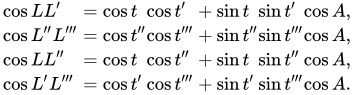
and  make at their point of intersection. [Then we have]

The proof is easily obtained in the following way. Let

we have then
Therefore
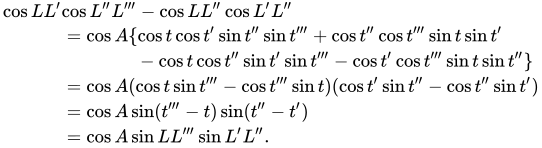
Since each of the two great circles goes out from in two opposite directions, two supplementary angles are formed at this point. But it is seen from our analysis that those branches must be chosen, which go in the same sense from toward and from toward 
Instead of the angle we can take also the distance of the pole of the great circle from the pole of the great circle  However, since every great circle has two poles, we see that we must join those about which the great circles run in the same sense from toward and from toward respectively.
The development of the special case, where one or both of the arcs and are we leave to the reader.
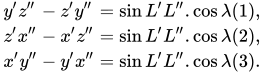
6) Another useful theorem is obtained from the following analysis. Let

be three points upon the sphere and put

We assume that the points are so arranged that they run around the triangle included by them in the same sense as the points Further, let  be that pole of the great circle which lies on the same side as
  We then have, from the above lemma,
Therefore, if we multiply these equations by respectively, and add the products, we obtain

wherefore, we can write also, according to well known principles of spherical trigonometry,
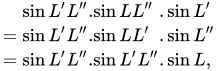
if denote the three angles of the spherical triangle. At the same time we easily see that this value is one-sixth of the pyramid whose angular points are the centre of the sphere and the three points (and indeed positive, if etc.).
The nature of a curved surface is defined by an equation between the coordinates of its points, which we represent by
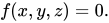
Let the total differential of  be
be

where


are functions of

We shall always distinguish two sides of the surface, one of which we shall call the upper, and the other the lower. Generally speaking, on passing through the surface the value of

changes its sign, so that, as long as the continuity is not interrupted, the values are positive on one side and negative on the other.
The direction of the normal to the surface toward that side which we regard as the upper side is represented upon the auxiliary sphere by the point Let

Also let  denote an infinitely small line upon the surface; and, as its direction is denoted by the point on the sphere, let

We then have

therefore

and, since  must be equal to we have also

Since 


 depend only on the position of the surface on which we take the element, and since these equations hold for every direction of the element on the surface, it is easily seen that must be proportional to
  Therefore

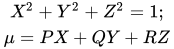
Therefore, since
and

or
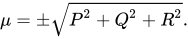
If we go out from the surface, in the direction of the normal, a distance equal to the element  then we shall have

and

We see, therefore, how the sign of  depends on the change of sign of the value of in passing from the lower to the upper side.
Let us cut the curved surface by a plane through the point to which our notation refers; then we obtain a plane curve of which is an element, in connection with which we shall retain the above notation. We shall regard as the upper side of the plane that one on which the normal to the curved surface lies. Upon this plane we erect a normal whose direction is expressed by the point  of the auxiliary sphere. By moving along the curved line, and will therefore change their positions, while remains constant, and and
  are always equal to
  Therefore describes the great circle one of whose poles is
  The element of this great circle will be equal to
  if denotes the radius of curvature of the curve. And again, if we denote the direction of this element upon the sphere by
  then
then  will evidently lie in the same great circle and be from as well as from If we now set

then we shall have

since, in fact, 

 are merely the coordinates of the point referred to the centre of the sphere.
Since by the solution of the equation  the coordinate may be expressed in the form of a function of we shall, for greater simplicity, assume that this has been done and that we have found

We can then write as the equation of the surface

or

From this follows, if we set

where 
 are merely functions of and We set also

Therefore upon the whole surface we have

and therefore, on the curve,

Hence differentiation gives, on substituting the above values for 



or
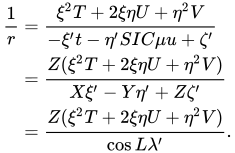
Before we further transform the expression just found, we will make a few remarks about it.
A normal to a curve in its plane corresponds to two directions upon the sphere, according as we draw it on the one or the other side of the curve. The one direction, toward which the curve is concave, is denoted by the other by the opposite point on the sphere. Both these points, like and  are from and therefore lie in a great circle. And since is also from
  or
or  Therefore

where  is necessarily positive. Since is regarded as positive in our analysis, the sign of
  will be the same as that of

And therefore a positive value of this last expression means that  is less than or that the curve is concave toward the side on which lies the projection of the normal to the surface upon the plane. A negative value, on the contrary, shows that the curve is convex toward this side. Therefore, in general, we may set also
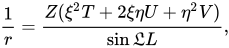
if we regard the radius of curvature as positive in the first case, and negative in the second.  is here the angle which our cutting plane makes with the plane tangent to the curved surface, and we see that in the different cutting planes passed through the same point and the same tangent the radii of curvature are proportional to the sine of the inclination. Because of this simple relation, we shall limit ourselves hereafter to the case where this angle is a right angle, and where the cutting plane, therefore, is passed through the normal of the curved surface. Hence we have for the radius of curvature the simple formula

Since an infinite number of planes may be passed through this normal, it follows that there may be infinitely many different values of the radius of curvature. In this case 
 are regarded as constant, as variable. In order to make the latter depend upon a single variable, we take two fixed points
 apart on the great circle whose pole is Let their coordinates referred to the centre of the sphere be


 We have then

If we set

then we have

and the formula becomes

and likewise
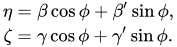
Therefore, if we set
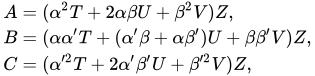
we shall have
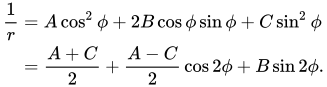
If we put
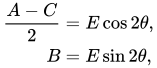
where we may assume that  has the same sign as
  then we have

It is evident that denotes the angle between the cutting plane and another plane through this normal and that tangent which corresponds to the direction  Evidently, therefore,
  takes its greatest (absolute) value, or its smallest, when
  and its smallest absolute value, when
 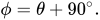 Therefore the greatest and the least curvatures occur in two planes perpendicular to each other. Hence these extreme values for are
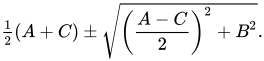
Their sum is  and their product
  or the product of the two extreme radii of curvature is
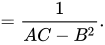
This product, which is of great importance, merits a more rigorous development. In fact, from formulæ above we find

But from the third formula in [Theorem] 6, Art. 7, we easily infer that

therefore

Besides, from Art. 8,
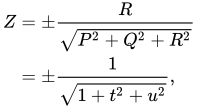
therefore
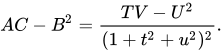
Just as to each point on the curved surface corresponds a particular point on the auxiliary sphere, by means of the normal erected at this point and the radius of the auxiliary sphere parallel to the normal, so the aggregate of the points on the auxiliary sphere, which correspond to all the points of a line on the curved surface, forms a line which will correspond to the line on the curved surface. And, likewise, to every finite figure on the curved surface will correspond a finite figure on the auxiliary sphere, the area of which upon the latter shall be regarded as the measure of the amplitude of the former. We shall either regard this area as a number, in which case the square of the radius of the auxiliary sphere is the unit, or else express it in degrees, etc., setting the area of the hemisphere equal to
The comparison of the area upon the curved surface with the corresponding amplitude leads to the idea of what we call the measure of curvature of the surface. If the former is proportional to the latter, the curvature is called uniform; and the quotient, when we divide the amplitude by the surface, is called the measure of curvature. This is the case when the curved surface is a sphere, and the measure of curvature is then a fraction whose numerator is unity and whose denominator is the square of the radius.
We shall regard the measure of curvature as positive, if the boundaries of the figures upon the curved surface and upon the auxiliary sphere run in the same sense; as negative, if the boundaries enclose the figures in contrary senses. If they are not proportional, the surface is non-uniformily curved. And at each point there exists a particular measure of curvature, which is obtained from the comparison of corresponding infinitesimal parts upon the curved surface and the auxiliary sphere. Let  be a surface element on the former, and
  the corresponding element upon the auxiliary sphere, then

will be the measure of curvature at this point.
In order to determine their boundaries, we first project both upon the  -plane. The magnitudes of these projections are
 The sign of will show whether the boundaries run in the same sense or in contrary senses around the surfaces and their projections. We will suppose that the figure is a triangle; the projection upon the -plane has the coordinates

Hence its double area will be

To the projection of the corresponding element upon the sphere will correspond the coordinates:
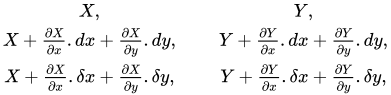
From this the double area of the element is found to be
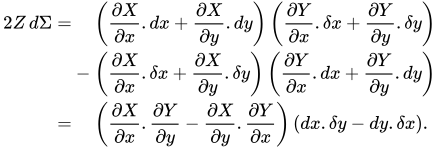
The measure of curvature is, therefore,
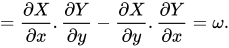
Since
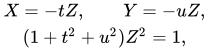
we have

therefore

and
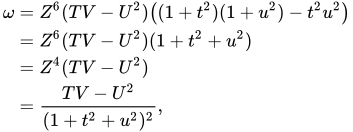
the very same expression which we have found at the end of the preceding article. Therefore we see that
- "The measure of curvature is always expressed by means of a fraction whose numerator is unity and whose denominator is the product of the maximum and minimum radii of curvature in the planes passing through the normal."
We will now investigate the nature of shortest lines upon curved surfaces. The nature of a curved line in space is determined, in general, in such a way that the coordinates of each point are regarded as functions of a single variable, which we shall call  The length of the curve, measured from an arbitrary origin to this point, is then equal to

If we allow the curve to change its position by an infinitely small variation, the variation of the whole length will then be
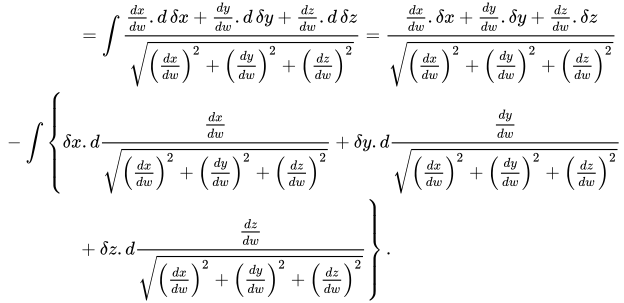
The expression under the integral sign must vanish in the case of a minimum, as we know. Since the curved line lies upon a given curved surface whose equation is

the equation between the variations 


must also hold. From this, by means of well known principles, we easily conclude that the differentials

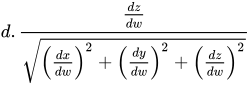
must be proportional to the quantities respectively. If is an element of the curve; the point upon the auxiliary sphere, which represents the direction of this element; the point giving the direction of the normal as above; and  the coordinates of the points referred to the centre of the auxiliary sphere, then we have

Therefore we see that the above differentials will be equal to  And since are proportional to the quantities
  the character of the shortest line is such that
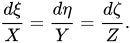
To every point of a curved line upon a curved surface there correspond two points on the sphere, according to our point of view; namely, the point which represents the direction of the linear element, and the point which represents the direction of the normal to the surface. The two are evidently apart. In our former investigation (Art. 9), where [we] supposed the curved line to lie in a plane, we had two other points upon the sphere; namely, which represents the direction of the normal to the plane, and which represents the direction of the normal to the element of the curve in the plane. In this case, therefore, was a fixed point and were always in a great circle whose pole was In generalizing these considerations, we shall retain the notation but we must define the meaning of these symbols from a more general point of view. When the curve is described, the points also describe curved lines upon the auxiliary sphere, which, generally speaking, are no longer great circles. Parallel to the element of the second line, we draw a radius of the auxiliary sphere to the point but instead of this point we take the point opposite when is more than from In the first case, we regard the element at as positive, and in the other as negative. Finally, let be the point on the auxiliary sphere, which is from both and and which is so taken that lie in the same order as
The coordinates of the four points of the auxiliary sphere, referred to its centre, are for
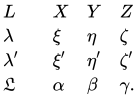
Hence each of these  points describes a line upon the auxiliary sphere, whose elements we shall express by


 We have, therefore,

In an analogous way we now call

the measure of curvature of the curved line upon the curved surface, and its reciprocal

the radius of curvature. If we denote the latter by  then
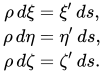
then
If, therefore, our line be a shortest line, 

 must be proportional to the quantities But, since at the same time

we have

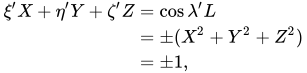
and since, further,
and since we always choose the point so that

then for the shortest line

or and must coincide. Therefore
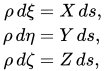
and we have here, instead of curved lines upon the auxiliary sphere, only  to consider. Every element of the second line is therefore to be regarded as lying in the great circle
  And the positive or negative value of
  refers to the concavity or the convexity of the curve in the direction of the normal.
We shall now investigate the spherical angle upon the auxiliary sphere, which the great circle going from toward makes with that one going from toward one of the fixed points  e.g., toward In order to have something definite here, we shall consider the sense from
  to
to  the same as that in which and
  lie. If we call this angle
  then it follows from the theorem of Art. 7 that

or, since  and
and

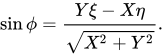
we have
Furthermore,

or
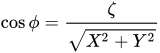
and
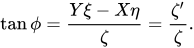
Hence we have

The denominator of this expression is
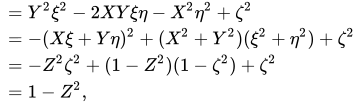
or

We verify readily by expansion the identical equation

and likewise

We have, therefore,

Substituting these values, we obtain


Now

On substituting we obtain, instead of what stands in the parenthesis,

Hence

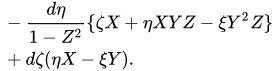
Since, further,
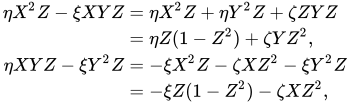
our whole expression becomes

The formula just found is true in general, whatever be the nature of the curve. But if this be a shortest line, then it is clear that the last three terms destroy each other, and consequently

But we see at once that
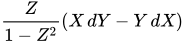
is nothing but the area of the part of the auxiliary sphere, which is formed between the element of the line the two great circles drawn through its extremities and
 and the element thus intercepted on the great circle through
  and
and  This surface is considered positive, if and lie on the same side of
  and if the direction from
  to
to  is the same as that from
  to
to  negative, if the contrary of one of these conditions hold; positive again, if the contrary of both conditions be true. In other words, the surface is considered positive if we go around the circumference of the figure
  in the same sense as
  negative, if we go in the contrary sense.
If we consider now a finite part of the line from to and denote by  the values of the angles at the two extremities, then we have

the sign of the area being taken as explained.
Now let us assume further that, from the origin upon the curved surface, infinitely many other shortest lines go out, and denote by that indefinite angle which the first element, moving counter-clockwise, makes with the first element of the first line; and through the other extremities of the different curved lines let a curved line be drawn, concerning which, first of all, we leave it undecided whether it be a shortest line or not.  If we suppose also that those indefinite values, which for the first line were
  be denoted by
 for each of these lines, then
  is capable of being represented in the same manner on the auxiliary sphere by the space
  Since evidently
  the space
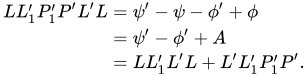
If the bounding line is also a shortest line, and, when prolonged, makes with 
 the angles
 if, further,
 denote the same at the points
  that did at in the line then we have

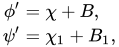
but
therefore

The angles of the triangle  evidently are

therefore their sum is

The form of the proof will require some modification and explanation, if the point falls within the triangle. But, in general, we conclude
- "The sum of the three angles of a triangle, which is formed of shortest lines upon an arbitrary curved surface, is equal to the sum of
 and the area of the triangle upon the auxiliary sphere, the boundary of which is formed by the points corresponding to the points in the boundary of the original triangle, and in such a manner that the area of the triangle may be regarded as positive or negative according as it is inclosed by its boundary in the same sense as the original figure or the contrary."
Wherefore we easily conclude also that the sum of all the angles of a polygon of  sides, which are shortest lines upon the curved surface, is [equal to] the sum of
 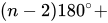 the area of the polygon upon the sphere etc.
If one curved surface can be completely developed upon another surface, then all lines upon the first surface will evidently retain their magnitudes after the development upon the other surface; likewise the angles which are formed by the intersection of two lines. Evidently, therefore, such lines also as are shortest lines upon one surface remain shortest lines after the development. Whence, if to any arbitrary polygon formed of shortest lines, while it is upon the first surface, there corresponds the figure of the zeniths upon the auxiliary sphere, the area of which is and if, on the other hand, there corresponds to the same polygon, after its development upon another surface, a figure of the zeniths upon the auxiliary sphere, the area of which is  it follows at once that in every case

Although this proof originally presupposes the boundaries of the figures to be shortest lines, still it is easily seen that it holds generally, whatever the boundary may be. For, in fact, if the theorem is independent of the number of sides, nothing will prevent us from imagining for every polygon, of which some or all of its sides are not shortest lines, another of infinitely many sides all of which are shortest lines.
Further, it is clear that every figure retains also its area after the transformation by development.
We shall here consider 4 figures:
- an arbitrary figure upon the first surface,
- the figure on the auxiliary sphere, which corresponds to the zeniths of the previous figure,
- the figure upon the second surface, which No. 1 forms by the development,
- the figure upon the auxiliary sphere, which corresponds to the zeniths of No. 3.
Therefore, according to what we have proved, 2 and 4 have equal areas, as also 1 and 3. Since we assume these figures infinitely small, the quotient obtained by dividing 2 by 1 is the measure of curvature of the first curved surface at this point, and likewise the quotient obtained by dividing 4 by 3, that of the second surface. From this follows the important theorem:
- "In the transformation of surfaces by development the measure of curvature at every point remains unchanged."
This is true, therefore, of the product of the greatest and smallest radii of curvature.
In the case of the plane, the measure of curvature is evidently everywhere zero. Whence follows therefore the important theorem:
- "For all surfaces developable upon a plane the measure of curvature everywhere vanishes,"
or

which criterion is elsewhere derived from other principles, though, as it seems to us, not with the desired rigor. It is clear that in all such surfaces the zeniths of all points can not fill out any space, and therefore they must all lie in a line.
From a given point on a curved surface we shall let an infinite number of shortest lines go out, which shall be distinguished from one another by the angle which their first elements make with the first element of a
definite shortest line. This angle we shall call

Further, let
be the length [measured from the given point] of a part of such a shortest line, and let its extremity have the coordinates
Since

and
therefore, belong to a perfectly definite point on the curved surface, we can regard
as functions of
and

The direction of the element of
corresponds to the point
on the sphere, whose coordinates are

Thus we shall have

The extremities of all shortest lines of equal lengths correspond to a curved line whose length we may call  We can evidently consider
  as a function of and
  and if the direction of the element of corresponds upon the sphere to the point whose coordinates are
  we shall have

Consequently
 This magnitude we shall denote by
  which itself, therefore, will be a function of and
We find, then, if we differentiate with respect to

because

and therefore its differential is equal to zero.
But since all points [belonging] to one constant value of lie on a shortest line, if we denote by the zenith of the point to which correspond and by the coordinates of [from the last formulæ of Art. 13],

if is the radius of curvature. We have, therefore,

But

because, evidently, lies on the great circle whose pole is Therefore we have

or independent of and therefore a function of alone. But for  it is evident that
 and therefore
  Whence we conclude that, in general,
  or
or

From this follows the beautiful theorem:
- "If all lines drawn from a point on the curved surface are shortest lines of equal lengths, they meet the line which joins their extremities everywhere at right angles."
We can show in a similar manner that, if upon the curved surface any curved line whatever is given, and if we suppose drawn from every point of this line toward the same side of it and at right angles to it only shortest lines of equal lengths, the extremities of which are joined by a line, this line will be cut at right angles by those lines in all its points. We need only let in the above development represent the length of the given curved line from an arbitrary point, and then the above calculations retain their validity, except that  for
for  is now contained in the hypothesis.
The relations arising from these constructions deserve to be developed still more fully. We have, in the first place, if, for brevity, we write  for
for 
(1)

(2)

(3)

(4)

(5)

Furthermore,
(6)

(7)

(8)

and
[9]
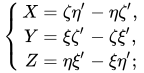
[10]
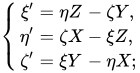
[11]
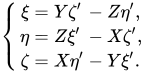
Likewise, 

 are proportional to and if we set

where  denotes the radius of curvature of the line then
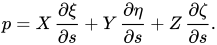
By differentiating (7) with respect to we obtain

We can easily show that 

 also are proportional to In fact, [from 10] the values of these quantities are also [equal to]

therefore
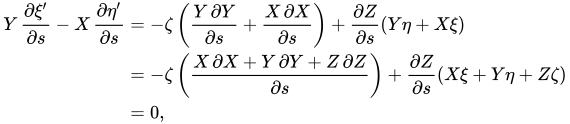
and likewise the others. We set, therefore,

whence

and also

Further [we obtain], from the result obtained by differentiating (8),

But we can derive two other expressions for this. We have
![{\displaystyle {\frac {\partial m\xi '}{\partial s}}={\frac {\partial \xi }{\partial \theta }},\qquad \left[{\frac {\partial m\eta '}{\partial s}}={\frac {\partial \eta }{\partial \theta }},\qquad {\frac {\partial m\zeta '}{\partial s}}={\frac {\partial \zeta }{\partial \theta }},\right]}](./_assets_/eb734a37dd21ce173a46342d1cc64c92/427509b5b774fe50b28f9786f9df5fac7bada796.svg)
therefore [because of (8)]

[and therefore, from (7),]

After these preliminaries [using (2) and (4)] we shall now first put in the form
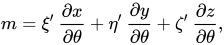
and differentiating with respect to we have[1]
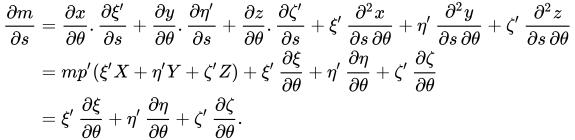
If we differentiate again with respect to and notice that
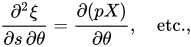
and that

we have
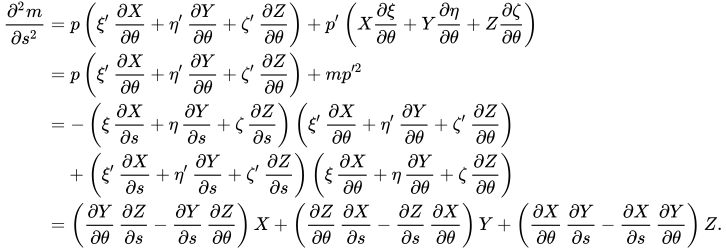
[But if the surface element

belonging to the point be represented upon the auxiliary sphere of unit radius by means of parallel normals, then there corresponds to it an area whose magnitude is

Consequently, the measure of curvature at the point under consideration is equal to
![{\displaystyle \left.-{\frac {1}{m}}\,{\frac {\partial ^{2}m}{\partial s^{2}}}.\right]}](./_assets_/eb734a37dd21ce173a46342d1cc64c92/1279eefb74f80d8e6c4b9ce4dfc7964dacc4a799.svg)


 This work is a translation and has a separate copyright status to the applicable copyright protections of the original content.


![{\displaystyle {\begin{aligned}m\,{\frac {\partial m}{\partial s}}&={\frac {\partial x}{\partial \theta }}.{\frac {\partial ^{2}x}{\partial \theta \,\partial s}}+{\frac {\partial y}{\partial \theta }}.{\frac {\partial ^{2}y}{\partial \theta \,\partial s}}+{\frac {\partial z}{\partial \theta }}.{\frac {\partial ^{2}z}{\partial \theta \,\partial s}}\\&=\left.m\xi '\,{\frac {\partial \xi }{\partial \theta }}+m\eta '\,{\frac {\partial \eta }{\partial \theta }}+m\zeta '\,{\frac {\partial \zeta }{\partial \theta }}.\right]\end{aligned}}}](./_assets_/eb734a37dd21ce173a46342d1cc64c92/ffacf61b74861f19085fb7aa040c73a1b38d6dde.svg)