Mr. Three

MR. THREE
A Complete Novel by HAROLD LAMB
Author of “The Devil's Bungalow,” “The Hundred Visitors,” etc.
WHOEVER VENTURES AGAINST THE UNKNOWN FOLLOWS THE PATH
OF DANGER—A PROVERB WHICH WAS TO BE PROVED TRUE WHEN YOUNG
BOB WARNER JOURNEYED INTO THE HINTERLANDS OF CHINA
Chapter I
The Domino Players
DOMINOES clinked on the tables in the lounge of the Bonhomme Club, in San Francisco. Black cubes, of the American game, and white dominoes of the Chinese; ivory and bamboo pieces of the new game of mah jongg, a fad in the clubs of San Francisco, but a game known to the Chinese for some two thousand years.
It was after the luncheon hour and cigar smoke rose toward the high ceiling. Few words were spoken, so busily did the dominoes clink and chink. The stakes, more often than not, were high. Those who play in the Bonhomme Club are not pikers. Here were gathered men high in the professions, some heads of leading industries in the city, travelers, authors—most of them had made their mark.
Their hour of diversion it was, yet only one—a new arrival—turned to the reading matter on the long table by the fireplace and took up a magazine. He was a slender man, still under middle age; he moved leisurely as if in all his life he had never hurried. Something in the set of his shoulders and the muscles of his hands suggested military life, or physical fitness, and the skin of his lower cheeks and neck was tanned a deep brown.
Two mah jongg players glanced at him more than once. Presently the taller of the pair, a man with a notable, ruddy countenance, hailed the reader.
“Bob Warner, or I'm,a liar! Come out of it, man. Want to sit in with us—three birds of a kind, eh?”
Warner looked up and answered gravely. “Thanks, Hearn, I prefer to keep what feathers I've got. Besides, I'm off all things Oriental.”
“Suit yourself, my lad. So you're fed up on China, after six years of it! What did you get out of it? Something good?”
 Clifford Hearn, ten years ago, had been in a New York university with Robert Warner. Working in Wall Street with small means, he had profited by the boom of '16; then he had a hand in a fishery combine that boosted prices until the Government took notice, and the law was invoked to try the heads of the company. Hearn fought his way out of the mess, and doubled his stake twice over by getting control of a copper mine in Arizona in the days after the war when copper mines were shut down and the metal was going begging.
The man was a fighter. Which is to say that he was never afraid to take a chance. He had scattered his money among leases in the oil fields of Southern California, as if over a faro board; his luck was good. In fact, those who followed his lead said it had never failed him, They called him King Cliff—those who knew him at all—and many stories they had of Cliff's luck.
Hearn had always patronized Warner, who was a shy chap, in college, where he fiddled around with ancient history and forgotten languages. The older man had waxed affluent by rapid methods, options on land and oil and stock selling rather than by the surer method of cultivation and building.
“Not so good,” responded Warner. “I've got together some rather curious—experiences.”
With a nod the promoter brushed aside the ivory dominoes, signing to one of the attendants to put them away as he rose to join the man by the fireplace. “Experiences, I'll say that!” He smiled at his companion of the gaming table, a slender individual, faultlessly dressed. “Ray, I want you to meet Bob Warner, the collector. He collects trouble. Bob, this is Count Camprubi, a friend of mine just over from China, himself. He has a story that will interest you.”
The pallid features of Camprubi were handsome, and only his full, brawn eyes and carefully chosen English indicated his foreign birth.
“I am most pleased to make your acquaintance, Mr. Warner. You collect—trouble? Ah, I am afraid I do not understand.”
“You will, Ray, when you know Warner better,” chuckled Hearn. “He has been in more tight places than any man in this room, barring you, maybe. They say he saved his skin once by hopping a tin Lizzie out of the Gobi desert, and another time by out-deviling a bunch of devil-worshippers somewhere up the Yang-tse River. He goes in for mysteries, picks 'em to pieces. Last two years the United States Government used him as an informal agent in getting tourists out of the hands of bandits in the interior of China.”
As in their college days, the big man spoke patronizingly, and Warner had the impression that Camprubi knew all this beforehand.
“Hardly all of that,” he responded dryly. “I've only knocked about the Gobi, looking into things that interested me. I'm in California to stay—want to get my hand on a fruit ranch in the Imperial Valley, where I can read magazines that haven't pages torn out to make pipe spills for someone else a year ago. For years I've been dreaming of a real nigger cook who can turn out waffles and never heard of soy beans.”
The newcomer in the Bonhomme stood on the hearth and surveyed the rapidly thinning throng of men with relish. He wanted to sit around with his own kind again, and dine at hotels, with perhaps the theatre or opera afterward. For seven years he had scouted the edge of the Gobi, or the great rivers of inland China, on business for somebody else. People were always blundering into trouble and had to be helped out.
He had collected, yes. But what he had gathered together was a lot of queer happenings, grim enough. He had been near the heart of Asia. He was sick of dung fires and the stench of sheepskins, and he never wanted to see camels again.
“Look here, Bob.” Hearn drew out cigars and lit one after the others had refused. “We've been hanging around, Ray and I, to talk to you, ever since your steamer docked a week ago. You'll keep this confidential, of course?”
“Not necessarily,” said the collector quickly. “You don't have to tell me anything, Hearn.”
Camprubi glanced at his companion and shrugged slightly, returning to the study of his cigarette holder.
“Well, this is to your interest as much as ours,” went on the promoter after a pause. “We have knowledge of something really big. You know I'm not talking just to say something. Proof is, I'm going into it myself, backing it, in fact. Camprubi got wind of it, and I've checked everything as far as we've gone. You know more about such things than I do, and you can verify the facts to suit yourself. We know where to find”—he hesitated, studying Warner's face—“the biggest lot of unset jewels in the world.”
Bob Warner looked up with a smile. “Going to trade with Lenin and the Bolsheviks for the crown jewels of Russia?”
 “I said 'unset.' These stones are loose, about a quart of 'em, near as I can make out. No earthly doubt about their value. We've seen an inventory—so many rubies, so so many sapphires, matched, as large as a man's thumbnail.” Hearn lowered his voice, although by then the lounge was nearly emptied. The fine eyes of Count Camprubi glowed softly.
“They are really crown jewels,” he added in explanation. Choosing his words with care, he went on. “They are within the borders of China. But they are not a treasure of the later emperors. They date back beyond the time of the empire that we know as Cathay.”
“Earlier than Marco Polo?” In spite of himself, Warner was interested.
Camprubi lifted his slender fingers. “Ah, very much. Before the monarchs of Cathay were the kings of Tsin, in the beginning of history, as we know it. Les anciens, mon ami”
“This treasure,” said Hearn quietly, “dates from the time of the pyramids of Egypt, more or less. Call it three thousand years.”
“Egypt,” said Warner frankly, “is full of tombs that aren't there at all. The whole East is rife with ruins and each one has a story. And a story is just a story. The favorite yarn is that some dead king laid away his private stock where no one else could find it.”
“True,” assented the foreigner. “But there are always exceptions.”
“This is one,” added the promoter decisively. “Lord Carnarvon hit on another exception, when he found this Tut-ankh-amen tomb. The men that found it cleared a million, didn't they?”
After satisfying himself that no one else was within hearing, Clifford Hearn explained the legend that had aroused his interest. He did so in the matter-of-fact phrases of modern business, yet in his voice was the thrill of the searcher—the tensity of a gambler who is waiting his turn to sit in a game of stupendous stakes.
THREE thousand years ago lived the emperor Chong-Wang, monarch of Tsin, one of the first dynasties of what is today China. Chong-Wang took pride in a collection of jewels, brought from the mountains of India and Persia—as the empires are known today—over the caravan routes of Asia that are old as civilization' itself.
The court historian of his reign made a list of the chief jewels of the monarch, and this list has come down in the annals known as the Bamboo and wooden slips, being inscribed on tablets of bamboo. It was the custom of the emperor to take long hunting trips into the west. During one of these expeditions into the great plain beyond the mountains of Tsin, Chong-Wang was attacked by a savage dog, among the hunting beasts, and died of his hurts.
Wherever he went, Chong-Wang took with him the precious stones that he prized. Rather than entrust them to an attendant, he was in the habit of placing them in a secret place in whatever palace or camp-site he happened to be.
When the emperor of Tsin died, swiftly and violently, he was quartered in a certain hunting pavilion called Singan-mu, or Palace of the West. Although the next emperor ordered a careful search of the pavilion to be made, no jewels were discovered,
Such was the legend of Chong-Wang and his hoard of precious stones. And that was all.
“Except,” Camprubi smiled, “for an additional word of the worthy historian, who relates that the hound that killed the king was quite four cubits high, shaped like a tiger, and had the eyes of a demon. A typical bit of Oriental sophistry, to make it seem as if Chong-Wang had been attacked by a devil instead of an ordinary dog.”
Warner nodded. “I know the legend. Professor Rand, head of the mission college at Lanchow—an old friend—showed me a translation from the Bamboo Books.”
Suspicion, like a shadow, passed over the Count's handsome features, and Hearn's eyes narrowed thoughtfully. “Most of the accounts of royal wealth, especially in the Orient, are exaggerated,” he observed. “But this looks straight. No reason to suppose Chong-Wang's historian would draw up a false list for his master's use. And the inventory has been handed down with the legend.”
“And we can accept both as fact,” put in Camprubi. “What do you make of it, Mr. Warner?”
“Mighty little. Admitting the truth of the legend—supposing the emperor had the jewels, and hid them—it all happened three thousand years ago. Chong-Wang died, I think, in 1077 B. C., which makes it exactly three thousand years, as this is 1923.”
“Well?”
Warner glanced at his watch impatiently. “In that time anything not built of stone would become dust. A hunting pavilion hardly sounds substantial. Why, the surface of the earth changes in thirty centuries. Mountains might be worn down, and a river could flow over a city. Besides, the exact position of Singan-mu is not known.”
A glance passed between the two adventurers, Camprubi questioning, Hearn thoughtful. “I am an Italian,” said the slender man presently, “and among the records of the Vatican I discovered the second chapter of the treasure. I learned the approximate position of Singan-mu.”
To Warner it was as if someone had drawn back a curtain disclosing a thing unknowable. It was incredible; and yet, these two men were hardly fools. He held back a question as to how the Italian had obtained his knowledge.
 Following his own purpose, however, Hearn gave him an inkling, to arouse his interest further. “After this Marco Polo went to Cathay from Venice, priests made the journey, to spread Christianity. Jesuits they were. One of them—I'm not saying which one or when—made a convert of a Chinese nobleman, who pointed out the ruins of Singan-mu.”
Just a little the upper lip of Camprubi curled away from white teeth. His long fingers, shaped for a musician's talent, moved restlessly. Warner thought he was like a cat, watching over a saucer of milk. Camprubi's discovery brought the location of the treasure out of legendary times. True, but
Hearn guessed at his point. “That was three hundred years ago. The frontiers of China were war-ridden after that. The priest, you can be sure, was half a prisoner—more anxious about his own skin than buried jewels. Singan-mu was lost again, until this year.”
He tossed his cigar into the hearth, half-smoked. “Warner, an American antiquarian—you can call him that—hit on some ruins near the edge—well, the edge of the beyond, we'll say. On one of the granite blocks he found an inscription, two ancient Chinese characters. They were the reign title of Chong-Wang. And the position of the ruins he uncovered agrees roughly with the latitude and longitude given by the priest.”
The three men were silent for a moment. Warner found it hard to believe what he heard. Out of the darkness of antiquity, into the shadows of medieval times, and then into the broad light of today the secret of the emperor of Tsin had come.
“Strange,” he murmured. “But, somehow, I can't think such a hoard would be left unmolested all this time.”
“Nature took care of that, my boy.” Hearn smiled. “You said yourself the face of the earth changes in thirty centuries. It does, and it did. Since Chong-Wang hunted in the fertile valleys and hills of—this place, it has changed. He wouldn't have known it ten centuries later, because it was a barren waste of clay and rock; then it was covered with the sand that drifted in from the Gobi.”
Warner nodded. This was true of all the western border of China.
“So, most of the time,” the promoter went on, “Singan-mu was buried under a rising tide of sand. Then the prevailing winds changed from westerly to northeast, and the sand was driven back a few inches a year. This went on for centuries. Evidently this Singan-mu place was on a hill. Anyway, it came to the surface again, and a doddering old American fossil gatherer hit on one of the granite blocks.”
“The sand,” added Camprubi softly, “helped to preserve the ruins from the corrosion of the elements.”
“It's out of my line a bit, this,” observed Hearn dryly, “and you can be sure I've had experts check every step in my theory. Ray here,” he nodded at the Italian, “knows what he's saying. And, look at this!”
From the side pocket of his tweed coat he drew a chain of linked portions of a hard gray substance. The fragments resembled soapstone, and were pitted deeply. They were strung together on modern twine, but were themselves of ancient workmanship; lines of carving on the surface were still discernible.
“Jade!” cried Warner.
“You said it,” nodded Hearn. “A jade necklace. Precious stones, probably emeralds, were set in those holes.”
“It came from Singan-mu,” added Camprubi.
The two seekers after the treasure of Chong-Wang had been careful, while arousing Warner's interest, to keep from telling him anything that would point out the position of Singan-mu, the ruins of the pleasure pavilion of the emperor of Tsin. It might be anywhere along the line of the most barren and forbidding desert in the world—the Gobi, that lies behind the back door of China.
So, likewise, Camprubi said nothing of how he came to possess the jade necklace without its jewels. He must have secured it in China, and brought it to show as evidence to Hearn, who had never been there.
“Possibly,” the Italian murmured, “the jade was part of the hoard of Chong-Wang, brought to the surface by the working of the shifting sand, Possibly the man who found it took the emeralds, and sold the setting. I bought it in Shanghai from a curio dealer who told me its history, aware that the story would add to its price.”
The jade was undoubtedly very old. Warner knew that its use, as a setting for jewels dated back to before the time of goldsmiths. Without comment he handed it back to Hearn, who pocketed it and surveyed him curiously.
“Its a good bet, even if we lose,” the promoter said. “I've a hunch that the jewels are there. The Jesuit knew a little about Singan-mu; the fossil digger found out a little more. Neither of them thought of anything but doing their stuff—converting pagans and collecting inscriptions for museums; each one had his line. I want the goods, and I'll get them.”
He glanced at the Italian. “Ray and I will. Nobody living has any claim to the hoard—nobody but the finder. Ray, here, crossed over from Shanghai, looking for a partner to tackle the thing. He brought his story to me. He needed money, equipment, and a bunch of men to see it through. He says the interior of China is not safe for a small party. I'm going into it, and we need a third.”
 He tapped the collector on the shoulder. “When your ship docked, I said that you were the one to help us out. Bob, you know the country like a book; you can steer us up the Yang-tse, through China, and get a caravan together at one of the border towns. You know what we'd have to take along.”
“I know,” said Warner, He was aware that his qualifications fitted. He would be able to handle natives, to direct the work of excavation, to act as interpreter.
“How would a thousand suit you, for the trip, and all expenses? Of course you'll figure on a percentage of what we find,” he added as Warner made no response. “We can settle that on the boat. I want to catch the next steamer out from here.”
“You accept?” Camprubi asked.
“No,” answered Warner.
“What!” Hearn laughed. “Why, it's right in your line, man! Call it two thousand, then.”
Warner shook his head. “I'm not going with you, Hearn.”
The two men studied him with varying emotions. Clifford Hearn had been certain that the collector would jump at the chance. Warner had little money, and such a search would interest him beyond measure. He had assured himself of these things before approaching the man who had just come in from the Orient.
“But, damn it, man,” he cried, “you won't lose anything if we should fail. I'll go as high as a fifteenth of the percentage of the jewels”
“I think Mr. Warner is not convinced of our chances of finding Singan-mu,” put in Camprubi, who was more observing. “He may think that the Chinese have already unearthed all that was valuable, as the natives of Egypt have done with so many of the royal tombs.”
“Partly that,” smiled the collector.
“So? Then I can assure Mr. Warner that the natives of the Gobi have a most hearty fear of the spot. They do not go near it. They say there is a devil in Singan-mu, a four-legged devil. Each to his own fancy. I prefer the legend of a woman devil. It is,” he shrugged, “more pleasant to contemplate.”
“Then you'll be entertained, Count,” added Hearn grimly. “Since there's a woman trying to work our claim.” To Warner, he explained, “Other people have wind of this. But we hold most of the trumps. We've been frank with you—what's your real reason for backing out?”
“Frankly,” Warner laughed, “I've a hunch as well as you. I think it's dangerous. Meddling with the unknown is not always agreeable, Hearn. If I were you I'd leave it alone.”
“Scared, eh?” The big man's jaw thrust out, and the friendliness fell away from him on the instant. “All right. Stay out, then, and be careful to keep what you've heard to yourself, see?”
Again suspicion glowed in the dark eyes of the Italian, although he spoke quietly. “If you should try to use the information that we have given you, Mr. Warner, it would be unfortunate.”
So firm a grip had the prospect of the jewel hoard taken upon the minds of the two men that, for an instant, greed, stark and unfeeling, was stamped upon their faces.
Although Warner had not said it, the idea of becoming a partner in the venture with Hearn and Camprubi did not suit him. “I've no intention of talking about your find,” he pointed out impatiently. “And I'm not interested in it. When you get to the headwaters of the Yang-tse find a Mohammedan for a caravanbash. The Moslems do not share the superstitions of the Chinese. And don't load up with equipment here. Anything you want can be bought at Shanghai. Good luck to you.”
He nodded to Hearn and left the room.
Chapter II
A Blow in the Dark
AT THE door of the Bonhomme Club the collector hesitated. He had been a fool to refuse Hearn's offer. What if they found the jewels of Chong-Wang? A long chance, but what a reward!
Hearn was a good leader. Those who followed King Cliff had made fortunes. He was ruthless in dealing with enemies, but he always stood up for his friends. And, to interest a man like that, the Italian, Camprubi, must have information he had not shown—although, counting on his acceptance, they had been open enough.
Well, he had made his choice. After all, he had come back to California to live. Professor Rand, likewise, must be returned from the mission college, having resigned his position. And several old friends would be glad enough to see him.
Two hours later Warner felt depressed. He had called on one pal of his newspaper days—now general manager of a new corporation. The man had been delighted to see him, but busy, very busy. Warner had left after a brief talk, interrupted by phone calls and questioning subordinates.
A second friend was on his way to the Berkeley country club—asked if Warner played golf. The collector smiled. Golf, during seven years in the barrens of Central Asia! His friend muttered about an engagement, a foursome—said he must catch the ferry, and would Warner make use of his car and chauffeur?
“Thanks,” grinned the man from the Orient, “I'm walking.”
Another of his friends, he learned over the telephone, had left San Francisco. It was clear to Warner that the newspaper coterie of seven years ago existed no longer. He was a stranger in San Francisco.
Idly he sauntered along the streets, and presently found that he had come to the Embarcadero, having followed the line of least resistance, which, in San Francisco, is down hill. Here laden trucks thundered dustily over the cobbles, and stevedores made their way out of the piers, coats on their arms. A factory whistle blew. Warner saw, directly in front of him, the high bow of the steamer that would take Hearn to China. Smoke was rolling up thickly from a funnel.
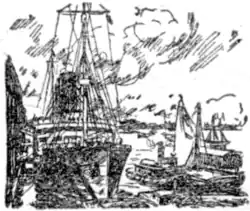 His nostrils dilated as he sniffed the odor of dusty planks and warm sea water, of oil and wine and fish. Here was the jumping-off point. If he were going with Hearn, he would see the muddy waters of the great Yang-tse within three weeks—see the blue hills of Ichang, and the red clay that marked the threshold of Central Asia. He knew just what men he would take with the caravan; they would be glad to see him, and Rand, at Lanchow, would have all the latest newspapers.
With a sigh, Warner turned on his heel. Professor Rand was in San Francisco, like himself. Here, at least, was one man who had time to spare. He would go directly to the professor's house, and take him out to dinner.
So the collector pushed through the increasing throng that flowed down the hilly streets to the ferry. Catching a cable car he started up California Street toward the residential section, staring out at the tomblike structures that towered over the rushing people of the street.
The city had changed.
Without trouble he found the Rand house. An old Chinese appeared at the door in answer to his ring.
“Is Professor Rand at home?”
The servant shook his head.
“When will he be in?”
This seemed to give the Chinese food for thought. His patient, wrinkled face puckered. “Long time,” he ejaculated. “Solly. Him stop China-way long time.”
Impatiently, Warner shifted to colloquial Chinese, and the aged guardian of the gate showed his appreciation by a respectful bow, when the white man made himself known as Professor Rand's friend. Mr. Two—as the servant named himself—explained that his master had changed his plans, although he had resigned his post as head of the Lanchow college, and had not left China as yet. “T'a pu lai—he comes not,” Mr. Two concluded patiently.
Warner was more than a little puzzled. Rand had said definitely, six months ago, that he would meet him in San Francisco. Moreover, Mr. Two revealed a courtesy and intelligence not often seen in a Chinese servant in the States,
“Very well,” Warner said regretfully.
Mr. Two bowed and clasped his hands by way of acknowledgment. As soon as the visitor had gone, he locked the front door from the outside, and padded out quietly into the street. Without looking around, he started downhill, toward the Chinese quarter.
It was nearly dark by then, and Warner faced another restaurant dinner alone. His way led also to the downtown streets and he allowed Mr. Two to serve as a guide. The Chinese plodded on, immersed in his own thoughts.
An evening breeze from off the sea chilled the air and fog thickened the dusk. Street lights glowed. Warner found it necessary to hasten a little to keep the bent form of Mr. Two in sight. Few people were stirring on the California street at that hour.
A church spire loomed up out of the mist, and under this Mr. Two paused. Warner stopped, because behind him he heard an unfamiliar, pattering sound. It drew nearer, and the collector smiled, seeing a large dog, nose to the pavement, running past him, its claws scraping on the pavement. In the shadow of the church something moved.
“What in thunder?”
Warner's exclamation was provoked by the sight of Mr. Two fleeing down the side street, past the mission. The arms of the old Chinese were flung over his head, and a slipper dropped from one foot. All at once he cried out—a long, shrill intonation of fear.
Hearing this, the collector began to run after him, glancing from side to side to make out what had frightened the servant. With surprising agility Mr. Two darted into a side alley. The dog, as animals will, trotted after the fleeing man. Mr. Two—seemingly blind for the moment—tripped over a raised grating in the sidewalk.
He fell headlong against a flight of stone steps, under the solitary light of the alley. Warner heard the impact of his skull against the stone, and knew by the limpness of his thin body that he was badly hurt. The dog passed on, but another man emerged from across the alley, and stooped over the prostrate servant.
Warner, coming up, saw the other thrust a hand into the breast of Mr. Two's tunic. Then the newcomer turned and saw the white man standing over him. Dropping his chin on his chest, he sidled away, moving like a huge crab, and disappeared down the alley. For an instant Warner glimpsed a broad, pock-marked face, a loose-lipped mouth set with long, pointed teeth. Then the second Chinese was gone.
Kneeling beside Mr. Two, he found that the servant was conscious. But his eyes were lusterless and his skin pallid. Blood trickled down into his mouth. As the white man, suspecting a fracture of the skull, started to feel his head, Mr. Two reached into his girdle, panting with agony as he moved,
“Me finish,” he muttered. Peering up, he recognized Warner. “Will you take this object to my son?” The words came clearly in Chinese, as if expelled by an effort of will. Having said them, Mr. Two's lips ceased to move. His fingers thrust into the white man's hand something round and hard. Glancing down, Warner saw that he held what appeared to be a medal of iron or bronze.
“Why, yes—certainly,” he responded mechanically. The black beads that were the eyes of Mr. Two continued to fasten upon him steadily.
Briefly Robert Warner answered the questions of the patrolman, summoned to the spot. The officer wrote down the name and address of the injured Chinese, and the fact that it had been an accident. An ambulance arrived, and a man in white knelt by Mr. Two for a moment.
The skull was fractured, the heart very weak; death would come at any time. The young surgeon explained that the shock had proved too much for the aged Oriental. They could operate, yes—would take Mr. Two to the hospital—but the man could never survive it.
 “He doesn't want to go to the hospital,” remarked Warner, observing a sudden hostility in the black eyes. Mr. Two, like all of his race, dreaded going under the knife. “Better take him back to the house. The other servants can look after him, and get in a doctor. His son may be there.”
Mr. Two's eyes closed in unmistakable satisfaction.
“Who are you, anyway?” asked the officer.
“Friend of Professor Rand. Knew him for years in China.”
“Name? Address? Occupation?”
The notebook was closed. The ambulance surgeon and his helper lifted the limp body upon a stretcher; the collector summoned a taxi and went to his hotel for a valise and overnight change of clothing. It occurred to him that Mr. Two might have been alone in the Rand house and if so he would—because he had assumed responsibility for the Chinese—need to spend the night there. Several letters were waiting for him at the desk, and these he thrust into a coat pocket, beside the metal plaque given him by Mr. Two.
He found the ambulance parked in front of the Rand residence, and went in. The surgeon had placed Mr. Two on a couch in the library, and was lighting a cigarette in the hall. “Let ourselves in with the key we found in his pocket. Other servants must be out. Don't try to move him. He's still alive, but an hour's his limit, Want me to notify a physician—one lives around the corner?”
“Thanks, yes.”
The man in white waved his hand, pleased that the hospital had not been called upon to perform a useless operation, and ran down the steps, humming under his breath. Warner closed the door, glanced at the dying Chinese, and switched on additional lights. After giving Mr. Two a drink, he made the rounds of the house, to discover that only one bedroom in the basement bore signs of occupation—a neat cot, a cheap image of Buddha, with incense stand on a shelf, and some clothing hanging on the door.
The wants of Mr. Two had been few. And he had been the sole caretaker of the Rand residence. The covers were over all the furniture—had been there, apparently, since the professor's last visit to his home. Warner left his suitcase in an upper bedroom and returned to his patient.
The black eyes of Mr. Two were open again. Warner remembered the thing that was to be given to the son of the Chinese. Taking out the metal disc he surveyed it, with increasing interest.
It was a bronze disc, circular, and clearly of ancient workmanship. On one side the medal bore a dragon of conventional design and around this an arrangement of eight miniature diagrams. These last, resembling the hours on the face of a watch, were formed in every case of three lines, some unbroken, others broken.
“I wonder just how,” Warner muttered, “you come to have the eight kua in your possession?”
Like the seal of Solomon or the Talisman of Saturn, of the Hebrews, the Pa-Kua, or eight trigrams of the Chinese, stood for something unknown to western minds. The eight kua had always existed.

The original meaning of the symbols is no longer known. Age has given to the eight kua an occult significance; they are a formula, a talisman, if you will.
Mr. Two must have had distinguished ancestors. The bronze was the kind of thing handed down by fathers to sons, and only the superior classes owned any; but Mr. Two was undoubtedly Professor Rand's servant.
“Your son, where is he?” Warner asked, bending over the stolid, wrinkled face. “How can I find him?”
The Chinese understood, but could not answer; nor could his hand grasp a pen. His lips twitched, and he lifted his hand. Warner returned to the scrutiny of the medal. The characters on the back were hopelessly obscured; the dragon was notable for its fine craftmanship, and might signify that the bronze was a gift from one of the rulers of China.
The bronze was solid; there was no other mark on its surface, nothing to give a clue to the name or the whereabouts of Mr. Two's son.
Perceiving a tensing of the muscles of the dying man, Warner glanced at him. The thin, quivering finger still pointed out across the bed. Of a sudden he was aware that Mr. Two wanted him to notice something. With his eyes he followed the direction of the pointing finger. It indicated bookshelves against the opposite wall.
“This shelf?” The white man laid his hand on the lowest tier.
Mr. Two remained as before.
“This, then? The third? Ah!” The old Chinese forced his head to move slightly, notwithstanding the agony it caused him. Warner ran his eye over the volumes on the shelf—old, leather backed books, journals of travelers, and the seventeenth century geographies.
 Repeating the process of touching one volume after another, he came to one that satisfied his patient. Bringing it to the table, he read the title—Astley's Collection of Voyages, Vol. IV. And the date, 1747.
Quickly he skimmed over the page headings—Voyages and Travels in the Empire of China—Western Tartary. “What in all creation does the old chap want of this?” he wondered.
Then he laid the book on the table beside the bronze. The bell at the front door rang, loud in the silent house. The doctor, Warner thought, as he went to answer it, had come too late to do anything but make out the death certificate. Mr. Two had died.
Opening the street door, he peered out into the mist. “Come in!”
Into the hall walked Clifford Hearn and Count Camprubi. A woman was with them.
“Heard you were here,” Hearn explained. “So we dropped in for a last palaver. After you left I thought things over a bit. I'm pretty sure you don't want to back out. Hold on, you don't know the Countess.”
“Mrs. Camprubi,” corrected the Italian. “You will pardon our intrusion? Our boat leaves the day after tomorrow, and we were anxious to see you.”
Warner glanced in some surprise at the woman, who extended her hand with a smile. She had splendid teeth, and her olive skin was flawless. A natural grace, an alertness marked her movements. Over a close-fitting semi-formal black dress she wore a brown camel coat, as if it had been caught up from a motor car.
“I am so please' to meet the frien' of Cliff,” she said in broken English, a little huskily. “Thees fog is so moch annoying, is he not?”
Warner had meant to ask how Hearn had known that he was at the Rand house, but, remembering Mr. Two, he requested the men quickly not to go into the library. The only lights burning on the lower floor, however, were in that room, and Hearn was already on the threshold.
“Why not?” he responded carelessly. “What the devil”
Before the Countess could enter, Warner, hurried forward, annoyed, and placed a blanket over the face and body of the Chinese. “Rand's servant,” he explained briefly, “dead in an accident. Sorry I can't be more hospitable, Hearn. You know this isn't my house. Come into the drawing-room and talk, if you wish.”
But the promoter and Camprubi were staring curiously at the table, at the bronze disc. The woman glanced at them fleetingly and turned to Warner with a slight shiver. “Thees fog, so many things 'appen in him. I do not mind. He is a Chinese, eh? I do so love the Orientals. Tell me, was he killed by the tongs?”
“Fell against a flight of steps.”
“Ah,” Camprubi picked up the disc of the eight kua and held it under the reading lamp. “A perfect example, of the trigrams. This is Mr. Rand's, of course.”
“No,” said the collector shortly. The staring and questioning seemed to him out of place in the presence of the dead; even though Mr. Two were a yellow man. A faint odor of cordials and cigarettes hung around the Italians.
“Yours?” asked Hearn.
“In a way, yes.”
“Want to sell it? Ray, here, sets big store by such things.” Hearn took the medal from the Italian, who appeared reluctant to give it up. He turned it over, tapped it, and stared intently at the trigrams, changing the position of the disc in his hand constantly.
“No, I don't.”
Hearn frowned. “You wouldn't draw much of a prize for company manners, Bob. Guess you've forgotten the dinners I staked you to when you were living on books, mostly, at college.” Seeing the collector flush, he tried to cover up his lapse. Hearn, in his youth, had been one of those who believe that restaurant spreads and invitations to ride in his car were the desideratum of friendship. “Look here, Bob, why don't you pick up and make the trip with us? I can promise you one thing. These jewels are there, in the Singan-mu place, and I'm going to get them.”
Still, he turned around in his powerful fingers the bit of bronze as if it were a combination he would like to set aright.
“Thanks,” said Warner thoughtfully. “I've decided not to go with you.”
Hearn looked at the Italian moodily. Camprubi, expressionless as ever, shook his head slightly. “May I ask, Mr. Warner, how you are acquainted with Professor Rand?”
“Some years ago,” explained the collector, “I came down sick about a week's trek out in the Gobi during a famine when the tribesmen were particularly unruly. Rand heard of my fix from one of his native servants and came out, alone. He nursed me through the fever. Took a good ten days to do it, and I only learned afterward that he was on starvation rations the while—no food to be had, except what he brought, and he would not leave me. After we got back he was laid up in the Lanchow hospital. He wasn't strong enough for a thing like that. I owe him my life, of course.”
He held out his hand for the bronze. But Hearn's fingers closed about it. “Give you a hundred for this, Bob?”
“No!” Warner stepped forward. “It belonged to this servant, and I promised to pass it on to his son, whoever he may be. Anyway, I can't sell it.”
Once more the mask of good fellowship fell from the heavy countenance of Hearn, and his jaw set. But, swiftly, the woman stepped between them and took it from him.
“Why,” she cried, “it is what you call a charm! I have so many given me by Raimundo—Egyptian, and Arabic. It would make a so splendid pendant.” She held it admiringly against a pearl necklace around her throat. “You will be charitable, Mr. Warner? You will let me keep it and then you can choose another from those of mine, eh?”
By way of answer Warner held out his hand for the bronze. The Countess studied it, pursing her lips reflectively. Then, with a smile, she placed it in a pocket of her coat.
Glancing down at the Italian, Warner saw that the slender man was poised on the edge of his chair, an unlighted cigarette in his hand, as if he were watching a clever bit of repertoire on the stage.
It was not clever enough to interest the collector. These three wanted the eight kua, for some reason, and wanted it very much. That they were so casual in attempting to gain it showed that they must have a poor opinion of him. He spoke to Camprubi.
“In court, my dear Count, three witnesses can overrule the testimony of one, as you are doubtless aware. But still, in this country, a charge of theft means a jury trial. Perhaps three months, perhaps twenty. You would not want to miss your boat.”
 Campbell lighted his cigarette and answered, indifferently.
“My dear fellow, you should know the jealousy of collectors. Frankly, I covet the eight kua, and you have no interest in it. Almost, I should be willing to pardon my wife if she should be so unkind as to carry off the bronze in her coat.”
Hearn broke into hearty laughter. “What a show you guys are staging! Bob, you can't deny a pretty woman what she wants. Besides, she'll make good her promise to let you choose your recompense.”
“Consider, Mr. Warner,” elaborated the Italian, “that my wife does not accompany us to the Orient. Your charge would necessarily be laid against her. What a spectacle you would make, in court, accusing a charming young woman of robbing you of a servant's trinket that did not belong to you.”
Anger seized upon Robert Warner. The metal disc was worthless to him, he had no notion of why it was valuable to the others, but he meant it to go to the son of Mr. Two, if possible.
“Right!” he said calmly. “I'll be the spectacle, and you two will be accessories to the theft. You'll be summoned as witnesses, and that means you'll stay within the borders of the United States until the trial is over.”
Camprubi drew in his breath sharply, and Hearn swore softly. The Countess alone seemed pleased with the situation. In the silence, Warner heard distinctly a light tap within the room, as of steel striking against glass. The woman's eyes traveled behind him, and she smiled.
“I am sorry,” she observed pleasantly, “that you are angry. Please take the thing. I am afraid you look at matters too seriously, Mr. Warner.”
With that she laid the eight kua on the table and drew her coat about her. Hearn remarked that it was late; they had stayed too long. Camprubi tapped the collector lightly on the shoulder. “A word to the wise, Mr. Warner. You have a stubborn streak; you do not take advice well—such as the friendly prompting of our Cliff. So, I add my humble word. Do not meddle; that is foolish.”
Warner picked up the bronze disc, put it in the side pocket of his coat and led the way to the front door, through the dark hall. Without answering he opened the door and watched his three visitors go down the steps into the fog. The blurred lights of a motor showed in front of the house. A gust of cold air swept the entrance, and Warner, in the act of closing the door, paused, his faculties alert. He had heard nothing unusual, but in the hall he had sensed a new odor, something stale and warm—something that reminded him of the presence of animals.
He wondered if a dog were quartered in the Rand residence. He had found no trace of one, but the smell in the hall
His right wrist was caught by chilled fingers and bent up sharply. In the utter darkness he could make out nothing. Starting back he tried to wrench free. No weakling, the collector knew that the fingers of the unseen assailant were immensely powerful.
As if he had been a child, he was whirled off his feet and flung to the floor behind the door. Feet padded away from him. He sprang up, glancing toward the yellow glow that came from the library, shooting into the fog veils that had drifted in from the street.
A shadow passed across the library entrance, and Warner, gathering himself together, raced down the hall and into the lighted room. It was empty, a hasty glance assured him of that. His nerves tingled as he glanced at the blanketed form on the couch. Mr. Two was there—or was he?
Warner was not easily startled, and it was said of him that he had no nerves. Perhaps this was because he had spent the best years of his life outside the beaten track; he had faced opposition in lands where few of his kind strayed, and he had matched his wits against formidable powers—forces that emanated from evil minds of great intensity. Such forces were hardly understood in his own country, where even crime runs in accepted channels, and the criminal is usually more frightened than the man he attacks—where the stimulus of drugs is called upon to nerve the housebreaker or the safe blower to his task.
But, as he drew back the blanket from the form on the couch, Warner's nerves were alive with an impulse of fear. Impalpable voices were calling to him to take heed, to protect himself.
The lined face of the Chinese revealed itself, as before, lifeless and tranquil. Ne doubt that Mr. Two was dead, and so had not moved
Out of the corner of his eye Warner saw one of the window curtains sway toward him. Half of one of the long, French windows was open, and in the opening a face, outlined against the fog that pressed in around it.
It was the face of the Chinese who had bent over Mr. Two in the alley some hours ago. No mistaking the bald forehead, scarred by pock marks, or the pointed teeth. The left hand of the man was raised over his shoulder, and Warner swayed his body sharply to one side, drawing back against the wall without wasting time in shifting his feet.
The raised hand of the intruder held a thin knife by the tip, and the slanting eyes glinted with an evil relish.
As the white man moved, the knife flashed toward him. The point thudded into his coat, under his left arm, pinning him to the wall. If he had not shifted his body it would have struck under his heart. The attack was unprovoked, reasonless.
The yellow face withdrew into the fog as the white man, jerking loose the knife, went to the window. No use in going further; the rear porch of the old house, the back yard—everything was veiled in the mist,
“Now why?” Warner murmured. “Why was that done?”
Inspecting the side of the window frame he noticed an abrasion of the wood where the slender blade of the knife had slipped through the crack to raise the simple latch. Yellow Fangs, as he mentally christened the powerful Chinese, must have been standing on the back porch, looking in at the white men. When they had left the library he had entered, followed Warner into the hall—for what reason?
“I wonder?” He slipped a hand into his coat pocket. The bronze disc was gone. He remembered that Yellow Fangs had been searching Mr. Two's clothing in the alley when Warner disturbed him. Many people seemed to desire the replica of the eight kua. Yet the thing itself was not of great value. As a curio, possibly, but intrinsically the bronze was worth no more than a few dollars.
He shook his head thoughtfully, No reason to associate Hearn and Camprubi with a brute type like Yellow Fangs. More likely, the Chinese had seen the white men quarrel over the medal and had coveted it, believing it valuable—as a monkey snatches at anything bright in another's hand.
 Looking down, the collector saw he held in his hand the letters brought from the hotel, that he had removed from his coat in searching for the lost disc. Until now he had had no time to read them. Two, advertisements of real estate firms, he tossed into the waste-basket. A third, bearing a Chinese postmark, he»opened with the knife. It was in a woman's hand, one that he could not place.
Warner read it through slowly, then seated himself at the table and for a half-hour pored over it, weighing each word. When he had done he sat staring moodily in front of him, seeing nothing,
The letter was from Margaret Rand, the daughter of Professor Rand. It had been sent from the mission college at Lanchow. She had written, the letter explained, because Robert Warner was her father's intimate friend and because she knew that he would be expecting Professor Rand to join him in San Francisco.
Warner had not seen Margaret for several years, as she had been living for that time in San Francisco while she finished her course in the University of California. Rand had come to the States every other year to be with her. Warner knew that it was for the girl's sake that the professor had resigned his post in Lanchow, to come to San Francisco.
He remembered her as a shy child, devoted to her father, a little spoiled perhaps. She had been born in China, and the servants of the household were her slaves. She used to ride a shaggy Mongol pony in the hills, her long hair flying over her shoulders, and a troop of pet dogs after her. Rand, in their conferences, had admitted that Margaret was a wild little thing, domineering over the servants, stubborn in her ways; and that she had not relished college. He had wanted to give her the social advantages of life in San Francisco
And now, Margaret wrote, her father was dead.
Professor Rand had been engaged in research work beyond the edge of the Gobi, north of Lanchow. He had made camp there with one of his native helpers. One night, the camp had been attacked by wolves or one of the formidable bands of wild dogs that roamed the uninhabited wastes of the Gobi. The men had been asleep in their blankets on the ground, and when the native boys had gained their feet and their rifles and beaten off the savage invaders it was found that Rand had been fatally injured.
So Margaret wrote, adding that she intended to remain where she was, until the work of excavation that Professor Rand had been engaged upon at Singan-mu was completed.
Chapter III
The Voice of the Past
FROM the neighborhood physician who called in late that night, having been out of town when the ambulance surgeon notified his home, Robert Warner learned two things. One was the name and address of a firm of lawyers who managed Rand's affairs in San Francisco; the other was the fact that Mr. Two had died of heart failure, caused either by the shock of the fall or by severe fright.
“Oh, either,” the yawning practitioner “had answered. “Shock or fright—it comes to pretty much the same thing. Take an automobile accident, for example. You hear constantly that So-and-so suffered from bruises and shock. The injured man may only have a few skin abrasions, but the mental ordeal of facing death or mutilation has raised havoc with his cardiac system and brain cells. Quarts of blood have been drained from his brain and forced at high pressure through the heart. He suffers from it. Why”
Warner had smiled, thinking of the knife of Yellow Fangs. “I see your point. Taking an opposite instance, a drunken man can roll out of a second story window, fall a dozen feet or so, and think nothing of it, after the hootch is out of his system.”
“Yes. His nerves are normal, because his imagination has not been aroused. Preconceived—or, you might say hereditary—fears play havoc with the high-strung mentality of our modern human beings. I had a case once—a lady half-drowned herself by jumping in the Oakland estuary because a cur dog came nosing around her. The patient's sister had died from the bite of a mad dog, twenty years ago.”
After the physician's car had purred away into the fog, Warner had returned to his table and reading light, to reason out the letter of Margaret Rand.
Professor Arthur Rand had been excavating at Singan-mu, when he died. The archeologist, of course, had known the legend of Chong-Wang's hunting pavilion—had related it to Warner.
But, a year or so ago, Rand had not been aware of the situation of the hunting pavilion of Singan-mu. Evidently, he had hit upon a clue to it since his last trip to the States. How? If Mr. Two could talk—
Mr. Two had pointed out the book on the table. Within its covers there must be something he wished the white man to read. Sleep, during the remainder of the night, was out of the question, and Warner, lighting his pipe, took up the bulky tome.
A few minutes' scrutiny convinced him that there was no marker in it, nor had Rand penciled any of the pages. Patiently, he began at the first page of the Travels, and glanced down the fading print. He had the knack of old newspaper men—could grasp the contents of a page by running his eye down it.
Several hours later he set his pipe aside and sat up alertly. Near the end of the volume he had come to “Travels in Western Tartary by order of the Emperor of China, between the years 1688 and 1698—by John Francis Gerbillon, Jefuit.”
“The Emperor intended by this Progress to avoid the excessive Heats at Peking during the Dog Days; for in this part of Tartary there blows a cold Wind during July and August”
Warner read on with keen interest, until he uttered an exclamation of surprise.
“July 1, being the fourth moon of the Chinefe calendar, the Jefuit, Father Gerbillon set out with the Imperial retinue, to go beyond the Weftern border. A little after we paffed the Great Wall, which is here of baked clay, yet has the Wind driven upon it the Sand from the defert, so that the horfes eafily encompas'd its paffage...This, Faher Gerbillon learn'd, is the South-weftern. end of the Great Wall. ... ... ... ... ......
“From the Wall we journey'd due Weft for three days over a plain, very bare and sandy, The firft day we progreffed 60 li, the second 70 and the third 55 to a ring of mountains about 300 geometrical paces high, all of black rock.
“Rather than crofs-over these black hills, the Emperor went around, although the country was treelefs and swept by high Winds and we lacked of Water.
“Father Gerbillon was told by a Mandarin that the ring of mountains was an ill-omened place. In the center of the ring are ruins called Singan-mu, which is to say Castle of the West, where a former Emperor died, leaving a Treasure very fair and great in some place under the mark of Earth.
“The Mandarin related that thefe black hills are accurfed by reafon of a T'au Wu, which signifies Untamable.
“That Evening we had a Storm with Hail and Thunder, which vastly frighten'd the Travellers. The Court Aftrologers proclaim'd that this Storm was caufed by the evil T'au Wu, and the next day we marched in hafte go li to an oasis”
After copying down this portion of the journal of the priest, Robert Warner returned the heavy volume to its place on the shelf. The message of the missionary was clear enough—a little uncanny, it was, this voice coming out of the past. He wondered how Mr. Two had known of the book. But of course, Professor Rand, after discovering the portion relating to Singan-mu, would have questioned Mr. Two, who was above the average intelligence. Doubtless they had discussed it
What was the Untamable? It might be anything; probably one of the myriad Oriental superstitions connected with places where men had died.
So Professor Rand was the archeologist who had hit upon the ruins of Singan-mu! Camprubi had seen fit to conceal this fact. Warner suspected that the Italian had been told about the narrative of Father Gerbillon by Rand, who was honesty itself, and as confiding as a child. The seeker after knowledge would not now stand in the way of the seeker after wealth.
 But there was Margaret, alone in a city at the edge of the Gobi, not far from the southern point of the great wall. She would remain there until the excavation at Singan-mu, begun by her father, was ended.
She had no business out there—a scatter-brained girl of nineteen. The young flappers of today were always running wild, getting into trouble. She ought to be here in San Francisco. Doing what?
Warner smiled ruefully, visioning the slip of a girl, on her shaggy pony, racing across the edge of the desert. After all, he had no authority over her, and—he had planned to forget everything West of the Golden Gate.
Determined to think no more of Singan-mu or Margaret, he went upstairs, made a bed and was soon sound asleep.
In the morning he found that he was still thinking of Rand's girl. He walked to the business district and sent a cable to Lanchow, advising Margaret Rand to return to San Francisco, and prepaying a reply.
After seeing that Mr. Two's body was turned over to a Chinese fraternal society, and that Rand's attorneys had the keys to the house, now closed up, he retired to his hotel. Two days passed restlessly and he found he had no inclination to look at real estate, fruit ranches or bungalows.
By inquiring at Hearn's hotel, he learned that the promoter and the Italian had taken the steamer bound for Shanghai by way of Japan. Also that there had been many inquiries about the foreigner. He had, it seemed, been one of the principals in an oil swindle, and now faced suit for using the Government mails for fraudulent purposes.
Warner heard rumors, too, that Hearn had been interested in the oil leases sponsored by Camprubi. Those leases must have lost him a good bit of money. Talk in the restaurants around the San Francisco Stock Exchange confirmed the fact that Hearn's fortune was balancing precariously, and that for the second time Government agents were trying to lay hands on him. He had pyramided land profits into oil stocks and, in the vernacular, was “hung up.” That is, unless he could produce several hundred thousands in cash his stocks would be sold.
Clifford Hearn needed money badly.
That afternoon came a reply to his cable.
Have promised friends to finish important work mentioned in letter. Can not leave. Best wishes.
Margaret Rand.
Upon receiving this, Warner swore effectively and whole-heartedly for a quarter of an hour. It was like the girl—stubborn! If she had made a promise she would keep it. Most likely, her friends were natives, or she would have named them. He did not relish it at all.
Then the Countess called him up. Would he come to her hotel? She was so worried. She did not know anything about her husband's affairs, but people, the police, were constantly questioning her, and she had so few friends.
Warner decided to call on her. He did not think she was Camprubi's wife, but merely one of the trio of adventurers. Nevertheless, the woman was pleasing to the eye and her distress had not prevented her from achieving a careful toilette. Her accent made conversation delightful.
She was thinking of leaving San Francisco. The fogs were bad for voice, and now that Raimundo had abandoned her so heartlessly, she would need to eke out a living by her singing. Yes—she flushed at the confession—she had to go on the stage, now and then. Times were hard, very hard for the old families of Europe; but America was so, so hospitable.
She turned dark, inquiring eyes on Warner.
“I'd advise Chicago or New York, in that case,” suggested the collector reflectively. “San Francisco is unhealthy for some people.”
The Countess assented. That was what she had in mind. But she knew so very little about ter-rains. From where did they go? How did one secure a compartment?
Warner thought this over for a while and then announced that he would see that her trunks were cared for and that she got on the right train—would accompany her to the station, because he was leaving the city himself. She was pleased, decided to go on the morrow.
“You will accept a little gift, for the journey, Countess?” he answered. “One of the curios that you are pleased to gather?”
“Not the Chinese disc?” Her” eyes flew up to his, startled.
Warner handed her the thin-bladed knife with the ivory handle that had been thrown at him by the visitor of several nights ago. The effect upon the woman was a little surprising. Her fingers curled inward, went to her supple throat with a gesture of instinctive dread that was not acting.
“The dagger of that savage! What you do with it? Where do you get it?”
“What savage?”
Her eyes lost their stare, became thoughtful, unreadable. “Ah, you pardon my very bad Englees, yes? Raimundo 'as so man enemies. They 'unt for and him, and that is”—she hesitated—“the Chinese stiletto, a throwing knife. It frightened me.” Appeal crept beck into her voice. “I am so lonely.”
“Still,” suggested Warner, “it might serve as a memento.”
The next evening he ushered her to the Los Angeles train, bound for the East. When he had sorted the numerous boxes, hand-bags and coats into her compartment, the bell began to clang, and the porters entered the vestibules. Warner had along only a large bag, containing a change of clothing and some books.
“I have not quite decided where I'm going,” he confessed. “When in doubt I resort to the toss of a coin, my lucky piece.”
The Countess glanced at him questioningly. “You spoke as if”
“Here goes. Tails Los Angeles, heads Canada.” He flipped the coin and showed it to her. It was a Chinese tael, of old-fashioned coinage, and clearly the side uppermost bore the stamp of the Government. “Heads wins.” He caught up his bag. “Luck to you, Countess!”
She mustered a rueful smile as he darted out of the car before the porter closed the vestibule. He did not again set eyes on the Countess.
 As the train pulled out he turned over the lucky piece with a grin. Both sides were alike. Pocketing it, he made his way to the ferry, to catch the evening train north. He stopped long enough to send a second cable.
Taking the C. P. boat, Vancouver, arriving Lanchow early in six weeks. Want to look over your friends.
Robert Warner.
The cable was addressed to Margaret Rand.
Although Warner's steamer left port a full week after the boat bearing Hearn and his party, it made a faster run across the Pacific and docked in the northern port shortly after the other vessel was due in Shanghai. He wasted little time in Peking, but took the southern express as far as Honan.
Here it was necessary to hire a cart, horses and servants for the overland trek—five hundred miles due west to the wall and Lanchow. Experienced in the vicissitudes of travel in China, the collector made rapid progress. Which means that he negotiated slowly for his boys and the cart, drew up a signed contract, and rejected four of the first five riding ponies offered him at extortionate prices. Having convinced the natives that he did not mean to hurry, could not be cheated, and knew where he was going, he was ready to start a week sooner than any novice in the interior of China.
Two things caused him some uneasiness. He heard at Honan that a strong party of bandits, under unscrupulous leaders, had held up the crack Peking-Shanghai express and carried off a number of Americans and Europeans, holding their captives for ransom in the hills. During the fighting several of the “foreign devils” had been killed. This meant that the bandits of the interior would grow bolder.
The Government at Peking had practically no control over the roving bands of former soldiers, and the factions of the rebel chieftains. Lanchow was hardly a safe residence for an American girl, unattended.
Again, as he was following his mule cart out of Honan under the ancient arch that spanned the road along the Hwang-ho, he passed a cavalcade of riders entering the city, and noticed that the leader pulled up his pony to gaze at the American. This was natural enough. Warner, accustomed to take note of passers-by, observed that the head man was powerful in build, with a broad, pock-marked face. The smallpox scars around the eyes held his attention.
He could not be certain, but he fancied that this man resembled the creature of the fog who had tried to kill him in San Francisco—Yellow Fangs, he thought of him. It was difficult to believe that the man of San Francisco could be in Honan. For half a moment he contemplated halting and accusing the other of stealing the bronze disc. Then, with a shrug, he passed on, following the unmelodious tunk-tank of the bell on the mule cart.
Granting that the rider was the thief, he knew the uselessness of bringing a charge against the Chinese without evidence. Moreover, the man in the black hat seemed to be in a position of some authority. Warner did not care to be delayed.
Glancing back he caught the eyes of the Chinese Moslem fixed on him with evil satisfaction.
Chapter IV
At the Rand Compound
ALTHOUGH the American was eager to make good time, obstacles seemed to multiply in his path. One of the cart mules died; the axle of the cart came apart; his tinned food was stolen supplies; guides were never to be found when wanted.
Gradually he worked forward, into a world unchanged since the middle ages—a world of primitive inns, shrines on the mountainsides, of half-naked peasants digging patiently in the fields with the tools of Biblical times. San Francisco, with its hotels and echoing streets slipped away into the limbo of dreams. Warner jogged interminably after the tunk-tank of the cart bell, alert for any sign of aggression on the part of bandits.
He saw nothing suspicious, but was perfectly well aware that his progress was being retarded by some powerful influence. His servants announced that they would go no farther from their home, and he paid them off, hiring inferior coolies at a mountain village.
The new boys, from head-boy to cook, wilfully misunderstood his orders, prepared uneatable meals, quarreled among themselves, until Warner dismissed them, put his remaining supplies on a pack animal and pressed on with a native picked up from an inn.
His last man-of-all-work bore the harmonious name of Sing Low, and moved in an everlasting silence, tinted rosily with forbidden opium. He was proud in the possession of rusted metal spectacles from which the glass had been broken long since. Notwithstanding, his sight was keen, although Sing Low's emaciated limbs and creased, leather-like countenance bespoke untold years. He was a hunter who had drifted in from the western plain, and a long Russian rifle of the Crimean War era formed the sum of his worldly goods. It never left his hand.
Warner discovered that Sing Low could bring down game for the evening meal, and what was more to the point, cook it tastefully. Also the hunter never tired, and they were able to make thirty miles a day. Silence and red clay dust held them in a never ending pall.
Once Sing Low expressed an opinion upon the bearers who had been discharged. He shook his head contemptuously, spat toward the east, and scanned the white man sadly from wrinkled, hairless eyelids,
“Plenty tlouble belong you,” he croaked. “My word!”
Warner was fast becoming convinced that plenty of trouble was in store for him. It was in no particularly pleasant frame of mind that he made his way into the narrow streets of Lanchow.
Lanchow, he reflected, was unchanged since the day of the priest, Father Gerbillon. To avoid the piles of refuse and the packs of snarling, misshapen dogs, he turned his horse toward the main thoroughfare. Sing Low cleared a way methodically through the snapping curs with the butt of his long rifle. He cracked upon the skull of a creature with the head of a bulldog, the body of a grayhound. Warner glimpsed a small monster with the muzzle and pointed ears of a wolf and the dwarf trunk of a spaniel. The dogs of China!
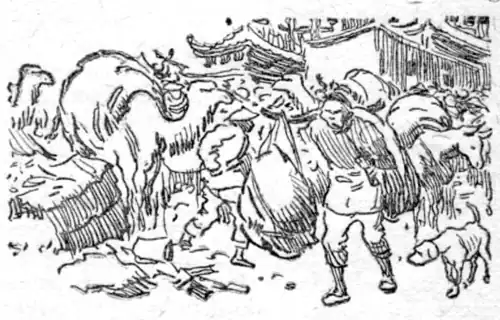
Out in the central street they pressed into a mass of stolid camels, and sweating donkeys, of cursing men and howling, filthy children. A caravan was setting out into the Gobi. Their ponies moved with difficulty in the trampled mud, shying at the camels. Overhead the sky hardly showed, for the ramshackle wooden houses nearly met over the street. From littered windows stained and evil faces peered down at the “foreign devil,” and the clucking of human tongues, the grunting of animals, was a veritable bedlam.
Warner wondered whether the caravan he passed was bound for Russia, Turkestan or India. His pony became jammed in between the beasts of the camel men and, perforce, he halted.
“Eh, you stop! I saying you stop!”
Turning in the saddle, he beheld a ragged soldier shoving through the crowd toward him, followed by half a squad of riflemen dressed like the army of Falstaff, yet armed, he noticed, with serviceable carbines.
“Have got passpo't?” demanded the English-speaking non-com, who, was distinguished by a badge on his shoulder. “You showing me passpo't plentee quick!”
His tone was surly, and he elbowed aside the staring camel men viciously. He had the broad face and round, black velvet cap of a Chinese Moslem. Warner suspected that this was a patrol of some kind that had missed meeting him at the city wall. Now, he had no passport. The provisional Government at Peking had been too disorganized to supply such a thing, and would have refused to allow him to proceed if he had applied. But, foreseeing such a contingency, the American had in his pocket an elaborately written menu, a souvenir of a dinner, years ago, with one of the greatest diplomats of the old regime, in Peking.
The official crest, and the flourishing characters that set forth the list of delicacies, with the signature of the guests below, did somewhat resemble the all-important passport. At least to a low-class Chinese who could not read. Warner's guess was that the blue-clad soldier could not read.
The man took it and squinted thoughtfully. Over his shoulder, the American caught a glimpse of a tall mandarin standing composedly with folded arms. Then the
“No have got passpo't! Mei shuo shen mo—it does not say anything.” The sergeant spoke to one of his men, who began to undo the fastenings of the pack on the led horse. Another tried to take the reins of Warner's pony.
“You come stop along governor's yamen,” ordered the non-com with surly satisfaction. “You catch tlouble along passpo't.”
Suddenly the man in front of Warner struck the pony savagely over the head as it dodged back from his upraised hand. He used his rifle barrel and the injured animal reared. When its forefeet came down, Warner's Colt was pointed at the chest of the sergeant.
“I'll call on your governor,” he said slowly, “if you have one. Meanwhile, order your men away from my horses, pronto, and keep your distance. Understand—hands off?”
If he had allowed the soldiery to plunder the pack animal, he would have lost prestige at once. Worse, the mob might have seized the occasion to rush him. Tried by heat and weariness, his temper flared. Silence held the immediate vicinity of the American, while the slant eyes of the soldiers glittered and they fingered their weapons. A forty-five Colt usually ends an argument.
The mob, instead of giving ground, drew in closer, like animals, sensing a kill. Haggard, leprous faces peered up at Warner. Then the mandarin who had held himself in the background stepped forward.
He did not wear the usual red button, or official cap. In fact his simple outer robe was threadbare; but his height and splendid head stamped him as a mandarin before he spoke, in the soft inflection of a scholar.
“Ignorance is a misfortune,” he said in Chinese, “but lying is a misdeed.”
The sergeant, finger on trigger, lifted his lip in a snarl. Warner saw two or three of the rifle muzzles moving up toward him and realized that he was faced by men bolder than the usual run of provincial soldiery.
“How could you, who are of little worth, read the passport when you held it upside down?” said the mandarin again. “No governor sits in the yamen. Lanchow is in the hands of the rabble. By what authority do you accost a foreign gentleman?”
This time, hearing the chuckles of some members of the crowd, the soldier turned angrily. He handed the mandarin the official-appearing menu.
“Then do you read it, who are meddlesome, and say what it contains.”
Warner, who had followed the conversation, glanced at the mandarin curiously. The tall man in gray took the paper and read it through. Not a muscle moved in his olive countenance.
“It says,” he announced, “that this honorable person is to be permitted to go where he will in the Empire, and it is signed by the highest officials.”
The soldier glared, and looked around irresolutely, unwilling to release his captive. Warner glanced quizzically at the tall scholar, who folded the menu and handed it back to him impassively.
“Who is lying now? I don't know what game you're up to, old chap,” the American said to himself, “but the world lost a grand poker player in you.”
Just then came a diversion. A pony, driven fast, twisted its way through the throng. A girl's face, framed against the ugly heads of the camels, turned to Warner and a clear voice cried:
“Welcome to our city! Gracious, what a reception committee! Where's your outfit, Mr. Warner, and why in the world did you come?”
It was Margaret Rand. He had no chance to answer because one of the soldiers failed to get out of the way of the pony and was knocked down. To Warner it seemed as if the native deliberately allowed himself to be struck.
At all events he rolled clear of the dancing hoofs, none the worse for the impact; but one of his comrades shouted angrily at Margaret and reached for the horse's head. At once the girl struck down vigorously with her riding crop, and the soldier, obeying a muttered command from his leader, let the rifle fall and reached up with both arms.
By intent, or ill chance, his claw-like fingers closed around her throat as she tried to avoid his grasp. Warner's revolver roared. The soldier spun around and fell ten feet from where he had been standing.
He had been hit in the lower shoulder, and a bullet from a Colt's forty-five knocks a man down—no matter where he is hit. That was why the white man carried it.
Like an echo of his shot, the rifle of the patrol leader barked and flame seared Warner's cheek as a bullet whistled by the base of his skull. The Chinese had jerked the trigger too hastily, or he could not have missed at five yards. Even so, the faculties of the white man were numbed by the shock of the discharge.
He heard the click of a fresh cartridge forced into the chamber of the rifle, and swayed forward in his saddle. As he did so, there was a thudding report from behind him, and swirling smoke enveloped the American and his now frantic pony.
Warner, forcing his eyes to function, beheld a bluish spot that seemed to leap upon the forehead of the patrol leader, as the native's head jerked back. The mouth of the Chinese fell open and his body crumpled down slowly.
Sing Low had not been interested in the attack upon Margaret Rand, but as he understood his duties as handy man, it was right and expedient to shoot down the man who threatened the life of his master. And Sing Low never liked to waste a cartridge. Warner had deliberately avoided taking the life of the soldier who had grasped the American missy—Sing Low understood that, but the hunter did not hold to such foreign ethics—on the edge of the Gobi.
Now there were only two of the patrol on foot and armed. Chinese Mohammedans are more unruly than the orthodox Celestials. They are swayed by the influences sent out from Mecca, and by wandering mullahs. But they are cleverer. The two who remained erect saw Warner's Colt upraised alertly, as the head of the white man cleared, and they beheld the long rifle of Sing Low loaded again. They vanished into the crowd.
Warner reined his pony beside Margaret Rand and waited for the volley of stones, knives and abuse that he fully expected from the mob in the alley. But in front of the two Americans the tall mandarin now stood with lifted hand.
(illustration)
“Slaves of impulses,” he addressed the throng in tones that carried up to the housetops, “are you likewise fools—as these dog soldiers? The man who was killed was a bandit. If you lay hand on these barbarians, an electric letter will be sent to Peking and a devil soldier boat will come up the Hwang-ho, and the devil soldiers will carry off many of you to Peking, where those who are taken will be shortened at both ends.”
(By this the mandarin meant that if the crowd attacked the Americans, a telegram would bring a foreign gunboat up the river and the marines would seize prisoners, who might have their heads and feet cut off by the Chinese authorities in Peking.)
The restless throng listened, as mobs will listen when a leader speaks up, and presently indulged their feelings for the moment in making fun of the two soldiers on the ground. The mandarin made a sign to the girl.
“Come to the compound,” urged Margaret, her cheeks pallid in the gloom of the alley. “Oh, why did you do that?”
Warner was looking around for the tall man in gray who had disappeared in the crowd—wishing to thank him for his intervention.
“He'll turn up at the bungalow,” she explained, “of course.”
“Who is the chap?”
“Just Yuan Shi—Mr. Three. Now tell me, please, Mr. Warner, just why you came halfway 'round the earth to see my friends?”
The small compound that had housed Professor Arthur Rand for a quarter of a century was almost deserted. No servants were visible about the laundry shack or the kitchen. Margaret herself, assisted by a pretty, plump Chinese woman, prepared tea for her visitor while Warner cleansed himself of some of the red dust, and shifted to clean flannels. He had seen that the room used by Rand as a study was shut up.
The garden inside the wall of the compound showed traces of neglect, but the house was neat as ever. Accustomed to observe his surroundings minutely, Warner hazarded a guess that the bungalow had been kept up by the two women, without any men servants for some time. Only one horse, beside the two he had brought, stood in the stable shed—Margaret's pony, Rex, now grown stiff and notional with age.
Evidently the girl had very little money.
“I think, Miss Rand, it was on account of—a hunch. An idea, you know, that I might find work here.”
“Work?” Her brows went up. “But you have always been so busy. Father”—her under lip quivered just a little—“said that you had been employed by the State Department at Washington, to get information on the Shantung question and your collections were to go to the Metropolitan Museum.”
“Where they are now,” he nodded. “I've heard about the discovery of Singan-mu and wish to look at the ruins.”
Over the samovar she studied his dark face, with the high cheek bones and the deep-set gray eyes. It was so difficult to tell what Robert Warner was thinking.
“Why,” she asked suddenly, “did you lose your temper this afternoon in the bazaar quarter? Your servant killed one of the Moslems. Their bands have been drifting into Lanchow lately, and they may make a great deal of trouble for you.”
His lips tightened and his eyes lost the glint of humor. “I couldn't stand for it, Mar—Miss Rand. For that scoundrel laying his hands on you. Have they bothered you before?”
“In a way, yes. After dad left me, I dismissed some of the servants. Then the horses were stolen, but Rex—my pony chum, you know—found his way back again. Another time, while I was in town doing the marketing, thieves entered and ransacked the house, especially father's study. They took some ornaments and a little paper money that was in his desk. I think that frightened our remaining cook and house-boy, because they deserted me without their last month's wages, which is unusual. I'm sorry your man killed the soldier.”
“Tm not,” responded Warner. “To my mind the bandits were determined to pick a fight. They got what they wanted. That mandarin is a cool hand, and he certainly did us a good turn. Know him?”
Margaret smiled. “Mr. Three is the only friend I have, except, of course, Miss Thousand Pieces of Gold, who is more devoted than a sister could be.”
 At that moment the pleasant-faced servant appeared to remove the tea things, and, under her breath, Warner heard her croon a phrase that she did not know he understood. “Ah, my Most Precious Pearl, when your honorable mother left you, to go to the spirit world of the ancestors, who was there but the humble and unworthy Thousand Pieces of Gold to minister to you, to wipe away your tears when the exalted scholar, your father was also to the world of the elder people?”
A shadow passed across the face of the young American girl, and her eyes closed. For a moment the death of Arthur Rand held the thoughts of the three. Margaret's fine head drooped as if the weight of her coils of bronze hair was too great.
Warner hardly knew this slender, quietly moving woman for the healthy little animal in pig-tails and knickers that had raced around the compound four years ago. Knowing the fidelity of native women like Thousand Pieces of Gold, he was sure that she would allow herself to be cut to pieces before permitting harm to come to her mistress. But concerning Mr. Three he was doubtful. The name was a common one in the Celestial kingdom, where large families are the rule.
“Your father knew this mandarin?” he asked gently. It surprised him that he should dislike the warmth with which Margaret spoke of the Chinese.
She nodded, without replying. The strain of the fight in the town was beginning to show in her manner.
“Trusted him?”
Again a nod.
“Then Mr. Three knew of Professor Rand's discovery of Singan-mu?”
“He worked with him, at the excavating,” Margaret explained. “They never permitted me to go out into the desert, although daddy was so full of the possibilities of finding inscriptions and weapons that he hardly came home at all.”
“Then, this Mr. Three is the friend whom you promised to help, with the completion of the work?”
“Yes. He asked me for a particular reason not to leave Lanchow until all the site of the pavilion had been explored. Daddy's notes are all in English, and the account of the priest”
“Of Father Gerbillon?”
“How did you know of it?” She studied the collector curiously. “But, then, you always did know everything”
“Not quite, Miss Rand.” Warner laughed, “I happened upon the book in your father's library in San Francisco, where I went, hoping to see him.”
“Yes, daddy noticed it the last time he was in the States—at my graduation. That was why he brought me here for the last time, and gave up his position in the university. The prospect of uncovering one of the residences of an emperor of Tsin excited him tremendously, and he lived in a kind of day dream until he started out into the desert.
“You see,” she went on, her chin on her hand, her eyes moody, “daddy never thought that the hunting palace of Chong-Wang could actually be found, until he happened to read the travels of the old priest. The fact that Singan-mu might exist so near here settled his determination.”
“Did you know”—Warner was about to tell her of the unfortunate fate of the servant in San Francisco, but changed his mind, seeing the girls fatigue—“that jewels of stupendous value may be somewhere on the site of that pavilion?”
“Yes, of course. Daddy talked that over with you, didn't he? But all he thought of was uncovering some data to throw new light on ancient history.”
“Then Mr. Three, this mandarin fellow, was aware of the possibility of finding jewels worth more than the treasure of a Moghul—or a Czar, for that matter?”
Again the girl nodded. Warner leaned forward impulsively. “Margaret, why don't you go back to San Francisco?”
“I'm afraid,” she smiled wryly, I haven't the money. You see, we're very poor. Daddy's pension has stopped, of course, and he never saved anything.”
Warner was silent for several moments. “Your father once did me a service that would be impossible to repay in any fashion. He saved my life. There's no reason why you shouldn't draw on me for any sum that you need for the trip home, and”
“And a course in secretarial work, I suppose—and then, after I've proved that I'm not a business woman, a living income. Certainly not, Mr. Robert Warner! I've a perfectly good reason why that can't be done. I'm not going to do it!”
She rose and went to lean against one of the bamboo posts. The glow of sunset was behind her, touching the shimmering bronze of her head, and glowing upon the white of her dress—for Margaret had chosen the native custom of wearing white in mourning for Arthur Rand. Black made her unhappy.
Considering the fairness of the woman, the twisted brow and resolute lips, Warner wondered if the quest for the jewels had not drawn her thoughts toward the desert. From the earliest times the sheen and the splendor of precious stones had been craved by women. If a struggling stenographer in prosaic New York would sacrifice half of her living for a real diamond, what would a girl like Margaret, brought up in semi-poverty, on the very edge of the caravan traffic with Asia, give up for a treasure like that of Singan-mu?
A puff of air stirred the mulberry trees by the veranda and Robert Warner was aware for the first time of the harbinger of the desert—the warmth of countless miles of sun-beaten sand, borne into the strip of cultivation around Lanchow. Margaret, too, sensed it, and raised her head.
 Then he thought of Hearn and Camprubi, coming to search the Gobi; and the amiable Yellow Fangs, feared even by the Countess.
“Don't be an utter child, Margaret,” he said slowly. “This is Of course, not the place for you. You must leave it.”
“No, I love it.” She did not turn her head. “I—I can't leave the place where daddy is.”
Suddenly she faced him, her eyes closed. “I thought that was what you came for. It—it was kind of you. But you had my cable. Please go back, before you come to harm at the hand of the bandits. No one around here would do me any injury. You saw this afternoon how different it is with you. And, if you are thinking of going to Singan-mu, it is useless. You would not be permitted to search. What we are looking for belongs to others.”
Again came the breath of warm air, bearing the infinite particles of dust that hang over the floor of the desert. The vast crimson panoply of sunset softened to a purple shroud.
A hundred questions pried at Warner's brain. Why would Mr. Three not permit him to go to Singan-mu? Who had been robbing the compound? But he saw that Margaret was over-tired, and forbore questioning her.
“I'm going to see this thing through,” was all he said.
A light step on the veranda, and the soft voice of Thousand Pieces of Gold. “Dinner served, all ploper.”
As the collector was following Margaret into the hall of the bungalow, he turned and whistled softly. Out of the gathering shadows of the courtyard there stole a tall figure, emaciated as a skeleton, draped with odds and ends of clothing tied about with rags, and odorous of sheep and horses.
“You watch the compound gate, Sing Low,” ordered the American. “You watchee one piece door, sabe no fellow come—can do?”
“All li,” crooned the ancient huskily. “Can do.”
Whereat the black shadow faded into the twilight as noiselessly as a ferret seeks its den. Lights, glowing through the lattice screens of the veranda, illumined the clay courtyard faintly. Sing Low was no longer to be seen. From the open door of the bungalow a broad path of radiance passed over the front steps and reached as far as the gate of the compound.
An hour passed, and Thousand Pieces of Gold was heard to gather up the dishes; then Margaret sought her bedroom, with a weary good night to her guest. The gate in the compound wall swung open soundlessly and a gray figure stepped into the path of light. It halted.
Sing Low had risen from somewhere, and drawn near. Although he made no noise audible to European ears, the visitor had heard his approach. The faint voice of the hunter muttered a question, followed by an objection to the stranger's further approach.
Sibilant monosyllables came from the lips of the man in gray, and the word T'au-wu repeated several times. As if satisfied, Sing Low retired again into invisibility and the newcomer advanced to the veranda, seating himself in a chair at the right of the yellow glow from the open door.
Chapter V
The Untamable
SEVERAL minutes later Robert Warner strode out of the door with a firm step of the Anglo-Saxon who cares not who hears his approach. He was smoking a pipe, and, halting for a moment, he fiddled with the bowl, prodding it with his knife. When he had it adjusted to his satisfaction, he reached carelessly into his jacket pocket with his left hand. Drawing out a match he moved to his right, out of the illumination from the door. Before striking the match against a post he faced around and thrust his right hand into his side pocket. When the match glowed, it was cupped in his left fist and the fingers of his right hand were touching the Colt.
“Hm,” he murmured, “thought I smelled musk and silk. So Mr. Three spends his evenings on the front porch?”
He was studying the slant eyes and the firm, smiling lips of the tall mandarin who had taken a seat in one of the chairs in the shadow. Mr. Three appeared not in the least surprised. Warner wondered how he got past the vigilant Sing Low.
“It is more fitting, honorable guest,” he added in the quick monosyllables of the mandarin dialect, “that a distinguished visitor should cross the threshold and take his seat in the light. Then talk is easier and no suspicion, like a snake, could come between us.”
A slight movement of the hand was the only sign of surprise made by Mr. Three at being addressed in his own tongue.
“Those who sit in the light can not see into the shadows,” he responded. “Here it is possible to watch the gate in the wall. You could not have forgotten your enemies of this afternoon.”
The man was right, Warner admitted to himself. Lighting his pipe, he blew out the match and settled down in a chair on the other side of the glow from the door. It was useless, he knew, to wait until Mr. Three should speak. His companion was the son of noblemen—could, perhaps, trace his ancestry back to days when the Mayflower and the Normon conquest were yet in the limbo of future things. Blue blood ran in his veins, his was the courtesy of the elder world, and the wisdom of the ancients, to whom time is nothing, and the warfare of men no more than the squabbles of children. Warner felt like a schoolboy in the presence of an all-knowing teacher.
Yet he must make Mr. Three talk, and from his words separate truth from evasion, if he would safeguard Margaret Rand. After half an hour's thought he chose the one opening that would serve him.
“Mr. Three, is it not true that profit avails nothing when honor is smirched? So the venerable masters of wisdom have announced.”
“It is most true.”
“This afternoon you did us a service, and for that we are grateful. Will you consent to answer one question, to relieve my stupid mind?”
“I will answer.”
“Why do you permit the barbarian girl-child to remain in this place that is dangerous to her, in order to serve your interests? Will your honor be clear if you permit the daughter of your friend to be sacrificed for your profit?”
 The mandarin was silent a long time. “It is not I who keep the American missy in Lanchow.”
“She made to you a promise, and that binds her.”
“True. Yet of her own will she desires to learn the secret of Singan-mu.”
Warner thought this over. “Will you forgive my unpardonable curiosity if I ask whether the American missy hopes to gain the jewels of Singan-mu? Remember that I also was the friend of the honorable scholar, her father.”
“Most true. What will you advise her to do?”
The quick question brought an emphatic answer from Robert Warner.
“To return with me to the coast, and to sail for my country, at once. She should not go into the desert.”
Warner sensed a certain hostility in Mr. Three's silence. Then
“The beautiful girl-child of the distinguished barbarian desires to avenge the murder of her father.”
Before Warner could say anything, the mandarin launched into a detailed account of the fate of Arthur Rand. Listening attentively, the American perceived that it agreed with all that he had known. Mr. Three, whatever his motive, was speaking the truth.
When Professor Rand returned to Lanchow for the last time, full of his purpose to uncover the ruins of the palace that might be at Singan-mu, he set out almost at once with a small caravan of half a dozen natives, some ten camels and Mr. Three. They ascertained the southwestern point of the Great Wall of China, two or three days' ride from Lanchow. The wall ended in precipitous hills.
Striking due west from here, following the directions in the narrative of the priest, they sighted on the fifth day, the ring of black hills rising from the floor of the desert. These mountains, being treeless, were marked by outcroppings of black basalt, which gave them their distinctive coloring. And, on the inside, they sloped so steeply as to be really precipices.
It was the work of a hard day to get the camels down into the basin of sand that formed the core of the ring of hills. Professor Rand's hopes were raised by the discovery of a Chinese hieroglyphic character chiselled upon one of the cliffs along which they descended. Other inscriptions were found at various points in the hills.
They set to work, digging in the approximate center of the circle of cliffs. Months passed. They uncovered, some ten feet below the surface, traces of walls, and several teak beams, preserved by the sand and the dry climate. Scattered bronze weapons and clay images enabled Rand to decide that this was actually the site of the hunting palace of the long dead emperor of Tsin.
Especially, a jade necklace, from which the jewels had disappeared, aroused their hopes.
Mr. Three interrupted his tale long enough to explain that the best of the weapons and pottery were then placed in the study of the dead scientist for safe keeping. All but the jade necklace. That had disappeared while they were in Singan-mu.
Possibly one of the natives had stolen it, but Mr. Three himself believed that a European tourist who heard of the excavation work and wandered out to the hills from the Great Wall, had bribed one of their followers to steal it for him. This tourist had manifested an interest in archeology, and Rand had discussed the ruins with him frankly.
The tourist was an Italian, named Camprubi.
About a week after Camprubi left, they noticed tracks of an animal about camp. The beast had approached during the night, evidently from its lair in the hills. The prints left in the sand resembled those of a wolf, but were too large to belong to a wolf of any known species. They were as large as a man's fist, doubled up.
Sight of them aroused the superstitious fears of the natives, who had not relished the trip in the first place. That day they deserted in a body, and that night Mr. Three distinctly heard an animal howling on the heights above them. The remaining camels became very restless, and Mr. Three advised Rand to leave the basin of Singan-mu.
The American had scoffed at the idea of danger—had refused to abandon his work of excavation which was still incomplete. When evening came they sat about the fire for a considerable time, until the professor sought his blankets, and Mr. Three maintained his vigil alone. Believing that he heard something moving in the direction of the cliffs, he left the fire, to investigate.
Immediately in front of him the savage baying of a beast resounded. Involuntarily—he was without a weapon, as he never carried one—he fell on his knees, and pressed his head against the sand.
Nevertheless, he had half a glimpse of the thing as it hurtled past him, going toward the fire. It was larger than any dog the mandarin had ever seen, and too solidly built for a wolf. In its long leaps it resembled a tiger, and yet it bayed. It seemed to be on the trail of one of the two men.
Briefly, Mr. Three was aware of a shaggy mane around a fierce head, and of a muzzle that gleamed whitely in the clear starlight. He ran after the beast, as soon as he could pull himself together. He heard Rand scream and beheld the hind quarters of the huge animal standing over the white man's blankets.
Stooping and turning aside for an instant to snatch a burning log from the camp-fire, he made for the spot where Rand lay, to discover that the beast had escaped into the shadows. Once the mandarin saw a pair of green eyes glowing at him in the darkness. The throat of the white man had been torn out.
“But,” objected Warner quickly, “you said Professor Rand had been murdered.”
“No,” responded Mr. Three out of the darkness, “I did not say that. It was his daughter who thinks so.”
“And why is that?”
The mandarin took his time about answering. “A woman's intuition is a thing that takes no account of logic or of impossibilities. She believes that I did not see an animal, but a man. When one is afraid one sometimes sees a pagoda instead of a tent, or a lion instead of a cat. That is true, I admit. And it is also true that I was very frightened.”
Somehow the idea of the quiet mandarin becoming à slave to fear struck Warner as a monstrous thing. As if divining his companion's thought, Mr. Three went on.
 “The former emperor, Chong-Wang, the illustrious, was slain on that spot by an animal that appeared to be a hunting hound. But among my people this is believed to be a T'au wu, a demon. We call it the Untamable, and from time to time it is related by those who live at the edge of the desert that this monster is heard howling upon the heights.
“Professor Rand, also, was slain by the T'au wu.”
Mr. Three said this as one would state an obvious fact. Just as definitely, he might have remarked that Rand had died from blood poisoning. The Chinese of the old school believed in demons as firmly as in the existence of their fathers' spirits. Warner moved impatiently; to him this hypothesis was absurd.
“By the Untamable, Mr. Three? What is that—a ghost?”
“A demon. Do not the incarnate powers of evil walk upon the earth, my friend? Does not your Bible speak of unfortunate men possessed by devils, and of the Arch-Demon who comes forth from the kingdom of darkness to visit the earth? Kai, that is so.”
“Nonsense. Either you suffered from hallucination, induced by heat or over-anxiety, or you saw a man of flesh and blood that night.”
The quiet voice of the mandarin dealt with this as he might have silenced the questioning of a fretting child. “The surgeon's assistants in the Lanchow Mission hospital examined the body of their late master—no other white men remained here, because of the troubles. They assured me that the throat of my unfortunate friend was lacerated by the fangs of an animal, by long fangs that could not possibly have been human fingers. So, the Untamable was not a man. I did not add that I brought the body of my friend hither in a sling between two camels.”
“It might have been a wolf, running amok, stricken with madness.”
“A wolf does not bay.” The mandarin leaned forward to peer into the shadows, and Warner saw that his face was set, his pose shoulders rigid. That afternoon Mr. Three had stood among flying bullets without as much as moving his eyes. Yet now the trace of devastating fear, strong and primitive, was upon him. “Nor was it an hallucination, my friend. By its twisting trail a snake is known. By its odor, an animal. The sense of smell, of all our senses, is least susceptible to illusion. When the T'au wu passed me I caught distinctly a fetid odor, indescribably repulsive, that suggested death and decay.”
He withdrew into the shadow again. “The words T'au wu signify lust of eating and slaying. Is it too much to believe that, out in the desert, the spirit of evil has taken the form of an animal?”
For once Warner had no answer. Into the screened veranda crept the scent of the desert, of the vast, unchanged expanse of gray sand, misshapen clay and tortured rock, where life sprang only from death and where the hand of man had made no impression. What secrets did it hold?
“Whoever ventures against the unknown,” the voice of Mr. Three concluded, “follows the path of danger.”
Warner reflected that this was what he himself had said, in the club in San Francisco, some time ago.
Chapter VI
Sing Low Makes Magic
LATE the next afternoon a boy came into the compound with a note for Robert Warner. The native said a foreign devil had given it to him twenty-four hours ago, on the western caravan road.
It was from Clifford Hearn, and it ran as follows:
Warner: You are a damned sneak. If you try to follow us further you will get what is coming to you, for using the information given you in confidence. Get out of Lanchow before sunset and keep going, east.
This brief missive was signed merely with the letter H. But Warner knew the promoter's handwriting. Without comment he showed it to Margaret Rand. She was able to tell him that two white men had passed through Lanchow a day before he arrived, and that the caravan he had seen in the town had been their supplies, following after them.
Evidently the camel men had reported, on joining Hearn out on the western trail, that they had seen Warner in Lanchow. The boy who brought the note added the information that the white devils had a score of armed men with them, and supplies for a month or more, with a number of rattan baskets and shovels for digging into sand.
So Hearn and Camprubi had reached Lanchow ahead of him. He smiled, reflecting that they had suspected at once he had come to try for the jewels of Chong-Wang.
“I don't intend to follow the beggars, Margaret,” he observed, “but I'm getting pretty tired of threats and I'm going to stay here as long as it suits me—which is until you decide to go home.”
“And if I go to the desert?”
“You are not going.” He thought of the tale of Mr. Three, and, although he did not share the superstition of the mandarin, he did not like to contemplate Margaret Rand in the black hills. “I'll see to that.”
“Indeed?” She glanced at him fleetingly. “What did Mr. Hearn mean by 'information given in confidence?'”
Warner told her of the interview at the club and his refusal to join the promoter's party. They were walking out of the compound at the time, into a grove of firs, carpeted with lilies of the valley, that had been a favorite playground of the girl in other years. “I don't think any jewels of value are left in the ruins, Margaret,” he ended thoughtfully. “If there are, the chances of finding them seem slight. Your father did not discover a sign of them.”
“Mr. Three believes they are there. The site of the pavilion is very extensive.”
“But in three thousand years the part in which they were buried—remember that the Jesuit said they were under the earth—may have sunk thirty feet. Unless a searcher had a real indication of where they had been placed, he might dig for years without result.”
“Mr. Three is certain they will be found this year. And it's autumn now.”
Warner halted and flung out his hands. “Margaret, everything you do or say seems to be ruled by Mr. Three. Why, in the name of all that's logical, does he feel the treasure will crop up this year?”
“Because it was placed there in 1077. That date, added to 1923, makes exactly 3,000. He says that in three thousand years the earth will give up what is hidden, and whoever seeks will find it.”
Again Warner was faced with the reasonless superstition of an alien mind. That the working of nature itself was governed by any such law, he couldn't admit. The movements of the surface of the earth had hidden the pavilion for ages; it was true that now, after generations had passed, the desert was changing again, and the ruins of Tsin were near the upper level of the sand. But this was nothing more than chance.
“Are you turning into a confounded Buddhist, Peggy?” he groaned. “You used to have a mind of your own. Who is Mr. Three?”
It struck him suddenly that in the talk of the evening before, the mandarin had failed to establish his own identity.
Margaret glanced at him in surprise. “Didn't you know? Of course, though, you have not been with father for the last year. Why, Yuan Shi is a descendant of the former Tsin emperors. He used to hold an important diplomatic post in Peking, but the revolution brought him back into private life, and he came to live near the ancient home of his people.”
“I've heard of people tracing themselves back to Adam,” Warner grinned, “but this is quite a family tree—thirty centuries old!”
 The girl was quite serious. “It does seem a long time. But father told me the family traditions of the upper class mandarins went back to legendary times, when the dragon was supposed to be alive in China. Mr. Three's father had a kind of family coat-of-arms, that had been handed down for hundreds of years”
“One of those kua things?”
“With an imperial dragon on it,” she nodded. “Why, did you see it in San Francisco? Mr. Three sent his father there, with daddy the last time—to keep him away from harm, I suppose.”
Warner drew a long breath. “What was he called—this parent of Mr. Three?”
“Yuan Sha—Mr. Two, I suppose we would say.”
“Then I've seen the kua emblem—had it in my possession, and lost it again.” He related all that had passed on upper California Street, including the visit of Hearn and his friends, their offer for the bronze disc, and its seizure by the pock-marked Chinese.
Stooping over a mound of the green lilies, she listened in silence, and uttered a little exclamation of regret at the end. “Mr. Three will be very sad, and—he valued the bronze kua more than anything else. He will not blame you, because he is very just, and you did your best, didn't you?” She bent her head for a moment and stood up. “Daddy is here,” she added softly. “He liked this spot, and—we used to sit here and read—” Tears gleamed on the lids of her half-closed eyes, and the pulse in her slender throat throbbed. But when she looked at him again her expression had changed; she paled and her eyes seemed to grow darker, as if she were listening to sounds unheard by the man.
Before now he had observed this rapt concentration in Margaret Rand. Raised on the edge of the barren lands, among natives and animals, she was more at home in the open country than in the compound. Her world was the open trail of the gypsy.
“I had no one but daddy,” her words came in a whisper, “and they took him away from me. I am not afraid of them! Daddy never harmed them, and they took his life cruelly, wantonly. So I am going to punish the one who did it, and—I know he can be found in Singan-mu. We will start for there tomorrow, Mr. Three and I.”
“But the Italian, Camprubi, could not have killed your father.” Warner made a quick calculation. “He must have been in Shanghai at the time, in order to reach the States a week before I did.”
Margaret nodded, and with a last glance at the grave under the firs, began to walk back, toward the bungalow. Warner fell into step beside her, moodily. At the compound, she ordered Mr. Three to go into Lanchow and hire four pack camels. The small outfit they were taking was already assembled in the bungalow. For some reason the mandarin did not seem to like being away from the house at night, and would not go until the white man promised that he would see that nothing went wrong.
“You are welcome to stay as long as you like,” she assured the collector quietly. “Daddy brought in a good many things that would interest you, and you will find them in his study. Mr. Three tells me he would rather you did not come with us.”
While the maid served tea, Warner talked frankly to Margaret Rand, explaining what kind of men she would face in Hearn and Camprubi. They, of course, would assume that she was on the trail of the treasure. There was not another white man within five hundred miles of the black hills. Singan-mu itself was in the desert; whatever was found would be taken by the strongest hand on the spot; Hearn had a dozen rifles with him. Then, the bandits must be considered. It was utter folly for her to go to Singan-mu.
The only response she made was to point out that his presence would add to her troubles, by enraging Hearn. She would go with Mr. Three and the Chinese woman.
That evening Warner sat on the porch, smoking and thinking things over. Confronted by the peculiar mind of Mr. Three and the uncertain moods of a young girl, he was decidedly perplexed. It did not add to his comfort to think he had lost the valuable token that belonged to the mandarin—that he had promised to give to Mr. Three.
He meant to have a return match with Yellow Fangs, and to recover the bronze disc. If he could persuade Margaret to remain a while in Lanchow, with Mr. Three, he could follow Hearn and Camprubi and try to drive a bargain with them, on behalf of the girl and her Chinese friend. It would not be much of a bargain—Warner grinned, at thought of his reception.
“What in thunder are you up to?” he exclaimed suddenly.
Sing Low for some time had been busied in the semi-darkness about the veranda. First fetching an armful of sticks from the kitchen, he had kindled a tiny blaze just beyond the steps in front of the door. Warner, believing the hunter felt the night chill, had hardly noticed the man's occupation, until Sing Low appeared again from the rear of the house. This time he had a dishpan and a wooden spoon.
Upon the tin pan he now began to beat with the spoon, emitting from time to time a husky shout.
“Sing Low makee light, makee noise. So fashion, flighten devil.” The hunter paused long enough to explain.
“What?”
“Devil, him catchee *fraid. Go away.”
“What devil?”
 Sing Low shook his head ominously and pointed a skinny finger toward the gate of the compound. Then he listened intently for some minutes. Warner gathered that the hunter had heard something that aroused his superstition—an almost daily happening among the natives. But when the old man began again on the dishpan, Warner called to him sharply to stop.
“I'd rather have a visit have a visit from your spook than that,” he growled. “Go and watch the gate.”
For the first time since they had become master and man, Sing Low balked at an order. He ceased his uproar reluctantly, and sat down close to Warner, shutting his eyes. “Watchee man, can do,” he crooned. “Watchee devil, no can do.”
For a while they were silent as Warner listened to the night sounds. A bat or two flitted almost soundlessly overhead, and somewhere near at hand a dog howled. Nothing alarming in that, and, ascertaining that the compound gate was still closed, Warner was thinking of other things, when he saw that Sing Low had faced about and was craning toward the rear of the compound. His eyes still shut, the expressionless mask of the hunter's face was drawn and intent.
“What's the matter, Sing Low?”
A finger pointed toward the stable and a shake of the head was his only answer. Warner strained his ears without hearing anything more than some restless movements of the ponies. Behind him the bungalow door opened and Margaret looked out.
“Something has frightened the horses,” she said quickly. “They may break loose. Perhaps thieves are here again. I'm going to look”
“You're not!” Warner rose. By now the animals were plunging against the sides of their stalls, and snorting. “I'll take a look around. Where's the mandarin?”
“In Lanchow, burning prayers for his father. He knows now that Mr. Two is dead.”
“Go to your room, Margaret, and lock the door.” Seeing her hesitate, he turned and caught her up in his right arm, walking through the living room into the girl's sleeping chamber. Thousand Pieces of Gold appeared, and surveyed them with surprise.
Warner set down his burden, placed the key, which had been on the bureau, in the lock. As Margaret started to object, he handed her his Colt. “Sing Low has gone balmy for the time being, and the noise he made was enough to scare a New York police horse. Probably the neighbors are coming to investigate, but I want you inside this door, and the key turned in the lock. I promised Mr. Three that I'd look after the house.”
“But you haven't any weapon”
“No need of one. Just the same, Margaret, if anyone monkeys around your window, shoot. And hold that six-shooter tight, if you do. It kicks.”
“Nonsense.” She flushed, and glanced amusedly at the quiet maid who stood close to her. “I don't intend to lock myself in ”
“No,” said Warner, closing the door, and holding it, “but you see I'm going to stay here until you do, and those horses want looking after, judging by the racket they're making now.”
He heard an exclamation from the women within, and presently the click of the key in the lock. Going to the veranda he found Sing Low kneeling by the fire with his head on the ground, and his rifle for once abandoned. Leaving his ally in this position of defense against evil spirits, the white man smiled and made his way to the stable.
It was an open shed, and he found the three ponies half out of their stalls, kicking and tugging at the halters.
After several moments of talking to the animals and handling them, they stood quietly shivering, with ears pricked back. “That's that,” said Warner and started to walk back toward the house. At once the ponies commenced cutting up again.
As he swung around to go toward them, the white man halted in his tracks. In the deep shadow at one side of the stable shack a pair of green eyes glowed.
They were near the wall, and must have been, he thought, a full three feet above the ground. Some animal of considerable size had entered the compound—how, he did not know. Feeling along the earth, he picked up a stout fragment of wood and hurled it at the eyes.
They vanished at once, nor did he hear anything move. It was not altogether a comfortable situation, afoot in the dark and unarmed, possibly with a panther for neighbor.
Something soft and loose fell about the white man's head. The edge of a bag slipped down over his nose and mouth. Warner moved without a second's delay—he dropped to the ground, jerking his head free of the sack as he did so.
Once on the ground, he rolled and kept on rolling, until he brought up against a post of the stable. Looking up, toward the lights of the house, he made out the figure of a man moving over him—caught the gleam of steel in the man's hand.
He could not have gained his feet before the half-seen assailant struck. But as the knife flashed down, something moved over Warner's head. Something thumped against the chest of the other man, who fell back and down as if struck by an axe.
Warner had rolled almost under the hoofs of one of the ponies. The frantic animal had lashed out above him, knocking his foe aside. Once more he moved over, but this time stood up unharmed, crouching, to see the bulk of his adversary against the light when the other rose.
Footsteps pattered behind him and he turned in time to swing his fist into the face of another almost invisible antagonist. He heard the man grunt, and stepped forward, hitting out hard and straight. This time the man who had come from behind went down.
A roaring report from the house told him that Margaret had fired the Colt. No other weapon sounds exactly like a service forty-five. It was followed by a woman's scream.
It was like a girl, he thought, as he ran toward the house, to shoot first and cry out afterward. Pitching against the back door, he found it to be locked, although to the best of his knowledge it had been open before then.
Rounding the bungalow he came upon the form of Sing Low, outstretched by the veranda steps, his head twisted on his shoulders. Catching up the rifle, the white man plunged into the drawing-room. This was empty.
A glance into the dining-room and kitchen convinced him that no one else was on the lower floor.
“Open the door, Peggy,” he called. “This is Bob.”
When no answer came he rammed the butt of the long, heavy rifle against the door, over the lock, with all the strength of his shoulders. This he followed up with his foot, flat against the lock. The light door shivered and swung away from him.
 Entering, he saw, through floating wisps of powder fumes, Margaret Rand standing facing the window, which had been opened from without.
“That face—that evil face!” she cried, and dropped to her knee, over the form of Thousand Pieces of Gold. “Poor little thing!”
From the breast of the young Chinese servant the ivory hilt of a native knife projected. Her silk tunic was stained, and Warner saw that the long blade had entered just under the heart. The eyes of Thousand Pieces of Gold opened feebly, fastened upon her mistress and stared rigidly.
“A man—something looked in at us,” cried Margaret. “He was pushing open the window blinds when we heard him. Then he drew back his arm, and she jumped in front of me. I fired the revolver over her shoulder, and she began to move queerly. I didn't know until now that the man had thrown a knife, but she must have thought he would do it, and put herself in front of me. What—what is happening?”
Warner took the weapon from her limp fingers and drew the girl to her feet. Miss Thousand Pieces of Gold had given her life for her mistress—she would no longer minister to the child with whom she had been raised.
“There is danger,” he said quietly. “Three men at least—thieves, probably—are within the compound. Stay close to me, Peggy.”
Moving swiftly to the lamp he blew it out. Drawing the girl to one side of the bedroom door, out of the path of illumination from that quarter, he stood still and listened. These invaders might be native thieves, but they were knife men, fully prepared to kill. Granting that his fist had laid out one enemy, two were still to be dealt with, and he could not venture out into the drawing-room or porch until he located them.
A movement was perceptible in the room next to Margaret's bedroom. This would be the study. Warner could make out a subdued crackling, as of papers being shuffled hastily. Without exits he hesitation he fired through the thin wooden partition.
The sound grew louder and the smoke in the bedroom thickened. He could hear the horses plunging. After a moment he drew the girl toward the door.
“I'm afraid they've set fire to the house, Peggy—probably entered the window of the study. We'll have to go out. Keep behind me.”
In the drawing-room the lamp glowed yellow. Wraiths of smoke curled up from the cracks in the study partition. Tears, born of helplessness, stood in the eyes of Margaret Rand. They could not fight the fire with these knife throwers—these assailants of the night—outside the bungalow.
The heat grew oppressive all at once.
“Kitchen's on fire, too,” muttered Warner, his six-shooter poised, his eyes vigilant on the windows. “Pick up that chink's rifle, Peggy. Good. Keep behind me. The front door's the only exit left.”
Sweeping books and ornaments from a small ebony table, he turned it on end, picked it up by one of the lower legs, resting the upper edge against his shoulder. With his gun hand clear of the table he walked out of the house.
“Cleared out, I think. Stay behind this parapet, Peggy. That's good.” The compound, now clearly outlined by the red glow of flames, was deserted. Flames were breaking from the kitchen windows, in the rear of the bungalow, and Warner made certain that their foes had left the compound. The gate now stood open.
“The poor horses!” cried Margaret. “We must take them outside.”
“Tie those empty sacks over their heads—a blanket will do.” He caught up a pair of heavy bags, one of which had been destined for him, it seemed. Tossing them to the girl, he ran back to the house, toward the half-made packs stacked in the drawing-room in readiness for their intended departure the next day.
The native he had knocked down and the one kicked by the horse had moved themselves or been moved away.
For several minutes, while the roar of the flames in the lightly built house grew rapidly, Warner carried out the packs containing blankets and food staples, his spare ammunition, and Margaret's personal belongings. The articles in the study of Professor Rand were doomed, and it was impossible to remove the body of the unfortunate Chinese girl. Dropping the last bundle, beyond the reach of the flames, he ran, panting, to the stable, took the halters of his two ponies, and led them outside the gate, followed by Margaret with Rex, her saddle pony.
Leaving them still muffled in the sacks, he returned to the stable shack. The thatched roof was now blazing, but he was able to rescue two saddles.
As he passed the bungalow he thought of Sing Low. Perhaps the hunter was not dead. Smoke enveloped the veranda, and embers from the roof fell thickly around the lank form of the native. Crawling forward, Warner seized his legs, and dragged him clear. The bald forehead of the hunter was scorched, and his singed rags were odorous, but a pulse still throbbed in his wrist, and he groaned as he was deposited on the cool earth outside the compound.
Margaret was there, safe, with the horses, standing in a throng of staring natives, who had been attracted by the fire. Silently they watched the bungalow crumble into the maw of the flames.
“I was warned by old Sing Low,” the white man said grimly, “but I failed to protect the house or to guard the life of the serving maid.”
So he admitted in his fluent mandarin dialect to Mr. Three, who had come up with the camels from the streets of Lanchow and who now stood looking gravely at the scene of desolation. Mr. Three had changed his attire to white linen, from head to foot, and the crowd gave back at his approach respectfully, beholding this evidence of mourning in a man of high character.
“Water flows down,” responded the mandarin impassively, “but man looks up. You have saved the life of the young mistress, and the blame for the misfortune is mine. I, filled with unworthy grief, neglected my friends.”
Warner shook his head. He had been worsted for the second time by a clever enemy. He was no believer in excuses. The attack had been well planned, and executed with devilish ingenuity. Every move he made had been anticipated by these relentless foemen. If it had not been for the sturdy hind leg of a pony, he would have been killed and Margaret Rand as well. As it was, her home was gone, and with it whatever relics the professor had brought from Singan-mu.
The wanton attack on the girl filled him with a cold rage. Who had ordered it? What manner of man was it whose eyes glowed at night like an animal's? He kept these thoughts to himself, but Mr. Three seemed to guess them.
 It was evidence, the mandarin explained, of the power of those who guarded Singan-mu. The raid had been launched after it was known in the town that the Americans were preparing to go into the desert.
But another explanation was offered from an unexpected source. Sing Low had recovered consciousness, and now retrieved his rifle from a native who sought to steal away with it.
“Number One piecee devil come,” the old hunter murmured tranquilly, feeling his sore forehead. “He hit Sing Low on him head. He lookee horses, they catchee flight; he lookee house, him catchee fire.”
Margaret touched Warner on the arm. “I'm going to start for Singan-mu at once. These men who killed poor Thousand Pieces of Gold are the same who fought my father, and I'm going to fight back.”
“Right!” responded the collector. “The Gobi can't be any worse than this, and it's time we acted for ourselves. And if there's anything in the legend of the treasure, no one has a better right to it than you and Mr. Three.”
“But I thought you would not go to Singan-mu.”
Warner was busy tightening the cinch on one of the ponies. “I want to have a look at this T'au wu, Peggy. Collecting demons is a little out of my line, but this one seems to be a rare specimen.”
He knew Margaret well enough to be sure that nothing could turn her back from the venture now. When Mr. Three, assisted by some of the crowd, had adjusted the packs on the kneeling camels, Warner suggested they make a feint of starting east, toward the railroad, to throw off pursuit. Lanchow was hardly the place for Margaret to spend the night, and they were safer on horseback than near the scene of the raid.
The mandarin smiled. “Surely you are too intelligent to think that our enemies could be deceived by a child's trick.”
Warner swung himself into the saddle and gathered up the reins, The mandarin was riding one of the camels, as their stock of supplies was barely enough for three loads. “Right!” Warner admitted. “Then we'll head west from here. But, my honored friend, I wish one thing to be clear between us. I shall give the commands, and you will obey, unless you do not agree with me. If so, you will discuss what is to be done with the American missy and with me, openly. You have a proverb that says, 'There can not be two suns in the heavens, or two generals to an army.'”
Quietly Mr. Three bent his head. “Let it be so. We have also a saying that a blind man can not see a ghost.”
Chapter VII
The Finger of Mr. Three
THE malignant power that had struck at the Rand household did not molest their journey to the Great Wall. They made good time; the native inns where they stopped were clean—fairly so, at least—and the innkeepers accommodating. For a moment the adversary left the trail clear for their passage; the tiger sheathed its claws.
They skirted the gray remnant of the ancient wall, and passed through the foothills where it ended. Due west, toward the setting sun they turned the camels. They met with no more villages—nothing but the rolling brown knolls, the gray-white alkaline deposits, and the sharp rock pinnacles that form the edge of the Gobi, the most barren of deserts.
Margaret called Warner's attention to a change in Mr. Three. He seemed to grow taller, as he sat his camel, his inscrutable eyes searching the horizon. Warner heard him chanting a song that went some-what as follows:
“The dragon sleeps on the mountain top,
Where the clouds rest. ... ...
A thousand chariots go to the west,
On the heels of the sun.
Ten thousand banners flutter like birds
Under the sun's rays.
The plumes of the warriors are tossing like grass
When the wind blows,
And the fires of the host are a myriad stars,
While the dragon sleeps on the mountain top.
Sing Low, as well, seemed at home on the plain, The two Chinese chose the route for each day, and Warner left the guidance to them, merely checking up by compass. Before they left behind the last of the rolling country, Sing Low bagged a pair of gazelles for the pot. He made an extraordinary shot of it—knocking over two animals at nearly three hundred yards.
That night they dined well, and Margaret contributed raisin muffins to the repast. Warner was glad to see that the cooler air and brisk wind of the higher altitude restored the color to her cheeks. They progressed steadily upward, coming out upon a vast level of clay, without any vegetation. As if they were entering a world without life, the desert was bare of human beings. Occasionally, however, they passed by fragments of old ruins that gave indication of former habitation. Warner himself was glad to be out of the towns of middle China. On leaving the last village inside the Wall, he had noticed the body of a child, half-devoured by wolves or dogs that had uncovered it.
On the third night the sun set behind a ridge of rocky hills that jutted up from the plain.
“The black hills,” said Mr. Three.
He led them, the next day, to a winding ravine that offered, he explained, the only feasible path for camels to enter the ring of hills. Without comment he pointed out the tracks of numerous horses that had gone in before them. The trail, such as it was, twisted among outcroppings of the blue-black basalt, at times skirting a sheer drop of hundreds of feet. Once Mr. Three stopped and glanced at Warner inquiringly, pointing to a strip of cardboard nailed to a stunted fir.
Scrawled in charcoal were these words:
Best available detour.
He smiled and explained the meaning of the message. After a little scouting they decided to follow the advice given by the sign, and take the turning indicated by the arrow that accompanied the placard.
A short distance up he came upon a second sign.
Highway under construction, Dangerous but passable. Proceed at your risk.
Margaret laughed whole-heartedly. “Someone seems to have gone to a great deal of trouble to mark the way”—as they crossed a natural bridge of limestone, difficult indeed, and left the gorge behind them. They stood now at the summit of the pass. Five hundred feet or so below them was a sandy valley, almost circular.
It must have measured a mile across, but so clear was the air that they made out distinctly the wall tents of Around the tents were tiny depressions and mounds, and miniature portions of stone walls, looking from the heights like ant hills. a large caravan pitched near the center of the bottom.

“This is the best view,” observed a pleasant voice beside them, “of the ruins of Singan-mu. From here you can readily discern where the work of excavation has been carried on. I am glad to see that you took advantage of my signs. We lost two pack horses and one man in trying out other routes to the pass.”
Raymund Camprubi sat within a stone's throw, perched in a nest of boulders, as well groomed and as much at ease as if he had been on Market Street. His glance flickered over Mr. Three and dwelt for a long moment on Margaret Rand. With a quick indrawing of breath he stood up and removed his cap.
“Singan-mu welcomes you, Miss Rand. If I had known, if I had enjoyed the pleasure of your acquaintance, I should have gone to the foot of the descent to guide you up. As it is, being incurably lazy, I watched from the summit.” He shifted the strap of a field-glass case on his shoulder. “You are on time.”
Margaret met his gaze without confusion. “It was kind of you to wait.”
“Ah!” The Italian shook his head. “We have been expecting Mr. Warner. He is invaluable; we could do nothing without him. Your arrival,” again he bowed his slender shoulders, “makes—how do you say it?—a pleasure of a business trip.”
The man was undoubtedly in high good humor. Warner glanced down at the camp. “Your partner's note did not read that way.”
Camprubi shrugged indifferently. “Cliff must have his jest, you know. But then, it was the best way to bring you here. Have you forgotten we offered you a large sum of money to assist us? Well, here you are, for nothing.” He started down the trail, ahead of them. “Allow me to act as your guide, Miss Rand. There are no points of interest to casual travelers until we come to the excavation. I take it that you are here merely as sightseers? What else?”
Humming to himself and paying no further attention to the men, he led the way for Margaret's pony. The camels took up their grunting progress after the slender girl. Mr. Three sat wrapped in impenetrable silence.
They dropped steadily down the almost precipitous descent. Warner was struck by the wild desolation of the scene—the black walls of the cliffs, the grotesque pinnacles and towers of red and white sandstone. All these formed a frame for the level stretch of gray sand.
It was like the descent of the Grand Canyon of the Colorado—like a colisseum of the giants. He glanced down quizzically, observing that this was the only feasible way from the summit to the ruins. The sand was the floor of an amphitheater, where tiny gladiators moved about in the sand. Here, unless a miracle happened, Mr. Three would be pitted against Hearn and Camprubi, and there would be blood upon the sand. Warner was sorry that the Italian had seen Margaret Rand; he did not like the way Camprubi's eyes rested on her.
Only once during the descent of the cliff did Mr. Three display interest in what was happening. That was when, halfway down, the trail ran horizontally under a face of black rock many feet high, At this the Chinese glanced swiftly, and then at Camprubi. But the Italian evidently attached no importance to the rock.
Scrutinizing it carefully, Warner made out a series of abrasions several inches deep and six feet in length, They were chipped and scarred where slabs of stone had fallen away, but he made out three lines that formed the following figure:
——
——
He remembered that Professor Rand had discovered Chinese hieroglyphics on these cliffs, but this was not a Chinese character. A moment later he started. This was one of the eight kua, the trigrams that had been on the bronze disc!
He heard the Italian address Margaret.
“I trust, Miss Rand, that you will accept of our hospitality. We are camped at the only waterhole in the valley, so you must share our—what you say—quarters, eh?”
The girl shook her head, “Thank you, no. We will make camp near the cliff.
“But you would lack water!”
“We have plenty.”
Camprubi studied the few goatskins carried by one of the camels, and glanced reflectively at Warner. “Miss Rand, she has plenty of the great American bluff,” he whispered to the collector. “Ah, a fine spirit, and Santa Maria, what a figure!”
As they entered the camp of the adventurers, Warner seized an opportunity to ask the mandarin if what Camprubi had said about the water hole was true. Mr. Three agreed that it was a fact.
This was serious.
Hearn looked as if he had been hard at work, and had not enjoyed his task. In contrast to the neat Italian, he was unshaven, his skin streaked with grime and mosquito bites. His white teeth gleamed through a stubby beard in recognition of the collector.
“Thought you could beat us to it, Bob? The Countess is a little too clever to be outguessed as easily as you figured. She had her doubts about your intentions, my boy, and cabled to Honolulu from Los Angeles that you might be crossing from Canada. We arranged to have you checked up, at Honan, and here we are ahead of you.”
Warner surveyed the camp silently. In beating Margaret Rand to the excavations at Singan-mu, the promoter had scored a point. His tents surrounded the digging, and his men were at the well.
“What's Rand payin' you, to work for him, Bob?”
“Nothing,” Warner responded briefly. “He's dead.”
There was no mistaking the big man's surprise and interest. “So? Well, that leaves the girl, Where do you stand with her?”
“Nowhere, except that I'm trying to get her out of Singan-mu unhurt.”
“Keeping your mouth shut, I guess, is more like it. I know you're a stickler for keeping your word. If you haven't a working agreement with her, why not pack her back to Lanchow and come in with us? My offer is still good. Chances are she will be better off that way.”
“No, thanks.” Warner decided that King Cliff had run up against obstacles in his search—obstacles that the collector could deal with.
“All right.” Hearn tipped his wide-brimmed hat over his bloodshot eyes. “I've been treating you like a friend. The stakes in this game ain't lollypops, even if you've been a sucker, right along. You and that flapper stand as much chance as—hey, you son of blazes, what the hell you doin'?”
This last remark was addressed to Sing Low, who had come up with the pack animals. “Camel wantchee dlink, all velly ploper,” husked the old native.
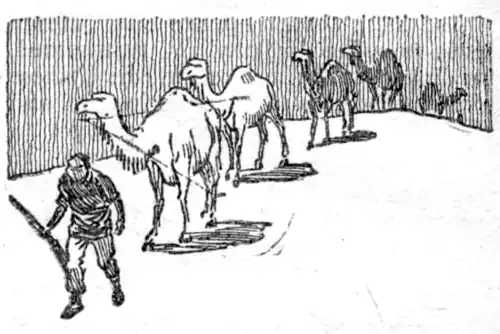
Hearn tapped the butt of a heavy automatic in his belt. “Keep away from that water hole. I wont have your stinking beasts fouling it. Camel catchee bullet, you sabe?”
Sing Low looked at Warner inquiringly.
“That well was found by Professor Rand,” observed the collector quietly. “Otherwise, it's common property. This is desert country and Miss Rand has a right to use it.”
“Miss Rand can make terms with me, if she wants to use it.”
“You mean you want her to pay for water?”
“I don't like being double-crossed.” Hearn twisted his head and called out something to one of his men. A Mohammedan coolie who had been squatting nearby sprang up and ran to head off Margaret's pony. The little animal, left to its own devices by its mistress, had started toward the smell of water.
“Do you figure to keep our horses from water?” demanded Warner.
Hearn merely nodded.
Warner flushed and stiffened in his saddle. Then a hand touched his shoulder and Mr. Three's voice spoke in his ear. “When a man is angry he should take care where he places his foot. Six ill-born Mohammedans with rifles are watching us. If anything should happen to you what would become of the American missy?”
After a moment's silence Warner signed to Sing Low to accompany him with the animals. Going back a quarter mile from the main camp, he pitched the one tent with the hunter's assistance on a clay knoll midway between the water hole and the path up the cliff.
Then, leaving Sing Low to attend to the animals and unpack their scanty stock of blankets, he returned on foot to the dining tent where Margaret and Mr. Three sat. Hearn had invited them to dinner, saying that he had a good deal to talk about, and Margaret had accepted.
“The thing shapes up like this,” Hearn began, as coffee and cordials were served. The dinner had been excellent, the Chinese servants efficient and the red wine cool and good. The promoter usually managed to make himself comfortable, wherever he might be. “We've come a few thousand miles to dig up the jewel hoard of the dead emperor. You are here with the same idea. The treasure was buried somewhere within the circle of these hills, presumably in the site of the pavilion that Professor Rand uncovered. He knew it was somewhere about, but failed to hit on it before he died. This Yuan Shi”—he glanced at the impassive Mr. Three—“knows it is here. Its value is fabulous, but if Chong-Wang, the old emperor, took such pains to hide it we can expect, logically, that the rubies alone will be worth tens of thousands—the diamonds more.”
He made his points concisely, speaking, as he had often done, at the head of a table of directors.
“Gentlemen, the value of jewels changes with the centuries. Sapphires are more common now than rubies, but these—to be collected by an emperor of Cathay, must have been of remarkable size. Such stones are hardly on the market today—outside of the crown jewels of the late lamented Czar, in Petrograd. Values are high, just now, and if these stones of Chong-Wang are sold gradually by one person and not dumped on the market by several, or a dozen natives, the profits of our adventure will be enormous.”
He turned to Margaret who sat at his right hand. “Miss Rand, given time I am sure to unearth the hoard. But your Chinese friend—who I believe is a descendant of the Tsin dynasty—may have a clue to where to search within the limits of the pavilion, which is large. My men occupy the site of the excavation, and I hold the well. I have supplies enough for months and means of getting more from inland villages.”
He paused to crumble a piece of bread into his empty glass. “I hold all the trumps, as you might say. But I want to deal with you fairly. I'll offer you a fourth of all net profits, for any information you have.”
“We have no more knowledge of the treasure than you, Mr. Hearn.”
“To sell?” Camprubi leaned forward.
“No, to use in any way.”
Hearn and Camprubi exchanged glances. Warner reflected that, in coming to the camp, he had noticed that the excavations had been purely guesswork. Here and there a stone door lintel, or the rocks of a wall had been uncovered. In a few weeks frost would set in and snow might come. The night air was very cold, after the sun left the basin of Singan-mu. Hearn was anxious to go to work with some purpose in view.
“I have come,” said the girl slowly, “partly to help Mr. Three recover the jewels that belong to him rightfully. But I want to find the men who murdered my father.”
“Murdered?” Camprubi was frankly startled.
“Yes. I think the natives are watching Singan-mu. Or—or something is. I intend to find out.”
“What are the strangers saying?” Mr. Three asked Warner politely. The collector explained and the mandarin considered, his hands thrust into his sleeves. “Tell them that I, too, desire to avenge the death of my honorable father, in San Francisco.”
“But,” objected Warner, “your much respected parent died accidentally. It was my ill fortune to be present.”
“When a thing happens twice it may be coincidence; when it occurs three times the chance of accident is almost eliminated. The fourth time brings certainty.”
“Show me what you mean.”
Drawing one hand from a sleeve, the mandarin gave to his friend a scroll of rice paper. On it was written in Chinese characters, in Mr. Three's fine hand, the following cryptic sentences:
The revered emperor, Chong-Wang, slain by a hound of the hunting pack.
The worthy Professor Rand, killed by an animal resembling a dog.
The honorable Mr. Two, dead of heart failure, when pursued by a dog.
Warner recalled the fog of San Francisco, the sudden fright of the old Chinese, the pattering run of the dog. He had hardly thought of the animal again. “There was no fourth time,” he pointed out.
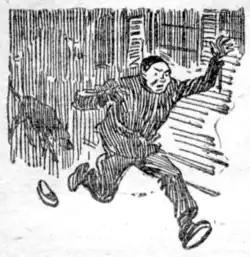 “There was a fourth time, my friend, yet, thanks to your energy, with no fatal result. In the attack on the bungalow of the young American missy you heard a dog howl, and you saw in the dark the eyes of an animal.”
The roundabout reasoning of the mandarin did not carry much weight with Robert Warner. He knew the superstition of the Chinese. But Mr. Three was in earnest. “Say to the strange barbarians,” he demanded coldly, “that I am prepared to deal with the T'au wu, the demon that slays. From the elder days the men of my family have feared the T'au wu. If the two barbarians”—he nodded at Hearn and Camprubi, who were looking on curiously—“would keep their skins whole, they must leave Singan-mu. Tell them that.”
“He says,” explained Warner quizzically, “that there's a special demon in this place—a kind of four-footed devil that he can handle. But he warns you to leave while you are still unharmed.”
Margaret glanced up in surprise, but Camprubi's dark face was serious. “It's the native legend again. I don't like it particularly.”
Warner had his own suspicions about the T'au wu. In San Francisco he had seen a powerful Chinese with a disease-scarred face stooping over the dead Mr. Two. Yellow Fangs, as he christened this individual, certainly had an interest in the treasure, because the man had attacked him to get the bronze disc given him by Mr. Two.
And Yellow Fangs had known of Camprubi's search, because the Countess feared the fellow. The native was savage enough to have killed Rand with his own hands. True, Mr. Three had seen the thing that attacked the professor, and had said that it was an animal. But Yellow Fangs was not far above the animal order.
Clothed in sheepskins, and seen on hands and knees, the powerful native might have been mistaken in the dark for a dog or wolf.
And yet—Warner had beheld, distinctly, the green eyes of a beast looking at him in the Rand compound. Possibly, human beings existed with eyes like that.
His meditation was interrupted by Margaret, who declared that she was going to her tent. Camprubi offered to escort her, but Warner and Mr. Three rose to take their leave in spite of Hearn's pressure to stay for another round of coffee and cordials.
The Italian, however, accompanied Warner and the girl. Midway between the camps he halted and bowed, much amused, it seemed, at something. “Here is our Rubicon. It is a pity that we must be adversaries in this small matter of a treasure. Really, Miss Rand, do you think I swallow the stories about revenge and all that sort of thing? Good night signorita—good night, Warner.”
He went off, and not until they reached their tent and the vigilant Sing Low did they notice that Mr. Three was not with them. The mandarin had a habit of going and coming as he pleased; still, Warner waited up for him until the light went out in Margaret's tent, and Sing Low appeared to replenish the scanty fire of dried camel's dung.
Stretched on his blanket, he smoked a last pipe, staring up at the constellations, ringed above him by the circle of black hills. Hearn and Camprubi had things pretty much as they wanted them, he thought.
He noticed that a light was still burning in one of Hearn's tents, and decided to investigate, to make certain that his friend was not in the other camp. Instructing Sing Low to keep watch while he was gone, he made his way toward the lighted tent.
The low voices of men, talking lazily, halted Warner midway between the camps. Listening for some moments he identified the speakers as two of Hearn's Mohammedans. Evidently they had been posted as sentries to guard against intrusion. Moving more carefully, he circled the natives and continued on, keeping out of the direct line between the guards and the tent. Reaching the picket line of Hearn's horses, he squatted down and waited patiently.
As he expected, a tall native appeared presently out of the black void, stared around, and moved down the line of ponies to where the camels grunted and wailed in their sleep. This would be the horse guard.
On hands and knees he moved past the embers of a camp-fire toward the red glimmer of the tent that was his objective. In so doing he risked a shot from the natives, but he desired to find out it Hearn or Camprubi knew anything about Mr. Three, and if he came openly to the tent he would not discover anything useful.
Creeping to the edge of the canvas, he listened long enough to make certain that the two adventurers and another man were within. He heard Camprubi laugh, and Hearn's answering growl.
“He's stubborn.”
A shadow moved across the light and Warner waited until it had passed, before he raised the lower edge of the canvas enough to look into the tent. On a cot not four feet from his eyes lay Mr. Three, bound or rather swathed from head to heel.
Only the mandarin's left arm was free of the cotton wrappings. By the table on which the lamp stood Camprubi sat in a wicker chair. Hearn he could not see. The shadow of the cot prevented them from noticing him, so intent were they on what was happening to Mr. Three.
Over the cot—it was his shadow that Warner had seen—stooped a grinning Mohammedan, a long, delicate knife in his hand. His left hand grasped Mr. Three's wrist, and Warner set his teeth as he perceived that two joints of the mandarin's little finger had been cut off. The native's knife wavered over the bloody stump, and Camprubi remarked with the interest of one supervising an absorbing experiment, “The thumb comes next, I believe. Yuan Shi, the torture of a Thousand Pieces, an ancient and honored expedient of the Chinese, will deprive you of your left hand in half an hour. In an hour, you will lack a foot. Why not tell us the meaning of the bronze disc before the tent of my honorable friend becomes a slaughter pen.”
But the set lips of the mandarin did not open.
“You infernal beast!” Warner rolled under the tent wall and came up on one knee. As he did so the Colt which had been lying in a shoulder holster under his coat rose in his right hand. Camprubi made a covert sign to the native and sprang to his feet.
The fingers of the Mohammedan opened and his wrist snapped forward. His eyes gleamed, and then opened full as he spun around and fell heavily upon the rich carpet. Warner had fired as the knife moved in the native's hand, and the heavy bullet of the forty-five tore through the man's heart, driving his body back and down.
 The dagger dropped harmlessly on the cot.
A second time Warner shot, the heavy weapon flashing toward Camprubi, who had drawn an automatic from his side pocket. The right arm of the Italian was jerked back as if hit by a sledge hammer, and he staggered to the far wall of the tent, cursing and staring. His forearm had been broken.
So quickly had Warner acted that Hearn only had his automatic half drawn from its belt holster. Seeing the Colt's muzzle swing toward him, he raised his hands, empty.
“Keep 'em like that,” said Warner quietly. At the same time he placed the knife in Mr. Three's bleeding hand. The mandarin worked quickly and silently at his bonds.
“Take his many-shot gun,” the collector advised his friend when Mr. Three had freed his feet. “Don't move, Hearn. So you wanted to buy me over, in order to get at this mandarin without my interfering? That's like you, Hearn. Yuan Shi never harmed a man, that I know of, and he doesn't carry a weapon. He was your guest, here, and”
“The Mohammedans are coming to the tent entrance,” observed Mr. Three.
“If you lift a hand against Miss Rand,” continued Warner, “I'll carry this fight right to you. You can still do the decent thing and get out of the site her father discovered.”
Hearn made no response. Waiting until he heard the natives' voices outside the closed flap of the tent, Warner slipped under the side after his friend. A caravan man, running toward them, turned at the sight of the weapons and fled into the darkness. Before others could come to that side of the tent, the two had made good their escape past the horses. No attempt was made to follow them.
Chapter VIII
Water
SHELTERED by the canvas covering from the sun that made a furnace of the valley of Singan-mu the next morning, Warner questioned the mandarin and learned that he had been set upon as he was following them out of the camp the evening before. His arms had been caught and a sack flung over his head. Bound and gagged, he had been carried back into Hearn's tent.
When Camprubi returned, the adventurers had tried to make him admit that he knew something of the exact location of the jewels. Failing in this, the Italian had recourse to the Chinese torture of the Thousand Pieces, which consists merely in slicing a prisoner gradually, cutting into his limbs until he confesses or dies.
Margaret Rand listened, white of face, but no one suggested that they abandon the valley. Mr. Three would not forsake his quest.
About the main camp, the natives were at work, digging and hauling the sand from the pits in large baskets. Through his field-glasses, Warner could make out Hearn bossing them, and judged that the promoter was driving his men hard. Meanwhile, they could do nothing.
“Hearn seems to know that you—or your father—possessed the bronze disc of the eight kua,” he observed thoughtfully. “What was it, exactly?”
“A symbol of rank,” responded the mandarin, “handed down for many generations. My venerated father believed that it afforded a clue to the place where the jewels were hidden, but we could discover no such meaning in it.”
“No inscription was on it—no characters?”
Mr. Three shook his head. “Nothing, except the dragon, and the eight trigrams. The five-clawed dragon is, as you know, a mark of imperial lineage.”
“And the trigrams?”
“Represent the elements, in this fashion; three parallel lines represent the sky, three broken lines the earth, two broken lines above one straight line the thunder. And the others, mountains, fire, water, steam and wind.”
“Well,” smiled Margaret, “we have the sky here and the earth, and the mountains. I suppose wind and thunder happen along—and steam could be managed; but we have mighty little water. I had to give half of one goatskin to the poor ponies.”
“That leaves us only enough for three days,” Warner observed.
“Less, with the horses. I don't care so much about the camels, but I can't bear seeing Rex and the others suffer, when there's water so near.”
“We haven't made much out of the trigrams,” he pointed out. “Although—I say, Peggy, the cliff by the trail is marked—seems to be one of the trigrams carved in the rock. A long time ago, too.”
Mr. Three nodded. “That is the symbol Kon, mountains.”
“Why, so they are.” Margaret glanced up at the overhanging precipice. “Someone has put up highway signs, hundreds of years ago.”
“Signs!” Warner frowned at the black rock. “Signs—hundreds of years.” Never a talkative man, he fell silent, and occupied himself for the rest of the morning in examining the valley carefully through his glasses, while Mr. Three slept. Sing Low did not seem to require sleep—at least no one had ever seen him at it.
Nearly across the valley from them the collector fancied he made out a dark object moving into a nest of rocks. The distance was too great to be certain. The bed of the basin quivered under heat rays and the very towers and pinnacles of stone seemed to move under his gaze. Yet Hearn did not knock off work until the sun set.
“Isn't there anything we can do?” Margaret asked next morning, when Warner resumed his scrutiny of the landscape.
He suggested, with a smile, that they could saddle two ponies and examine the geologic structure of Singan-mu. “Mighty interesting, this mingling of basalt with sandstone strata. The granite has been in place three thousand years, or twice that; the limestone is a parvenu. See how those black cliffs stand up in almost a perfect circle, Peggy? Tempting to an artist, I'd say.”
“To paint?”
“To paint on, Peggy, or rather sculp. Who is that American sculptor at work chiselling a Civil War panorama on Lookout Mountain? The Chinese have done the same thing before, as usual. I've seen the giant figures, in half relief, on just such cliffs”
He went off to saddle the horses, leaving the girl more than a little puzzled. Although the two Chinese said nothing, they as well were a trifle disturbed by the white man's course. From the tent they watched the two riders make the circuit of the cliff walls, choosing the hardest going, climbing slopes above the bed of sand, disappearing into gullies, passing through nests of boulders.
For hours they were out in heat-ridden Singan-mu and when they came in from far side the ponies were dark with sweat, and restless.
“No wonder!” cried Margaret excitedly. “We saw a tiger's tracks, Sing Low.”
The mandarin glanced at Warner quizzically. The white man helped Margaret down, and led her into the shade, ordering Sing Low to water the horses after a while.
“They've earned it. And that warm, goat-ridden liquid isn't fit for you, Peggy. We'll get some fresh, tonight.”
“How?”
He looked at his watch. “Time for your siesta, young lady. I've been a brute, dragging you through that rubble. But I wanted to take you; something always happens when I leave you behind.”
“That was why you desired my company?”
Warner studied the circles under her bright eyes, her flushed cheeks. The ride had exhilarated her, but the girl was not far from the edge of illness. A hot anger against those who had hurt her seized upon him. “Yes, that was why,” he forced himself to answer lightly,
When she had withdrawn into the tent, he led Mr. Three to the shadow of the knoll, out of hearing. Then he threw himself down in the sand and fished out his pipe. The mandarin regarded him calmly, and observed, “My friend, you, too, have seen the tracks of the T'au wu.”
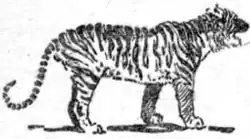 “Um. These were fresh, clear enough in the sand. A tiger has its lair in Singan-mu.”
“A beast, but not a tiger. You know the animals of the desert. Was it not a dog?”
Warner hesitated. “The tracks were too large. A tiger made them.”
“The paws of the cats resemble not the mark of a dog. You are too wise to mistake them. It was not a tiger that I saw make night the merit-deserving barbarian died.”
Puffing at his pipe, the white man studied the shimmering sky, his thoughts elsewhere. “Yuan Shi, all the eight trigrams are carved on these cliffs. Was that known to you?”
The mandarin started. “It was not known to me.”
Leisurely Warner explained that he had noticed through the glasses some marks resembling the trigram over the trail. Investigation disclosed a companion inscription a thousand yards or so to the left. The third, badly obscured by the action of the elements, was visible on close inspection an equal distance along the face of rock.
Knowing by then where to look for the others, approximately, Warner had hit upon six out of the eight. Two were no longer visible—probably destroyed by a fall of rock. Some were carved on flat-faced boulders, where no other surface offered, but all were on a level with the one over the trail, and all seemed to have been made about the same time. Unless one sought them out, they would not be noticed among the cracks and scars of the hard granite.
“However well one hides the eggs, the chickens will hatch out,” quoted the mandarin philosophically. “The eight kua, then, are here, but their meaning is as far from our understanding as ever. It is possible they were cut by the followers of Chong-Wang, as a talisman against evil spirits.”
“I'd give a mint-ful to look over that bronze disc again,” sighed Warner to himself. “Wonder what Yellow Fangs got out of it, and where the devil that demon keeps himself.”
Mr. Three stared thoughtfully at the black cliffs that, three thousand years ago had looked down upon his ancestors. To him, it was a significant thing, that finding of the ancient trigrams. He did not know how, but he was morally certain that in some manner the treasure of his ancestors would be revealed to him before long.
If either of the two had known, that afternoon, what results the quest for water in the night would bring home, Warner would have been astonished, but Mr. Three would have been satisfied that the spirits of his forebears were working in strange ways for his own good.
Chapter IX
More Tracks in the Sand
CONVINCED that Margaret must have fresh water, Warner announced after the girl had retired for the night, that he was going to penetrate the enemy's camp to the well and endeavor to fill two of the goatskins. The mandarin, who was no adept at scouting, insisted on accompanying him as far as the horse lines.
Sing Low, when the matter was explained to him, had an alternative to suggest. Although he failed to exhibit any feeling in respect to Margaret, the white man noticed that the hunter went to a deal of trouble to provide little comforts for the girl, and suspected that he was attached to her.
Now Sing Low declared that he would go for the water, because he could enter unheard and unseen where the big barbarian would attract attention. “More better Sing Low him catchee water,” he ended emphatically. “More better you watchee, so.” He pointed at Warner's Colt.
The white man saw the wisdom of this, and it was agreed that he and Mr. Three should establish, as it were, a line of support, midway between the camps, while the old hunter stole forward to the well. Then, if Sing Low were discovered and pursued, they could cover his flight.
Water they must have. The supply on hand would not take them back to the Wall, if it should be necessary to retreat from Singan-mu.
Their small camp in darkness, they waited until the beginning of the third watch of the night, called by the Chinese the Tiger Watch. Even then, although the air was bitterly cold, Hearn's tents were lighted. Unwilling to wait longer, for their adversaries to settle down, Warner gave the word to go forward and cautioned Sing Low to watch for the outpost of natives he had encountered two nights ago.
The hunter slipped ahead of them, and Warner and the mandarin followed slowly, peering into the hazy illumination—bright starlight and a crescent moon, close to the mountain ring, clear in the cold air, Although their eyes were accustomed to it, this half-light was more trying than greater darkness, owing to the absence of shadows on the gray sand.
Reaching a rock-strewn knoll several hundred yards from their objective, they found Sing Low awaiting them, and halted when the hunter held up a cautionary finger. Another rise, a crest of sand, hid the camp; but they heard with uncanny distinctness Camprubi's high tenor voice singing a profane hymn. At times hoarse laughter reached them, over the sand, and Warner wondered whether Hearn's party were celebrating a discovery of some kind. They seemed to be drinking,
This was favorable to Warner's plan, and Sing Low departed on his quest, carrying two empty goatskins. Almost at once he merged into the swells of sand. They saw him cross the rise ahead of them.
The minutes passed slowly, and the two watchers were gripped by the chill of the Gobi night, the harbinger of the long winter that was almost upon them. Warner moved his right arm, to keep the circulation going in his fingers. Holding his watch close to his eyes he made out that Sing Low had only been gone forty minutes, although it had seemed hours.
Then he replaced his watch quickly and caught up his revolver.
“Great Scott!” he whispered involuntarily. Even Mr. Three caught his breath.
The sound that reached them was the whimpering of a man, of a human being that choked and panted, drawing nearer them. It was hard to decide from what quarter it came.
 Another moment and Mr. Three pointed toward the crest in front of them. Over the ridge came a misshapen form, a thing that ran on two legs, but bent nearly double, with a great hump where its back should have been.
As it dropped down the slope toward them, the gasping became clearer. The figure staggered and swayed from side to side yet moved forward with a gliding motion utterly unlike the walk of a man. Mr. Three caught his companion's shoulder.
“It is Sing Low with the water skins—filled. He is frightened.”
No one but a Chinese or a Himalayan coolie could have run at such a pace bearing such a weight on his shoulders. A white man of Sing Low's age barely could have moved with his burden. He gave a curious clucking groan as he staggered through the sand up the slope.
As if in answer came the savage baying of a dog behind him—a snarling wail that brought the watchers to their feet at once.
“The T'au wu!” Mr. Three took a step back, to flee, but held his ground by an effort of will. Warner ran down the slope, perceiving as he did so, a dark form sweep over the rise in front of him.
He passed Sing Low, and kept on toward the thing that was drawing nearer over the sand. Then he made out the gleaming eyes of an animal, for a second. The eyes were stationary now, and, as Warner advanced, ready to shoot, they disappeared.
"You can't get away this time, my friend, the devil,” he muttered, casting about for a trace of the beast. Pulling out his electric torch, he threw its beam in a quick circle around him. Where he stood, in the depression between the two ridges, the sand had formed into hollows and gullies, any one of which might conceal the thing that had chased Sing Low.
Advancing cautiously, he made out in front of him a line of heavy tracks in the sand—tracks similar to those he had come upon the day before. They turned aside into one of the hollows and thither the white man ventured.
He had not progressed a dozen steps before he switched off the light. Too clearly for any doubt on his part he caught a message of danger in the wind. An odor, stale and animal-like, penetrated his nostrils. And memory, rendered acute by the suspense of the moment, identified the taint as the one he had noticed in the hall of Rand's San Francisco house months ago. He held his breath, straining his ears.
The odor grew stronger and he whirled to face the direction of the light wind. And fear clutched at his heart.
A shadow, a dark form, rose against the stars. Something that clutched and snarled fell on his shoulders, bearing him down into the sand. Claws tore at his chest and teeth snapped at his ear; a foul breath sickened him.
His right arm, with the revolver, was pinned to the ground. His adversary was upon his chest, and pain seared his throat as it was gripped by iron muscles.
Warner was no weakling. Fighting off the loathing—the inertia that saps the strength of a man who, unwittingly, has put his hand on a snake or a creeping thing—he twisted his body. The claws tightened, although his adversary was thrown prone on the sand beside him.
He could hear the panting of the other, and the grinding of long teeth. He struggled to keep the head of the thing from reaching his throat—anything but that! But now his breath was shut off, and his lungs ached.
Feeling weakness flow through his limbs, Warner made a new effort. With the electric torch he struck at the dark blur of his antagonist's head. He could feel it thudding against hair, or fur, but the grasp on his threat did not relax.
Desperately, he pulled up his knees and thrust out with his legs. For a second the grip on his throat was broken and air rushed into his laboring lungs. With renewed strength he brought down the heavy torch and this time was rewarded by the dull impact of metal against a skull. The claws fell away from his chin and he was conscious of two dark figures that stood over him, shutting out the stars.
Blood in his eyeballs obscured his sight and his head swam. While his right hand groped vainly for the revolver he stared up at the newcomers.
“T'au wu catchee master,” quavered the voice of Sing Low.
His Chinese friends, in spite of their dread, had drawn near the scene of the fight, and had heard the struggle. With a hoarse chuckle he propped himself up on an elbow. “No, Sing Low. Master—catchee T'au wu!”
He tried to switch on the light, found it dead, and struck a match, shielding it against the wind. Bending over the form that lay stretched on the sand beside him, he beheld a powerful man clad in greasy sheepskins, a bearskin wrapped around his shoulders.
Strongly the stale odor emanated from the unclean body. And, clearly, he made out the evil countenance of Yellow Fangs, the loose lips parted to show the pointed teeth, the shining, pallid skin, and the pock-marked eyes, now closed. Blood flowed from a cut on the man's forehead, and beside his head lay a dirty sable cap.
The match burned out, and Mr. Three and Sing Low helped him to his feet. He had to hold their arms for a moment while his head cleared. His chest was strangely warm and he had noticed blood on the long nails of the man's claw-like hands.
“You are badly hurt, my friend,” said Mr. Three.
“Cheap enough, if we've ended the T'au wu,” Warner thought, puzzling over the circumstance that he had heard the baying of a dog distinctly and had seen the tracks in the sand. Yellow Fangs, whatever else he might be, was certainly a man. Warner scratched another match.
The body was gone.
Sing Low muttered under his breath and Mr. Three sighed. The glow of the match disclosed prints in the sand, marks of hands and toes, and then of feet leading away from the spot. Yellow Fangs had made off without a sound.
“Playing 'possum,” grunted Warner. “Saw those two chaps come up and tricked us neatly.”
But to Sing Low the disappearance of Yellow Fangs needed no explanation. The T'au wu had taken the form of a dog to pursue the hunter; then it had turned itself into a man to attack Warner; when it wished to go away it had simply changed to a spirit again, and vanished. True, there were traces of its going, but a demon if it so willed, might leave traces. Surely it could do stranger things than that.
Yellow Fangs had a good start, among the dunes, and Warner was too weak to attempt pursuit. The Chinese would not think of it. Recovering the Colt, they turned back to where Sing Low had left the water skins.
 These they carried to the tent, and Sing Low listened at the flap to make certain from her even breathing that Margaret Rand still slept within. Meanwhile by common consent they kindled a fire and Mr. Three dressed the white man's throat as well as their scanty means permitted. The long nails of their enemy had pierced the skin and torn the flesh in a dozen places. Infection might set in, but the hurts were not serious in themselves.
Warner thought that Mr. Three appeared pleased. The mandarin smiled at him and drew something from his long sleeve.
“The spirits have been kind. On the sand by the body I found this.”
In his hand was the bronze disc, the talisman of his family, more precious to Mr. Three than the jewel hoard of Singan-mu.
“Now,” observed the mandarin, who was polishing the tarnished bronze with a clean chamois, “a way is opened to attain what we desire and to defeat our enemies.”
Placing the disc on the cloth upon the sand he surveyed it intently, with the greatest satisfaction, his lips moving the while. After recovering from the first force of his elation, he explained to Warner that his father's spirit, and perhaps that of his venerable ancestor, Chong-Wang, would undoubtedly slay the T'au wu—the three being together in the spirit world—and in some way, even as the disc had been returned to him, the hiding place of the jewels would be pointed out.
Was not this the three thousandth year since the hiding of the treasure?
“And the two barbarians—what of them and their caravan?” Warner asked curiously.
Mr. Three waved his mutilated hand indifferently, They were only barbarians; they had many rifles, true, but this struggle with the T'au wu, the Untamable, was not to be ended by rifles.
“Well,” responded the white man grimly, “we need all the help we can get. If you have any more allies in the spirit world, summon them up. But be sure to have them do away with those rifles.”
This levity seemed to hurt Mr. Three's feelings and he became silent. But Sing Low, who had been occupied by his thoughts for a long time, looked at the white man curiously.
“Wish someone could tell me,” muttered Warner in English, “who the devil this T'au wu, alias. Yellow Fangs, alias a dog, alias a tiger, really is—and what he is. He stole the bronze disc in San Francisco and dropped it here in the Gobi, Apparently he has killed two good men, Rand and Mr. Three's daddy, and he just missed three tries at me”
“Can do,” observed Sing Low.
“What?”
“Can do. Sing Low tellee name belong T'au wu, velly ploper.”
Chapter X
Digging In
THE fourth morning of her stay in the Singan-mu basin found Margaret Rand called upon to assume a new responsibility. As soon as she realized Warner's injury, she bundled him into blankets under canvas, and washed his throat with a reckless quantity of the fresh water secured by Sing Low the previous night. Her patient was feverish and insisted upon talking in spite of her effort to keep him quiet.
“Sing Low has cleared up most of this confounded T'au wu puzzle, Peggy,” he proclaimed. “He's knocked about the edge of the Gobi for years, from Tibet to Peking. As soon as he had a good look at Yellow Fangs, he classified him and gave him a name and occupation. Yellow Fangs really is Gepa, a native of Tibet,”
Margaret sighed. She had heard many times of the people of Tibet, who lived in the heights of the Himalayas, cut off voluntarily from the world. Isolated, worshipping the devil for the most part, they were one of the most degenerate races of the earth. Their dead they placed in the village streets to be devoured by the fierce breed of dogs that they seemed to be attached to.
Utterly remorseless, they had the brains of ten-year-old children. It was seldom that one of them ventured down from the frozen heights of the Himalayas; the natives of China—Margaret's companions—feared them as workers of black magic. Professor Rand had maintained that the Tibetans were the men Marco Polo had mentioned as having the heads of dogs instead of human beings.
“Gepa,” assented Warner, “is no more than an animal. His dominant instinct is hatred of civilized man. Why Camprubi lugged him along from Tibet, I don't know—except that it amused him, and, of course, provided him with a guide from India to China.”
“Camprubi”
 “Lied to me when he said he had merely touched at the treaty ports before he came to the States. He wandered over from India, and the collection that the Countess is keeping for him is really loot of various kinds that he has bought up cheap along his route. He kept Gepa as a servant—a useful kind of bodyguard. The Countess was afraid of the native—called him a monster, I remember. Gepa is cunning enough, and Camprubi must have used him to spy on the Rand house in San Francisco. That was how Mr. Two came to be killed, and how I lost that talisman.”
“And then,” Margaret added thoughtfully, “this Tibetan recognized you at Honan, and at Lanchow”
“Camprubi left a few of his Mohammedans to make trouble for me. “They did. After he heard that they had not put us out of business, he must have sent Gepa with a couple of hangers-on to raid your house, and steal your ponies. Left to his own devices, the Tibetan came near killing us both.”
She glanced from the tent, and shivered. “No, no! I can't believe it. Hearn used to be your friend”
“He isn't any more, Peggy, Besides, Cliff is wanted in the California courts. He's playing the last card in his last hand, to get money. At that, I don't think he knew much about Gepa, or the attack on you.”
“But Camprubi?”
Warner lay back, his eyes closed. “The Italian is the kind of man you meet sometimes in this world of ours, Peggy. He's the mere shell of a gentleman. His code begins and ends with himself. He'll kill a man or woman as quickly as you or I would shoot a wolf—if he had something to gain by it. After all, this isn't Market Street, or Times Square”—he smiled reminiscently—“and they warned us off. That Italian is clever, Peggy. Think how he pretended to believe the native legend, and escorted us on our way that night he had Mr. Three trussed up for torture. He'll make trouble for Hearn yet.”
His hand touched hers. “Peggy, this fever—if anything happens to me, don't trust either of those men for a minute. If Camprubi comes near you, shoot him! If we were only able to carry the fight to them!”
“Please lie down—Bob!” Her fingers, cool and firm, pressed upon his forehead. “You're making yourself worse.”
“Lord, what a fool I've made of myself,” he groaned. “I never trusted Mr. Three until now. And I was blind not to see through Camprubi's tactics”
“Bob!” She sat up quickly, her curving lips drawing into a level line of determination. “Do you think Camprubi had—did he plan the death of my father?”
“Give the devil his due, Peggy. The Count was not here when it happened, and Mr. Three vows it was an animal, though he can't put a name to it.”
Her eyes softened as they rested on his flushed cheeks and over-bright eyes. “If you try to talk any more I'm going to leave the tent. Please!”
Warner fell asleep presently, his mind still dwelling on the mystery of Singan-mu. All that he told Margaret he believed, but two things he had not been able to explain to himself. One was the fact that Gepa could not have been at Singan-mu when Professor Rand was killed. The other—and this troubled his sleep—was the green eyes he had seen in the night.
Out of the back of his consciousness came memories of other days, when the witches' sabbath was kept upon the earth and human beings lived in fear of werewolves, the creatures of darkness that assumed the form of a beast at night.
In this fantastic dream he heard the howling of the huge dog packs that ran through the vast, primordial forests of the elder world. Unseen wings beat the air around his head, and formless shapes flew past, toward the tryst of Satan. He felt that he was flying with them, to the altar before which a young girl was to be offered as sacrifice.
From a great height he looked down upon this woman, and saw that she was Margaret Rand. Around her, in the darkness, he beheld a circle of fiery eyes.
Then the eyes vanished, and he saw only the face of the girl, felt her hand on his forehead. The nightmare ended and he slept quietly.
Margaret came out of the tent and sat down by Mr. Three, who was contemplating the work in progress in the excavations, below him. In spite of the heat, Hearn was driving the natives again to their task. Mr. Three deduced from this that no discovery had been made, as yet. But Margaret was uneasy. The injury to Robert Warner left them without any idea what to do. She realized for the first time how much she had depended on him.
“Is that the bronze tablet?” She leaned over the metal disc that Mr. Three had polished to a gleaming brightness. “And there's the dragon. Yuan Shi, I dreamed about the dragon last night, before I saw it. That was strange.”
Mr. Three's expression indicated that nothing was strange or curious. Still, he waited with interest for her to say more. Dreams, in his philosophy, always meant something. They were the means by which the spirits of the other world communicated with human beings.
“We must think of something to do, Yuan Shi.” She frowned determinedly. “Surely the dragon must have a meaning.”
He nodded patiently.
“And the white man found all these symbols carved in the cliffs. That, also, has some meaning.”
Again Mr. Three made a gesture of assent, Margaret continued to gaze at it hopefully. “Yuan Shi,” she whispered, “see—the dragon's claw points toward one of the characters! Which one is it?”
“K'un, the earth.”
Margaret smiled ruefully. “The two barbarians are digging in the earth, sure enough.” Suddenly she sprang up and went into the tent. Returning a moment later, she spread on the sand the copy of the narrative of the priest that Warner had brought with him. Once or twice they had read it over, without learning anything new.
“Listen, Yuan Shi. This reads, 'under the mark of the earth.”
The mandarin's glance traveled to the cliff on their left, and his eyes brightened. It was a slender clue, but Mr. Three reminded himself of the proverb that if you never climb a mountain you will never see a valley. Moreover, the dragon had appeared to Margaret in a dream. This, to him, was most significant.
They decided to move their camp that afternoon to the cliff, under the next inscription of the kua, and to search there for some indication of the hiding place of Chong-Wang.
It was just after the little cavalcade led by Margaret Rand had left the knoll that destiny brought about a change in the affairs of Singan-mu. Or, as the mandarin believed, the ancient gods of his people manifested their power at last.
To the girl it seemed an ominous event. They had covered half the distance over the sand, toward the cliff, heading diagonally away from the trail upon which they had camped when a fusillade of shots resounded from the other camp.
Warner, thinking they were being fired upon, tumbled out of the hammock in which, slung between two ponies, he had been dozing. Puffs of smoke spurted up from Hearn's tents and gray figures ran from the camp, following a stampede of ponies and camels. But no bullets came in their direction.

“The barbarians and the black-hearted Moslems are fighting among themselves.” Mr. Three explained the mystery, and Warner took out his glasses, The mandarin had spoken the truth. Hearn's followers were fleeing the other camp, shooting as they ran; several of the natives carried bundles that might contain their belongings, or loot. And they were driving before them all of Hearn's animals.
He saw the big man run out, his automatic flashing. Two men reinforced him, and Warner made them out to be Camprubi, shooting with his left hand, and a powerful native in sheepskins—Yellow Fangs, or Gepa.
The Tibetan pursued one of the fugitives, overtook him and pulled him down. Then he kneeled on the unfortunate Mohammedan, and when he stood up the other lay prone. Several of the caravaneers, mounting the running ponies, passed near Gepa and fired at him, but he remained on his feet unharmed.
Warner observed that the deserters now numbered no more than a half-dozen, with three rifles. The tide of pack animals and men, fleeing the rain of bullets from the automatics of the white men, passed over the knoll that Warner's party had just left, and a pair of the Moslems swerved out, toward the four camels that were slouching along behind Sing Low.
Seeing this, Warner ran back to the rear of his short column. But the camels—always perverse animals—broke away, toward the others of their kind, carrying with them the bulk of Margaret's supplies.
Sing Low, enraged by the loss of the valuable beasts, had dropped on one knee, sighting his long rifle at the galloping Moslems.
“Hold the ponies!” Warner shouted over his shoulder at Margaret, who had Rex by the head; Mr. Three lost no time in grasping the bridles of the other two horses. “No use,” the white man warned Sing Low. “Let the camels go—they'd die, anyway, because we have no water for them.”
He was too weak to run farther and most of the natives were out of range of the hunter's antiquated piece. Sing Low muttered crossly, and, carrying his rifle, began to make his way nimbly up the rocks, back toward the trail. He was in time to hail the last of the fugitives, when all the pack animals were well up the mountain.
Rejoining Warner, he explained, as they moved toward the new site under the cliffs, that the Moslems were headed for Lanchow.
“They sellum camel; they sellum pony.” Sing Low pointed down at Hearn's camp. “They catchee too much work, too much kick.” He held up four fingers. “So many, they catchee die. Gepa, him number one devil. They lun away—you sabe?”
“Yes,” acknowledged Warner. “I understand.” Hearn's followers had become disgruntled at the hard work, and the dangers of Singan-mu. One had been lost in the pass, another Warner had dispatched, and two more had been killed in the recent fight. No great wonder that the Moslems preferred the more remunerative banditry of the Chinese towns.
Their departure left Warner with a minimum stock of food and water and ammunition, but deprived Hearn of all his animals, This, he pointed out to Margaret, would make it necessary for them to keep a careful watch on the three remaining ponies. Undoubtedly, Hearn would try to get his hands on them, because it would be impossible for the white men to walk the distance to the Wall, carrying the necessary food.
“They have water, grub and firearms,” he summed up, “while we have the horses. Without the ponies, we're at their mercy. Have Mr. Three and Sing Low throw up a barricade around the animals and our camp site—I'm walking in my sleep. That mandarin must have given me a sedative and sleeping powder in one dose.”
“No,” the girl smiled, “I did.”
She arranged his blankets in the shadow of the rock, and he dozed off again while the two Chinese tied the horses in a clump of dry tamarisk, and proceeded to roll and lift stones to form a wall.
They were directly under the inscription in the rock. Margaret could reach up and touch the lowest line, that, chipped and defaced, was still clearly visible. This character consisted of three broken lines, each a yard long, a couple of inches wide, and as deep.
— —
— —
— —
Toward sunset she saw Hearn come out and approach the base of the slope on the summit of which, against the rise of sheer rock, they were quartered. He had glasses, and spent some time in studying their new camp. It was impossible to conceal the horses, but she reasoned that Hearn would conclude that they were fortifying themselves in a better position than the knoll.
Hearn walked back to the camp at the well, and Margaret found herself sharing the subdued excitement of the two Chinese. Mr. Three and Sing Low were laboring as they had not worked heretofore—digging out the stone and rubble from the base of the cliff, directly under the inscription. The crescent moon gave them light enough to see by—Margaret had forbidden a fire—and the girl watched the valley below, rising at times to change the cold compresses on the head of the sleeping man.
Toward midnight Warner awoke, very weak but rid of the fever. He stared for a few minutes at the tireless Chinese who had succeeded in hollowing out a space about six feet square against the cliff.
“Great Scott, Peggy,” he said bluntly, “no earthly use in doing that. Granting that this inscription marks the hiding place of Chong-Wang's private stock, it must lie a couple of hundred feet under us.”
“Why?” Margaret was keenly disappointed.
“All this slope, up to this point where the cliff rises out of it, is débris, fallen from the precipice or swept up against it for three thousand years.
“Then the level of the ground in Chong-Wang's time must have been”
 “The level of the ruins, or a little above. To get down that far we'd need a steam shovel. Or else a hundred coolies, an outfit of dynamite, and a couple of months—all of which we haven't got.”
Even Mr. Three saw the force of this, and their labors ceased. The slender clue they had hit upon had led to an impasse. But the efforts of the Chinese brought to light a slight discovery. Some three feet under the lowest line of the inscription a narrow ledge ran along the face of the cliff. It ascended from one side and ended under the carving.
Chapter XI
The Weapon of Mr. Three
IT WAS said of Robert Warner that he had a stubborn streak in him, running all the way through. Which was only another way of saying that he never gave up, once he had started after something. Mr. Three pointed out with philosophical resignation, that they might have expected to find a ledge leading up to the inscription. How else could the man who carved it have reached the spot?
“Quite true, my friend.” Warner stepped to the granite ridge and found that he was obliged to grip the edge of the lowest of the three indentations in the rock to hold himself in place. With his free hand he reached up toward the second line. Although he was a tall man, he could not touch it it. Satisfied of this he fell to brushing leaves and grit from the lowest cut, was just space enough to insert his hand, and he kept on until he came to the end, where the line broke off at the center gap.
Here he paused. More bits of rubble fell, and his fingers failed to encounter the solid rock as before. Presently he found that he could insert his arm up to the elbow. Where the line of the inscription ended, a hole went back into the cliff.
“Great, jumping hoopsnakes!” he cried softly.
Margaret started. “Snakes! Bob”
“A handle—a lever of some kind, rusty as the devil! We've found it, Peggy. Yuan Shi, here is the place!” He worked away with his arm for some moments, without being able to move the ancient lever that ran through a slot in the solid rock toward the center. “Hand me up a pick, Sing Low. That's right.”
Whatever the mechanism within the cliff might be, time and disuse had put it out of action effectively. Warner began to tap with the butt of the pickaxe on the surface of the rock, sounding it. The cliff was solid enough except at the center slab, between the lines of the inscription.
“Something behind here, folks!” he chuckled. “What a donkey I've been, not to tap it before. A hollow compartment's in back here, somewhere. The lever must be designed to open it. Funny no cracks showed. Here goes!”
“Be careful, Bob,” warned Margaret breathlessly. “It might be dangerous.”
He paused, to glance back at them. Mr. Three and the girl were close to him, below, in the shallow excavation. The mandarin's hands were quivering. Sing Low sat tranquilly at one side. All were watching the gray wall of rock, vaguely outlined in the moonlight.
“Right, Peggy. You and Mr. Three stand clear.” Warner began to probe with the pick, seeking to get a purchase on the mechanism within. Perspiration streamed into his eyes, and he brushed it away. “Give me the crowbar, Sing Low. This is no good.” He discarded the pick, and lifted the heavy iron bar slowly to his shoulder.
From the boulders surrounding their camp a man spoke. “We will attend to that for you, Warner.”
It was Camprubi, leaning over the barricade, automatic in hand. His right arm was in a sling. On the other side a tall figure climbed over the rocks as Warner let fall the bar and drew his right hand up toward the opening of his coat under which hung his six-shooter.
“Hands up, Warner!' Hearn's command rasped quickly. “None of that! Gepa is here, and he'd like nothing better than to chuck that knife of his. That's the way we want things done”—as Warner stepped down from the ledge and moved beside Mr. Three, who stood impassive as ever in the face of this new misfortune, his hands folded in his sleeves. “I told Ray that you'd lead us to the treasure if we gave you rope enough.”
Hearn advanced behind Sing Low, who for once was far from his rifle. The powerful form of Gepa took shape beside them. Mr. Three, the hostile party knew, had brought no weapon to Singan-mu. Margaret, palpably, was unarmed.
Satisfying himself that Warner was covered by Hearn and Gepa, the Italian advanced to the cliff. “So there is a compartment behind this center point,” he smiled. “And it can be pried open from this hole? Good!” His eyes gleamed as he surveyed the girl. “Miss Rand, I am afraid we must take you with us, when we have the jewels of Chong-Wang—as a hostage, is it not so? Your friends—ah, that is another matter.”
“I will not leave without them,” the girl said resolutely.
“No? Unfortunately you may find it undesirable to accompany Yuan Shi, who is going to join his venerated parent. Gepa will see to that.”
“You coward!” Margaret's cheeks went pale with anger. “You planned my father's death, when you were his guest, and your servant attacked him after you left. And you sent the men who killed that poor Chinese girl. Why don't you shoot me—if you want to leave China alive?”
Warner whispered to her, cautioning her to silence, but the harm was done. For once Camprubi's poise forsook him and his thin features were twisted by vindictive rage. His left hand, holding the weapon, quivered like the head of a snake about to strike.
“Ah, so that is it?” he whispered. “Then your friend, the chivalrous Mr. Warner, must remain at the pass in the hills. It will be necessary for him to fall. An unfortunate accident”—he laughed, seeing the girl's quick distress. “As for you, my talkative lady”
“Cut the chatter, Ray!” Hearn snarled. “Tell Gepa to use the crowbar on that opening.”
The Italian spoke to his follower in a dialect unknown to Warner, and the giant Tibetan slouched down beside his master, picked up the bar and stepped to the ledge replacing his knife in his girdle. Once more Warner was aware of the stench of sheepskins and grease. From between set lips he cautioned Mr. Three, who had stirred restlessly.
“Do not move, my friend. The yellow barbarian seeks a pretense to slay.”
 Gepa lifted the heavy bar as easily as a bamboo cane and plunged the point into the opening. Hearn urged him on profanely, and he strained against the bar, which was now wedged in the interior mechanism. Something grated loose, a stone dropped within, and Gepa heaved on the bar with all the strength of his knotted shoulders.
“Heads up!” cried Warner, involuntarily. But Camprubi, suspecting a trick, was half a second late in glancing up and back.
The entire center slab, half a ton of rock, had been pried from its resting place. The oblong stone, like the lid of a sarcophagus, swept out and down. A whining cry from Camprubi, a thudding impact, and the body of the Italian lay prone in the excavation, crushed by the slab.
Around his faintly stirring limbs a dark pool spread swiftly. A dozen feet above, a niche, six feet high, was bared in the cliff. And, upon the back of the recess, as vivid as when it was first painted three thousand years ago, the figure of a yellow dragon met their eyes.
Warner had pushed Margaret back. The movement caught Hearn's eye, and the man, startled by the crushing down of his companion, shot hastily at the two young people.
The red flash of the gun and its echoing roar let loose a dozen devils. Or so it seemed to the bewildered girl. As if a hidden spring had been touched, five men were galvanized into action, so swift, so shadowy to the sight, that Margaret could only stare in dumb horror. First to move was the old hunter, Sing Low. Unarmed, he stretched a bony hand up and back and gripped Hearn's ankle, muttering his rage at the bullet fired at the young woman.
Sing Low did not dislodge Hearn from his footing, but the big man staggered and caught the hunter's pigtail to steady himself. One after the other, he fired three shots into the thin body of the Chinese.
Torn by the heavy bullets, Sing Low still kept his grip on Hearn, who had to struggle to win free. In the moonlight he beheld the slanting eyes of the old man fixed upon him in a kind of wild triumph.
Almost at the same instant Sing Low had moved, Gepa leaped from the ledge. Frightened by the fate of Camprubi, all his cruel instincts aroused, the giant Tibetan sprang a full ten feet from the cliff—as it happened, toward Mr. Three. The mandarin, arms folded and head bent, stood like a statue, only his eyes moving.
When the figure of his foe was in mid-air, Yuan Shi withdrew his right hand from his sleeve. Warner, glancing toward him anxiously, saw that he held, pointed toward the native, the blue-barrelled automatic that he had picked up in Hearn's tent three nights ago.
Mr. Three, perhaps, had never taken into his hand a barbarian weapon, but he knew how they worked. He had nerves of steel, and he waited until Gepa had leaped before he pulled the trigger.
Twice the automatic barked, before it was knocked from the mandarin's hand by the body of his antagonist. Mr. Three went down, and as he fell, gripped the hand of Gepa that held the knife. They rolled over on the stones, the Tibetan grunting hoarsely.
Hearn lifted his gaze from them and found Warner eyeing him from behind the muzzle of the long Colt.
“Drop your gun!” The collector spoke quietly, but there was in his voice the tension of nerves-strained taut. In this last fight, under the painted dragon of Singan-mu, there was no room for hesitation. With Gepa loose the lives of all the Americans were at stake. Hearn knew this—understood that his own life was forfeit, and cast down his weapon hastily.
“I'm through, Warner!” he cried huskily. “Don't shoot, for God's sake! I'm through.”
From the corner of his eye Warner watched the two forms lying beside him in the shadow. One rose, and he saw that it was Yuan Shi, once more slow moving and thoughtful, the son of a line of kings. The mandarin glanced at the dying Sing Low and moved toward Hearn. In front of the big man he paused and there was silence for a long moment.
“Ask the worthless one,” he requested Warner, “what part he played in the death of my honorable father.”
Hearn was voluble in his reply, feeling that he was being judged. Camprubi, he said, had not told him of the fate of Professor Rand. The Italian had lied cleverly, making out that Rand and his daughter were trying to solve the secret of Singan-mu ahead of them. Unable to converse with the natives, Hearn had been forced to rely on what his companion explained to him of the events that transpired.
The torturing of Yuan Shi had been Camprubi's idea, and Hearn had barely seen Gepa, who kept away from the other natives. As to Mr. Two, Hearn thought the old Chinese had died in the San Francisco street of fright, following upon his flight from a dog that happened along by chance, in the fog—of fright, intensified by the shock of his fall, when he felt Gepa's hands at his throat and saw the evil face of the Tibetan close to his own. Camprubi had said that the family of Mr. Two had a hereditary fear of dogs. Gepa, on the other hand, had often been seen accompanied by a black dog, in the hills around Singan-mu.
“I will not ask for further punishment of this robber,” Mr. Three announced after an interval of thought. Glancing down at the remains of Camprubi, he added scornfully, “A snake can not creep without its head.”
“You are our prisoner, Hearn,” explained Warner coldly. “And you will be until we reach the States.”
“Please,” said Margaret, “let him go.”
Warner made no response. He kicked Hearn's automatic away in the rocks and bent over Sing Low. The eyes of the old Chinese were still open, and Sing Low shook his head slightly when the American tried to search for his wounds.
“Sing Low him catchee die,” the gentle voice crooned. “You belly him, master?”
Knowing the dread of the Chinese—that they should go unburied, Warner gave his assurance earnestly. Mr. Three stepped to his side.
 “O servant of proved fidelity,” the measured tones of the mandarin proclaimed, “your burial will be in a coffin that we shall make. Prayers, properly written, will be burned upon the spot. Rice, silver, dates, clothing, slippers, and a walking stick will be burned likewise, so that your journey in the spirit world will not be without comfort. Your native village will hear the praises of Sing Low, who was faithful. My word is given.”
The failing ears of the old man, who clung tenaciously to the thread of existence, drank in every word, and a complacent expression replaced the anxiety in his wrinkled face.
He looked at Warner, smiling, “Catchee number one piecee fun'lal. First chop, velly—ploper. You watchee Lady-Missy? You catchee she wife? Can do?”
Warner did not have the courage to look at Margaret, who had drawn near. “All right, Sing Low—can do,” he responded quietly.
The Chinese did not speak again and presently they saw that life had left him.
Whereupon Mr. Three turned and went to stand under the yellow dragon. The Americans saw him bend his head and fall on his knees. He remained thus for so long that Hearn moved restlessly and whispered, “Why don't the blasted heathen fetch out the treasure? It must be there.”
“Because,” responded Warner grimly, “he isn't a blasted heathen. That dragon, set up ages ago, represents to him the incarnate spirit of his ancestors.”
“This isn't a church,” went on the promoter, his eyes greedy for a glimpse of what the niche contained. “Say, Warner, if there's something in it—you know—why, we're two against one.”
Something in the other's silence warned him that he was on dangerous ground, because he hastened a further assurance.
“I don't ask for anything, much, for myself, Warner. But there's the girl—she ought to have the big share of it. You don't mean to let him get his hands on it, do you? Why don't you go up there and look?”
“Hearn,” said the other contemptuously, “Mr. Three doesn't know how to double-cross a friend. And,” he smiled, “if you talked for the rest of your life you couldn't convince him that his imperial ancestor did not kill Camprubi by letting that stone fall as it did.”
Yuan Shi began to search the niche with his eyes, then with his hand. Apparently there was nothing concealed in it, but presently he began to sweep out sand from the bottom of the recess. Deeper his hands went until he leaned forward and pulled out a small black box.
This, too, bore the dragon crest, and they waited until the mandarin had saluted it respectfully in its turn. The casket was ivory, tarnished by age to its present color, and after a moment's scrutiny Mr. Three drew off the cover deftly. He now held a bundle of silk, that fell to pieces on contact with the outer air.
Mr. Three crumbled away an inner covering of brocade, brittle as gold leaf. Then he showed to Warner his two cupped hands and what they contained.
“Blazes!” whispered Hearn. “What a find!”
In the moonlight a mass of jewels as large as cherries shimmered and flashed. Dark for the most part, there were many diamonds of prodigious size among them. Upon the diamonds the faint light fairly glowed, and Hearn gazed, open mouthed.
In his hands Mr. Three held an emperor's ransom. How long the four stood looking at the hoard they do not know. But presently Mr. Three turned away and replaced them in the box. He took the casket under his arm and went away from the camp. Margaret, meanwhile, fell asleep where she sat, and Warner tucked a blanket around her. This done he faced Hearn grimly. “Lie down—I'm going to tie you up.”
But before he could do so he heard across the valley the long drawn howling of a dog. On the light wind it rose and fell, seeming to draw nearer, and retreat as they listened. Warner heard a step at his side and Mr. Three's voice.
“The T'au wu—the Untamed.”
Chapter XII
The End of the Trail
ONCE more, just before their departure from the valley, they heard the howling. Echoing among the high rocks, the sound defied any sense of direction. Powerful and menacing, it hung in the air—the voice of a chained devil.
Once Sing Low had been buried, and the other bodies disposed under a pile of boulders sufficient to keep off prowling wolves, Warner hurried matters as much as possible. Margaret was feeling the strain, and he was afraid the plucky girl would break down.
Taking only what they needed from Hearn's outfit, they packed the supplies on one of the ponies. Margaret rode Rex, and Mr. Three and Warner took turns in the other saddle.
It was late in the afternoon before they left the pass behind and dropped down toward the outer plain. A cold wind was blowing from the frozen tundras of the north, and a fine dust of sand swirled in the air. Hearn, footsore and nearly exhausted—he had followed as best he could—drew up to the other man's stirrup.
“Ain't you goin' to camp on the slope, here?”
Warner shook his head. For the sake of the girl, he wanted to put as much distance as possible between them and the valley of Singan-mu, where the yellow dragon on the cliff stared down at three graves.
“Tonight we'll get that Chink to show us the sparklers again, eh, Bob?” Hearn lowered his voice. “He carries the casket, slung over his shoulder all the time. If you don't make a list of the stones, he may hold out some of the best on us—on you, I mean. He knows their value.”
“Yes,” responded Warner, “he does.”
“How will you split with him—three equal shares? You can claim a third; Miss Rand won't kick at that. Say, look here, why do you let him get away with a third? Make him split here, where he's at your mercy, before we get into the towns. I'll see that you draw the best of the lot, and as for my share”—Hearn pondered, mastered by his great desire for the diamonds—“I just want enough to live on, out Shanghai way. You know, Bob, I don't figure ọn going back to the States for a while.”

“Figure on this,” said Warner gravely, “a while. Those jewels belong to Yuan Shi. We are not going to ask to look at them. Miss Rand will not take any, and I can get along without them.”
Hearn spat out a mouthful of sand and grit, and looked at his companion incredulously.
He knew Warner well enough to be sure that he meant what he said. “How about me?” he asked anxiously. “I'm not going any further than Shanghai.”
 “Yes, you are, Hearn. As far as San Francisco. Your debtors and some officers of the law are waiting for you there. By this time extradition papers will be ready for you at the American consulate in Shanghai.”
Hearn winced, remembering the collapse of his fly-by-night oil companies in California. Then his heavy lip lifted in a snarl. He could make his escape from Warner before reaching Lanchow—could steal enough of the supplies to get him in as far as the railroads. Besides, he had money.
So, keeping his thoughts to himself, he lagged behind the others. His mind would not keep from the casket for long. He would make his try for that, too, when he took his leave. If Warner was fool enough to allow Mr. Three to keep the treasure, he, Hearn, was made of better stuff. He would show them!
Only, he wished the sand would stay where it belonged, on the ground. It was in his eyes and mouth, making the task of following the trail of the horses difficult. A brown murk hung around the plodding man. Presently he noticed that the sun had gone down. A red glow marked the west, and, before him the moon rose, a silver ball shining through the haze. And still Warner had not made camp!
About this time Warner called a halt, arranged blankets for Margaret, and a canvas screen to keep off the bite of the wind. While Mr. Three set about unpacking, he scouted around for the sparse fuel of the Gobi—bits of dried camel dung and branches of tamarisk that clung to the hollows in the sand. So it happened that he was several hundred yards from the camp when he heard the baying of a hound.
Making his way to the top of a knoll, he listened. It was coming down the wind, in the quarter from which they had approached the camp. And, as he listened, Warner caught another sound that chilled his blood.
Above the sobbing wail of the beast rose the hoarse screaming of a man.
“Hearn!” Warner leaped down from the hillock and began to run toward the trail. Nothing was visible in the gray pall of dust, in the silvery half-light of the moon. But he ran as he had never run before, to intercept the fleeing man and the thing behind him.
He could hear no footfalls in the loose sand; only, nearer now, the screams directed his steps. Plunging over a crest, Warner saw Hearn emerge from the outer murk. The big man was fleeing with uncanny swiftness, his arms flung over his head, his mouth open.
“This way!” Warner shouted.
But Hearn kept on, toward the camp, passing fifty feet from Warner. As he did so, from the gloom behind him came something that halted Warner in his tracks, his pulse leaping.
Luminous eyes glowed from a dark muzzle, foam-flecked, almost brushing the sand. A black, shaggy mane bristled around the hideous head of the beast, that advanced with the long leaps of a tiger. It was as large as a small pony, and its hide seemed shrunk on its bones.
A strong, fetid odor was in the air. Hearn turned his head and faced about, swaying on his feet. The beast leaped, striking him down. It loomed over him, snarling, its muzzle hanging above his throat.
Warner shot once at its flank, away from Hearn's head. As the animal staggered and raised its muzzle, he fired again, and again.
The heavy bullets drove it away from the prostrate man, and when Warner ran up, reloading his weapon, the long limbs of the animal were threshing in its death agony. He waited until it no longer moved.
“Good Lord!” he breathed. “What is it?”
Hearn clutched at his wrist, quivering. The man's nerve was broken, and his teeth chattered as Warner drew him erect. “It was on my trail. Gepa's hound! Don't leave me behind again!' He began to sob, his shaking fingers brushing at his eyes. “Take me with you, Bob—anywhere. I never saw—this thing before. Camprubi told me—the native had one.”
“Steady!” whispered Warner. “Buck up; here comes Mr. Three.”
He bent over the prostrate animal, studying its long mane and enormous, yellow fangs. “It's larger than any dog—by Jove, I have it now! This is one of the mastiffs of Tibet.”
With the toe of his boot he touched the gaunt ribs of the beast. “They are the largest breed of dogs in the world, and used as guardians of the temples in Tibet. There is bloodhound strain in them, and more than a little wolf, and—they subsist on the bodies of dead human beings. You know the Tibetans throw out their dead to be devoured by dogs. These temple beasts are peculiarly savage because no one in Tibet is permitted to harm them. Gepa brought the hound with him when he came to the Gobi in Camprubi's caravan.”
After a moment's thought, he added, “Here is the murderer of Professor Rand. Gepa must have left the beast behind when he went to America with Camprubi. Half-starved in this barren country, the dog attacked the first humans who ventured here. And the natives, hearing its howling, took it for an incarnation of the T'au wu legend.” He glanced at Hearn coldly. “I suppose you know Gepa had this thing along when he raided Miss Rand's bungalow?”
“Ray—Camprubi only said he had a scheme to frighten Yuan Shi.”
“Well, it didn't. But it nearly did for Sing Low, and for you, just now. Gepa must have kept it tied up in one of the gullies in Singan-mu, waiting his chance to set the dog on us. I saw it once, at a distance. Probably Gepa loosed the hound when you made your last attack, and, being half-starved, it followed the trail of the only game that offered.”
Hearn shivered.
“If I hadn't promised to take you to the States,” Warner added grimly, “I don't know that I would have troubled to shoot it, a moment ago.”
But Mr. Three had another theory, and he explained, with satisfaction as they walked back, that the T'au wu was ended. It had been killed, Mr. Three said, in its human form when Gepa died, and now in its animal incarnation. The evil spirit of Singan-mu was no more.
At the camp Warner heard his name called by a frightened girl. Hastening to her, he felt his hands caught in an eager grasp.
“Bob—Bob! You must never leave me again. I'm so—every time you go away for a while something awful happens. I want you to take me home.”
Her voice broke as she remembered that she no longer had a home, in China.
Smiling, he took her hand in his. “Peggy, some time pretty soon, when you are rested up, I'm going to take you to a shack on the edge of the Imperial Valley, in our country, and I'm going to ask you if it measures up to your idea of a home, with—with Rex and a desert and all thrown in.”
Something caught at his throat and he, too, found no more words.
IT WAS almost a year later that Robert and Peggy Warner heard from Mr. Three again. During that time “King Cliff” Hearn had faced his trial in the Federal courts and had been sentenced to serve from two to five years at hard labor.
One summer evening there came to their bungalow in Southern California an old Chinese man of business from San Francisco. Warner was a little surprised at the respect the stranger manifested for them—a respect that sprang from something other than their ready hospitality and Warner's ceremonious greeting in the mandarin dialect.
Not until they looked at the contents of a package that the Chinese handed to Peggy, did they understand.
“It is a matter of business,” observed the stranger, “entrusted to my undeserving hand by the illustrious and nine times honored prince, Yuan Shi.”
“With regret,” responded the white man firmly, “do I decline to undertake any business in your thrice-distinguished country. I have retired from my profession to take up the humble pursuit of farming.”
The Chinese inclined his head gravely. “You have acquired sufficient merit in my poor country. This is a gift.”
When he had departed after a polite farewell, they opened the rice paper package. An inlaid ebony box was disclosed, and within this a necklace of splendid, matched rubies. The crimson stones, varying from the smallest size to one great ruby in the center, clustered around a gold pendant on which was worked the figure of an imperial dragon.

This work is in the public domain in the United States because it was published before January 1, 1930.
The longest-living author of this work died in 1962, so this work is in the public domain in countries and areas where the copyright term is the author's life plus 62 years or less. This work may be in the public domain in countries and areas with longer native copyright terms that apply the rule of the shorter term to foreign works.

Public domainPublic domainfalsefalse