Microbe Hunters/Chapter 9
CHAPTER IX
BRUCE
TRAIL OF THE TSETSE
I
"Young man!"—the face of the Director-General of the British Army Medical Service changed from an irritated red to an indignant mauve-color—"young man, I will send you to India, I will send you to Zanzibar, I will send you to Timbuctoo—I will send you anywhere I please"—(the majestic old gentleman was shouting now, and his face was a positively furious purple) "but you may be damned sure I shall not send you to Natal! . . ." Reverberations. . . .
What could David Bruce do, but salute, and withdraw from his Presence? He had schemed, he had begged, and pulled wires, finally he had dared the anger of this Jupiter, so that he might go hunt microbes in South Africa. It was in the early eighteen nineties; Theobald Smith, in America, had just made that revolutionary jump ahead in microbe hunting—he had just shown how death may be carried by a tick, and only by a tick, from one animal to another. And now this David Bruce, physically as adventurous as Theobald Smith was mildly professorial, wanted to turn that corner after Smith. . . . Africa swarmed with mysterious viruses that made the continent a hell to live in; in the olive-green mimosa thickets and the jungle hummed and sizzled a hundred kinds of flies and ticks and gnats. . . . What a place for discoveries, for swashbuckling microscopings and lone-wolf bug-huntings Africa must be!
It was in the nature of David Bruce to do things his superiors and elders didn't want him to do. Just out of medical school in Edinburgh, he had joined the British Army Medical Service, not to fight, nor to save lives, nor (at that time) to get a chance to hunt microbes—not for any such noble objects. He had joined it because he wanted to marry. They hadn't a shilling, neither Bruce nor his sweetheart; their folks called them thirteen kinds of romantic idiots—why couldn't they wait until David had established himself in a nice practice?
So Bruce joined the army, and married on a salary of one thousand dollars a year.
In certain ways he was not a model soldier. He was disobedient, and, what is much worse, tactless. Still a lieutenant, he one day disapproved of the conduct of his colonel, and offered to knock him down. . . . If you could see him now, past seventy, with shoulders of a longshoreman and a barrel-chest sloping down to his burly equator, if you could hear him swear through a mustache Hindenburg would be proud to own, you would understand he could, had it been necessary, have put that colonel on his back, and laughed at the court-martial that would have been sure to follow. He was ordered to the English garrison on the Island of Malta in the Mediterranean; with him went Mrs. Bruce—it was their honeymoon. Here again he showed himself to be things soldiers seldom are. He was energetic, as well as romantic. There was a mysterious disease in the island. It was called Malta fever. It was an ill that sent pains up and down the shin bones of soldiers and made them curse the day they took the Queen's shilling. Bruce saw it was silly to sit patting the heads of these sufferers, and futile to prescribe pills for them—he must find the cause of Malta fever!
So he got himself into a mess. In an abandoned shack he set up a laboratory (little enough he knew about laboratories!) and here he spent weeks learning how to make a culture medium, out of beef broth and agar-agar, to grow the unknown germ of Malta fever in. It ought to be simple to discover it. His ignorance made him think that; and in his inexperience he got the sticky agar-agar over hands and face; it stained his uniform; the stuff set into obstinate jelly when he tried to filter it; he spent weeks doing a job a modern laboratory helper would accomplish in a couple of hours. He said unmentionable things; he called Mrs. Bruce from the tennis lawn, and demanded (surely any woman knew better how to cook) that she help him. Out of his thousand dollars a year he bought monkeys—improvidently—at one dollar and seventy-five cents apiece. He tried to inject the blood of the tortured soldiers into these creatures; but they wriggled out of his hands and bit him and scratched him and were in general infernally lively nuisances. He called to his wife: "Will you hold this monkey for me?"
That was the way she became his assistant, and as you will see, for thirty years she remained his right hand, going with him into the most pestilential dirty holes any microbe hunter has ever seen, sharing his poverty, beaming on his obscure glories; she was so important to his tremendous but not notorious conquests. . . .
They were such muddlers at first, it is hard to believe it, but together these newly wed bacteriologists worked and discovered the microbe of Malta fever—and were ordered from Malta for their pains. "What was Bruce up to, anyway?" So asked the high medical officers of the garrison. "Why wasn't he treating the suffering soldiers—what for was he sticking himself away there in the hole he called his laboratory?" And they denounced him as an idiot, a visionary, a good-for-nothing monkey-tamer and dabbler with test-tubes. And just—he did do this twenty years later—as he might have discovered how the little bacillus of Malta fever sneaks from the udders of goats into the blood of British Tommies, he was ordered away to Egypt.
II
Then he was ordered back to England, to the Army Medical School at Netley, to teach microbe hunting there—for hadn't he discovered the germ of an important disease? Here he met (at last God was good to him) His Excellency, the Honorable Sir Walter Hely-Hutchinson, Governor of Natal and Zululand, et cetera, et cetera. Together these two adventurers saw visions and made plans. His Excellency knew nothing about, microbes and had perhaps never heard of Theobald Smith—but he had a colonial administrator's dream of Africa buzzing with prosperity under the Union Jack. Bruce cared no fig for expansion of the Empire, but he knew there must be viruses sneaking from beast to beast and man to man on the stingers of bugs and flies. He wanted (and so did Mrs. Bruce) to investigate strange diseases in impossible places.
It was then that he, only a brash captain, went to the majestic Director-General, and I have just told how he was demolished. But even Directors-General cannot remember the uppish wishes of all of their pawns and puppets; directors may propose, but adroit wire-pulling sometimes disposes, and presently in 1894, Surgeon-Major David Bruce and Mrs. Bruce are in Natal, traveling by ox-team ten miles a day towards Ubombo in Zululand. The temperature in the shade of their double-tent often reached 106; swarms of tsetse flies escorted them, harassed them, flopped on them with the speed of express trains and stung them like little adders; they were howled at by hyenas and growled at by lions. . . . They spent part of every night scratching tick bites. . . . But Bruce and his wife, the two of them, were the First British Nagana Commission to Zululand. So they were happy.
They were commanded to find out everything about the disease called nagana—the pretty native name for an unknown something that made great stretches of South Africa into a desolate place, impossible to farm in, dangerous to hunt big game in, suicidal to travel in. Nagana means "depressed and low in spirits." Nagana steals into fine horses and makes their coats stare and their hair fall out; while the fat of these horses melts away nagana grows watery pouches on their bellies and causes a thin rheum to drip from their noses; a milky film spreads over their eyes and they go blind; they droop, and at last die—every last horse touched by the nagana dies. It was the same with cattle. Farmers tried to improve their herds by importing new stock; cows sent to them fat and in prime condition came miserably to their kraals—to die of nagana. Fat droves of cattle, sent away to far-off slaughter-houses, arrived there hairless, hidebound skeletons. There were strange belts of country through which it was death for animals to go. And the big game hunters! They would start into these innocent-seeming thickets with their horses and pack- mules; one by one—in certain regions mind you—their beasts wilted under them. When these hunters tried to hoof it back, sometimes they got home.
Bruce and Mrs. Bruce came at last to Ubombo—it was a settlement on a high hill, looking east toward the Indian Ocean across sixty miles of plain, and the olive-green of the mimosa thickets of this plain was slashed with the vivid green of glades of glass. On the hill they set up their laboratory; it consisted of a couple of microscopes, a few glass slides, some knives and syringes and perhaps a few dozen test-tubes—smart young medical students of to-day would stick up their noses at such a kindergarten affair! Here they set to work, with sick horses and cattle brought up from the plain below—for Providence had so arranged it that beasts could live on the barren hill of Ubombo, absolutely safe from nagana, but just let a farmer lead them down into the juicy grass of that fertile plain, and the chances were ten to one they would die of nagana before they became fat on the grass. Bruce shaved the ears of the horses and jabbed them with a scalpel, a drop of blood welled out and Mrs. Bruce, dodging their kicks, touched off the drops onto thin glass slides.
It was hot. Their sweat dimmed the lenses of their microscopes; they rejoiced in necks cramped from hours of looking; they joked about their red-rimmed eyes. They gave strange nicknames to their sick cows and horses, they learned to talk some Zulu. It was as if there were no Directors-General or superior officers in existence, and Bruce felt himself for the first time a free searcher.
And very soon they made their first step ahead: in the blood of one of their horses, sick to death, Bruce spied a violent unwonted dancing among the faintly yellow, piled-up blood corpuscles; he slid his slide along the stage of his microscope, till he came to an open space in the jungle of blood cells. . . .
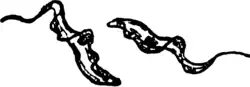
There, suddenly, popped into view the cause of the commotion—a curious little beast (much bigger than any ordinary microbe though), a creature with a blunt rear-end and a long slim lashing whip with which he seemed to explore in front of him. A creature shaped like a panatella cigar, only it was flexible, almost tying itself in knots sometimes, and it had a transparent graceful fin running the length of its body. Another of the beasts swam into the open space under the lens, and another. What extraordinary creatures! They didn't go stupidly along like common microbes—they acted like intelligent little dragons. Each one of them darted from one round red blood cell to another; he would worry at it, try to get inside it, tug at it and pull it, push it along ahead of him—then suddenly off he would go in a straight line and bury himself under a mass of the blood cells lining the shore of the open space. . . .
"Trypanosomes—these are!" cried Bruce, and he hurried to show them to his wife. In all animals sick with nagana they found these finned beasts, in the blood they were, and in the fluid of their puffy eyelids, and in the strange yellowish jelly that replaced the fat under their skins. And never a one of them could Bruce find in healthy dogs and horses and cows. But as the sick cattle grew sicker, these vicious snakes swarmed more and more thickly in their blood, until, when the animals lay gasping, next to death, the microbes writhed in them in quivering masses, so that you would swear their blood was made up of nothing else. . . . It was horrible!
But how did these trypanosomes get from a sick beast to a healthy one? "Here on the hill we can keep healthy animals in the same stables with the sick ones—and never a one of the sound animals comes down . . . here on the hill no cow or horse has ever been known to get nagana!" muttered Bruce. "Why? . . ."
He began to dream experiments, when the long arm of the Authorities—maybe it was that dear old Director-General remembering—found him again: Surgeon-Major Bruce was to proceed to Pietermaritzburg for duty in the typhoid epidemic raging there.
III
Only five weeks they had been at this work, when they started back to Pietermaritzburg, ten miles a day by ox-team through the jungle. He started treating soldiers for typhoid fever, but as usual—thief that he was—he stole time to try to find out something about typhoid fever, in a laboratory set up, since there was no regular one, of all places—in the morgue. There in the sickening vapors of the dead-house Bruce puttered in snatched moments, got typhoid fever himself, nearly died, and before he got thoroughly better was sent out as medical officer to a filibustering expedition got up to "protect" a few thousand square miles more of territory for the Queen. It looked like the end for him, Hely-Hutchinson's wires got tangled—there seemed no chance ever to work at nagana again; when the expedition had pierced a couple of hundred miles into the jungle, all of the horses and mules of this benevolent little army up and died, and what was left of the men had to try to hoof it back. A few came out, and David Bruce was among the lustiest of those gaunt hikers. . . .
Nearly a year had been wasted. But who can blame those natural enemies of David Bruce, the High Authorities, for keeping him from research? They looked at him; they secretly trembled at his burliness and his mustaches and his air of the Berserker. This fellow was born for a soldier! But they were so busy, or forgot, and presently Hely-Hutchinson did his dirty work again, and in September, 1895, Bruce and his wife got back to Ubombo, to try to untangle the knot of how nagana gets from a sick animal to a healthy one. And here Bruce followed, for the first time, Theobald Smith around that corner. . . . Like Theobald Smith, Bruce was a man to respect and to test folk-hunches and superstitions. He respected the beliefs of folks, himself he had no fancy super-scientific thoughts and never talked big words—yes, he respected such hunches—but he must test them!
"It is the tsetse flies cause nagana," said some experienced Europeans. "Flies bite domestic animals and put some kind of poison in them."
"Nagana is caused by big game," said the wise Zulu chiefs and medicine men. "The discharges of the buffalo, the quagga, and waterbuck, the koodoo—these contaminate the grass and the watering places—so it is horses and cattle are hit by the nagana."
"But why do we always fail to get our horses safe through the fly country—why is nagana called the fly disease?" asked the Europeans.
"Why, it's easy to get animals through the fly belt so long as you don't let them eat or drink!" answered the Zulus.
Bruce listened, and then proceeded to try out both ideas. He took good healthy horses, and tied heavy canvas bags round their noses so they couldn't eat nor drink; he led them down the hill to the pleasant-looking midday hell in the mimosa thickets; here he kept them for hours. While he watched to see they didn't slip their nose bags, swarms of pretty brown and gold tsetses buzzed around them—flopped on to the kicking horses and in twenty seconds swelled themselves up into bright balloons of blood. . . . The world seemed made of tsetse flies, and Bruce waved his arms. "They were enough to drive one mad!" he told me, thirty years afterward I can see him, talking to those pests in the language of a dockforeman, to the wonder of his Zulus. Day after day this procession of Bruce, the Zulus, and the experimental horses went down into the thorns, and each afternoon, as the sun went down behind Ubombo, Bruce and his migrating experiment grunted and sweated back up the hill.
Then, in a little more than fifteen days, to the delight of Bruce and his wife, the first of those horses who had served as a fly-restaurant turned up seedy in the morning and hung his head. And in the blood of this horse appeared the vanguard of the microscopic army of finned wee devils—that tussled so intelligently with the red blood cells. . . .
So it was with every horse taken down into the mimosa—and not one of them had eaten a blade of grass nor had one swallow of water down there; one and all they died of the nagana.
"Good, but it is not proved yet, one way or another," said Bruce. "Even if the horses didn't eat or drink, they may have inhaled those trypanosomes from the air—that's the way the greatest medical authorities think malaria is passed on from one man to the next—though it sounds like rot to me." But for Bruce nothing was rot until experiment proved it rot. "Here's the way to see," he cried. "Instead of taking the horses down, I'll bring the flies up!"
So he bought more healthy horses, kept them safe on the hill, thousands of feet above the dangerous plain, then once more he went down the hill—how that man loved to hunt, even for such idiotic game as flies!—and with him he took a decoy horse. The tsetses landed on the horse; Bruce and the Zulus picked them off gently, hundreds of them, and stuck them into an ingenious cage, made of muslin. Then back up the hill, to clap the cage buzzing with flies on to the back of a healthy horse. Through a clever glass window in one of the cage-sides they watched the greedy brutes make their meal by sticking their stingers through the muslin. And in less than a month it was the same with these horses, who had never eaten, nor drunk, nor even inhaled the air of the plain—every one died of the nagana.
How they worked, Bruce and his wife! They post-mortemed dead horses; they named a sick horse "The Unicorn" and tried to keep him alive with arsenic. To find out how long a tsetse fly can carry the trypanosomes on his stinger they put cages of flies on sick dogs and then at intervals of hours, and days, let them feed on healthy ones. They fed dying heifers hot pails of coffee, mercifully they shot dogs thinned by the nagana to sad bags of bones. Mrs. Bruce sterilized silk threads, to dip in blood swarming with trypanosomes, then sewed these threads under the hides of healthy dogs—to find out how long such blood might remain deadly. . . . There was now no doubt the tsetse flies, and only the flies, could carry the nagana, and now Bruce asked:
"But where do the tsetses of the plain get the trypanosomes they stick into cows and horses? In those fly belts there are often no horses or cattle sick with nagana, for months. Surely the flies [he was wrong here] can't stay infected for months—it must be they get them from the wild animals, the big game!" That was a possibility after his heart. Here was a chance to do something else than sit at a microscope. He forgot instantly about the more patient, subtle jobs that demanded to be done—teasing jobs, for a little man, jobs like tracing the life of the trypanosomes in the flies. . . . "The microbes must be in game!" and he buckled on his cartridge belt and loaded his guns. Into the thickets he went, and shot Burchell's zebras; he brought down koodoos and slaughtered water-bucks. He slashed open the dead beasts and from their hot hearts sucked up syringes full of blood, and jogged back up the hill with them. He looked through his microscopes for trypanosomes in these bloods—but didn't find them. But there was a streak of the dreamer in him. "They may be there, too few to see," he muttered, and to prove they were there he shot great quantities of the blood from ten different animals into healthy dogs. So he discovered that the nagana microbes may lurk in game, waiting to be carried to gentler beasts by the tsetse. So it was Bruce made the first step towards the opening up of Africa.
IV
And Hely-Hutchinson saw how right he had been about David Bruce. " 'Ware the tsetse fly," he told his farmers, "kill the tsetse fly, clear the thickets in which it likes to breed—drive out, exterminate the antelope from which it sucks the trypanosomes." So Bruce began ridding Africa of nagana.
Then came the Boer War. Bruce and Mrs. Bruce found themselves besieged in Ladysmith with nine thousand other Englishmen. There were thirty medical officers in the garrison—but not one surgeon. With each whine and burst of the shells from the Boer's "Long Tom" the rows of the wounded grew—there were moanings, and a horrid stench from legs that should be amputated. . . . "Think of it! Not one of those medicoes could handle a knife! Myself, I was only a laboratory man," said Bruce, "but I had cut up plenty of dogs and guinea-pigs and monkeys—so why not soldiers? There was one chap with a bashed-up knee . . . well, they chloroformed him, and while they were at that, I sat in the next room reading Treve's Surgery on how to take out a knee-joint. Then I went in and did it—we saved his leg." So Bruce became Chief Surgeon, and fought and starved, nearly to death, with the rest. What a boy that Bruce was! In 1924 in Toronto, in a hospital as he lay propped up, a battered bronchitic giant, telling me this story, his bright eye belied his skin wrinkled and the color of old parchment—and there was no doubt he was as proud of his slapdash surgery and his sulky battles with the authorities, as of any of his discoveries in microbe hunting. He chuckled through phlegm that gurgled deep in his ancient air-tubes: "Those red-tape fellows—I always had to fight their red-tape—until at last I got too str-r-rong for them!"
V
Presently, two years after Ladysmith, he became stronger than they—and they came asking him to hunt microbes. . . .
For death was abroad on the shores of Lake Victoria Nyanza, in Central Africa, on the Equator. It crept, it jumped, it kept popping up in new villages, it was in a way a very merciful death—though slow—for it was without pain, turning from a fitful fever into an unconquerable laziness strange to see in the busy natives of the lake shore; it passed, this death, from lethargy into a ridiculous sleepiness that made the mouths of the negroes fall open while they ate; it went at last from such a drowsiness into a delicious coma—no waking from this!—and into a horrible unnatural coldness that merged with the chill of the grave. Such was the African sleeping sickness. In a few years it had killed hundreds of thousands of the people of Uganda, it had sent brave missionaries to meet their God, and English colonial administrators home to their final slumber. It was turning the most generous soil on earth back into an unproductive preserve for giraffes and hyenas. The British Colonial Office was alarmed; shareholders began to fear for their dividends; natives—those who were left—began to leave their villages of shaggy, high-pitched, thatch-roofed huts. And the scientists and doctors?
Well, the scientists and doctors were working at it. Up till now the wisest ones were as completely ignorant of what was this sleeping death as the blackest trader in bananas was ignorant. No one could tell how it stole from a black father to his neighbor's dusky pickaninnies. But now the Royal Society sent out a commission made up of three searchers; they sailed for Uganda and began researches with the blood and spinal fluid of unhappy black men doomed with this drowsy death.
They groped; they sweat in the tropic heat; they formed different opinions: one was pretty sure a curious long worm that he found in the black men's blood was the cause of this death; a second had no definite opinion that I know of; the third, Castellani, thought at first that the wee villain back of the sleeping death was a streptococcus—like the microbe that causes sore throats.
That was way off the truth, but Castellani had the merit of working with his hands, trying this, trying that, devising ingenious ways of looking at the juices of those darkies. And so one day—by one of those unpredictable stumbles that lie at the bottom of so many discoveries—Castellani happened on one of those nasty little old friends of David Bruce, a trypanosome. From inside the backbone of a deadly drowsy black man Castellani had got fluid—to look for streptococcus. He put that fluid into a centrifuge—that works like a cream separator—to try to whirl possible microbes down to the bottom of the tube in the hope to find streptococcus. Down the barrel of his microscope Castellani squinted at a drop of the gray stuff from the bottom of the fluid and saw—
A trypanosome, and this beast was very much the same type of wiggler David Bruce had fished out of the blood of horses dying of nagana. Castellani kept squinting, found more trypanosomes, in the spinal juices and even in the blood of a half a dozen doomed darkies. . . .
That was the beginning, for if Castellani had not seen them, told Bruce about them, they might never have been found.
Meanwhile the smolder of the sleeping death broke into a flare that threatened English power in Africa. And the Royal Society sent the veteran David Bruce down there, with the trained searcher Nabarro, with Staff-Sergeant Gibbons, who could do anything from building roads to fixing a microscope. Then of course Mrs. Bruce was along; she had the title of Assistant—but Bruce paid her fare.
They came down to Uganda, met Castellani. He told Bruce about the streptococcus—and the trypanosomes. Back to the laboratory went these two; microscopes were unpacked, set up; doomed darkies carried in. Heavy needles were jabbed into these sad people's spines. Castellani, the young Nabarro, and Mrs. Bruce bent over their microscopes to find the yes or no of the discovery of Castellani. There they sat, in this small room on the Equator, squinting down the barrels of their machines at a succession of gray nothingnesses.
A bellow from Bruce: "I've got one!" The rest crowd round, squint in turn, exclaim as they watch the writhing trypanosome poke his exploring whip about in the gray field of the lens. Then they go back to their places—to shout discovery in their turn. So it went, from breakfast till the swift dusk of evening. In every single sample of spinal fluid from each one of his more than forty sleeping-sickness patients, Bruce and his companions found those trypanosomes.
"But they may be in healthy people's spines too!" said Bruce. Bruce knew that if he found them in healthy negroes, all this excitement would be only a wild-goose chase—he must prove they were to be found only in folks with sleeping sickness. But to get fluid out of healthy people's spines? Folks dopey from the sleeping death didn't mind it so much—but to jab one of those big needles into the back of healthy wide-awake colored people, who had no wish to be martyrs to science. . . . Can you blame them? It is no picnic having such a spear stuck into your spine. Then Bruce hit on a crafty scheme. He went to the hospital, where there was a fine array of patients with all kinds of diseases—but no sleeping sickness—and then, flimflamming them into thinking the operation would do them good, this liar in the holy cause of microbe hunting jabbed his needles into the smalls of the backs of negroes with broken legs and with headaches, into youngsters who had just been circumcised, and into their brothers or sisters who were suffering from yaws, or the itch; from all of them he got spinal fluid.
And it was a great success. Not one of these folks—who had no sleeping sickness—harbored a single trypanosome in the fluid of their spines. Maybe the operation did do them some good—but no matter, they had served their purpose. The trypanosome, Castellani and Bruce now knew, was the cause of sleeping sickness!
Now—and this is rare in the dreamers who find fundamental facts in science—Bruce was a fiend for practical applications, not poetically like Pasteur, for Bruce wasn't given to such lofty soarings, nor was he practical in the dangerous manner of the strange genius I tell of in the last chapter of this story; but the moment he turned to the study of a new plague, Bruce's gray eyes would dart round, he would begin asking himself questions: What is the natural home of the virus of this disease?—How does it get from sick to healthy?—What is its fountain and origin?—Is there anything peculiar in the way this sleeping sickness has spread?
That was the way he went at it now. He had discovered the trypanosome that was the cause. There were a thousand pretty little researches to tempt the scholar in him, but he brushed all these aside. Old crafty hand at searching that he was, he fished round in his memories, and came to nagana, and screwed up his eyes: "Is there anything peculiar about the way sleeping sickness is located in this country?" He pondered.
He sniffed around. With Mrs. Bruce he explored the high-treed shores of the lake, the islands, the rivers, the jungle. Then the common-sense eye which sees things a hundred searchers might stumble over and go by—showed him the answer. It was strange—suspiciously strange—that sleeping sickness was only found in a very narrow strip of country—along the water, only along the water, on the islands, up the river—even by the Ripon Falls where Victoria Nyanza gives herself up to the making of the Nile, there were cases of it, but never inland. That must mean some insect, a blood-sucking insect, which lives only near water, must carry the disease. That was his guess, why, I cannot tell you. "Maybe it is a tsetse fly, a special one living only near lake shores and river banks!"
So Bruce went around asking everybody about tsetse flies in Uganda. He inquired of local bug experts: no, they were sure tsetse flies could not live at an altitude above three thousand feet. He asked the native headmen, even the black Prime Minister of Uganda: sorry, we have a blood-sucking fly, called Kivu—but there are no tsetse flies in Uganda.
But there must be!
VI
And there were. One day, as they walked through the Botanical Garden at Entebbe, Bruce pushing his bulky body between the rows of tropic plants ahead of his small wife—there was a glad shriek from her. . . . "Why, David! There are two tsetse—on your back!" That woman was a scientific Diana. She swooped on those two tsetses, and caught them, and gave them a practical pinch—just enough to kill them, and then showed them to her husband. They had been perched, ready to strike, within a few inches of his neck. Now they knew they were on the trail.
Hard work began in the laboratory; already Bruce had found an excellent experimental animal—the monkey, which he could put into a beautiful fatal sleep, just like that of a man, by injecting fluid from the spines of doomed negroes. But now to catch tsetse flies. They armed themselves with butterfly nets and the glass-windowed cages they had invented in Zululand. Then these inseparable searchers climbed into canoes; lusty crews of black boys shot them across the lake. Along the banks they walked—it was charming in the shade there—but listen! Yes, there was the buzz of the tsetse. . . . They tried to avoid being bitten. They were bit—and stayed awake nights wondering what would happen—they went back to the laboratory and clapped the cages on the backs of monkeys. It was a good time for them.
That is the secret of those fine discoveries Bruce made. It was because he was a hunter. Not only with his mind—but a bold everlastingly curious snouting hunter with his body too. If he had sat back and listened to those missionaries, or stayed listening to those bug experts—he would never have learned that Kivu was the Uganda name for the tsetse. He would never have found the tsetse. But he carried the fight to the enemy—and as for Mrs. Bruce, that woman was better than a third hand or two extra pairs of eyes for him.
Now they planned and did terrible experiments. Day after day they caused tsetse flies to feed on patients near to death (already too deep in sleep to be annoyed by the insects); they interrupted the flies in the midst of their meal, and put the angry, half-satisfied cages of them on the backs of monkeys. With all the tenderness of high-priced nurses watching over Park Avenue babies they saw to it that only their experimental flies, and no chance flies from outside, got a meal off those beasts. Other searchers might have rolled their thumbs waiting to see what happened to the monkeys, but not Bruce.
He proceeded to call in a strange gang of co-workers to help him in one of the most amazing tests of all microbe hunting. Bruce asked for an audience from the high-plumed gay-robed potentate, Apolo Kagwa, Prime Minister of Uganda. He told Apolo he had discovered the microbe of the sleeping death which was killing so many thousands of his people. He informed him many thousands more already had the parasite in their blood, and were doomed. "But there is a way to stop the ruin that faces your country, for I have reason to believe it is the tsetse fly—the insect you call Kivu—and only this insect, that carries the poisonous germ from a sick man to a healthy one—"
The magnificent Apolo broke in: "But I cannot believe that is so—Kivu has been on the Lake shore always, and my people have only begun to be taken by the sleeping sickness during the last few years—"
Bruce didn't argue. He bluffed, as follows: "If you do not believe me, give me a chance to prove it to you. Go down Apolo Kagwa, to the Crocodile Point on the Lake shore where Kivu swarms so. Sit on the shore there with your feet in the water for five minutes. Don't keep off the flies—and I'll promise you'll be a dead man in two years!"
The bluff was perfect: "What then, is to be done, Colonel Bruce?" asked Apolo.
"Well, I must be dead sure I am right," Bruce told him. Then he showed Apolo a great map of Uganda. "If I'm right, where there is sleeping sickness—there we will find tsetse flies too. Where there are no tsetse—there should be no sleeping sickness."
So Bruce gave Apolo butterfly nets, and killing bottles, and envelopes; he gave directions about the exact way to set down all the facts, and he told how Apolo's darky minions might pinch the flies without getting stabbed themselves. "And then we will put our findings down on this map—and see if I'm right."
Apolo was nothing if not intelligent, and efficient. He said he would see what could be done. There were bows and amiable formalities. In a jiffy the black Prime Minister had called for his head chief, the Sekibobo, and all the paraphernalia, with rigid directions, went from the Sekibobo to the lesser headmen, and from them down to the canoe men—the wheels of that perfect feudal system were set going. . . .
Presently the envelopes began to pour in on Bruce and called him away from his monkey experiments. They cluttered the laboratory, they called him from his peerings into the intestines of tsetse flies where he looked for trypanosomes. Rapidly, with perfectly recorded facts—most of them set down by intelligent blacks and some by missionaries—the envelopes came in. It was a kind of scientific co-working you would have a hard time finding among white folks, even white medical men. Each envelope had a grubby assorted mess of biting flies, they had a dirty time sorting them, but every time they found a tsetse, a red-headed pin went into that spot on the map—and if a report of "sleeping sickness present" came with that fly, a black-headed pin joined it. From the impressive Sekibobo down to the lowest fly-boy, Apolo's men had done their work with an automatic perfection. At last the red and black dots on the map showed that where there were tsetses, there was the sleeping death—and where there were no tsetses—there was no single case of sleeping sickness!
The job looked finished. The unhappy monkeys bit by the flies who had sucked the blood of dying negroes—these monkeys' mouths fell open while they tried to eat their beloved bananas; they went to sleep and died. Other monkeys never bit by flies—but kept in the same cages, eating out of the same dishes—those monkeys never showed a sign of the disease. Here were experiments as clean, as pretty as the best ones Theobald Smith had made. . . .
VII
But now for action! Whatever of the dreamer and laboratory experimenter there was in him—and there was much—those creative parts of David Bruce went to sleep, or evaporated out of him; he became the surgeon of Ladysmith once more, and the rampageous shooter of lions and killer of koodoos. . . . To wipe out the sleeping sickness! That seemed the most brilliantly simple job now. Not that there weren't countless thousands of blacks with trypanosomes in their blood, and all these folks must die, of course; not that there weren't buzzing billions of tsetses singing their hellish tune on the Lake shore—but here was the point: Those flies lived only on the Lake shore! And if they had no more sleeping-sickness blood to suck, then. . . . And Apolo Kagwa was absolute Tsar of all Uganda . . . Apolo, Bruce knew, trusted him, adored him. . . .
Now to wipe sleeping sickness from the earth!
To conference with Bruce once more came Apolo and the Sekibobo and the lesser chiefs. Bruce told them the simple logic of what was to be done.
"Of course—that can be done," said Apolo. He had seen the map. He was convinced. He made a dignified wave of the hand to his chiefs, and gave a few words of explanation. So Bruce and Mrs. Bruce went back to England. Apolo gave his order, and then the pitiful population of black men and their families streamed inland out of the lake shore villages, away—not to return for years, or ever—from those dear shady places where they and the long line of their forefathers had fished and played and bargained and begot their kind; canoes, loaded with mats and earthen pots and pickaninnies set out (not to return) from the thickly peopled island—and the weird outlandish beating of the tom-toms no longer boomed across the water.
"Not one of you," commanded Apolo, "may live within fifteen miles of the Lake shore—not one of you is to visit the Lake again. Then the sleeping death will die out, for the fly Kivu lives only by the water, and when you are gone she will no longer have a single sick one from whom to suck the fatal poison. When all of our people who are now sick have died, you may go back—and it will be safe to live by the Lake shore for always."
Without a word—it is incredible to us law-abiding folks—they obeyed their potentate.
The country around Lake Victoria Nyanza grew, in the frantic way tropical green things grow, back into the primordial jungle; crocodiles snoozed on the banks where big villages had been. Hippopotami waddled onto the shore and sniffed in the deserted huts. . . . The tribes of the lake, inland, were happy, for no more of them came down with that fatal drowsiness. So Bruce began to rid Africa of sleeping sickness.
It was a triumph—in a time of great victories in the fight of men against death. The secret of the spread of malaria—you will hear the not too savory story of it presently—had been found in India and Italy. And as for yellow fever—it seemed as if the yellow jack was to be put to sleep for good. Great Eminences of the medical profession pointed in speeches amid cheers to the deeds of medicine. . . . The British Empire rang with hosannahs for David Bruce. He was promoted Colonel. He was dubbed Knight Commander of the Bath. Lady Bruce? Well, she was proud of him and stayed his assistant, obscurely. And Bruce still paid, out of his miserable colonel's salary, her fare on those expeditions they were always making.
Africa looked safe for the black men, and open to the benevolent white men. But nature had other notions. She had cards up her sleeve. She almost never lets herself be conquered at a swoop, Napoleonically—as Bruce and Apolo (and who can blame them?) thought they had done. Nature was not going to let her vast specimen cabinet be robbed so easily of every last one of those pretty parasites, the trypanosomes of sleeping sickness. A couple of years passed, and suddenly the Kavirondo people, on the east shore of the Lake where sleeping death had never been—these folks began to go to sleep and not wake up. And there were disturbing reports of hunters coming down with sleeping sickness, even in those places that should have been safe, in the country from which all human life had been moved away. The Royal Society sent out another Commission (Bruce was busy with that affair of goat's milk giving Malta fever) and one of these new commissioners was a bright young microbe hunter, Tulloch. He went on a picnic one day to a nice part of the shore whose dark green was dotted with scarlet flowers. It must be safe there now, they thought, but a tsetse buzzed, and in less than a year Tulloch had drowsed into his last cold sleep. The Com- mission went home. . . .
Bruce—you would think he would be looking by this time for some swivel-chair button-pressing job—packed his kit-bag and went back to Uganda, to see what he had left out of those experiments that had looked so sure. He had gone off half-cocked, with that Napoleonic plan of moving a nation, but who can blame him? It had looked so simple, and how expect even the craftiest of the cheaters of Nature to find out, in a year, every single nook where Nature hides the living poisons to kill the presumptuous men who cheat her! Lady Bruce as usual went with him, and they found new epidemics of sleeping sickness flaring up in unwonted places. It was a miserable discouraging business.
Bruce was a modest man, who had no foolish vanity to tell him that his own theories were superior to brute facts. "My plan has been a washout," you can hear him grumbling. "Somewhere, aside from the human being, those tsetses must get the trypanosomes—maybe it's like the nagana—maybe they can live in wild beasts' blood too. . . ."
Now if Bruce had theories that were a little too simple he was just the same an exceedingly crafty experimenter; if he had a foolish faith in his experiments, he had the persistence to claw his way out of the bogs of disappointment that his simplicity and love of gorgeous deeds got him into. What a stubborn man he was! For, when you think of the menagerie of birds, beasts, fishes and reptiles Uganda is, you wonder why he didn't pack his bags and start back for England. But no. Once more the canoe man paddled Bruce and his lady across to that tangled shore, and they caught flies in places where for three years no man had been. Strange experiments they made in a heat to embarrass a salamander—one laborious complicated record in his notes tells of two thousand, eight hundred and seventy-six flies (which could never have bitten a human sleeping-sickness patient) fed on five monkeys—and two of these monkeys came down with the disease!
"The trypanosomes must be hiding in wild animals!" Bruce cries. So they go to the dangerous Crocodile Point, and catch wild pigs and African gray and purple herons; they bleed sacred ibises and glossy ones; they stab and get blood from plovers and kingfishers and cormorants—and even crocodiles! Everywhere they look for those deadly, hiding, thousandth-of-an-inch-long wigglers.
They caught tsetse flies on Crocodile Point. See the fantastic picture of them there, gravely toiling at a job fit for a hundred searchers to take ten years at. Bruce sits with his wife on the sand in the middle of a ring of bare-backed paddlers who squat round them. The tsetses buzz down onto the paddlers' backs. The fly-boys pounce on them, hand them to Bruce, who snips off their heads, waves the buzzing devils away from his own neck, determines the sex of each fly caught, dissects out its intestine—and smears the blood in them on thin glass slides. . . .
Washouts, most of these experiments; but one day, in the blood of a native cow from the Island of Kome, not hurting that cow at all, but ready to be sucked up by the tsetse for stabbing under the skin of the first man it meets, Bruce found the trypanosome of sleeping sickness. He sent out word, and presently a lot of bulls and cows were driven up the hill to Mpumu by order of Apolo Kagwa. Bruce, himself in the thick of it, directed dusty fly-bitings of these cattle—yes! there was no doubt the sleeping-sickness virus could live in them. Then there were scuffles in the hot pens with fresh-caught antelope; they were thrown, they were tied, Bruce held dying monkeys across their flanks, and let harmless tsetses, bred in the laboratory, feed on the monkey and then on the buck. . . .
"The fly country around the Lake shore will have to be cleared of antelope, too, as well as men—before the Kivu become harmless," Bruce said at last to Apolo.
And now the sleeping death really disappeared from the shores of Lake Victoria Nyanza.
VIII
The ten thousand smaller microbe hunters who work at lesser jobs to-day, as well as the dozen towering ones whose adventures this book tells, all of them have to take some risk of death. But if the ten thousand smaller microbe hunters of to-day could by some chemistry be changed into deathfighters like Bruce! There was something diabolical in the risks he took, and something yet more devilish in the way he could laugh—with a dry humor—and wish other microbe hunters might have died to prove some of his own theories. But he had a right to wish death for others—
"Can young tsetse flies, bred in the laboratory, inherit the sleeping-sickness trypanosome from their mothers? Surely there was a chance of it (you remember that strange business of Theobald Smith's mother-ticks bequeathing the Texas fever microbe to their children). But analogies are for philosophers and lawyers. "Are artificially hatched young tsetses dangerous?" asks Bruce. "No!" he can answer. "For two members of the commission" [modestly he does not say which two members] "allowed hundreds of tsetse flies, bred in the laboratory, to bite them. And the result was negative."
But no man knew what the result would be—before he tried. And the deaths from sleeping sickness (according to the best figures) are one hundred out of one hundred. . . .
How he enjoyed hearing of other men trying to kill themselves to find out! His last African foray was in 1911—he stayed until 1914. He was near sixty; his blacksmith's strength was beginning to crack from a nasty infection of his air-tubes got from I know not what drenching rains or chills of high tropic nights. But a new form of sleeping sickness—terrible stuff that killed in a few months instead of years—had just broken out in Nyassaland and Rhodesia. There was a great scientific quarrel on. Was the trypanosome causing this disease some new beast just out of the womb of Nature—or was it nothing else than Bruce's old parasite of nagana, tired of butchering only cows, dogs and horses, and now learning to kill men?
Bruce went to work at it. A German in Portuguese East Africa said: "This trypanosome is a new kind of bug!" Bruce retorted: "On the contrary, it is nothing but the nagana germ hopping from cows to men."
Then this German, his name was Taute, took the blood of an animal about to die from nagana, and shot five cubic centimeters of it—it held millions of trypanosomes—under his own skin: to prove the nagana parasite does not kill men. And he let scores of tsetse flies bite him, flies whose bellies and spit-glands were crammed with the writhing microbes—he did these things to prove his point!
Was Bruce shocked at this? Listen to him, then: "It is a matter for some scientific regret that these experiments were not successful—though we can ill spare our bold and somewhat rash colleague—for then the question would have been answered. . . . As it is, these negative experiments prove nothing. It may be that only one man in a thousand would become infected that way."
Merciless Bruce! Poor Taute! He tried conscientiously to kill himself—and Bruce says it is too bad he did not die. He made the ultimate gesture—surely the God of searchers will reward him; then Bruce (and he is right) criticizes the worth of Taute's lone desperate experiment!
Nyassaland was the last battlefield of Bruce against the sleeping sickness, and it was his most hopeless one. For here he found that the Glossina morsitans (that is the name of the tsetse carrier of the sickness) does not make its home only on the shores of lakes and rivers, but buzzes and bites from one end of Nyassaland to the other; there is no way of running away from it, no chance of moving nations out from under it here. . . . Bruce stuck at it, he spent years at measurements of the lengths of trypanosomes—monotonous enough this work was to have driven a subway ticket chopper mad—he was trying to find out whether the nagana and this new disease were one and the same thing. He ended by not finding out, and he finished with this regret: that it was at present impossible to do the experiment to clinch the matter one way or the other.
That experiment was the injection of the nagana trypanosomes, not into one, or a hundred—but a thousand human beings.
IX
But there was grisly hope left in the old Viking. "At present it is impossible," he said, while he believed that somewhere, somewhen, men may be found, in the mass, who will be glad to die for truth. And as you will see, in a story of a band of American buck-privates in another chapter, there are beginnings of such spirit even now. But when great armies of men so offer themselves, to fight death, just as they now delight to fight each other, it will be because they are led on by captains such as David Bruce.