Microbe Hunters/Chapter 1
CHAPTER I
LEEUWENHOEK
FIRST OF THE MICROBE HUNTERS
I
Two hundred and fifty years ago an obscure man named Leeuwenhoek looked for the first time into a mysterious new world peopled with a thousand different kinds of tiny beings, some ferocious and deadly, others friendly and useful, many of them more important to mankind than any continent or archipelago.
Leeuwenhoek, unsung and scarce remembered, is now almost as unknown as his strange little animals and plants were at the time he discovered them. This is the story of Leeuwenhoek, the first of the microbe hunters. It is the tale of the bold and persistent and curious explorers and fighters of death who came after him. It is the plain history of their tireless peerings into this new fantastic world. They have tried to chart it, these microbe hunters and death fighters. So trying they have groped and fumbled and made mistakes and roused vain hopes. Some of them who were too bold have died—done to death by the immensely small assassins they were studying—and these have passed to an obscure small glory.
To-day it is respectable to be a man of science. Those who go by the name of scientist form an important element of the population, their laboratories are in every city, their achievements are on the front pages of the newspapers, often before they are fully achieved. Almost any young university student can go in for research and by and by become a comfortable science professor at a tidy little salary in a cozy college. But take yourself back to Leeuwenhoek's day, two hundred and fifty years ago, and imagine yourself just through high school, getting ready to choose a career, wanting to know—
You have lately recovered from an attack of mumps, you ask your father what is the cause of mumps and he tells you a mumpish evil spirit has got into you. His theory may not impress you much, but you decide to make believe you believe him and not to wonder any more about what is mumps—because if you publicly don’t believe him you are in for a beating and may even be turned out of the house. Your father is Authority.
That was the world three hundred years ago, when Leeuwenhoek was born. It had hardly begun to shake itself free from superstitions, it was barely beginning to blush for its ignorance. It was a world where science (which only means trying to find truth by careful observation and clear thinking) was just learning to toddle on vague and wobbly legs. It was a world where Servetus was burned to death for daring to cut up and examine the body of a dead man, where Galileo was shut up for life for daring to prove that the earth moved around the sun.
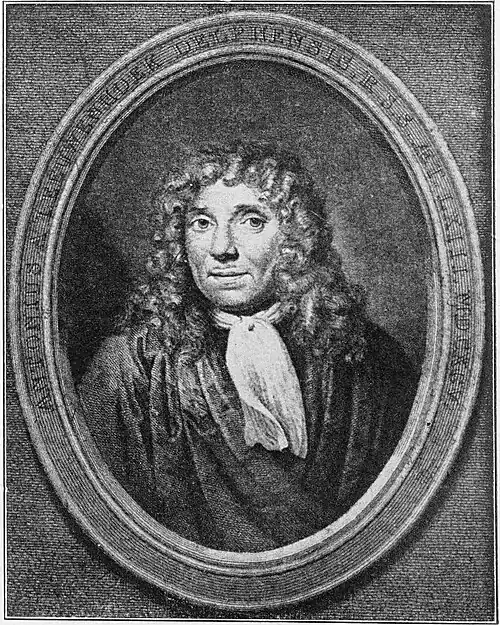
Antony Leeuwenhoek was born in 1632 amid the blue windmills and low streets and high canals of Delft, in Holland. His family were burghers of an intensely respectable kind and I say intensely respectable because they were basket-makers and brewers, and brewers are respectable and highly honored in Holland. Leeuwenhoek's father died early and his mother sent him to school to learn to be a government official, but he left school at sixteen to be an apprentice in a dry-goods store in Amsterdam. That was his university. Think of a present-day scientist getting his training for experiment among bolts of gingham, listening to the tinkle of the bell on the cash drawer, being polite to an eternal succession of Dutch housewives who shopped with a penny-pinching dreadful exhaustiveness—but that was Leeuwenhoek's university, for six years!
At the age of twenty-one he left the dry-goods store, went back to Delft, married, set up a dry-goods store of his own there. For twenty years after that very little is known about him, except that he had two wives (in succession) and several children most of whom died, but there is no doubt that during this time he was appointed janitor of the city hall of Delft, and that he developed a most idiotic love for grinding lenses. He had heard that if you very carefully ground very little lenses out of clear glass, you would see things look much bigger than they appeared to the naked eye. . . . Little is known about him from twenty to forty, but there is no doubt that he passed in those days for an ignorant man. The only language he knew was Dutch—that was an obscure language despised by the cultured world as a tongue of fishermen and shop-keepers and diggers of ditches. Educated men talked Latin in those days, but Leeuwenhoek could not so much as read it and his only literature was the Dutch Bible. Just the same, you will see that his ignorance was a great help to him, for, cut off from all of the learned nonsense of his time, he had to trust to his own eyes, his own thoughts, his own judgment. And that was easy for him because there never was a more mulish man than this Antony Leeuwenhoek!
It would be great fun to look through a lens and see things bigger than your naked eye showed them to you! But buy lenses? Not Leeuwenhoek! There never was a more suspicious man. Buy lenses? He would make them himself! During these twenty years of his obscurity he went to spectacle-makers and got the rudiments of lens-grinding. He visited alchemists and apothecaries and put his nose into their secret ways of getting metals from ores, he began fumblingly to learn the craft of the gold- and silversmiths. He was a most pernickety man and was not satisfied with grinding lenses as good as those of the best lens-grinder in Holland, they had to be better than the best, and then he still fussed over them for long hours. Next he mounted these lenses in little oblongs of copper or silver or gold, which he had extracted himself, over hot fires, among strange smells and fumes. To-day searchers pay seventy-five dollars for a fine shining microscope, turn the screws, peer through it, make discoveries—without knowing anything about how it is built. But Leeuwenhoek—
Of course his neighbors thought he was a bit cracked but Leeuwenhoek went on burning and blistering his hands. Working forgetful of his family and regardless of his friends, he bent solitary to subtle tasks in still nights. The good neighbors sniggered, while that man found a way to make a tiny lens, less than one-eighth of an inch across, so symmetrical, so perfect, that it showed little things to him with a fantastic clear enormousness. Yes, he was a very uncultured man, but he alone of all men in Holland knew how to make those lenses, and he said of those neighbors: "We must forgive them, seeing that they know no better."
Now this self-satisfied dry-goods dealer began to turn his lenses onto everything he could get hold of. He looked through them at the muscle fibers of a whale and the scales of his own skin. He went to the butcher shop and begged or bought ox-eyes and was amazed at how prettily the crystalline lens of the eye of the ox is put together. He peered for hours at the build of the hairs of a sheep, of a beaver, of an elk, that were transformed from their fineness into great rough logs under his bit of glass. He delicately dissected the head of a fly; he stuck its brain on the fine needle of his microscope—how he admired the clear details of the marvelous big brain of that fly! He examined the cross-sections of the wood of a dozen different trees and squinted at the seeds of plants. He grunted "Impossible!" when he first spied the outlandish large perfection of the sting of a flea and the legs of a louse. That man Leeuwenhoek was like a puppy who sniffs—with a totally impolite disregard of discrimination—at every object of the world around him!
II
There never was a less sure man than Leeuwenhoek. He looked at this bee's sting or that louse's leg again and again and again. He left his specimens sticking on the point of his strange microscope for months—in order to look at other things he made more microscopes till he had hundreds of them!—then he came back to those first specimens to correct his first mistakes. He never set down a word about anything he peeped at, he never made a drawing until hundreds of peeps showed him that, under given conditions, he would always see exactly the same thing. And then he was not sure! He said:
"People who look for the first time through a microscope say now I see this and then I see that—and even a skilled observer can be fooled. On these observations I have spent more time than many will believe, but I have done them with joy, and I have taken no notice of those who have said why take so much trouble and what good is it?—but I do not write for such people but only for the philosophical!" He worked for twenty years that way, without an audience.
But at this time, in the middle of the seventeenth century, great things were astir in the world. Here and there in France and England and Italy rare men were thumbing their noses at almost everything that passed for knowledge. "We will no longer take Aristotle's say-so, nor the Pope's say-so," said these rebels. "We will trust only the perpetually repeated observations of our own eyes and the careful weighings of our scales; we will listen to the answers experiments give us and no other answers!" So in England a few of these revolutionists started a society called The Invisible College, it had to be invisible because that man Cromwell might have hung them for plotters and heretics if he had heard of the strange questions they were trying to settle. What experiments those solemn searchers made! Put a spider in a circle made of the powder of a unicorn's horn and that spider can't crawl out—so said the wisdom of that day. But these Invisible Collegians? One of them brought what was supposed to be powdered unicorn's horn and another came carrying a little spider in a bottle. The college crowded around under the light of high candles. Silence, then the hushed experiment, and here is their report of it:
"A circle was made with the powder of unicorn's horn and a spider set in the middle of it, but it immediately ran out."
Crude, you exclaim. Of course! But remember that one of the members of this college was Robert Boyle, founder of the science of chemistry, and another was Isaac Newton. Such was the Invisible College, and presently, when Charles II came to the throne, it rose from its depths as a sort of blind-pig scientific society to the dignity of the name of the Royal Society of England. And they were Antony Leeuwenhoek’s first audience! There was one man in Delft who did not laugh at Antony Leeuwenhoek, and that was Regnier de Graaf, whom the Lords and Gentlemen of the Royal Society had made a corresponding member because he had written them of interesting things he had found in the human ovary. Already Leeuwenhoek was rather surly and suspected everybody, but he let de Graaf peep through those magic eyes of his, those little lenses whose equal did not exist in Europe or England or the whole world for that matter. What de Graaf saw through those microscopes made him ashamed of his own fame and he hurried to write to the Royal Society:
"Get Antony Leeuwenhoek to write you telling of his discoveries."
And Leeuwenhoek answered the request of the Royal Society with all the confidence of an ignorant man who fails to realize the profound wisdom of the philosophers he addresses. It was a long letter, it rambled over every subject under the sun, it was written with a comical artlessness in the conversational Dutch that was the only language he knew. The title of that letter was: "A Specimen of some Observations made by a Microscope contrived by Mr. Leeuwenhoek, concerning Mould upon the Skin, Flesh, etc.; the Sting of a Bee, etc." The Royal Society was amazed, the sophisticated and learned gentlemen were amused—but principally the Royal Society was astounded by the marvelous things Leeuwenhoek told them he could see through his new lenses. The Secretary of the Royal Society thanked Leeuwenhoek and told him he hoped his first communication would be followed by others. It was, by hundreds of others over a period of fifty years. They were talkative letters full of salty remarks about his ignorant neighbors, of exposures of charlatans and of skilled explodings of superstitions, of chatter about his personal health—but sandwiched between paragraphs and pages of this homely stuff, in almost every letter, those Lords and Gentlemen of the Royal Society had the honor of reading immortal and gloriously accurate descriptions of the discoveries made by the magic eye of that janitor and shopkeeper. What discoveries!
When you look back at them, many of the fundamental discoveries of science seem so simple, too absurdly simple. How was it men groped and fumbled for so many thousands of years without seeing things that lay right under their noses? So with microbes. Now all the world has seen them cavorting on movie screens, many people of little learning have peeped at them swimming about under lenses of microscopes, the greenest medical student is able to show you the germs of I don't know how many diseases—what was so hard about seeing microbes for the first time?
But let us drop our sneers to remember that when Leeuwenhoek was born there were no microscopes but only crude hand-lenses that would hardly make a ten-cent piece look as large as a quarter. Through these—without his incessant grinding of his own marvelous lenses—that Dutchman might have looked till he grew old without discovering any creature smaller than a cheese-mite. You have read that he made better and better lenses with the fanatical persistence of a lunatic; that he examined everything, the most intimate things and the most shocking things, with the silly curiosity of a puppy. Yes, and all this squinting at bee-stings and mustache hairs and what-not were needful to prepare him for that sudden day when he looked through his toy of a gold-mounted lens at a fraction of a small drop of clear rain water to discover—
What he saw that day starts this history. Leeuwenhoek was a maniac observer, and who but such a strange man would have thought to turn his lens on clear, pure water, just come down from the sky? What could there be in water but just—water? You can imagine his daughter Maria—she was nineteen and she took such care of her slightly insane father!—watching him take a little tube of glass, heat it red-hot in a flame, draw it out to the thinness of a hair. . . . Maria was devoted to her father—let any of those stupid neighbors dare to snigger at him!—but what in the world was he up to now, with that hair-fine glass pipe?
You can see her watch that absent-minded wide-eyed man break the tube into little pieces, go out into the garden to bend over an earthen pot kept there to measure the fall of the rain. He bends over that pot. He goes back into his study. He sticks the little glass pipe onto the needle of his microscope. . . .
What can that dear silly father be up to?
He squints through his lens. He mutters guttural words under his breath. . . .
Then suddenly the excited voice of Leeuwenhoek: "Come here! Hurry! There are little animals in this rain water. . . . They swim! They play around! They are a thousand times smaller than any creatures we can see with our eyes alone. . . . Look! See what I have discovered!"
Leeuwenhoek's day of days had come. Alexander had gone to India and discovered huge elephants that no Greek had ever seen before—but those elephants were as commonplace to Hindus as horses were to Alexander. Cæsar had gone to England and come upon savages that opened his eyes with wonder—but these Britons were as ordinary to each other as Roman centurions were to Cesar. Balboa? What were his proud feelings as he looked for the first time at the Pacific? Just the same that Ocean was as ordinary to a Central American Indian as the Mediterranean was to Balboa. But Leeuwenhoek? This janitor of Delft had stolen upon and peeped into a fantastic sub-visible world of little things, creatures that had lived, had bred, had battled, had died, completely hidden from and unknown to all men from the beginning of time. Beasts these were of a kind that ravaged and annihilated whole races of men ten million times larger than they were themselves. Beings these were, more terrible than fire-spitting dragons or hydra-headed monsters. They were silent assassins that murdered babes in warm cradles and kings in sheltered places. It was this invisible, insignificant, but implacable—and sometimes friendly—world that Leeuwenhoek had looked into for the first time of all men of all countries.
This was Leeuwenhoek's day of days. . . .
III
That man was so unashamed of his admirations and his surprises at a nature full of startling events and impossible things. How I wish I could take myself back, could bring you back, to that innocent time when men were just beginning to disbelieve in miracles and only starting to find still more miraculous facts. How marvelous it would be to step into that simple Dutchman's shoes, to be inside his brain and body, to feel his excitement—it is almost nausea!—at his first peep at those cavorting "wretched beasties."
That was what he called them, and, as I have told you, this Leeuwenhoek was an unsure man. Those animals were too tremendously small to be true, they were too strange to be true. So he looked again, till his hands were cramped with holding his microscope and his eyes full of that smarting water that comes from too-long looking. But he was right! Here they were again, not one kind of little creature, but here was another, larger than the first, "moving about very nimbly because they were furnished with divers incredibly thin feet." Wait! Here is a third kind—and a fourth, so tiny I can't make out his shape. But he is alive! He goes about, dashing over great distances in this world of his water-drop in the little tube. . . . What nimble creatures!
"They stop, they stand still as 'twere upon a point, and then turn themselves round with that swiftness, as we see a top turn round, the circumference they make being no bigger than that of a fine grain of sand." So wrote Leeuwenhoek.
For all this seemingly impractical sniffing about, Leeuwenhoek was a hard-headed man. He hardly ever spun theories, he was a fiend for measuring things. Only how could you make a measuring stick for anything so small as these little beasts? He wrinkled his low forehead: "How large really is this last and smallest of the little beasts?" He poked about in the cob-webbed corners of his memory among the thousand other things he had studied with you can't imagine what thoroughness; he made calculations: "This last kind of animal is a thousand times smaller than the eye of a large louse!" That was an accurate man. For we know now that the eye of one full-grown louse is no larger nor smaller than the eyes of ten thousand of his brother and sister lice.
But where did these outlandish little inhabitants of the rainwater come from? Had they come down from the sky? Had they crawled invisibly over the side of the pot from the ground? Or had they been created out of nothing by a God full of whims? Leeuwenhoek believed in God as piously as any Seventeenth Century Dutchman. He always referred to God as the Maker of the Great All. He not only believed in God but he admired him intensely—what a Being to know how to fashion bees' wings so prettily! But then Leeuwenhoek was a materialist too. His good sense told him that life comes from life. His simple belief told him that God had invented all living things in six days, and, having set the machinery going, sat back to reward good observers and punish guessers and bluffers. He stopped speculating about improbable gentle rains of little animals from heaven, Certainly God couldn't brew those animals in the rain water pot out of nothing! But wait. . . . Maybe? Well, there was only one way to find out where they came from. "I will experiment!" he muttered.
He washed out a wine glass very clean, he dried it, he held it under the spout of his eaves-trough, he took a wee drop in one of his hair-fine tubes. Under his lens it went. . . . Yes! They were there, a few of those beasts, swimming about. . . . "They are present even in very fresh rain water!" But then, that really proved nothing, they might live in the eaves-trough and be washed down by the water. . . .
Then he took a big porcelain dish, "glazed blue within," he washed it clean, out into the rain he went with it and put it on top of a big box so that the falling raindrops would splash no mud into the dish. The first water he threw out to clean it still more thoroughly. Then intently he collected the next bit in one of his slender pipes, into his study he went with it. . . .
"I have proved it! This water has not a single little creature in it! They do not come down from the sky!"
But he kept that water; hour after hour, day after day he squinted at it—and on the fourth day he saw those wee beasts beginning to appear in the water along with bits of dust and little flecks of thread and lint. That was a man from Missouri! Imagine a world of men who would submit all of their cocksure judgments to the ordeal of the common-sense experiments of a Leeuwenhoek!
Did he write to the Royal Society to tell them of this entirely unsuspected world of life he had discovered? Not yet! He was a slow man. He turned his lens onto all kinds of water, water kept in the close air of his study, water in a pot kept on the high roof of his house, water from the not-too-clean canals of Delft and water from the deep cold well in his garden. Everywhere he found those beasts. He gaped at their enormous littleness, he found many thousands of them did not equal a grain of sand in bigness, he compared them to a cheese-mite and they were to this filthy little creature as a bee is to a horse. He was never tired with watching them "swim about among one another gently like a swarm of mosquitoes in the air. . . ."
Of course this man was a groper. He was a groper and a stumbler as all men are gropers, devoid of prescience, and stumblers, finding what they never set out to find. His new beasties were marvelous but they were not enough for him, he was always poking into everything, trying to see more closely, trying to find reasons. Why is the sharp taste of pepper? That was what he asked himself one day, and he guessed: "There must be little points on the particles of pepper and these points jab the tongue when you eat pepper. . . ."
But are there such little points?
He fussed with dry pepper. He sneezed. He sweat, but he couldn’t get the grains of pepper small enough to put under his lens. So, to soften it, he put it to soak for several weeks in water. Then with fine needles he pried the almost invisible specks of the pepper apart, and sucked them up in a little drop of water into one of his hair-fine glass tubes. He looked—
Here was something to make even this determined man scatter-brained. He forgot about possible small sharp points on the pepper. With the interest of an intent little boy he watched the antics of "an incredible number of little animals, of various sorts, which move very prettily, which tumble about and sidewise, this way and that!"
So it was Leeuwenhoek stumbled on a magnificent way to grow his new little animals.
And now to write all this to the great men off there in London! Artlessly he described his own astonishment to them. Long page after page in a superbly neat handwriting with little common words he told them that you could put a million of these little animals into a coarse grain of sand and that one drop of his pepper-water, where they grew and multiplied so well, held more than two-million seven-hundred-thousand of them. . . .
This letter was translated into English. It was read before the learned skeptics—who no longer believed in the magic virtues of unicorn's horns—and it bowled the learned body over! What! The Dutchman said he had discovered beasts so small that you could put as many of them into one little drop of water as there were people in his native country? Nonsense! The cheese mite was absolutely and without doubt the smallest creature God had created.
But a few of the members did not scoff. This Leeuwenhoek was a confoundedly accurate man: everything he had ever written to them they had found to be true. . . . So a letter went back to the scientific janitor, begging him to write them in detail the way he had made his microscope, and his method of observing.
That upset Leeuwenhoek. It didn’t matter that these stupid oafs of Delft laughed at him—but the Royal Society? He had thought they were philosophers! Should he write them details, or should he from now on keep everything he did to himself? "Great God," you can imagine him muttering, "these ways I have of uncovering mysterious things, how I have worked and sweat to learn to do them, what jeering from how many fools haven't I endured to perfect my microscopes and my ways of looking! . . ."
But creators must have audiences. He knew that these doubters of the Royal Society should have sweat just as hard to disprove the existence of his little animals as he himself had toiled to discover them. He was hurt, but—creators must have an audience. So he replied to them in a long letter assuring them he never told anything too big. He explained his calculations (and modern microbe hunters with all of their apparatus make only slightly more accurate ones!) he wrote these calculations out, divisions, multiplications, additions, until his letter looked like a child's exercise in arithmetic. He finished by saying that many people of Delft had seen—with applause!—these strange new animals under his lens. He would send them affidavits from prominent citizens of Delft—two men of God, one notary public, and eight other persons worthy to be believed. But he wouldn't tell them how he made his microscopes.
That was a suspicious man! He held his little machines up for people to look through, but let them so much as touch the microscope to help themselves to see better and he might order them out of his house. . . . He was like a child anxious and proud to show a large red apple to his playmates but loth to let them touch it for fear they might take a bite out of it.
So the Royal Society commissioned Robert Hooke and Nehemiah Grew to build the very best microscopes, and brew pepper water from the finest quality of black pepper. And, on the 15th of November, 1677, Hooke came carrying his microscope to the meeting—agog—for Antony Leeuwenhoek had not lied. Here they were, those enchanted beasts! The members rose from their seats and crowded round the microscope. They peered, they exclaimed: this man must be a wizard observer! That was a proud day for Leeuwenhoek. And a little later the Royal Society made him a Fellow, sending him a gorgeous diploma of membership in a silver case with the coat of arms of the society on the cover. "I will serve you faithfully during the rest of my life,” he wrote them. And he was as good as his word, for he mailed them those conversational mixtures of gossip and science till he died at the age of ninety. But send them a microscope? Very sorry, but that was impossible to do, while he lived. The Royal Society went so far as to dispatch Doctor Molyneux to make a report on this janitor-discoverer of the invisible. Molyneux offered Leeuwenhoek a fine price for one of his microscopes—surely he could spare one?—for there were hundreds of them in cabinets that lined his study. But no! Was there anything the gentleman of the Royal Society would like to see? Here were some most curious little unborn oysters in a bottle, here were divers very nimble little animals, and that Dutchman held up his lenses for the Englishman to peep through, watching all the while out of the corner of his eye to see that the undoubtedly most honest visitor didn't touch anything—or filch anything. . . .
"But your instruments are marvelous!" cried Molyneux. "A thousand times more clear they show things than any lens we have in England!"
"How I wish, Sir," said Leeuwenhoek, "that I could show you my best lens, with my special way of observing, but I keep that only for myself and do not show it to any one—not even to my own family."
IV
Those little animals were everywhere! He told the Royal Society of finding swarms of those sub-visible beings in his mouth—of all places: "Although I am now fifty years old," he wrote, "I have uncommonly well-preserved teeth, because it is my custom every morning to rub my teeth very hard with salt, and after cleaning my large teeth with a quill, to rub them vigorously with a cloth. . . ." But there still were little bits of white stuff between his teeth, when he looked at them with a magnifying mirror. . . .
What was this white stuff made of?
From his teeth he scraped a bit of this stuff, mixed it with pure rain water, stuck it in a little tube on to the needle of his microscope, closed the door of his study—
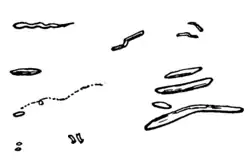 What was this that rose from the gray dimness of his lens into clear distinctness as he brought the tube into the focus? Here was an unbelievably tiny creature, leaping about in the water of the tube "like the fish called a pike." There was a second kind that swam forward a little way, then whirled about suddenly, then tumbled over itself in pretty somersaults. There were some beings that moved sluggishly and looked like wee bent sticks, nothing more, but that Dutchman squinted at them till his eyes were red-rimmed—and they moved, they were alive, no doubt of it! There was a menagerie in his mouth! There were creatures shaped like flexible rods that went to and fro with the stately carriage of bishops in procession, there were spirals that whirled through the water like violently animated corkscrews. . . .
Everybody he could get hold of—as well as himself—was an experimental animal for that curious man. Tired from his long peering at the little beasts in his own mouth, he went for a walk under the tall trees that dropped their yellow leaves on the brown mirrors of the canals; it was hard work, this play of his, he must rest! But he met an old man, a most interesting old man: "I was talking to this old man," wrote Leeuwenhoek to the Royal Society, "an old man who led a very sober life, who never used brandy nor tobacco and very seldom wine, and my eye chanced to fall on his teeth which were badly grown over and that made me ask him when he had last cleaned his mouth. I got for answer that he had never cleaned his teeth in his whole life. . . ."
Away went all thought of his aching eyes. What a zoo of wee animals must be in this old fellow's mouth. He dragged the dirty but virtuous victim of his curiosity into his study—of course there were millions of wee beasties in that mouth, but what he wanted particularly to tell the Royal Society was this: that this old man's mouth was host to a new kind of creature, that slid along among the others, bending its body in graceful bows like a snake—the water in the narrow tube seemed to be alive with those little fellows!
You may wonder that Leeuwenhoek nowhere in any of those hundreds of letters makes any mention of the harm these mysterious new little animals might do to men. He had come upon them in drinking water, spied upon them in the mouth; as the years went by he discovered them in the intestines of frogs and horses, and even in his own discharges; in swarms he found them on those rare occasions when, as he says, "he was troubled with a looseness." But not for a moment did he guess that his trouble was caused by those little beasts, and from his unimaginativeness and his carefulness not to jump to conclusions modern microbe hunters—if they only had time to study his writings—could learn a great deal. For, during the last fifty years, literally thousands of microbes have been described as the authors of hundreds of diseases, when, in the majority of cases those germs have only been chance residents in the body at the time it became diseased. Leeuwenhoek was cautious about calling anything the cause of anything else. He had a sound instinct about the infinite complicatedness of everything—that told him the danger of trying to pick out one cause from the tangled maze of causes which control life. . . .
The years went by. He tended his little dry-goods store, he saw to it the city hall of Delft was properly swept out, he grew more and more crusty and suspicious, he looked longer and longer hours through his hundreds of microscopes, he made a hundred amazing discoveries. In the tail of a little fish stuck head first into a glass tube he saw for the first time of all men the capillary blood vessels through which blood goes from the arteries to the veins—so he completed the Englishman Harvey's discovery of the circulation of the blood. The most sacred and improper and romantic things in life were only material for the probing, tireless eyes of his lenses. Leeuwenhoek discovered the human sperm, and the cold-blooded science of his searching would have been shocking, if he had not been such a completely innocent man! The years went by and all Europe knew about him. Peter the Great of Russia came to pay his respects to him, and the Queen of England journeyed to Delft only to look at the wonders to be seen through the lenses of his microscopes. He exploded countless superstitions for the Royal Society, and aside from Isaac Newton and Robert Boyle he was the most famous of their members. But did these honors turn his head? They couldn’t turn his head because he had from the first a sufficiently high opinion of himself! His arrogance was limitless—but it was equaled by his humility when he thought of that misty unknown that he knew surrounded himself and all men. He admired the Dutch God but his real god was truth:
"My determination is not to remain stubbornly with my ideas but I'll leave them and go over to others as soon as I am shown plausible reasons which I can grasp. This is the more true since I have no other purpose than to place truth before my eyes so far as it is in my power to embrace it; and to use the little talent I have received to draw the world away from its old heathenish superstitions and to go over to the truth and to stick to it."
He was an amazingly healthy man, and at the age of eighty his hand hardly trembled as he held up his microscope for visitors to peep at his little animals or to exclaim at the unborn oysters. But he was fond of drinking in the evenings—as what Dutchman is not?—and his only ill seems to have been a certain seediness in the morning after such wassail. He detested physicians—how could they know about the ills of the body when they didn't know one thousandth of what he did about the build of the body? So Leeuwenhoek had his own theories—and sufficiently foolish they were—about the cause of this seediness. He knew that his blood was full of little globules—he had been the first of all men to see them. He knew those globules had to go through very tiny capillaries to get from his arteries to his veins—hadn't he been the man to discover those wee vessels in a fish tail? Well, after those hilarious nights of his, his blood got too thick to run properly from the arteries to the veins! So he would thin it! So he wrote to the Royal Society:
"When I have supped too heavily of an evening, I drink in the morning a large number of cups of coffee, and that as hot as I can drink it, so that the sweat breaks out on me, and if by so doing I can't restore my body, a whole apothecary's shop couldn't do much, and that is the only thing I have done for years when I have felt a fever."
That hot coffee drinking led him to another curious fact about the little animals. Everything he did led him to pry up some new fact of nature, for he lived wrapped in those tiny dramas that went on under his lenses just as a child listens open-mouthed with saucer eyes to the myths of Mother Goose. . . . He never tired of reading the same story of nature, there were always new angles to be found in it, the pages of his book of nature were thumbed and dog-eared by his insatiable interest. Years after his discovery of the microbes in his mouth one morning in the midst of his sweating from his vast curative coffee drinkings he looked once more at the stuff between his teeth—
What was this? There was not a single little animal to be found. Or there were no living animals rather, for he thought he could make out the bodies of myriads of dead ones—and maybe one or two that moved feebly, as if they were sick. "Blessed Saints!" he growled: "I hope some great Lord of the Royal Society doesn’t try to find those creatures in his mouth, and fail, and then deny my observations. . . ."
But look here! He had been drinking coffee, so hot it had blistered his lips, almost. He had looked for the little animals in the white stuff from between his front teeth. It was just after the coffee he had looked there— Well?
With the help of a magnifying mirror he went at his back teeth. Presto! "With great surprise I saw an incredibly large number of little animals, and in such an unbelievable quantity of the aforementioned stuff, that it is not to be conceived of by those who have not seen it with their own eyes." Then he made delicate experiment in tubes, heating the water with its tiny population to a temperature a little warmer than that of a hot bath. In a moment the creatures stopped their agile runnings to and fro. He cooled the water. They did not come back to life—so! It was that hot coffee that had killed the beasties in his front teeth!
With what delight he watched them once more! But he was bothered, he was troubled, for he couldn’t make out the heads or tails of any of his little animals. After wiggling forward in one direction they stopped, they reversed themselves and swam backward just as swiftly without having turned around. But they must have heads and tails! They must have livers and brains and blood vessels as well! His thoughts floated back to his work of forty years before, when he had found that under his powerful lenses fleas and cheese mites, so crude and simple to the naked eye, had become as complicated and as perfect as human beings. But try as he would, with the best lenses he had, and those little animals in his mouth were just plain sticks of spheres or corkscrews. So he contented himself by calculating, for the Royal Society, what the diameter of the invisible blood vessels of his microbes must be—but mind you, he never for a moment hinted that he had seen such blood vessels; it only amused him to stagger his patrons by speculations of their unthinkable smallness.
If Antony Leeuwenhoek failed to see the germs that cause human disease, if he had too little imagination to predict the rôle of assassin for his wretched creatures, he did show that sub-visible beasts could devour and kill living beings much larger than they were themselves. He was fussing with mussels, shellfish that he dredged up out of the canals of Delft. He found thousands of them unborn inside their mothers. He tried to make these young ones develop outside their mothers in a glass of canal water. "I wonder," he muttered, "why our canals are not choked with mussels, when the mothers have each one so many young ones inside them!" Day after day he poked about in his glass of water with its slimy mass of embryos, he turned his lens on to them to see if they were growing—but what was this? Astounded he watched the fishy stuff disappear from between their shells—it was being gobbled up by thousands of tiny microbes that were attacking the mussels greedily. . . .
"Life lives on life—it is cruel, but it is God's will," he pondered. "And it is for our good, of course, because if there weren't little animals to eat up the young mussels, our canals would be choked by those shellfish, for each mother has more than a thousand young ones at a time!" So Antony Leeuwenhoek accepted everything and praised everything, and in this he was a child of his time, for in his century searchers had not yet, like Pasteur who came after them, begun to challenge God, to shake their fists at the meaningless cruelties of nature toward mankind, her children. . . .
He passed eighty, and his teeth came loose as they had to even in his strong body; he didn't complain at the inexorable arrival of the winter of his life, but he jerked out that old tooth and turned his lens onto the little creatures he found within that hollow root—why shouldn't he study them once more? There might be some little detail he had missed those hundred other times! Friends came to him at eighty-five and told him to take it easy and leave his studies. He wrinkled his brow and opened wide his still bright eyes: "The fruits that ripen in autumn last the longest!" he told them—he called eighty-five the autumn of his life!
Leeuwenhoek was a showman. He was very pleased to hear the ohs and ahs of people—they must be philosophical people and lovers of science, mind you!—whom he let peep into his sub-visible world or to whom he wrote his disjointed marvelous letters of description. But he was no teacher. "I've never taught one," he wrote to the famous philosopher Leibniz, "because if I taught one, I’d have to teach others. . . . I would give myself over to a slavery, whereas I want to stay a free man."
"But the art of grinding fine lenses and making observations of these new creatures will disappear from the earth, if you don't teach young men," answered Leibniz.
"The professors and students of the University of Leyden were long ago dazzled by my discoveries, they hired three lens grinders to come to teach the students, but what came of it?" wrote that independent Dutchman.
"Nothing, so far as I can judge, for almost all of the courses they teach there are for the purpose of getting money through knowledge or for gaining the respect of the world by showing people how learned you are, and these things have nothing to do with discovering the things that are buried from our eyes. I am convinced that of a thousand people not one is capable of carrying out such studies, because endless time is needed and much money is spilled and because a man has always to be busy with his thoughts if anything is to be accomplished. . . ."
That was the first of the microbe hunters. In 1723, when he was ninety-one years old and on his deathbed, he sent for his friend Hoogvliet. He could not lift his hand. His once glowing eyes were rheumy and their lids were beginning to stick fast with the cement of death. He mumbled:
"Hoogvliet, my friend, be so good as to have those two letters on the table translated into Latin. . . . Send them to London to the Royal Society. . . ."
So he kept his promise made fifty years before, and Hoogvliet wrote, along with those last letters: "I send you, learned sirs, this last gift of my dying friend, hoping that his final word will be agreeable to you."
So he passed, this first of the microbe hunters. You will read of Spallanzani, who was much more brilliant, of Pasteur who had a thousand times his imagination, of Robert Koch who did much more immediate apparent good in lifting the torments that microbes bring to men—these and all the others have much more fame to-day. But not one of them has been so completely honest, so appallingly accurate as this Dutch janitor, and all of them could take lessons from his splendid common sense.