Material Culture of the Iglulik Eskimos/Chapter 8
The winter dress of the man is wholly of caribou skin and consists of the following garments: the outer frock (qulitsaq). inner frock (atêga), outer trousers (silapâq), under trousers (ilupâq), outer stockings (kamikpâq), under stockings (aLersit), boots (tugtor qutit) and mittens (pualuk). Eight caribou skins go to a whole dress: two each for the outer and inner frock, two for trousers and two for stockings, boots and mittens. Fig. 106 shows a complete man's dress.
The outer frock is made of two caribou skins, and has the hair on the outside. Fig. 103 (Aivilingmiut) is an outer frock for the coldest winter period, made of rather longhaired caribou skin. Length of front from hood-opening to lower edge, 72 cm, width from sleeve edge to sleeve edge 1.45 m; it has slits in the sides and the back flap is a little longer than the fore flap. The front consists of a uniformly greyish-brown piece of skin, edged with a white strip 9 cm wide. The back is of similar colour and edging and also has across the back three white pieces of skin, a small one in the middle and two larger ones at the sides. The hood-opening is edged with a thin, white strip of skin; the sleeves have three white cross-bands. At the lower edge of the frock are fringes, about 15 cm long, of short-haired caribou skin. The cut will be seen on fig. 104: this shows that the frock must be regarded as a very modified sort of poncho, to which Hatt[1] has already drawn attention.
Fig. 105 shows the cut of a rather similar frock from the Iglulingmiut, Itibdjeriang; the length at the front is 56 cm, over-all width 1.30 m; it has white edgings and two cross-bands on the sleeves, but no white pieces on the back. The cut on this differs from the former, especially in that the hood and back are all in one piece.
Fig. 106 shows a spring frock from the Iglulingmiut, Itibdjeriang. It is of rather short-haired caribou skin. The front is of one fairly dark piece of skin, edged with black and white strips; the back, which is an individual fancy (its owner is the son of the aforementioned inventive Aua), is of three rather narrow flaps and it has three Image missingFig. 103.Man's winter outer frock; back view. white inlays with a black cross-stripe. The cut is as on fig. 103 with the differences involved by the three flaps and the triple back inlay; thus the back piece sends three narrow extensions down into the flaps.
This form of frock with slits in the sides, a short front flap and a longer back flap, is that used by the Aivilik Eskimos and also by most of the Iglulik and Ponds Inlet Eskimos. However. some Iglulingmiut — mostly older men — and a number of Tununermiut have a frock which, besides having slits in the sides, also has a slit in the front and is usually cut square at the bottom, so that it exactly resembles the Baffin Land frock.[2] A frock from the Iglulingmiut has slits in the front, but not in the back, where the flap extends further down than in front; length in front 75 cm, back 1.20 m, over-all width 1.40 m; at the bottom and round the hood a broad white edging with thin dark stripes; three insertions in the back as on fig. 103; the cut is as on fig. 104 with the alteration involved by the slit. A spring frock from Iglulik is cut square at the bottom and has slits both in front and behind and in the sides; at the bottom, round the hood and on the sleeves is a broad, white edging with black stripe; fringes quite without hair; length in front 83 cm, back 1.15 m, width over-all 1.45 m; cut as the preceding frock.

Fig. 107 (Iglulingmiut, Ponds Inlet) differs from all the other frocks I have seen in that the white stripes which edge the slits front, back and sides, are continued right up to the hood; it is the same length back and front; the cut mostly resembles fig. 104 but otherwise is characterised by the many inserted stripes; both on front and back, however the middle stripe consists of a very thin prolongation of the body which goes right down to the slit. Length in front 75 cm., over-all width 1,25 m.

An indoor frock from the Iglulingmiut. Ponds Inlet, consists of very short-haired caribou skin, of equal length back and front and slits only in the front, not behind or at the sides. Length front 68 cm, back 90 cm, over-all width 1.20 m. No white edging or insertions. Cut as on fig. 105.
These frocks without long flaps buy with slits in front, are, according to the older men, in comparatively new fashion which has spread from Ponds Inlet to more southerly areas, undoubtedly influenced from southern Baffin Land. The old frock of the Iglulik Eskimos had no slits front or back, but two flaps of unequal length, as Parry's and Lyon's illustrations also show.
In former days, before fox skins became a trading commodity, frocks were sometimes made of fox skins at Iglulik. especially when caribou hunting was a failure.
The inner frock is of the same cut as the outer frock, but the hair is inside; as a rule there are fringes, but sometimes only in the slits. There are of course, no edgings or insertions of vari-coloured pieces of skin; on the other hand the edges are often strengthened with a strip of sealskin sewn on.
Fig. 108 (Aivilingmiut) is a typical inner frock of the original cut, with flaps of unequal length front and back and with slits in the sides. Length front 72 cm, back 1.10 m; over-all width 1.25 m; edged Image missingFig. 107.Man's outer frock. throughout with narrow, black strips of seal skin. The cut of the body is shown on Fig. 109–10, the same. as on fig. 104; the sleeves are made of 8 and 9 pieces of skin sewn together.
A frock from Tununermiut, Ponds Inlet, is in front 63 cm long, at the back 100 cm; over-all width 1.20 m; edged with a strip of white short-haired caribou skin. Its cut is the same as on fig. 105; thus these two styles are used for both outer and inner frocks indiscriminately. The sleeves are of one large and three of four small pieces.
Fig. 111 (Iglulingmiut) is an inner frock, differing from the foregoing in having a slit in front. Length front 67 cm, back 1.15 m, over-all width 1.40 m; the back flap is only slightly longer than the front flap. Edged with black seal skin. Cut as on fig. 109–10. An inner frock from the Iglulingmiut, which has been used together with fig. 107, has four slits like this.
On fig. 106 will also be seen a pair of outer trousers of dark caribou skin with light cross stripes at the bottoms and across the thighs; width across the waist 48, across the bottom of each leg 32 cm; length along outer edge of the leg 62 cm. They are made up of six large and sixteen smaller pieces of skin; above the cross stripes the front and back each consist of a large piece of skin, whereas the part below these is of one large piece only on each leg. At the waist these trousers have a running cord. They are from the Iglulingmiut.
A similar pair of trousers from the Iglulingmiut is of short-haired caribou skin; the width at the waist is 40, at the bottom of legs 25 cm; length 70 cm. At the bottom are two broad, white stripes, separated by a dark one; across the legs near the fork are three white and two narrow, black stripes, rather higher up at the back two broad white and one thin, dark stripe, and on the outer side at the top a thin, white stripe. A pair of outer trousers from the Aivilingmiut have at the bottom of the legs white edges, but are otherwise made of skin of fairly uniform colour. Width at top 40, at bottom 28, length 65 cm.
A number of young men among the Aivilingmiut have now adopted the short trousers, very wide at the bottoms, of the Qaernermiut.
Fig. 112 (Iglulingmiut) is a pair of under trousers of caribou skin with the hair inside; at the bottom of the legs they are edged with black unhaired seal skin. Width at top 45, bottom of leg 22, outside length 62 cm. Fig. 113 shows the cut of these trousers. A pair of under trousers from the Aivilingmiut is just like these.
On fig. 106 are also seen a pair of outer stockings of caribou skin, for winter use (Iglulingmiut); the leg is made up of five horizontal belts of alternate dark and light skin; at the top is a running cord of plaited sinew thread. Length at back 50, width at top 22, at bottom 16, length of foot 22 cm. The cut is shown on fig. 114. A pair of similar outer stockings from the Aivilingmiut differs in that the sole of the foot is a separate piece; the upper is of deer-leg skin, the leg of four belts. Length 45, width at top 20, below 16, length of foot 27 cm. Another pair of outer stockings, from the Aivilingmiut, are of deer-leg skin (called merqolik). The foot is of caribou skin. Length of leg 35, of foot 22, width at top 23 cm. A running cord at the top.
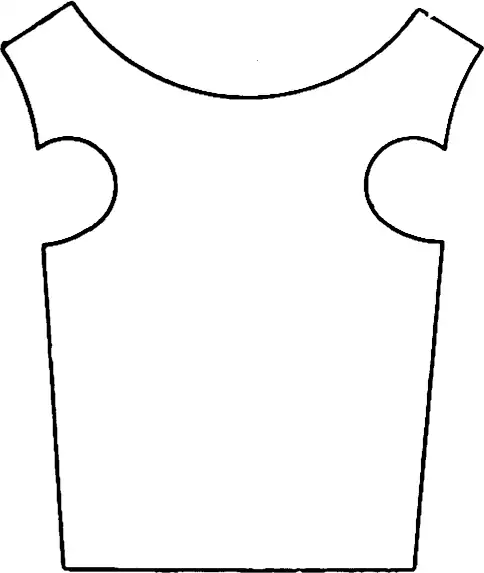
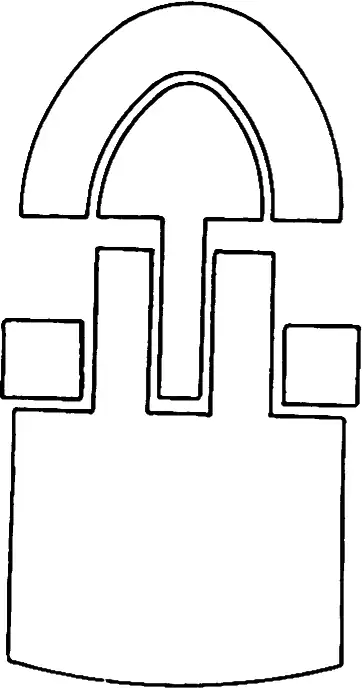
Fig. 115. is an under stocking of caribou skin with the hair inside; length at back 50, width at top 18, bottom 15, foot 20 cm. The cut is shown on fig. 116; most of the leg is of one large piece; the foot has a separate sole, crimped at the edge. A similar stocking from Ponds Inlet is 51 cm long, the foot 24 cm; on this the leg is made of one large piece, in which a long, narrow strip is inserted in the back. A pair of stockings from the Aivilingmiut are 60 cm long.
Fig. 117 (Aivilingmiut) is a caribou-skin shoe of the usual type used outside in winter. It is of caribou skin with the hair inside: a sole with turned up and crimped edges and an upper, consisting of a forward and a rear piece and a small piece let in one side; another sole is sewn on over the first sole with the hair downwards. The sewing throughout is with a running stitch; at the top the lace runs through a hem, formed by bending over the upper edge of the skin, and through two eyes of caribou skin sewn on the seam between sole and upper; it is of three-ply sinew-cord. The length of the shoe is 28 cm, width 14, height 8 cm.
Another pair of shoes from the Iglulingmiut (seen on fig. 106) differ from the usual shoes in having the uppers prolonged. upwards, the height thus being 12 cm; the uppers are are made of leg skin; between upper and sole are inserted two thin, ornamental strips of white and black seal skin; the eyes are of seal skin. Length 30, width 15 cm.
Fig. 118 (Iglulingmiut) is a caribou skin boot which is sometimes used in winter, mostly by young people. The leg is of leg skin in lengthwise strips with the hair inside. two at the back and one at the front; the front one is in two pieces, the lower one continuing into the upper-leather. The sole is of yellow bearded-seal skin edged at the top with a narrow black strip of seal skin, and under it is sewn a caribou-skin sole with the hair downwards; the eyes for the lace are on the edge of the sealskin sole; at the top of the boot is a running cord. Length down the back 38 cm, width at the top 20, at the bottom 16, length of the foot 27 cm.
Fig. 119 (Ponds Inlet) is a sock of caribou skin, which, in really Image missingFig. 112.Man's under trousers. cold weather, is worn between the outer and the under stocking, or in spring and autumn between the stocking and the sealskin boot; the hair is inside; the cut is the same as on the shoe.
Occasionally socks of seal skin (pineraq) are worn with the hair-side out.
Fig. 120 (Aivilingmiut, Repulse Bay) is a sealskin shoe of the kind that is used indoors, in the snow house, in winter where the caribou-skin shoe would soon be ruined by the damp. The sole is of light seal skin, turned up and crimped, strengthened by an extra sole of black bearded-seal skin; the upper, of black seal skin, is in two pieces; at the top is an edging of hairy caribou skin with a running cord, which passes through two eyes in the edge of the sole. 26 cm long, 12 cm wide, 8 cm high. A pair from Ponds Inlet are quite the same, except that the soles are of black, bearded-seal skin and the upper of yellow seal skin. A pair from the Aivilingmiut on Southampton Island have uppers of short-haired caribou skin and, between them and the black sole, is a strip of yellow seal skin.
Fig. 121 a (Aivilingmiut, Repulse Bay) is a mitten of caribou skin for winter use, with the hair side out. The wrist is decorated with two white and intermediate black stripes; the mitten is made of three pieces of skin, one of which forms the whole of the back, two the


For snow-house building they often use very long mittens which the wife has to tie on and remove after use.
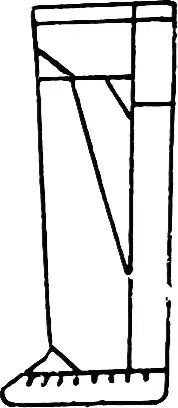
Fig. 121 b (Ponds Inlet) is a spring mitten for men, of caribou skin with the hair inside; it is fairly short-haired, edged at the wrist with a strip of seal skin. Length 26 cm.
From the Aivilingmiut, Chesterfield Inlet, we have a pair of finger mittens, of caribou skin with the hair inside, as used when caribou hunting or when working indoors; 28 cm long, 13 cm wide at the wrist; an edging of red cloth at the wrist. These are also mentioned by Lyon.[3] On one occassion I saw a right-hand mitten with free index finger for pulling the trigger when caribou hunting.
From the Aivilingmiut, Repulse Bay, there is a fox skin cap (nasaq), sometimes used by older men under the frock hood; it is sewn in semi-spherical shape, of summer skins, in three pieces of which a round one forms the crown, the other two the edge.
From the Iglulingmiut, Qajûvfik, we have a body belt of hare skin, 92 cm long, 6½ cm wide; on the inner side is sewn a piece of caribou skin of the same size, with the hair out, but the hair is cut very short; at each end are two strips of caribou skin for tying. These Image missingFig. 119.Caribou skin sock. Image missingFig. 120.Sealskin shoe. belts are sometimes used by older men to prevent a draught up under the frock. Previously they sometimes used a skin belt (nabluinitaq) about 15 cm wide, between the boot and the trouser leg.
This concludes the man's winter dress. In the house the outer frock and outer trousers are taken off, beaten with the snow-beater and placed in one of the store rooms, where they do not become damp as in the living room; as a rule the caribou-skin shoes are laid in a small compartment hollowed out of the snow under the platform and the sealskin shoes are put on instead.
For summer use they wear the inner frock and under trousers and under stockings of caribou skin, and with them sealskin boots and mittens; if it is cold the sealskin frock and trousers are worn outside the caribou skin dress.
Fig. 122 (Ponds Inlet) is a sealskin frock (natseq) of the usual form, cut square at the bottom, with a slit in front but none at the sides. Round the bottom and in the hood opening it is edged with a narrow, dark strip of skin and a wider, light strip; at the edges of the sleeves is a wider edging of a medium colour. Length front 0.79. back 1.04, over-all width 1.35 m. Fig. 123 shows the cut. The arms consist of two lengthwise pieces, one wide, the other narrower; in one a small gusset has been inserted.
A frock from the Iglulingmiut, Kingâgjuaq, is 68 cm front, 94 cm back, over-all width 1.28 m; it differs from the foregoing frock merely in that the hood is less pointed and has not the two separate, triangular pieces. We have a similar one from the Aivilingmiut. Image missingFig. 121.Mittens. Chesterfield Inlet; on this, however, there are only separate, oblique pieces at the bottom of the front of the body, and these are quite small. The hood is made of only two side pieces.
Fig. 124 (Ponds Inlet) is a pair of sealskin trousers; at the bottom of each leg is a light-coloured edge; across the legs a thin dark band. Width at the top 48, at the leg bottoms 22 cm; length down the sides 65 cm. Fig. 125 shows their cut. A pair of similar trousers from Chesterfield Inlet seem, from their size, to have been made for a European; width at the top 46, at the bottom of each leg 28, length 82 cm; at the Image missingFig. 122.Sealskin frock. bottoms is a wide, light edging; on two places on the legs there are narrow, dark, cross stripes; on the thighs and at the back vertical, alternate dark and light stripes, three in front, one behind.
On fig. 126 (Iglulingmiut) will be seen a sealskin boot boot (sing. kamik). They consist of yellowish, unhaired skin; the leg is in one piece, although in front there is a vertical, narrow stripe of black sealskin. The upper runs up into this with a point. Between upper and sole (of light bearded-seal skin) is a strip of black sealskin. At the top a running cord. Height of leg 42 cm; the foot is 27 cm long, 16 cm wide; width of leg at the top 20, at the bottom 17 cm. There are eyes for the lace at the joint between sole, upper and leg.
A pair of sealskin boots from Ponds Inlet are likewise of yellow skin, but have a black sole; they each consist of three pieces of skin: leg, upper and sole; the lace is a thin sealskin thong; at the top is a running cord of sinew thread. Another pair of boots from Ponds Inlet has legs and uppers of brown sealskin (water-tight skin), soles of black, bearded-seal skin, and laces of seal-thong.
From the Iglulingmiut we have a pair of wading boots, long boots of black sealskin, a little longer in front than behind;  Fig. 123.Cut of sealskin frock.
the legs 47 and 64 cm long back and front; the soles are strengthened with two pieces of walrus hide sewn on.
Fig. 123.Cut of sealskin frock.
the legs 47 and 64 cm long back and front; the soles are strengthened with two pieces of walrus hide sewn on.
The skin of young seals is sometimes used for the summer dress. On Southampton Island I saw a whole outer frock of this material, with the hair outside, cut square at the bottom. A pair of stockings of this skin, from Ponds Inlet, with the hair inside, are 32 cm long. A pair of socks from the Aivilingmiut, Southampton Island, are only 19 cm high. Young seal skin has the advantage over caribou skin in that it stands the damp better; it is not warm enough for winter use, however. On Southampton Island I saw a pair of socks of ptarmigan skin.
Fig. 121 c (Ponds Inlet) is a sealskin mitten, of water-tight skin, edged at the wrist with a light strip. The cut is the same as that of the caribou-skin mitten, and the back piece is heavily crimped where it is turned over; length 23 cm, width at the wrist 13 cm. A pair of Image missingFig. 124.Sealskin trousers. mittens from the Aivilingmiut are of light sealskin with two black borders on the wrist. A pair from Southampton Island are of hairy, young sealskin; an edging of hairy sealskin at the wrist.
Of the Iglulik men's dress in former days we have a good deal of information from Parry and Lyon. On the whole it seems to be the same dress that is used to this day. The frocks, however, seem to be shorter, cut square at the front but with a long back flap, (which they buttoned up when seal-hunting)[4] reaching almost to the ground. Parry[5] also 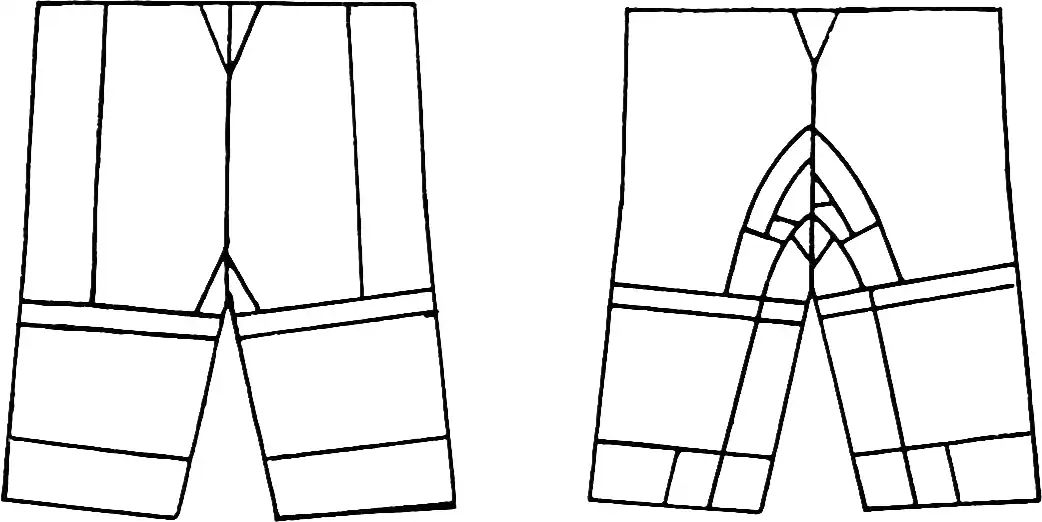 Fig. 125.Cut of sealskin trousers.
mentions that some of the Eskimos at Iglulik had outer frocks of fox skin; Lyon[6] says that the hood was edged with long white hair from the belly of the caribou. Of great interest is the cloak which Lyon describes from the same place: "Besides these two coats, they have also a large cloak, or, in fact, an open deer-skin, with sleeves: this, from its size, is more frequently used as a blanket; and I but once saw it worn by a man at the ship, although the women throw it over their shoulders to shelter themselves and children while sitting on the sledge". A garment of this kind is no longer in use.
Fig. 125.Cut of sealskin trousers.
mentions that some of the Eskimos at Iglulik had outer frocks of fox skin; Lyon[6] says that the hood was edged with long white hair from the belly of the caribou. Of great interest is the cloak which Lyon describes from the same place: "Besides these two coats, they have also a large cloak, or, in fact, an open deer-skin, with sleeves: this, from its size, is more frequently used as a blanket; and I but once saw it worn by a man at the ship, although the women throw it over their shoulders to shelter themselves and children while sitting on the sledge". A garment of this kind is no longer in use.
No special kayak dress is used now; the hunters at Ponds Inlet use their usual sealskin clothes. Whether the Iglulik Eskimos have formerly had a special kayak dress is uncertain, Image missingFig. 126.Sealskin boot. although older men thought they had heard of a kayak frock of water-tight skin, which, however, was not for fastening to the coaming of the manhole as is the case in Greenland.
Like that of the men, the women's winter dress is of caribou skin and consists principally of the same garments: outer frock (qulitsaq), inner frock (atêga), with carrying strap (qaqsungaut), which has two buttons (qaqsungakvit); trousers (qâgdlît), stockings (alersit), boots (kangmit) with side-pouches (quatdluk) and mittens (pualuk). Fig. 127 is a complete outer dress for a woman.
Fig. 127 (Aivilingmiut) shows an outer frock of caribou skin, of typical shape. The hair side is outside; it has two flaps, a short one in front and a longer one behind, sleeves and a large, long hood. At the bottom, at the hood opening and on the sleeves the frock is edged with a broad, white border, in which Image missingFig. 127.Woman's outer dress. there is a narrow black stripe near the edge. On the upper arms, shoulders and back under the pouch there are long-haired skin fringes. On the breast, just under the hood opening, are two loops of hairy skin for the carrying cord. Length front, from hood opening to bottom edge, 70 cm; back, from point of hood to bottom edge 1.64 m, of which the hood measures 58 cm; over-all width 1.16 m. Inside the hood opening it is lined with a strip of hairy caribou skin, 5 cm wide. Fig. 128 shows the cut. Shoulders and upper arms are alternately light and dark.[7]
A similar frock from the Iglulingmiut has the same white edging with black inlay, the same stripes on the upper arm and the same light insertion in the back pouch; there are no fringes on sleeves or shoulders, but two tassels of very short-haired fringe on the back; length front 0.63, back 1.47 (the hood 0.47) over-all width 1.15 m. The cut is principally the same as the foregoing, but the back of the hood is all in one piece which is only lengthened a little at the top, but otherwise has two longitudinal seams high up.

The other women's frocks in the collection, from the Aivilingmiut, Iglulingmiut and Tununermiut, correspond in size and cut to those described above. Sometimes there is no edging, but mostly there is a while edging; the back tassels are lacking, but most of them have white insertions in the back and white stripes on the upper arm. Sometimes the back of the hood is all in one piece, sometimes of several pieces. One of the frocks, from the Iglulingmiut, is a rather short-haired spring frock.
An inner frock (Aivilingmiut) is of caribou skin with the hair inside; on account of the lack of edgings and inlays, the cut is more Image missingFig. 129.Woman's inner frock with bead frimming. simple than that of the outer frocks. At the bottom and on the sleeves it is edged with a narrow, black strip of sealskin, of which the carrying strap is also made; round the hood opening is a narrow, hairy strip of caribou skin. Length front 0.55, back 1.55 (of which the hood 0.51). over-all width 1.12 m. Each of the sleeves consists of one large piece, in which two small pieces are gussetted.
Fig. 129 (Iglulingmiut) is a woman's inner frock with bead trimming. Size, cut and edging are the same as the above, but the back of the hood is put together in rather another manner. The glass beads are sewn on to a number of pieces of red and black cloth which are fastened on to the frock: a large red piece on the breast. narrower red and black bands across the upper arm and up over the shoulder (like the white stripes on the outer frock), at the sleeve openings, along the edge of the hood and the hood-opening, where they continue upwards and cover the most of the forepart of the hood; in the middle of the back are two small red patches. The beads are small, uniform in size except for a few larger beads which terminate free-ended strings. Their colour varies greatly: the white ones predominate; then there are five shades of blue, three of red, two of yellow, two green, black, dark brown, greyish, semi-opaque and opalescent. The various ornamental designs are often carried out over a white background. The serrated bands round the hood opening, along the edge of the hood and across the upper arm are made of white and blue beads on the background of the red and black cloth. The round figures on the breast consist of white and green beads on red background. The double curves are of brown beads, edged with white on a green Image missingFig. 130.Woman with bead trimming; fore side. background. The long, hanging fringes on breast and arm pieces and on the hood edge consist of strings of beads of variegated colours; thus on the breast: white — blue — yellow — blue dark — white — red — white — dark blue — white — dark blue — clear dull — green — clear dull; in the middle instead of the latter, are pierced caribou fore teeth. On the sleeves the colours of the bead strings are: white — dark brown — yellow — dark blue — white — dull red — white — dark blue — white — dark blue — white — green — dull white — blue — caribou fore teeth. The various strings of beads on the same edge are always coloured in the same manner and the various pieces of one colour are always of equal length. At the top of the front of the hood is a large flower: from a red central patch run four leaves, two green and two blue, all on white back- ground; round these, at some little distance from them, are concentric blue and yellowish-brown lines. On the middle of the back are two small red pieces of cloth embroided with a spectacle-like figure; from these hang long strings of beads ending in small cartridge cases. All the bead embroidery is prettily and carefully done work.
Fig. 130–31 is a woman (Aivilingmio, Chesterfield Inlet) with complete bead trimming; a similar beaded dress (worn by Niviatsianâq, now living on Southampton Island) is illustrated by Low.[8] Image missingFig. 131.Woman with bead trimming; back side. The arrangement of the bead embroidery (sapangat) is the same in all cases; Two large square breast-pieces (sâ). stripes across the upper arm (tuerut), bands on the wrists, trimming on the back of the hood. In Parry[9] too, there is a picture of bead trimming with a similar arrangement, which is apparently an old pattern. The designs do not vary much; serrated lines and double curves are common, but one sometimes sees flowers, caribou, stars and even European boots as motives. The double curve and the plant designs display kinship with Indian ornamentation.[10]
According to Eskimo circumstances a completely bead-embroidered dress is very valuable; there are scarcely more than ten in the whole tribe. Most of the women have no beads on their inner frock, or at the most a simple edging on sleeves and hood. Now and then an edging of beads, or one or two tassels of bead-strings, are seen on men's and children's dresses.
The women use only one pair of trousers; fig. 132 is a pair from Image missingFig. 132.Woman's trousers. the Aivilingmiut. They are of caribou skin with the hair outside. The cut is shown on fig. 133. A broad white and a narrower black, longitudinal stripe along the outside of the legs is characteristic of the women's trousers. Length 65 cm, width at top 42 cm at bottom 18 cm. Near the upper edge at the back are three loops for the cord. of seal thong: near the under edge, at the back and inner side, hang two skin strips. A pair of trousers from the Iglulingmiut have dimensions 70, 45 and 21 cm respectively; the cut is like the foregoing pair, but at the bottom the legs have several loops of skin strips, and no skin. strips are sewn on at the bottom.
On fig. 134 will be seen a woman's boot of caribou skin from the Iglulingmiut. It consists of a legging with the hair outside, and the boot itself, which has the hair inside, although on the sole the hair is downwards. The legging consists of a large flap coming to a point at the top and fastened to the trouser cord by means of a strap
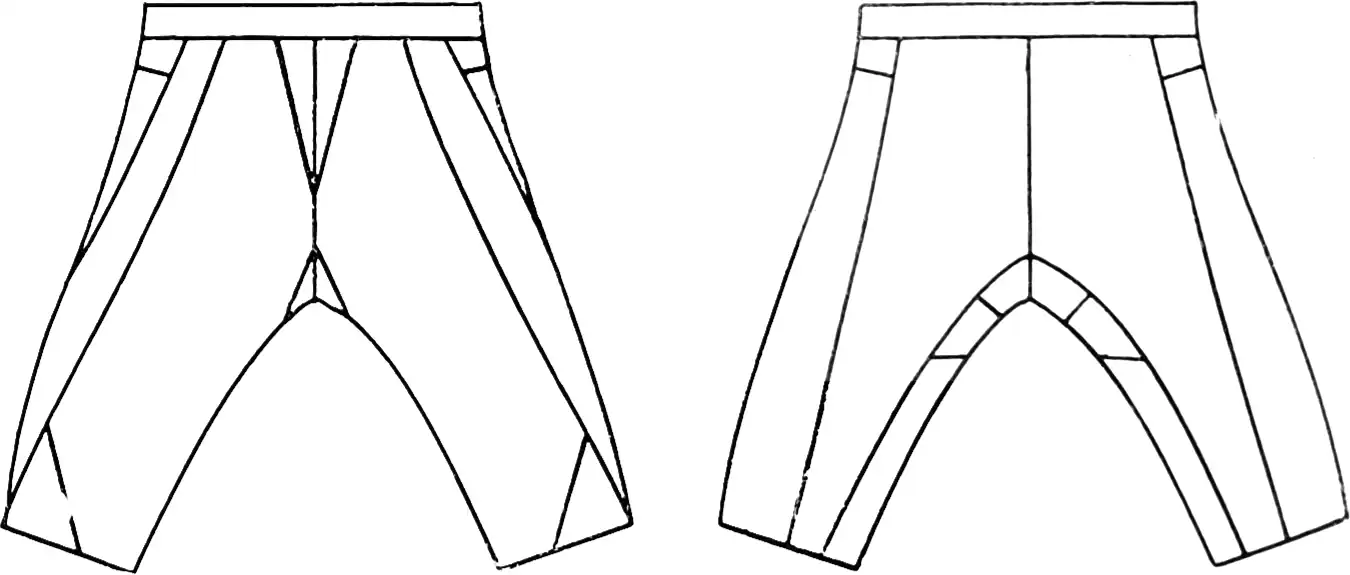 Fig. 133.Cut of woman's trousers. and a button; the back edge of this flap is white; then below this is a sack-shaped extension running out to the side; the front part is decorated with white stripes, the back with only one cross stripe. To
this flap the boot itself is sewn; it consists of sole, leg and upper. Total length 90, of which the leg measures 70 cm; width of the extension 38 cm, length of foot 21 cm.[11]
Fig. 135 is the stocking for this boot, seen from the back side. The upper part is quite of the same shape and size but the hairs are  Fig. 136.Cut of woman's stocking.
inside; the lower end has the usual stocking cut; at the top it is edged with a dark strip of seal skin; the strap at the top ends in a round ball of wood. The cut, which is the same as that of the boot, is shown on fig. 136.
Fig. 136.Cut of woman's stocking.
inside; the lower end has the usual stocking cut; at the top it is edged with a dark strip of seal skin; the strap at the top ends in a round ball of wood. The cut, which is the same as that of the boot, is shown on fig. 136.
A pair of woman's boots with stockings from the Iglulingmiut, Qajûvfik, has the white ornamental stripes at the front and the outer edge of the upper flap edged with a black strip of skin; on the stockings the seams of this ornament on the upper piece are lined up by sewing Image missingFig. 137.Buttons for women's dress. on thin, black strips of seal skin; the straps of the stockings end at the top in small, ball-shaped pads of caribou skin. The upper point of the boot is fastened to that of the stocking. Length 1.00 m,. width of extension 32, length of foot 22 cm.
Women's mittens do not differ in any way from those of the men.
Women with bad heads (mostly syphilis patients) must not go into the open air with the head bare and they use a hood of caribou skin. One of these has the hair, which is clipped short, outside, and a border of long hair round the opening. Folded: 26 cm high, 24 cm wide; bands for tying at the corners.
Women's summer dress consists simply of the caribou-skin inner frock, trousers, stockings and boots which, instead of having the lower part of caribou skin are now made of seal skin; in addition, they have sealskin mittens like the men's. In spring and autumn the women, like the men, wear caribou-skin mittens with the hair inside. The women never wear frocks or trousers of seal skin. Thus it applies to the women, but not the men, when Boas[12] writes of the Aiviliks; "It seems that they do not wear any sealskin clothing".
We have a pair of caribou-skin boots with sealskin feet from Ponds Inlet. The legging piece is of the usual shape and with white stripes; the leg and upper is of yellow skin, decorated at the top with two black cross stripes; the sole is of seal skin. The height of the leg is 12 cm, the length of the foot 21½ cm.
From the Aivilingmiut on Southampton Island there is a pair of long sealskin boots for women as often used on long summer journeys, when it is frequently necessary to wade. They are of light yellow seal skin, edged at the top with a narrow black strip. The leg consists of a piece of skin joined by a seam up the back; the sole is of dark sole skin. At the front a long, pointed flap runs from the leg right up to the belt; its upper point, however, consists of three separate pieces. The height of the leg is 80 cm at the front, 44 cm at the back. Length of foot 23 cm. There are the usual eyes for the lace on the sides of the instep; in the uppermost point is a hole.
Fig. 137 shows a number of buttons belonging to the women's clothing. No. 1–4 are buttons for the carrying strap round the back pouch. 1 is of soapstone (a grave at Usugarssuk); 2 (Qilalukan) of wood; 4 (Admiralty Inlet) is of a fine, brownish argillaceous slate, ornamented with a cross; 3 (Iglulik) is of wood, decorated with concentric figures. All these have the rhomb shape common to these buttons. From Iglulik we have an oval button of soapstone, 4.3 cm long. All the buttons have an eye on the back.
5–8 are wooden buttons for holding the boots up; 5–6 (Aivilingmiut, Southampton Island) are of shapes that are seen again on other two buttons from the Aivilingmiut and Repulse Bay; 7 is from Iglulik, 8 from Pingerqalik.
This woman's dress is undoubtedly the old dress of the Iglulik women; it is that which is illustrated and described by Parry[13] and Lyon[14] and later by Bessels[15] Boas,[16] Low[17] and Bernier;[18] in former days it has been in use. everywhere, from Chesterfield Inlet to Ponds Inlet.
With regard to the peculiar pouch-like extensions on the boots Parry[19] says that they were used for carrying the children in. They are not used for this purpose now, at any rate, and, what is more, it would be a very unpractical place to carry them; when they cannot walk by themselves they are carried in the back pouch. What the original use of these side-pouches has been is uncertain; if the women are asked, they simply reply that "this is how they are worn". They are never used as pockets; one might rather imagine them used as a kind of warming bag, into which the feet can be withdrawn when they are cold when sitting on the sledge or platform; but in the first place the women seldom sit long at a time on the sledge, and in the second place, I have never seen or heard of them being put to such a use; on the platform they usually sit without boots at all, with the bare feet crossed under them.
In northern Baffin Land another woman's dress has made its appearance during the past few years (fig. 138). It consists of an outer frock (qulitsaq), inner frock (atêga), short trousers (qâgdlit), leggings (qugtoraun), stockings (alersit), boots (kangmit) and mittens (pualuk).

Fig. 139 (Ponds Inlet) is an outer frock of this type, of caribou skin; it is cut square at the bottom, without slits, but rather wide; the hood is large and wide, rounded, not so long and narrow as the old style; the shoulders are not wide as on the latter. At the bottom it is edged with a white edging; across the fore-arm a white and a dark band, and the same round the hood opening; fringes on the lower edge. Length of front 70, of back 118, of which the hood measures 36 cm; over-all width 1.00 m; 45 cm from the lower edge the width of the frock is 45 cm; but from there it widens to 75 cm at the bottom; the width of the hood is 40 cm; there is thus a "waist" in the frock. On the lower edge of the hood and also towards the top on one side are sewn two red bands for tying up the hood opening in very cold weather. The cut is shown on fig. 140.
Another frock from Ponds Inlet, of the same cut, is richly decorated with patterns of alternating white and light-coloured pieces of skin; the front has two almost vertical lines running from the neck and diverging all the way; at the top they consist of a band at the Image missingFig. 141.Woman's inner frock; new style. top, of alternate white and dark squares, surrounded on both sides by thin white stripes, at the lower end by two wider stripes. Round. the bottom is a wide border of several white and dark stripes and a similar checked border; these are also along the front of the upper arm, across the upper arm and round the hood opening. Length in front 75 cm, back 1.35 m, over-all width 1.15 m; there is a pronounced "waist" in this frock, which is badly worn.
At Ponds Inlet I saw several of these frocks, which had two slits in the front; one, badly worn, has two vertical stripes in front, running from the lower edge, and presumably must be regarded as survivals of slits.
Fig. 141 (Ponds Inlet) is an inner frock of the same dress, of caribou skin with the hair inside; the cut is as that of the foregoing, but it has not the many edgings and insertions; it is very worn and greasy. It has some bead trimming, consisting of a breast ornament of a short cross band, from the ends of which run two inserted arches; there is also an edging round the hood opening. The breast trimming consists of a number of skin strips and red and black strips of cloth on which are sewn rows of blue, black, pale red and yellow beads, and serrated rows of blue, red and white beads; Image missingFig. 142.Woman's trousers; new style. from these hang fringes consisting of strings trimmed with varicoloured beads — light blue, dark blue, yellow, red and green — and ending in caribou foreteeth and with small cartridge cases. The hood-edging consists of four serrated rows of white, pink, yellow and light blue beads.
The bead trimming on frocks of this form is always so arranged; the breast-trimming is called sakiakut.
A pair of trousers for the same dress is shown on fig. 142; they are of caribou skin with the hair outside, except a thin strip at the top; across the top of the thigh is a wide, white stripe; length 47 cm; they fit tightly and barely reach the knee.
A legging, for protecting the knee and the lower part of the thigh is shown on fig. 143. It is 29 cm long and consists of a piece of caribou skin with the hair outside, a dark edge at the top. two white and one dark stripe, and fringes, at the bottom. By means of a piece of sealskin strap, which is split and fastened in two places to the outside at the top, these leggings are held up by he waist-cord.
The corresponding boots are shown on fig. 144; they are made with caribou leg-skin legs, feet of seal skin (in winter caribou skin). The uppers are of yellow skin, the sole of black sole skin; there are the usual eyes for the lace. The length of the leg is 31, the foot Image missingFig. 143.Woman's legging. Image missingFig. 144.Woman's boot; new style. 24 cm. The soles are strengthened with two pieces of seal skin sewn on; they are fastened round the leg by a sealskin lace round the top.
The first time we saw this dress was at Pingerqalik, where a woman, Arnânuk (fig. 138) was wearing it; at Ponds Inlet, however, it was fairly common and was worn by 12 of the 45 adult women whom I saw. Some of these women come from southern Baffin Land, the Akudnermiut and Orqumiut, and there is no doubt that this dress originates from there. As a matter of fact it is only a modified form of the old Baffin Land dress and only differs in that the frock, instead of the long, narrow back flap and shorter front flap, is cut square at the bottom; I also saw it in fairly widespread use at Cumberland Gulf, although the old dress with the long flaps still predominated. Presumably it has appeared here as a modification, under European influence, of their own old dress. Old Ututsiaq at Ponds Inlet told me that in former days all the Ponds Inlet Eskimo women had the same dress as those of the Aiviliks; but in the time of the whalers a number of Orqumiut came there, and their women had "clothing like men". This dress, made up of vari-coloured pieces of skin or copied in duffel. forms a pretty, becoming and practical woman's dress which now seems to be advancing in northern Baffin Land at the expense of the old one. Not only do the women of southern Baffin Land wear it, but also many Iglulik women; several women whom I saw in the old dress in the first year had, when I met them a year later at Ponds Inlet, adopted the new one. How long it is since this dress made its appearance cannot be said with certainly: the only one of the earlier expedition reports in which it is illustrated is Bernier's.[20] 1912. Two women with handsome dresses of this type are illustrated in a small publication in 1923.[21]
The first garment of the infant child is a cap of fox or bird skin, usually a raven skin; it must not be of caribou skin; one of these raven-skin caps is given to the child even at birth. When it has grown so big that it can put its head out of the pouch it receives a cap (nasaq) and a frock (qulitsakuluk) of caribou-calf skin. When the child is old enough to come out of the back pouch and sit on the platform, and later on run about, it is given a combination suit (atâjuit) — frock, trousers and boots all sewn in one piece of caribou skin, with the hair inside; if the child is going out, it is clad in a similar suit with the hair outside, and on top, a loose cap and mittens: the suit is open between the legs, where it is often furnished with long hair, often bear hair. They usually retain the suit until they are three or four years old: the only difference between the dresses of the boys and the girls is that even now the girls' dress has longitudinal stripes on the outside of the trousers. After the suit most children are given a dress consisting of hose (atâjoq), stockings and trousers in one, held up by braces (ujatsiutit), as well as a frock, loose cap, boots and mittens; the inner lining is usually of caribou skin; in summer it is very often of sealskin. As a rule the frock has an indication of a back flap, on a girl's dress both back and front, and it is on them that the wide shoulders begin; sometimes the hood is Image missingFig. 145.A winter-dressed boy. loose, at other times it is part of the frock. At Repulse Bay I have seen a little girl of eighteen months wearing a dress of this kind with a loose cap; but most often the child is three or four years old before the suit is discarded.
How the child's dress varies when the first few years have been passed will be seen from the following examples: A four year old boy on Southampton Island wore in summer: caribou-skin inner frock, under-trousers, stockings and mittens. and sealskin outer-trousers, socks and boots; in winter the same boy had caribou-skin inner and outer frock, cut straight at the bottom, hose with the hair inside, caribou-skin outer trousers, caribou-skin boots with the hair inside ("because children do not know that they must beat off the snow when they come inside the house"), and caribou-skin mittens. Another four-year old boy at the same place had a small flap on the frock. A four-year old boy at Ponds Inlet had, in summer, a caribou-skin inner frock with three slits. an outer frock of caribou-calf skin with three slits, and a cap, outer and under trousers of caribou skin, long caribou-skin stockings, small socks of caribou skin and long sealskin boots which went inside the trouser legs; the same boy also had a whole suit of clothes of young seal skin (see later). A boy of three years at Ponds Inlet had a caribou-skin outer frock, open, fastening down the front, without a hood, with two white longitudinal stripes down the back. A girl of four or five years at Ponds Inlet wore clothes of exactly the same style as the adult women; a five-year old boy at Ponds Inlet had four slits in the frock.
After the fifth or sixth year the dress more and more resembles that of the grown ups; the flaps lengthen, the shoulders of the girls become wider; the long hood and the side-pouches on the boots, however, are only given them when they grow up. Even on a 16 Image missingFig. 146.A summer-dressed boy. year-old boy at Repulse Bay I saw a frock that was cut square at the bottom; and a boy of eight or nine, at Repulse Bay, had a loose cap and sealskin trousers sewn together with caribou-skin boots into hose; a girl of twelve on Southampton Island wore a frock that was cut square at the bottom, of young seal skin, and a small hood; a girl of ten at the same place still wore braces; a boy of fourteen at the same place had a fully grown man's dress, but as a matter of fact he also did a grown man's work. A boy of eight at Ponds Inlet had long sealskin boots, tied to a strap sewn on to the trousers. As a rule, the women do not get long flaps until menstruation has commenced; until they have given birth to a child the back flap is often held up by a cord.
For the purpose of protecting the neck, children often have a loose piece of caribou skin, manuilitaq, in the hood opening, to catch the rime from the breadth; it can be easily taken out and dried.
To proceed now to describe the childrens garments in the collection:
From the Iglulingmiut, Qajufik, there is an infant's cap of raven skin, the feather-side out; to the face is a narrow edging of longhaired caribou skin with the hair inside, edged on the outside with a narrow, black strip of sealskin; caribou-skin fringe at the bottom; Image missingFig. 147.Infant's dress. height 18 cm, breadth (folded) 13 cm. A similar small cap from the Aivilingmiut is of summer fox-skin and consists of five pieces: a small piece for the back of the neck, two large side pietes and two edgings in front; at the corners a tying band of caribou skin; when folded the height is 18 cm, the breadth 14 cm.
A frock for an infant, from the Iglulingmiut at Qajûvfik, is of short-haired caribou skin with the hair outside; no hood or flaps; white edge and fringe at the bottom; in front open, with two tying bands and the same on the sleeves. Length 23 cm, overall width 63 cm. A pair of trousers for an infant girl, from the Aivilingmiut, are of caribou-calf skin with the hair outside; down the outside of the legs are red-brown stripes; at the top is an edging with the hair inside. Length 35 cm, width at the top 20, of the legs at the bottom 10 cm.
Fig. 147 (Ponds Inlet) is an infant's dress, of frock (a), hose (b) Image missingFig. 148.Outer-suit for a boy. and cap (c). The frock, trousers and cap have the hair outside, the stockings sewn to the trousers have the hair inside. The frock has a fringe at the bottom and a very small flap at the back. The cap is decorated with a broad, white edging, in which is a narrow, black stripe. Length of frock, 25, over-all width 50 cm, length of hose 41, of which the stockings measure 15; the cap is 14 cm high, 11 cm. wide; the trousers have the usual "women's stripes", which shows that the dress is for a girl.
A combination suit for infants, from Ponds Inlet, is of caribou-calf skin with the hair outside except the stockings; a slit in front
 Fig. 149.Cut of combination suit. with a tying band, an opening between the legs; length 55 cm, of which the legs measure 23 cm; over-all width 58 cm.
Fig. 148 (Aivilingmiut) is an outer-suit for a boy of four or five, of rather short-haired skin. Frock and trousers in one, but there are no stockings and no hood; on the back are two white stripes diverging downwards; and also white edging on the neck, slit and the opening between the legs; three pairs of tying bands, of caribou skin. Length 51, of which the legs measure 21, over-all width 73 cm.
Fig. 149 shows the cut of an inner combination suit for a four or five year old boy, Aivilingmiut; everything has the hair inside. There is a slit with three tying bands in front and one between the legs; length 77, of which the legs measure 40, over-all width 71 cm.
An infant's cap of caribou skin with the hair outside has at the bottom hairy fringes and consists of five pieces of skin, of which the rearmost (at the nape of the neck) is the head skin with the ear flaps. To the face is a narrow edging with the hair inside; the tying band is of dark seal skin. Height 24, breadth 16 cm. A cap for a rather smaller child, from the Aivilingmiut, is 16 cm high and 12 broad and is made of only three pieces, a small piece at the nape of the neck and two large side pieces; it also has a narrow strip of hair inside and a fringe. From the Iglulingmiut, Qajûvfik, there is a necktie of caribou skin, consisting of a row of six hairy pieces of skin sewn together, each about 10 cm long, with a tying band at the ends; Image missingFig. 151.Frock for half-grown boy. children sometimes wear these neck-ties between the frock and the cap.
Fig. 150 (Ponds Inlet) is an outer combination suit for a girl of seven or eight; the hair is outside except on the stocking feet; there is no hood as part of the frock; from the neck at the front runs a slit which can be tied by two pairs of thongs of yellow seal skin; a little way down the back is an opening, which is closed by a flap hanging down. edged with white and fringe; opening between the legs; across the legs and upper arms are white bands. Total length 1.00, of which the legs are 0,50 m; over-all width 1.95 m
Fig. 151 (Aivilingmiut) is a caribou-skin outer frock for a half-grown boy. At the front it is slightly curved, at the back it has a rather narrow flap; a broad white edging at the hood opening and at the back of the hood side-pieces; wide, light edgings. at the wrists. Length in front 48, back 75 cm, over-all width 1 m. At the bottom are very narrow borders of dark and light, short-haired caribou skin, and fringe; at the hood opening a thin border of light. short-haired caribou skin. Both frocks are of young, short-haired caribou.
A pair of outer trousers, of caribou skin, for a halfgrown boy (Aivilingmiut) have at the top an edging with the hair inside and two skin strips for fastening them up; across the legs are narrow, white stripes; at the bottom is an edging both inside and out. Length 55, width at top 35, at bottom 18 cm.
The corresponding under trousers have the hair inside; at the top an edging with the hair outside. Two suspenders, wide hairy strips of skin, are sewn on to the middle of the front and back; a little way up they are tied together with short strips of skin.
Fig. 152 (Aivilingmiut) is an outer frock for a half-grown girl. At the front a smal flap, at the back a bigger one, a white edging at the bottom; the sleeves have the wide shoulders of the women's frock and white stripes; several skin fringes on the upper arm, and there are also fringes at the bottom; the hood is small. Length front 61, back 91, of which the hood is 27, over-all width 95 cm. The corresponding inner frock is edged at the bottom with strips of light and dark, short-haired skin; there are no stripes on shoulder or over arm, no broad edging at the bottom, the back of the hood is of one piece and, along the sides of the upturned back-flap are narrow longitudinal stripes. Otherwise the cut is like that of the foregoing.
An inner frock for a somewhat younger girl, Aivilingmiut, has no hood; small flaps back and front; at the front of the neck is a slit, which can be closed by two pairs of bands; length front 40, back 35, over-all width 87 cm; the wide shoulders have already made their appearance on this dress. The corresponding outer frock is of caribou calf-skin, rather uniform in colour. Cut and size almost like the foregoing.
The corresponding outer-trousers are of caribou skin with the hair outside; at the waist is a border with the hair inside; stripes down the sides. At the top two suspenders, fastened at the middle of the front and back. Width at the top 33 cm, length 54 cm.
A pair of boy's outer stockings (Aivilingmiut) have dark feet. light legs with a narrow, black ring. Length of leg 20, foot 16 cm. A pair of boots for a half-grown girl (Aivilingmiut) have the hair inside Image missingFig. 153.Boy's suit of young sealskin. and under the sole is a piece with the hair downwards; otherwise they consist of leg, sole and upper; eyes for the laces; length of leg 21, of foot 21 cm. A pair of outer stockings and shoes for a smaller child (Aivilingmiut) are of the same shape and cut as those of the adults; the stockings are of leg skin; leg 12 cm long foot 13 cm. The shoes have no hair soles, are 17 cm long lace of plaited sinewthread.
From Iglulik we have a sealskin frock and trousers for a boy. The frock is cut square at the bottom, open in front where it can be tied by three cords; narrow edgings at neck and bottom, at the neck with the hair inside; it is made of a back piece and two side pieces, besides the sleeves, each of which consists of one piece; no hood; length front 38, over-all width 90 cm. At the top and bottom the trousers have edgings with the hair inside; three tying bands; open between the legs; consist mainly of four long pieces. Length 45, width at the waist 40, at bottom of legs 17 cm.
Fig. 153 (Ponds Inlet) is a boy's frock with trousers of young seal skin. The hair is outside; the frock is cut square at the bottom, open in front, with three tying bands. Length front 35, back 55, of which the hood accounts for 20 cm; over-all width 80 cm. The trousers are open between the legs; width at waist 35, at bottom 18, length 36 cm.
The children's dresses which are mentioned and illustrated by Parry and Lyon are quite the same as these. On the picture in Parry, p. 403, is a little girl with a fairly large hood, small back-flap on the frock and fairly wide boots; on p. 418 is a smaller child with a sort of ruff of long hair round the neck, which he refers to on p. 496. On page 530 are shown three children dancing; two of them, with wide shoulders and back-flaps, are apparently girls; they all have loose Image missingFig. 154.Snow goggles. hoods with fringes. Lyon[22] says that the usual dress for children between two and three years is a one-piece suit, open at the back. and a loose hood of the skin of the head of a cariboucalf, and later[23] he mentions an infant whose sole garment was a small vest of frock skin.
Snow-goggles (igjat) must be used in spring, from April to July, to protect the eyes against the strong light radiated by the snow. It is mostly the men, however, who use them; many women never use snow-goggles. The indifference which many Eskimos display with regard to protecting their eyes involves that a large number of them, especially the older people, have bad eyes; probably the three cases of blindness at Iglulik were due to this.
Fig. 154 a (Iglulingmiut, Itibdjeriang) shows the most common form of snow-goggle; it is cut out of wood in one piece with slits for the eyes and a hollow for the nose. In the middle of the fore side, near the lower edge, is a 3½ cm groove; at the ends are fastened two short sealskin straps by means of sinew-thread through two holes and a short connecting groove; at the other end of these straps are two cords of plaited sinew-thread; the goggles are 12½ cm long. 3 cm high.
Five other snow-goggles belong to the same type; one, which is quite new, is of ivory, the remainder of wood; one is crude, 4 cm high, another only 2½ cm; one has the sinew-thread fastened directly to the wood without any intermediate piece of sealskin. Parry[24] and Boas[25] figure similar snow-goggles.
A specimen from a grave find (Miffet Inlet, see in Fig. 200) is of wood and differs in that over the snow-goggle there is an eyeshade; it is 11½ cm long, 7 cm wide, 3.3 cm high. An old specimen, found near Kingadjuaq, has a similar eye-shade, as has also the specimen from Anangiarssuk;[26] this is appearently an earlier feature, also found on a specimen collected by Hall at Fury and Hecla Strait.[27]
Fig. 154 b (Repulse Bay) is different, in that it consists of two oblong-oval, hollowed out pieces with slits, joined together with sinew-thread cord; the dimensions of each eye piece are about 61½ and 3 cm. A similar pair is figured by Boas.[28]
These old forms are now gradually disappearing and giving place to European goggles with coloured glasses.
The Iglulik Eskimo women love decoration and ornaments; but before they had access to European metal, beads, etc. the possibilities were very limited; in this respect European culture has given rise to a rich development. The bead embroidery on clothing has already been referred to. Older women sometimes wear a brow band (qaorut), a band of sheet iron or brass, held in place by a strip of skin round the back of the head. One of these from the Iglulingmiut at Ponds Inlet is a band of brass, 12 cm long, 2.2 wide at the middle. 1.5 at the ends, with notches in one edge; a strip of seal skin is fastened to the ends and continues under the band, running round behind the head, where the ends are tied. A brow band of this kind is mentioned by Parry.[29] Ear-rings (siuterutit), in the form of short. hanging strings of beads, sometimes a single large glass or metal bead, are fastened in a hole in the lobe of the ear; only very few women wear these, however. Bracelets (taliaq) in the form of very thin bead bands, consisting of two or three rows of beads, on the wrist, are seen both on women and children, more rarely on men. Finger rings (nikilerarut) are extremely common among the women, but are also sometimes seen on men; they are oftenest of sheet iron and are worn on three or four fingers, and often on the little finger too, on both hands; a woman at Ponds Inlet had eight rings on eight different fingers, all except the thumbs.
Parry[30] says that the women at Iglulik made bracelets and finger rings of the beads that were given to them; they also had a row of pierced animal teeth along the lower edge of the frock or as a belt round the waist; these were particularly the teeth of bears and wolves, but also of musk-oxen, whilst wolverine bones and fox noses were sometimes used.
I only saw very few cases of men wearing a necklace (ujamik), consisting of one, two or three rows of beads.
The men wear their hair long. To prevent it falling over their eyes they employ a variety of devices: the side hair is plaited into two braids which are tied together at the back of the head; these side-braids are often very thin. The front hair may be cut off, a method which is seldom practised among the Aiviliks, however (but is common among the Netsiliks). A method which is said to have been greatly in use formerly at Iglulik and Ponds Inlet is that of plaiting the front hair into a small braid, which was rolled into a small bun on the forehead; I saw a man (Iglulingmio) on Southampton Island with his hair done this way, and two boys at Iglulik.
A very common method is to confine the hair by means of a hair band (quperikut), nowadays nearly always a strip of cloth trimmed with beads. One of these, from the Aivilingmiut, is of black cloth. about 1.1 cm wide, on which is sewn a row of oxygons of white beads. in all 67 triangles, all turning the point to the same side. Another, from Ingnertoq, is of black cloth, 1½ cm wide, decorated with six close rows of white beads; in the two middle rows, six to eight blue beads being set in at certain intervals, which make regular blue patches on a white background. A third hair-band from the Aivilingmiut. 1 cm wide, is of violet cotton cloth, decorated with four rows of beads, the two outside being white and the inner two with alternating white and red beads. A fourth, 0.8 cm wide, consists of five rows of beads sewn together without any underlay; the ground colour is bluish white and in it there are alternately small red crosses and blue crosses, the latter alternating with and without a yellow centre bead. Parry describes and illustrates on p. 548.7 a haird band consisting of alternating black and yellow strips of skin, at the top being plaited hair, at the bottom more than a hundred teeth, principally of caribou. fastened on with sinew-thread and forming at fringe. Many men, however, wear neither hair band nor anything else in their hair.
The women's usual form of hairdressing is that the hair is parted. in the middle and the two halves are plaited into a braid; the outer parts of these braids are laid into several folds and tied round with a cord; thus at each side of the head there is braid hanging down with a bundle at the end (fig. 138). The hair over the forehead is often plaited into two thin braids to prevent it falling over the eyes.
On festive occasions the young women especially used hair-sticks (tuklin); instead of being plaited, the hair was wound round a pair of long, cylindrical wooden sticks and, outside these, they wound ribbons, originally white and dark strips of caribou skin, later on variegated ribbons of cloth or bead embroidery, as illustrated by Low;[31] at the ends of the sticks the hair was to stand out like a star, for which reason the sticks ended in a small disc, often of seal skin. A pair of these hair sticks from Repulse Bay (Fig. 155) are 50 cm long, round; at the ends are discs of bearded seal skin, 3–3½ cm. The sticks are wound spirally with a band of white felt about 4 cm wide, with an edging, 0.8 cm wide, of red cloth on one edge; the thickness of the sticks is about 2 cm. These hair sticks are still used by a few women in Repulse Bay and more to the south; at Iglulik and Ponds Inlet they exist no more. but they are known and have been used formerly; they are spoken of by Parry[32] and Boas,[33] by Hall[34] from Nuvuk and Bessels[35] from Admiralty Inlet.
At Ponds Inlet a number of women do their hair in another manner: it is divided into three, two side pieces separated by a centre parting, and the back hair; the side pieces are plaited into braids, the back hair is gathered into a bun over the nape of the neck; the ends of the two. braids are tied together and laid over the bun, thus forming an arch at each side which hangs down over the ear. This pretty style (fig. 156), like the new dress, is due to influence from the southern Baffinlanders; it is the same hairdressing that is used at Cumberland Gulf. And it is principally (though not exclusively) the same women who wear their hair this way and wear the new dress: the old style is, however still the most general at Ponds Inlet. Sometimes I have seen, at Ponds Inlet too, the side hair plaited in two braids and gathered at the back without any bun; most often the cause of this is thin hair, or merely carelessness.
Children usually wear their hair long, loosely; girls, however, soon adopt the two side braids.
Most women are still tatooed (kakineq); but it is a custom that is going more and more out of use and only few of the youngest women are tatooed; at Ponds Image missingFig. 156.New style hair dressing. Inlet saw sixteen untatooed grown women, including nearly all those from southern Baffin Land.
The complete face tatooing looks like the illustration on fig. 157. The forehead lines are called qaujaq, the cheek lines tunit, those at the mouth eqerutit and the chin lines tablerutit. But by no means all women have the complete design, some the eqerutit, sometimes the tablerutit as well; on some women the centre of these is not trifurcated but bifurcated; tatooing the chin stripes is said to be especially painful and for that reason they are often omitted. On two old women at Ponds Inlet I saw rows of dots between the chin lines.
Transversal lines are often tatooed on the hands, in rows of (symbol characters) (symbol characters), (symbol characters), or (symbol characters); similar patterns are often seen over the whole fore-arm, upper arm and shoulders;[36] fig. 158 shows various tatooing patterns: a is the left hand of a woman at Repulse Bay; on the right hand she had only a few rows across the palm near the thumb. b is the hands of a woman from Iglulik; c is shoulder tatooing from Repulse Bay, d–e from Iglulik, f from Southampton Island; the latter is continued right down over the upper arms; the same woman was tatooed on the outer thighs with rows of transversal lines.
On Parry's picture, p. 160, is the face tatooing of a woman; it seems to conform to the present day pattern, as also does that figured by Boas[37] from the Aiviliks. The design shown by Boas[38] from Image missingFig. 157.Face tatooing. Ponds Inlet I have not seen, and the same applies to that figured by Hawkes[39] from Repulse Bay.
The men do not tatoo very much, most of them not at all. On one or both hands, and sometimes on the shoulders too, some men have a human figure; two men at Ponds Inlet had a rather big tatooing on the shoulders, consisting of a row of human figures on each shoulder. Perhaps Parry[40] means something similar when he says that several of the men had "a little of this kind of mark on the back part of their hands".
Women are tatooed, when they become grown up, by the other women. A set of special implements is used for this purpose: fig. 159 (Aivilingmiut) shows a copper needle, fastened to a wooden shaft with sinew-thread, in all 9.8 cm long; this is for making holes. Then there is a small wooden stick, very pointed at the end, 7.3 cm long, and a small soot box of bearded-seal skin, 5.9 cm long; the soot is inserted into the holes by means of the wooden stick. This set is quite new and unused.
This method differs from that described by Parry[41] ". . . by passing a needle and thread, the latter covered with lampblack and oil under the epidermis according to pattern previously marked out upon the skin. Several stitches being thus taken at once, the thumb is pressed upon the part, while the thread is drawn through, by which means the colouring matter is retained and a permanent dye of a blue tinge imparted to the skin." Carl Petersen[42] mentions the same method from Ponds Inlet.
Naturally, personal cleanliness is at a low level, as it must be among a people to whom water during eight months of the year is a precious commodity and who exclusively use skin clothing, of which they only have one suit and consequently cannot change it. In winter they do not wash themselves, except when they have become very dirty through flensing or shot-moulding, etc; in such cases the hands are rubbed in a little snow, or the mouth is filled with snow and, as it melts, it is spat out on the hands which are rubbed with it. This method comes so naturally to them that I have seen an old man wash himself in Image missingFig. 160.Louse catcher. this manner in summer by the side of a running stream. If through eating they have become very soiled, especially with fat, they wipe themselves on a piece of skin, often a bird skin, which in summer has been turned and dried for the purpose. The body and feet are never washed. Infant children are licked clean or dried with a piece of skin. Small pieces of caribou skin or lemming skin serve the purpose of toilet paper.
Lice are an inevitable torment, common to most Eskimos; they are most numerous on old people, especially the women, who spend nearly all their time indoors. The lice are difficult to get rid of. The best method of restricting their number is to turn the inner clothing and sleeping rug inside out and place them outside in the cold; when they have been out for some time they are beaten, and most of the lice, being frozen stiff, will fall off; but they are not exterminated in this manner. I have never seen them eat lice; they crack them between the finger nails. Of late years some Eskimos, mostly older women, have commenced to wear woollen vests under the frock; the lice, of course, always make their way into the warmest layer, and the effect is that the Eskimos can see the lice on the wool and pick them off; this they cannot do on the fur frocks.
The louse catcher (kumagsiun) is a stick with a bunch of stiff hairs on the end; it is pushed in under the clothing and pulled out with some of the lice sticking to the hairs; sometimes the other end is shaped so that they can use it as a scratcher too. Fig. 160 (Aivilingmiut, Southampton Island) consists of a stick of ivory 26 cm long, rather flat, slightly curved, with a bunch of bear hair at one end and a broad, sharp bend at the other. useful for scratching. Two louse catchers from Repulse Bay and Ponds Inlet are wooden sticks, 25 and 28 cm long respectively, with a bunch of bear hair fastened on one end with sinew-thread. Parry[43] mentions a seal rib with a bunch of white caribou hair on the end.
The comb (igdlaiutik) is used for dressing the hair and also for combing out the lice. Fig. 161 shows four combs; 3 (Aivilingmiut, Southampton Island) is of ivory, rather wide, 7.4 × 4.6 cm, with the handle decorated with (symbol characters) ornaments, a design that is also on two other combs, although on these the circle is double (symbol characters). 4 (Iglulik) is of ivory, 5.9 × 4.6 cm; 1 (Aivilingmiut, Southampton Island), is a simple, roughly made comb, 6 2 × 4.4 cm; 2 (Aivilingmiut) is of antler, 6.0 3.2 cm. All these combs have a rather wide handle, like those figured by Boas[44] from the Aivilingmiut; the same applies to that figured by Parry,[45] which in shape and ornamentation greatly resembles the comb in the Anangiarssuk find.[46]
Despite their lack of cleanliness, most Iglulik Eskimos do not look particularly dirty. This is especially true of the younger men, who are often out on laborious hunting trips when they frequently perspire. Older people, however, especially women, often have a complexion which very closely approaches black.
- ↑ 1914. p. 86.
- ↑ Boas 1888, fig. 397 and 1901, fig. 68.
- ↑ 1824, p. 314.
- ↑ See Parry 1824, fig. p. 163 and p. 495, Lyon 1824, p. 312.
- ↑ l. c., p. 387.
- ↑ 1824 p. 312.
- ↑ See also Boas' illustrations of Aivilik women's frocks, 1901, fig. 151–52.
- ↑ 1906, p. 168.
- ↑ 1824, p. 403.
- ↑ Speck 1914.
- ↑ See also Boas 1901, fig. 153.
- ↑ 1901, p. 102.
- ↑ 1824, pp. 90, 403, 418, 495.
- ↑ 1824, pp. 314, 515–16.
- ↑ p. 501.
- ↑ 1901 p. 104. figg. 153 b and 154 b, Pl. III–IV.
- ↑ pp. 144 and 164.
- ↑ 1912, pp. 62, 64, 71.
- ↑ 1824. p. 496.
- ↑ pp. 31. 71.
- ↑ JD. Craig, p. 20.
- ↑ 1824, p. 317.
- ↑ l. c., p. 395.
- ↑ 1824, p. 584.
- ↑ 1901, fig. 159 a–c.
- ↑ Mathiassen 1927 I, Pl. 38. 11.
- ↑ Mason, Prim. Travel, fig. 17, p. 286.
- ↑ 1901, fig. 159 d.
- ↑ 1824, p. 428.
- ↑ 1824, p. 497.
- ↑ p. 168.
- ↑ 1824 pp. 418 and 494.
- ↑ 1901 p. 107.
- ↑ 1879 p. 70.
- ↑ p. 501.
- ↑ See Boas 1901 fig. 158, arm tatooing on an Aivilik woman.
- ↑ 1901 p. 108.
- ↑ l. c. fig. 157 c.
- ↑ fig. 31 d.
- ↑ 1824 p. 499.
- ↑ l. c. p. 498.
- ↑ p. 103.
- ↑ 1824 p. 293.
- ↑ 1901 fig. 156.
- ↑ l. c. p. 548. 12.
- ↑ Mathiassen 1927 I Pl. 38. 1:.