Life Movements in Plants Vol 1/Chapter 17
XVII.—EFFECT OF INDIRECT STIMULUS ON GROWTH
By
Sir J. C. Bose,
Assisted by
Guruprasanna Das.
It has been shown that the direct application of stimulus gives rise in different organs to contraction, diminution of turgor, fall of motile leaf, electro-motive change of galvanometric negativity, and retardation of the rate of growth. I shall now inquire whether Indirect stimulus, that is to say, application of stimulus at some distance from the responding organ, gives rise to an effect different from that of direct application.
MECHANICAL AND ELECTRICAL RESPONSE TO INDIRECT STIMULUS.
I have already described the effect of Indirect stimulus on motile organs (p. 136). A feeble stimulus applied at a distance was found to induce an erectile movement or positive response of the leaf of Mimosa or of the leaflet of Averrhoa. This reaction is indicative of increase of turgor, an effect which is diametrically opposite to the diminution of turgor induced by the effect of Direct stimulus. It was also shown that an increase in the intensity of Indirect stimulus or a diminution of the intervening distance brought about a diphasic response, positive followed by negative. Direct stimulus gave rise only to a negative response.
Electric response to Indirect stimulus.—I have already explained how an identical reaction finds diverse expression in mechanical and electrical response, or in responsive variation of the rate of growth. It is of interest in this connection to state that my attention was first directed to the characteristic difference between the effects of Direct and Indirect stimulus from the study of electric response of vegetable tissues. I found that while Direct stimulus induced negative electric response, Indirect stimulus gave rise to a positive response. The clue thus obtained led to the discovery of positive mechanical response under Indirect stimulus.
Experiment 85.—The records given in Fig. 80, exhibit
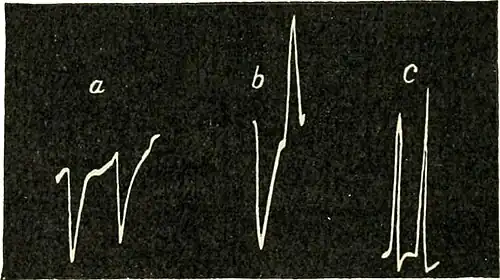
Fig. 80.—Electric response of Musa (a) Positive, (b) diphasic, (c) negative.
the electric response given by vegetable tissues. On application of feeble stimulus at a distance from the responding point, the response was by galvanometric positivity. Under stronger stimulus the response became diphasic, positive followed by negative. Direct stimulus induced a negative response.
VARIATION OF GROWTH UNDER INDIRECT STIMULUS.
Since the responsive. reactions of growing and non-growing organs are, as we shall find later. fundamentally similar, I expected that Indirect stimulus would give rise in a growing organ to an effect which would he of opposite sign to that induced by Direct stimulus—an acceleration, instead of retardation of growth; that would correspond to the positive mechanical and electrical responses to Indirect stimulus given by pulvinated organs and by ordinary vegetable tissues. The account of the following typical experiment will show that my anticipations have been fully verified.
Experiment 86.—I took a growing bud of Crinum and determined the region of its growth activity; lower down a region was found where the growth had attained its maximum and may, therefore, be regarded as indifferent region. I applied two electrodes in this indifferent region about 1 cm. below the region of growth. On application of moderate electric stimulus of short duration the response was by an acceleration of growth which persisted for nearly a minute, after which there was a resumption of the normal rate of growth. In this particular case the interval of time between the application of stimulus and the responsive acceleration of growth was 12 seconds. The interval varies in different cases from one second to 20 seconds or more, depending on the intervening distance between the point of application of stimulus and the responding region of growth. I give a record (Fig. 81)
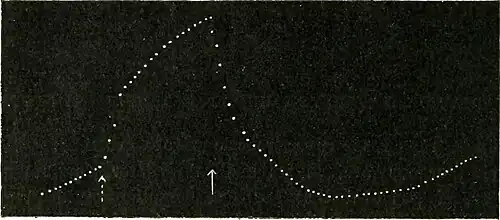
Fig. 81.—Effect of Indirect and Direct stimulus on growth of Crinum, taken on a moving plate. Dotted arrow shows application of Indirect stimulus with consequent acceleration of growth. Direct application of stimulus at the second arrow induces contraction and subsequent retardation of rate of growth. Successive dots are intervals of 5″. (Magnification 2,000 times).
obtained in a different experiment which shows in an identical specimen, (1) an acceleration of growth under Indirect and (2) a retardation of growth under Direct
stimulus.
TABLE XIX—ACCELERATING EFFECT OF INDIRECT STIMULUS ON GROWTH (Crinum).
| Specimen. | Condition of experiment. | Rate of growth. |
I … … … … … … … … … … … … … … … … … … … … … … … … … … … … |
Normal … … … … … … … … … … … … … … … … … … … … … … … … … … … … |
0.21 μ per second. |
After Indirect stimulus … … … … … … … … … … … … … … … … … … … … … … … … … … … … |
0.26 μ per„ second.„ | |
II … … … … … … … … … … … … … … … … … … … … … … … … … … … … |
Normal … … … … … … … … … … … … … … … … … … … … … … … … … … … … |
0.25 μ per„ second.„ |
After Indirect stimulus … … … … … … … … … … … … … … … … … … … … … … … … … … … … |
0.30 μ per„ second.„ |
It is thus seen that the effect of Indirect stimulus on growth-variation is precisely parallel to that obtained with the response of sensitive plant; that is to say, the effect induced by a feeble stimulus applied at a distance from the growing region is a positive variation or acceleration of growth. The effect becomes converted into negative or retardation of growth when the stimulus is Direct, i.e., when applied to the responding region of growth; under intermediate conditions, the growth-variation I find to be diphasic, a positive acceleration followed by a negative retardation. This is found true not merely in the case of a particular form of stimulus but of stimuli as different as mechanical, thermal, electric, and photic.
I shall in a subsequent paper formulate a generalised Law of Effects of Direct and Indirect Stimulus. From the experiments already described it is seen that:
It is seen that Indirect stimulus gives rise to dual reactions, seen in positive and negative response; of these the negative is the more intense. When the intervening distance is reduced, the resulting response becomes negative; this is due not to the absence of the positive, but to its being masked by the predominant negative. From the principle of continuity, this will also hold good in the limiting case, where by the reduction of the intervening distance to zero, the stimulus becomes Direct. In other words, Direct stimulus should also give rise to both positive and negative reactions. Of these the positive is masked by the predominant negative.
So much for theory; is it possible to unmask the contained positive in the resulting negative response under Direct stimulus? This important aspect of the subject will be dealt with in the following Paper.
SUMMARY.
The application of Direct stimulus gives rise to an electric response of galvanometric negativity. The application of stimulus at a distance from the responding point, i.e., Indirect stimulus, gives rise to positive electric response.
The mechanical responses of sensitive plants also exhibit similar effects, i.e., a negative response under Direct, and positive response under Indirect stimulus.
In the responsive variation of growth, Direct stimulus induces a retardation, and Indirect stimulus an acceleration of the rate of growth.
The effects of Direct and Indirect stimulus on vegetable organs in general are as follows: