Life Movements in Plants Vol 1/Chapter 15
XV.—EFFECT OF MECHANICAL STIMULUS ON GROWTH
By
Sir J. C. Bose.
Amongst the various stimuli which induce excitation in Mimosa may be mentioned the irritation caused by rough contact, by prick, or wound. Friction causes moderate stimulation, from which the excitated pulvinus recovers within a short time. But a prick or a cut induces a far more intense and persistent excitation; the recovery becomes protracted, and the wounded pulvinus remains contracted for a long period.
I shall now describe the effect of mechanical irritation on growth. For moderate stimulus, I employ rough contact or friction; more intense stimulation is caused by a prick or a cut.
EFFECT OF MECHANICAL IRRITATION.
Experiment 76.—In this experiment, I took a peduncle of Zephyranthes, which had a normal rate of growth of 0.18 μ per second. I then caused mechanical irritation by rubbing the surface with a piece of card-board. The mechanical stimulation was found to have caused a retardation of growth, the depressed rate being 0.11 μ per second, or three-fifths the normal rate. As this particular mode of stimulation was very moderate, the normal of rate growth was found to be restored after a short period of rest. After 15 minutes, the rate became 0.14 μ per second; after an hour the recovery was complete, the rate being now 0.18 μ per second, the normal rate before stimulation (Fig. 74a). We shall presently see that not only is the growth rate greatly depressed under intense stimulation, but the period of recovery also becomes very much protracted.
I have often been puzzled by the fact, that specimens apparently vigorous exhibited little or no growth, after attachment to the recorder. After waiting in vain for an hour, I had to discard them for others with equally unsatisfactory results. One of these specimens happened to be left attached to the recorder overnight, and I was surprised to find that the specimen, which had shown no growth the
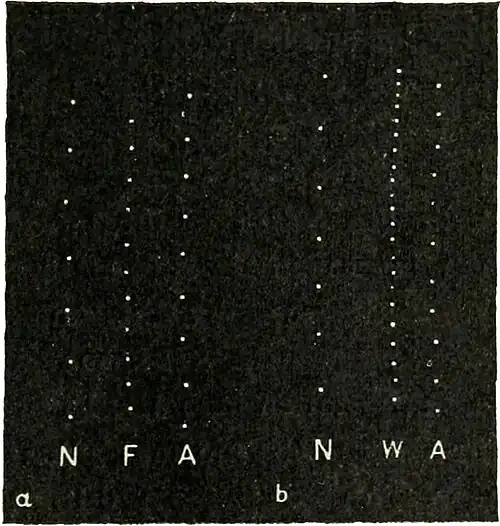
Fig. 74.—(a) N, normal rate of growth; F, retarded rate immediately after friction; A, partial recovery after 15 minutes.
(b) N, normal; W, immediately after wound; C, an hour after. (Successive dots at intervals of 5″.)
previous evening, was now exhibiting vigorous growth after being left to itself for 12 hours. I then realised that the temporary abolition of growth must have been due to the irritation of somewhat rough handling during the process of mounting and attachment of the specimen to the recorder.
In the matter of mechanical stimulation, some specimens are more irritable than others. The persistence of after-effect of irritation in retardation of growth will he demonstrated in the following experiments, where the stimulus employed was more intense.
EFFECT OF WOUND.
A prick causes an intense excitation in Mimosa. I tried the effect of this form of stimulation on responsive variation in growth.
Experiment 77.—The specimen was the same as had been employed in the last. experiment. After moderate stimulation due to friction it had, in the course of an hour, completely recovered its normal rate of growth of 0.18 μ per second. I now applied the stimulus of pin prick; the actual injury to the tissue due to this was relatively slight; but the retardation of growth induced by this more intense mode of stimulation was very great. With moderate mechanical friction the rate had fallen from 0.18 μ to 0.11 μ per second, i.e., to three-fifths the normal rate; in consequence of prick the depression was from 0.18 μ to 0.05 μ per second, i.e., to less than a third of the normal rate. After 15 minutes the rate recovered from 0.05 μ to 0.07 μ per second. After moderate friction the recovery was complete after an hour; but in this case the recovery after an equal interval was only three-fourths of the original, the rate being now 0.12 μ per second (Fig. 33b). I next applied the more intense stimulus caused by a longitudinal cut. This caused a depression of growth rate to 0.04 μ per second. A transverse cut, I find, gives rise to a more intense stimulation, than a longitudinal slit.
TABLE XVII.—EFFECT OF MECHANICAL IRRIGATION AND OF WOUND ON GROWTH. (Zephyranthes.)
| Nature of stimulus. | Condition. | Rate of growth. |
| Mechanical friction. | Normal rate … … … … … … … … … … … … … … … … … … … … … … … … … … … … |
0.18 μ per sec. |
Immediately after stimulation … … … … … … … … … … … … … … … … … … … … … … … … … … … … |
0.11 μ per sec.„ | |
15 minutes after stimulation … … … … … … … … … … … … … … … … … … … … … … … … … … … … |
0.14 μ per sec.„ | |
60 minutes after stimulation … … … … … … … … … … … … … … … … … … … … … … … … … … … … |
0.18 μ per sec.„ | |
| Prick with needle | Normal rate … … … … … … … … … … … … … … … … … … … … … … … … … … … … |
0.18 μ per sec. |
Immediately after stimulation … … … … … … … … … … … … … … … … … … … … … … … … … … … … |
0.05 μ per sec.„ | |
15 minutes after stimulation … … … … … … … … … … … … … … … … … … … … … … … … … … … … |
0.07 μ per sec.„ | |
60 minutes after stimulation … … … … … … … … … … … … … … … … … … … … … … … … … … … … |
0.12 μ per sec.„ |
The effect of mechanical stimulus on growth is thus similar to that induced by electrical stimulus. Moderate stimulus of rough contact induces an incipient contraction, seen in retardation of growth, the recovery being complete in the course of an hour; but intense stimulation, induced by wound, gives rise to greater and more persistent retardation of growth.
SUMMARY.
Mechanical stimulus induces incipient contraction or retardation of rate of growth, the effect being similar to that induced by electric stimulus.
Stimulus by contact or friction induces a retardation which is, relatively speaking, moderate. On the cessation of stimulus the normal rate of growth is restored within an hour.
Intense stimulation caused by the wound gives rise to greater and more persistent retardation of growth.