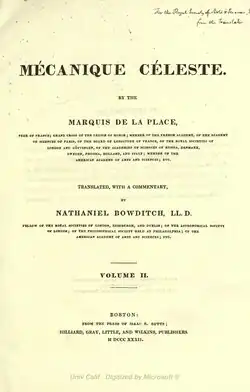
Index:Mécanique céleste Vol 2.djvu
|
CONTENTS OF THE SECOND VOLUME. THIRD BOOK. ON THE FIGURES OF THE HEAVENLY BODIES. CHAPTER 1. ON THE ATTRACTIONS OJ" HOMOGENEOUS SPHEROIDS, TERMINATED BY SURFACES OP THE SECOND ORDER 1 General method of transforming a triple differential into another, relative to three different variable quantities [1348'—1356'"]* Application of this method to the attraction of spheroids [1356""— 1361] . § 1 Formulas of the attractions of a homogeneous spheroid, terminated by a surface of the second order [1368, 1369] §2 On the attraction of a homogeneous ellipsoid, when the attracted point is placed within, or upon its surface. Reduction of this attraction to quadratures [1377, 1379], which, when the spheroid is of revolution, change into finite expressions [1385]. A point placed within an elliptical stratum, whose internal and external surfaces are similar, and similarly placed, is equally attracted in every direction [1369^] § 3 On the attraction of an elliptical spheroid upon an external point. Remarkable equation of partial differentials, which holds good relatively to this attraction [1398]. If we describe through the attracted point, a second ellipsoid, which has the same centre, the same position of the axes, and the same excentricities as the first, the attractions of the two ellipsoids will be in the ratio of their masses [1412""] §4,5,6 Reduction of the attractions of an ellipsoid, upon an external point, to quadratures [1421, 1426], which change into finite expressions [14::18], when the spheroid is of revolution. ... § 7 CHAPTER II. ON THE DEVELOPMENT OF THE ATTRACTION OF ANY SPHEROID IN A SERIES. . . . 63 Various transformations of the equation of partial differentials, of the attractions of spheroids [1429—1435] §8 Development of these attractions, in a series, arranged according to the powers of the distance of the attracted points from the centre of the spheroid [1436, 1444] § 9 Application to spheroids, differing but liltlo from a sphere; singular equation, which obtains between their attractions at the surface [1458] §10 VllI . CONTENTS OF THE SECOND VOLUME. A very simple result of this equation is, the relation between the terms of the series, expressing the attraction of a spheroid, upon an external point, and those of the radius of the spheroid, developed in a series of functions of a particular kind [1463, 1467]. These functions are given • by the' nature of the attraction [1465'] ; they are of very great use in the theory of the figures
General theorem [1470] ; expressing the double integral of the differentials which depend upon the product of two of these functions. Simplification of the expressions of the radius of the spheroid, and of its attraction, when the origin of the radius is fixed at the centre of gravity of the spheroid [1480', 1483^*] §12 On the attraction of a spheroid upon a point placed within it [1496] ; also of a stratum upon a point placed within it [1501]. Conditions which are necessary, in order that the point may be equally attracted in every direction [1502] §13 On the attractions of a spheroid, differing but little from a sphere, and formed of strata, varying according to any law [1505, 1506] § 14 Extension of the preceding researches to any spheroid whatever ; reduction of its attraction to a series of a very simple form ; new solution of the problems of the attractions of elliptical spheroids which results from this method [1507 — 1563] § 15, 16, 17 CHAPTER III. ON THE FIGURE OF A HOMOGENEOUS FLUID MASS IN EaUILIBRIUM, AND ENDOV^^ED WITH A ROTATORY BIOTION 199 General equation of the surface in a state of equilibrium [1564]. The ellipsoid satisfies this equation [1574"]. Determination of this ellipsoid. The gravities at the pole and at the equator are in the ratio of the diameter of the equator to the axis of the poles [1578"]. Two elliptical figures, and no more, can satisfy a given angular motion of rotation [1.597"] ; and relatively to the earlh, supposing it to be homogeneous, the equatorial diameter is to the polar axis as 680,49 to 1, in the most oblate ellipsoid [1603"] ; and as 231,7 to 230,7 [1592"], in the least oblate ellipsoid. A homogeneous fluid mass cannot be in equilibrium with an elliptical figure, unless the duration of its rotation exceed the product of 0day,1009 [=2h 25m], by the square root of the ratio of the mean density of the earth to that of the mass [1605'] § 18, 19, 20 If the primitive duration of rotation be less than this limit, it will increase by the flattening of the fluid mass ; and whatever be the primitive impressed force, the fluid, by means of the tenacity of its particles will finally attain a permanent elliptical figure, of a particular form, to be determined by the nature .of these forces. The axis of rotation is that passing through the centre of gravity, and which was, at the commencement of the motion, the axis of the greatest momentum of the forces [1607"— 1614""] § 21 CHAPTER IV. ON THE FIGURE OF A SPHEROID," DIFFERING BUT LITTLE FROM A SPHERE, AND COVERED BY A FLUID STRATUM IN EaUILIBRIUM 241 General equation of equilibrium [1615] § 22 Development of this equation, when the forces acting upon the fluid depend upon the centrifugal force of the rotatory motion, upon the attractions of the fluid and of the spheroid, and upon the attraction of foreign bodies [1616^'"'] § 23 Equation of equilibrium, when the spheroid and fluid are homogeneous and of the same density [1636]. Expression of the radius of the spheroid [1644], and the gravity of its surface [1647]. 97.121.167.179 00:28, 12 February 2025 (UTC)]]]] CONTENTS OF THE SECOND VOLUME. IX If there be no foreign attraction, this surface will be elliptical, and the ellipticity will be f of the ratio of the centrifugal force to gravity [1648] ; the diminution of the radius of the spheroid, from the equator to the poles, will be proportional to the square of the sine of * " th'e latitude [1G4S'"], and if we take the radius, and the gravity at the poles, for the unit of measure and of gravity respectively, we shall find, that the increment of gravity is equal to the decrement of the radius [1648, 1648'J §24,25 A direct demonstration, independent of series, that the elliptical figure is then the only one which corresponds to the state of equilibrium [1649" — 1676""] §26 In some cases, a homogeneous fluid mass, surrounding a sphere, can have an infinity of different figures of equilibrium. Determination of these figures [1676^ — 1701] §27,28 General equations of equilibrium of the fluid strata, of variable densities, which cover a spheroid [1702] §29 Examination of the case in which the spheroid is wholly fluid [1709'"]. If there be no foreign attractions, the spheroid will then be an ellipsoid of revolution [1731']. The densities will diminish, and the ellipticities increase from the centre to the surface [1731"]. The limits of the oblateness are between -f and g- of the ratio of the centrifugal force to gravity [1732"']. Equation of the curve, whose elements are in the direction of gravity, from the centre to the surface [1734] §30 Simplification of the expression of the radius of a spheroid covered by a fluid in equilibrium, supposing the origin of the radius to be fixed at the centre of gravity of the whole mass [1734'"], and that it turns about one of the principal axes [1755] § 31, 32 Very simple expressions of the force of gravity [1769], of the length of a pendulum [1770], and of the length of a degree upon the surface of the spheroid [1774], in terms of the radius [1765], An easy method, which results, for verifying by observation, any hypothesis that may be imagined, relative to the laws of the variations of the degrees and of gravity [1777^"]. The hypothesis of Bouguer, according to which the variation of the degrees from the equator to the poles is proportional to the fourth power of the sine of the latitude, is incompatible with the observations of the pendulum [1787"]. Reason why the aberrations from the elliptical figure are much more sensible in the degrees of the meridian, than in the lengths of the pendulum [1777"] §33 If the strata of the spheroid be supposed elliptical, the figure of the surrounding fluid will also be elliptical. The variations of the radii of the earth, of the degrees of the meridian and of gravity, will then be proportional to the square of the sine of the latitude [1795 — 1796]. The whole variation of gravity from the equator to the pole, divided by the whole expression of gravity, will be as much above or below f of the ratio of the centrifugal force to gravity at the equator, as the ellipticity is below or above the same quantity respectively [1806]. . § 34 Expressions of the attractions of elliptical spheroids upon an external point [1811", &c.]. § 35 Of the law of gravity at the surface of a homogeneous fluid spheroid, the attraction being as any power of the distance [1817] § 36 Method of noticing the terms depending on the square and higher powers of the centrifugal force, in the investigation of the figures of spheroids, covered by a fluid in equilibrium [1820" — 1839]. We can satisfy ourselves that the equilibrium of the fluid is rigorously possible ; although we cannot ascertain this figure, except by successive approximations [1839"] §37 C
Page:Mécanique céleste Vol 2.djvu/16 Page:Mécanique céleste Vol 2.djvu/17 Page:Mécanique céleste Vol 2.djvu/18 Page:Mécanique céleste Vol 2.djvu/19 Page:Mécanique céleste Vol 2.djvu/20 Page:Mécanique céleste Vol 2.djvu/21 Page:Mécanique céleste Vol 2.djvu/22 Page:Mécanique céleste Vol 2.djvu/23 |