Illustrations of Japan/Part 2
Japan.
Part Second.
Decription of the Ceremonies Customary in Japan at Marriages
and Funerals: Particulars Concerning the Dosia
Powder, &c.
Introduction
to the
Description of the Marriage Ceremonies
of
the Japanese.
In compliance with the urgent request of the Society of Sciences established at Batavia, I made very particular inquiries concerning the marriages of the Japanese. As it would be impossible to form any correct idea of them from the mere account that a foreigner might draw up, I have preferred giving a translation of a work on the subject printed in the country itself, and adding the necessary explanations between parentheses. This work, which enters into the most minute details, may lead the reader to suppose that the Japanese sink the more important matters in an ocean of frivolities; but before he adopts so harsh a notion respecting a people who are not inferior in politeness to the most distinguished nations of Europe, he ought to consider their present situation, and to acquire a smattering at least of their history.
On the first arrival of the Dutch in 1609, the Japanese were allowed to visit foreign countries. Their ships, though built on the plan of the Chinese junks, boldly defied the fury of tempests. Their merchants were scattered over the principal countries of India; they were not deficient either in expert mariners or adventurous traders. In a country where the lower classes cannot gain a subsistence but by assiduous labour, thousands of Japanese were disposed to seek their fortune abroad, not so much by the prospect of gain, as by the certainty of being enabled to gratify their curiosity with the sight of numberless objects that were wholly unknown to them.
This state of things formed bold and experienced sailors, and at the same time soldiers, not surpassed in bravery by those of the most warlike nations of India.
The Japanese, accustomed from their infancy to hear the accounts of the heroic achievements of their ancestors, to receive at that early age their first instruction in those books which record their exploits, and to imbibe, as it were, with their mother’s milk the intoxicating love of glory, made the art of war their favourite study. Such an education has, in all ages, trained up heroes; it excited in the Japanese that pride which is noticed by all the writers who have treated of them, as the distinguishing characteristic of the whole nation.
Having a keen sense of the slightest insult, which cannot be washed away but with blood, they are the more disposed to treat one another in their mutual intercourse with the highest respect. Among them suicide, when they have incurred disgrace or humiliation, is a general practice, which spares them the ignominy of being punished by others, and confers on the son a right to succeed to his father’s post. As with us, the graceful performance of certain bodily exercises, is considered an accomplishment essential to a liberal education, so among them, it is indispensably necessary for all those who, by their birth or rank, aspire to dignities, to understand the art of ripping themselves up like gentlemen. To attain a due proficiency in this operation, which requires a practice of many years, is a principal point in the education of youth. In a country where sometimes a whole family is involved in the misconduct of one of its members, and where the life of every individual frequently depends on the error of a moment, it is absolutely requisite to have the apparatus for suicide constantly at hand, for the purpose of escaping disgrace which they dread much more than death itself. The details of the permanent troubles recorded in their annals, and the accounts of the first conquests of the Dutch in India, furnish the most complete proofs of the courage of the Japanese. The law, which has since forbidden all emigration, and closes their country against strangers, may have taken away the food which nourished their intrepidity, but has not extinguished it: any critical event would be sufficient to kindle their martial sentiments, which danger would but serve to inflame, and the citizen would soon be transformed into a hero.
The extirpation of the Catholic religion, and the expulsion of the Spaniards and Portuguese, caused dreadful commotions in Japan for a number of years. The sanguinary war which we (the Dutch) carried on with those two nations, who were too zealous for the propagation of Christianity, and the difference of our religion, procured us the liberty of trading there, to the exclusion of all the other nations of Europe. The Japanese, perceiving that incessant seditions were to be apprehended from the secret intrigues of the Roman Catholics, and the numerous converts made by them, found at length that in order to strike at the root of the evil, they ought to apply to the Dutch, whose flag was then the terror of the Indian seas.
The bold arrest of governor Nuyts, at Fayoan, in 1630, showed them that the point of honour might every moment involve them in quarrels for the purpose of revenging the insults which their subjects might suffer in foreign countries or at sea. The decree of the Djogoun, which confiscated the arms of the people of Sankan, wounded the vanity of the Japanese. Numbers of malefactors, to avoid the punishment due to their crimes, turned pirates, and chiefly infested the coast of China, the government of which made frequent complaints on the subject to that of Japan. The nine Japanese vessels, then trading with licenses from the Djogoun, were to be furnished with Dutch passports and flags, in case of their falling in either with Chinese corsairs, or with our ships cruising against those of the Spaniards of Manilla and the Portuguese at Macao. The residence of Japanese in foreign countries rendered their government apprehensive that it would never be able entirely to extirpate popery. These various considerations induced the Djogoun, in the twelfth year of the nengo quanje (1631), to decree the penalty of death against every Japanese who should quit the country: at the same time the most efficacious measures were taken in regard to the construction of vessels. The dimensions were so regulated, that it became impossible to quit the coast without inevitable danger.
Cut off from all other nations, encompassed by a sea liable to hurricanes, not less tremendous for their suddenness than their violence, and thereby secured from the continuance of hostile fleets in these parts, the Japanese gradually turned their whole attention to their domestic affairs. Their respect for the Dutch by degrees diminished. A mortal blow was given to our importance in this country by the removal of our establishment from Firando to Nangasaki in 1640, the chief objects of which were, 1. To afford some relief to the inhabitants of that imperial city, who, since the expulsion of the Spaniards and Portuguese, were daily becoming more and more impoverished; 2. To keep us more dependent, by placing us under the superintendence of their governors. For the sake of our commerce, we patiently submitted to the destruction of our recently erected store-houses, the heavy expense incurred by the removal, and our imprisonment in the island of Desima, where the Portuguese had their buildings, and which we had heretofore in derision denominated their dungeon. The humiliating treatment to which they then first subjected us, according to our records of those times, caused the Japanese to remark that they might act towards us in a still more arbitrary manner.
Having no idea of the governments of Europe, ignorant that the mightiest empires there owe their greatness and the stability of their power to the benign influence of commerce alone, the Japanese hold the mercantile profession in contempt, and consider the farmer and the artisan as more useful members of society than the merchant. The little respect that still continued to be paid us was at length wholly withdrawn, on the reduction of the island of Formosa by Coxinga. A native of Firando, and carrying on an extensive commerce at Nangasaki, Coxinga solicited assistance from the court of Yedo against the Chinese. Miko-no-komon-sama, great-grandfather of the prince of Firando in my time, supported him with all his influence. The Djogoun rejected his application, because he would not embroil himself with that empire. Coxinga, attacking the Chinese in the island of Formosa, at the same time turned his arms against us. Though he was not openly favoured, yet our archives attest that the Japanese policy encouraged his hostilities, since the government took no notice of our complaints, regarding us no doubt, as too dangerous neighbours, and not conceiving itself secure so long as the empire should be exposed to the attacks of an enterprising people. The vexations to which we have since been exposed have frequently induced the Company to think of dissolving the establishment. Some of the Japanese, well-disposed towards the Dutch, even advised us to threaten them with it, and to recover our credit by the reduction of Formosa. The former was tried with some success, but we were not strong enough to attempt the latter.
Since the suppression of the rebellion at Arima and Simabarra, in 1638, the peace of the empire has not been disturbed: it was not interrupted either by the attempt of Juino Djosits and Marbasi Fiuia, in 1651, or by that of Jamagata Dayni, in 1767, the particulars of which I have given in the Secret Memoirs of the Djogouns. At the very commencement of the present dynasty, the government made regulations, as salutary as the welfare of the state, the happiness of the people, and the maintenance of order in the interior of the empire required. The active spirit of the Japanese could not fail to seek new objects, and by degrees their attention was turned to the establishment on fixed bases of all the observances due to each individual, according to his station in the different circumstances of life: so that every one might have precise rules for the government of his conduct towards others of every class, from the highest to the lowest. These very particular regulations were printed; otherwise a long life would scarcely suffice for acquiring a thorough knowledge of etiquette.
The military profession, as we have observed, is regarded by the Japanese as the most noble pursuit: a predilection for it is therefore encouraged in boys from their earliest years, by a suitable education, and by the Festival of Flags, which is held on the fifth of the fifth month. As they grow older, they apply themselves to the history of their country, and to the study of the duties attached to different offices, in which the sons regularly succeed their fathers. The study of the Chinese language also, in which they seldom make any very great proficiency, though persons above the lowest class devote their attention to it at all ages, affords them incessant employment. As their best works are written in that language, it is a disgrace for persons of distinction to be unacquainted with it. The precepts of Confoutsé have been in all ages explained and commented on in the public schools. From the remotest antiquity, the Japanese have respected the Chinese as their masters, and paid homage to their superior attainments. To them they went for many centuries to complete their education, and to augment their stores of knowledge. Since the prohibition of foreign travel, the only resource left them is to study the works of the Chinese, which they purchase with great avidity, especially since the zeal of the missionaries, by making them acquainted with the process of printing, has opened a new career to their fondness for study.
Several of our interpreters were well versed in the history of China and Japan. Among those who most excelled in this respect were Josio-Kosak, Nanioura-Motoisera, Naribajasi Zïubi, Naribasi Zenbi, Nisi-Kitsrofe, Foli-Monsuro, and likewise Matsmoura-Jasnosio, who, at my departure, was appointed tutor to the prince of Satsuma. I mention their names out of gratitude for the kind assistance which they afforded me in my researches. During my residence in Japan, several persons of quality at Yedo, Mijako, and Osaka, applied themselves assiduously to the acquisition of our language, and the reading of our books. The prince of Satsuma, father-in-law of the present Djogoun, used our alphabet to express in his letters what he wished a third person not to understand. The surprising progress made by the prince of Tamba; Katsragawa Hoznu, physician to the Djogoun; Nakawa-Siunnan, physician to the prince of Wakassa, and several others, enabled them to express themselves more clearly than many Portuguese, born and bred among us at Batavia. Considering the short time of our residence at Yedo, such a proficiency cannot but excite astonishment and admiration. The privilege of corresponding with the Japanese above-mentioned, and of sending them back their answers corrected, without the letters being opened by the government, allowed through the special favour of the worthy governor, Tango-no-Kami-Sama, facilitated to them the means of learning Dutch.
In the fifth chapter of the first volume of the work of Father Charlevoix, a mixture of good and bad, and swarming with errors, the character of the Japanese, as compared with that of the Chinese, is very justly delineated. Their vanity incessantly impels them to surpass one another in bodily exercises, as well as in the accomplishments of the mind. The more proficiency they make, the stronger is their desire to see with their own eyes all the curious things, the description of which strikes their imagination. When they turn their eyes to neighbouring nations, they observe that the admission of foreigners is not injurious to the government; and that a similar admission of strangers into their own country would furnish them with the means of studying a variety of arts and sciences of which they have but vague notions. It was this that induced Matsdaira-Tsou-no-Kami, the extraordinary counsellor of state, to propose in 1769 the building of ships and junks calculated to afford the Japanese facilities of visiting other countries, and at the same time to attract foreigners to Japan. This plan was not carried into execution in consequence of the death of that counsellor.
Though many Japanese of the highest distinction and intimately acquainted with matters of government, still consider Japan as the first empire in the world, and care but little for what passes out of it, yet such persons are denominated by the most enlightened Inooetzi-no-Kajerou, or frogs in a well, a metaphorical expression, which signifies that when they look up, they can see no more of the sky than what the small circumference of the well allows them to perceive. The eyes of the better informed had been long fixed on Tonoma-yamassiro-no-kami, son of the ordinary counsellor of state Tonomo-no-kami, uncle to the Djogoun, a young man of uncommon merit, and of an enterprising mind. They flattered themselves that when he should succeed his father, he would as they expressed it, widen the road. After his appointment to be extraordinary counsellor of state, he and his father incurred the hatred of the grandees of the court by introducing various innovations, censured by the latter as detrimental to the welfare of the empire. He was assassinated on the 13th of May 1784, by Sanno-Sinsayemon, as related in my Annals of Japan. This crime put an end to all hopes of seeing Japan opened to foreigners, and its inhabitants visiting other countries. Nothing more, however, would be required for the success of such a project, than one man of truly enlightened mind and of imposing character. At present, after mature reflection on all that is past, they are convinced that the secret artifices and intrigues of the priests of Siaka were the real cause of the troubles which for many years disturbed the peace of the empire.
In 1782 no ships arrived from Batavia, on account of the war with England. This circumstance excited general consternation not only at Nangasaki, but also at Osaka and Miyako, and afforded me occasion to stipulate with the government for a considerable augmentation in the price of our commodities for a term of fifteen years. Tango-no-kami, the governor, with whom I kept up a secret intercourse, proposed to me in 1783 to bring over carpenters from Batavia to instruct the Japanese in the building of ships and smaller vessels, a great number of barks employed in the carriage of copper from Osaka to Nangasaki having been wrecked on their passage, which proved an immense loss to the government. Knowing that it would be impossible to comply with his request, because none of the common workmen employed in our dock-yards in the island of Java possessed sufficient skill, and the masters were too few to allow any of them to be spared for ever so short a time; I proposed to Tango-no-kami to send with me, on my departure from Japan, one hundred of the most intelligent of his countrymen to be distributed in our yards, assuring him that pains should be taken to teach them all that was necessary to qualify them for carrying his views into execution at their return. The prohibition which forbids any native to quit the country, proved an insurmountable obstacle. On the arrival of a ship in the month of August, I caused the boats to manœuvre from time to time in the bay with Japanese sailors on board, which much pleased the governor, but did not fulfil his intentions. I then promised that when I reached Batavia, I would have the model of a vessel built, and present him with it on my return, together with the requisite dimensions, and all possible explanations: this I accordingly did in August the following year. The death of Yamassiro-no-kami, of which I received information immediately after my arrival at Batavia, annihilated all our fine schemes. Having finally quitted the country for Europe in the month of November in the same year, I know not whether my instructions on this point have been followed or not.
A plan so important as that here mentioned, other schemes which I pass over in silence, and the ordinary duties of my post, occupied my whole time. When therefore, I sat down to describe the manners and customs of the Japanese so imperfectly known in Europe, I had not leisure to draw up an accurate account of all the ceremonies attending the marriages of persons of quality; but was obliged to confine myself to the description of those common among farmers, artisans, and tradesmen. By comparing them with what is the practice in Europe and elsewhere among persons of those different classes the reader will be enabled to judge to what a length the Japanese carry the observance of the forms of politeness and etiquette.
The Editor has extracted from Charlevoix the following description of the mode of constructing and arranging private houses in Japan, as it will enable the reader to understand with the greater facility the account of the marriage ceremonies observed in that country.
The houses of private individuals must not exceed six fathoms in height, and few buildings are so lofty unless they be intended for store-houses. The palaces of the emperors themselves have but one floor, though some private houses have two; but the ground-floor is so low, that it can scarcely be used for any other purpose than stowing away the articles necessary for common use. The frequency of earthquakes in Japan has occasioned this mode of building: but, if these houses are not to be compared with ours for solidity or height, they are not inferior to them either in cleanliness or convenience. They are, with few exceptions, of wood. The ground-floor is raised four or five feet as a precaution against damp, for the use of cellars seems to be unknown in this country: and, as these houses are very liable to be consumed by fire, there is in each of them a spot enclosed with walls of masonry, in which the family deposits its most valuable effects: the other walls are made of planks, and covered with thick rugs, which are very nicely joined together.
The houses of persons of quality are divided into two series of apartments. On one side is that of the women, who, in general, never show themselves; and on the other, is what we should call the drawing-room, where visitors are received. Among the trades-people and inferior classes, the women enjoy more liberty, and are less careful to conceal themselves from view: but, upon the whole, the sex is treated with great respect, and distinguished by extraordinary reserve. Even in the most trifling matters the utmost politeness is shown to women. The finest pieces of porcelain, and those cabinets and boxes which are so highly esteemed and carried all over the world, instead of serving to decorate the apartments in ordinary use, are kept in those secure places above-mentioned, into which none but particular friends are admitted. The rest of the house is adorned with common porcelain, pots full of tea, paintings, manuscripts, and curious books, arms, and armorial bearings. The floor is covered with thick double rugs, bordered with fringe, embroidery, and such-like ornaments. According to the law or the custom of the country, they must all be six feet in length, and three in breadth.
The two suites of apartments into which the body of the house is divided consist of several rooms, separated by mere partitions, or rather by a kind of skreens, which may be moved forward or backward at pleasure; so that an apartment may be made larger or smaller as there may be occasion[1]. The doors of the rooms and the partitions are covered with paper, even in the most splendid houses: but this paper is adorned with gold or silver flowers, and sometimes with paintings, with which the cieling is always embellished. In short, there is not a corner of the house but has a cheerful and pleasing appearance. This mode of arrangement renders houses more healthy: in the first place, because they are entirely built of fir and cedar; in the second, because the windows are so contrived, that by changing the place of the partitions, the air is allowed a free passage through them. The roof, which is covered with boards or shingles, is supported by thick rafters; and, when a house has two floors, the upper is usually built more solidly than the lower. It has been found by experience, that a house so constructed, resists the shocks of earthquakes better. In the architecture of the exterior there is nothing very elegant. The walls, which, as I have observed, are of boards, and which are very thin, are covered in many places with a greasy earth found near Osaka; or instead of this earth, they give the outside a coat of varnish, which they lay on the roofs also. This varnish is relieved with gilding and paintings. The windows are filled with pots of flowers, which, according to Caron, they have for all seasons; but when they have no natural flowers they make shift with artificial ones. All this produces an effect that pleases the eye, if it does not gratify it so highly as beautiful architecture would do.
Varnish is not spared in the interior. The doors, the door-posts, and a gallery which usually runs along the back of the house, and from which there is a descent into the garden, are covered with it, unless the wood be so beautiful as to make them wish not to conceal the veins and shades; in this case they merely lay on a thin coat of transparent varnish. In the apartments are to be seen neither chairs nor benches; for it is customary, in Japan, as in all the rest of Asia, to sit on the ground. To avoid soiling the mats or rugs which cover the floor and serve for seats, they never walk on them in shoes, or more properly speaking, sandals, which are put off on entering the house. They sleep also upon these rugs over which people in good circumstances spread a rich carpet, and a wooden machine serves to support it. This is a kind of box, nearly cubical, composed of six small boards very neatly joined together and varnished; it is about a span long, and not quite so broad. Most of the household utensils are of thin wood covered with a thick varnish of a deep red. The windows are of paper, and have wooden shutters within and without; they are never closed but at night, and are not seen in the day-time, their sole use being to prevent persons from entering the house by favour of the darkness, either through the court or the gallery.
In the apartment for the reception of company, there is always a large cabinet opposite to the door, and against this cabinet visitors are placed. Beside the cabinet is a buffet, on which are put religious books; and, in general, by the door there is a kind of balcony, so contrived that without rising, you may have a view either of the country, the street, or the garden. As the use of fire-places is unknown in Japan, there is in the largest apartments a square walled hole, which is filled with lighted charcoal, that diffuses heat sufficient to warm the whole room. Sometimes a low table covered with a large carpet is set over the fire, and people sit upon it when the cold is very severe, nearly in the same manner as they do in Persia, on what is called a kartsü. In apartments in which a fire-place cannot be made, they supply the want of it by copper and earthen pots, which produce nearly the same effect. Instead of poker and tongs they use bars of iron to stir the fire, which they do with as much address as they use small varnished sticks instead of forks to eat with.
In the houses of very wealthy persons and in great inns are to be seen very curious articles, which serve to amuse travellers, such as: 1. A large paper, on which is represented some deity, or the figure of some person eminent for virtue, with an appropriate and frequently very rich border, in the manner of a frame. 2. Grotesque Chinese figures, birds, trees, landscapes, always in a masterly style, covering skreens. 3. Pots of flowers. 4. Perfuming-pans of brass or copper, in the shape of cranes, lions, or other animals. 5. Pieces of furniture of rare wood. 6. Toilets of carved work. 7. Plate, porcelain, &c.
- ↑ It may be seen from the engravings which accompany the description of marriages, that they have also sliding partitions; that a partition is composed of three or four shutters or leaves, running one before another on parallel grooves; and that, by this mode of separation, they can in a few moments make one large room out of several small ones.
Description
of the
Ceremonies Observed in Japan
at the
Marriages of Farmers, Artisans, and Tradesmen.
The marriage ceremonies of the highest and those of the lowest classes are totally different. Very curious particulars relative to this subject are given in several Japanese works, particularly in the Jomé-tori-tiofo-ki, in which the manner of conducting the bride out of the house of her parents is accurately described. The same thing is also to be found in the Kesi-foukoro, of which I here give a translation, together with the plates belonging to it, containing all that is to be observed at the marriages of farmers, artisans, and tradesmen;
The presents that are to be sent to the residence of the bride when the match is agreed on;
The ceremonies observed from the commencement till the conclusion of the marriage;
The apparel and what is most commonly worn on such occasions;
The furniture, ordinary and extraordinary;
The manner of contracting the engagement at three times, with a single earthenware jug full of zakki, and when three such jugs are employed;
How the nearest relatives on each side meet, and bind the new alliance by drinking zakki;
The manner of adorning the tekaké, the fikiwatasi, and the sousous; and the order in which the company are placed.
All this is shown in the Kesi-foukoro by several engravings on wood, the description of which is divided into numbered chapters, that whatever relates as well to marriage as to the value of the presents, among the highest, middling, and lowest classes, may be thoroughly understood by all. Thus
| No. | 1. | contains the list of the presents and the manner in which they are arranged; |
| 2. | The manner in which they are previously arranged at the house of the father; | |
| 3. | What is to be observed in regard to the paper; | |
| 4. | What ought to be written upon it; | |
| 5. | The form and manner of paying consgatulations, and the order in which the presents are arranged at the residence of the bride; | |
| 6. | The manner of delivering the lists of presents, &c. |
These numbers amount to 192. The substance of them is as follows:—
§ 1. Gives a description of the presents, and of what is to be observed in regard to their value, with reference to the condition and circumstances of each person. These presents consist of
| 150 | pieces of money, of the value of 4 taels 3 marcs each. |
| 5 | rolls of white pelongs. |
| 5 | rolls of red gilams. |
| 10 | single rolls, or 5 double pieces of red stuff for lining. |
| 15 | packets of silk wadding. |
| 5 | bunches of nosi, or dried rock-leech. |
| 3 | handfuls of dry sea-cats. |
| 50 | pieces of sea-lentil. |
| 53 | kommelmaas, or two or three couple of wild ducks. |
| 1 | tray with two bream. |
| 2 | kegs of zakki. |
Each person is at liberty to give the eleven articles composing such a present, or only nine, seven, or three, just as he pleases; representations of them, as well as of the trays on which they are offered, will be found in plates 4, 6, 9, and 10.
§ 2. The father of the bridegroom, after setting out the present at his house, invites all his relations, male and female, and likewise the mediators, and regales them with zakki and other refreshments.
§ 3. To make out a list of the presents they use fosio paper, or sougi-fara paper, according as it is longer or shorter. This paper is folded length-wise in the middle; and only one side is written upon. When the present is large, and one side is not spacious enough to hold the description of them, they take take-naga paper. This list must be written with thick ink, otherwise it would not be accepted.
§ 4. This list is made out as follows:
a Mokrok, or List of Presents.
| b | above, | pieces of money, | below | 150 | pieces. |
| c | above |
white pelongs, | below |
5 | rolls. |
| d | above |
red gilams, | below |
5 | rolls. |
| e | above |
red stuff, | below |
5 | double pieces. |
| g | above |
bunches of nosi, | below |
5 | |
| h | above |
sea-cat, | below |
3 | handfuls. |
| i | above |
sea lentil, | below |
50 | pieces. |
| k | above |
kommelmaas, | below |
50 | pieces. |
| l | above |
bream, | below |
2 | |
| m | above |
zakki, | below |
2 | kegs. |
| At the side | n. | Izjo, or the end. |
| o. | Niwa-Kanjemon, name of the bridegroom’s father. | |
| p. | the date. | |
| q. | Ima-i-Sioyemon, name of the bride’s father. |
§ 5. The presents having been carried to the house of the bride’s father, the messenger arranges them in the order in which they are enumerated in the list. If the place be rather too small for displaying them, still they must not be set out indistinctly; each of the articles must lie separately, but they may be laid as closely as possible to one another.
§ 6. Among the middling class trays with legs are used, and among the lower trays without legs.
§ 7. The messenger sent to the residence of the bride must be accompanied by the mediator. The former pays this compliment:—
“Niwa-Kanjemon is exceedingly flattered that Ima-i-Sioyemon-Sama gives his daughter to his son. For this reason he sends him this present, as a token that he wishes him durable health.”
§ 8. At the house of the bride’s father, a servant in decent attire, as well as the messenger, must be on the watch to receive the present. After comparing it with the list, he politely accepts it, and informs the master of the house of the present and the message.
§ 9. The messenger and mediator are then conducted into any suitable apartment.
§ 10. The conductor, his people, and the messengers, are then led into another apartment, by persons appointed for that purpose; who, after they are there seated, leave them for a moment. Meanwhile a cup of tea, and the apparatus for smoking, are handed round to each of the persons thus seated.
§ 11. If the messenger is a person of respectability, he is regaled with soni soup, famagouris (a species of muscle) with their sauce; a koemisiu, (a box of sweatmeats), and several other kinds of refreshments, the whole served up in small bowls exquisitely varnished, with covers. If he is an ordinary person, he is treated only with soni soup and soeimono, (fish chopped very small), with sauce in bowls of a more common kind, but also with covers. To these are added a box of balls made of fish and zakki.
§ 12. It frequently happens that the messenger and the master of the house are of different rank; if the former be of higher rank, the other comes to him and compliments him; in the contrary case, he is not expected to do so.
§ 13. The receipt contains a list of the presents at full length, and concludes with these words:—
“The present described above has been duly received by Ima-i-Sioyemon, who also wishes durable health to Niwa-Kanjemon.”
§ 14. The receipt being considered as an important document, the name of the father is inserted in it, and that of the messenger is not mentioned.
§ 15. At the expiration of three days, the messenger and those who accompanied him to the residence of the bride, receive a counter-present proportionate to what they brought; for instance,
The messenger 2 pieces of money, 1 roll of stuff for a cloak of ceremony, 10 quires of sougi-fara paper.
The conductor, 2 itsibs of gold, which make a half-koban, and 5 quires of sougi-fara paper.
Each servant 3 strings of sepikkes, and one quire of fansi paper.
§ 16. The day after that on which the present is carried to the house of the bride, the mediators are complimented by the parents of the young couple.
§ 17. The mediators are charged to ascertain, on behalf of the bride, the arms of the bridegroom, and the length of his robes.
§ 18. The two parties must settle between them on what day the marriage is to take place.
§. 19. The following articles are prepared for the bride at her own home:
- Long robes, wadded with silk for winter;
- A wedding dress, white, embroidered with gold or silver;
- Another dress, with a red ground;
- Another with a black ground;
- Another of plain white stuff;
- Another of plain yellow;
(People of quality have for this purpose costly stuffs, the ground of which, called aja, is sprinkled with squares of the same stuff, crossed each way, thus, 田, named saji-waifies. Such is the costume indispensably necessary on all great festivals. For mourning they have also stuffs with this aja ground, but without squares).
A number of summer robes, both lined and single, and all the other requisites of a wardrobe, as girdles, bathing gowns, chemises, under robes, fine and coarse, a bed-gown with sleeves, (a thick furred robe), a rug to sleep on, bed-clothes, pillows, gloves, carpets, bed-curtains, head-dresses, (usually of silk gauze, which young females wear when they go abroad), a light girdle (which is covered by the broad one, and serves to tuck up the robes with long trains), plain strings, (to tie round the cotton gown worn in bed), a silk cap, a furred cap of cotton, long and short towels, a cloak, a covering for the norimon, silk buskins, and a bag with a mixture of bran, wheat, and dried herbs, to be used in washing the face.
§ 20. The santok, or pocket-book, must contain a small bag of toothpicks, some skeins of moto-iwi (thin twine made of paper to tie the hair), a small looking-glass, a little box of medicines, and a small packet of the best kalambak.
§ 21. Several kinds of paper are also provided, as sikisi, tansac, nobé-kami, sougi-fara, fansi, fosio, mino-kami, tage-naka, and maki-kami, or paper in rolls for writing letters.
§ 22. Various trifling articles are also put up, as:
A kollo (a kind of harp,) a samsi (a sort of guitar), a small chest for holding paper, an inkhorn, a pincushion, several sorts of needles, Daïri dolls, a box of combs, a mirror with its stand, a mixture of iron and black to blacken the teeth, (the distinguishing mark of married women, some blackening them the moment they are married, and others when they first become pregnant), curling-tongs for the hair, scissors, a letter-case, a case of razors, several small boxes varnished or made of pasteboard or osier, dusters, a small bench for supporting the elbows when the owner has nothing to do, a case of articles for dressing the hair, small dolls, an iron for ironing linen, a large osier basket (to hold the carpets and various articles of linen used by women), a tub with handles, a small and very smooth board, a small sabre, called mamouri-gatana, with a white sheath in a little bag (this sabre, when carried about them, is thought to drive away evil spirits, and to preserve them from all infectious exhalations; and the same effects are ascribed to the sabres of the men), complimentary cords (small cords made of paper, painted with different colours, and gilt or silvered at each end, used to tie round presents), nosi or dried rock leech (a small piece of which is attached to every present in token of congratulation), silk thread, a small tub to hold flax, several slender bamboos, furnished with brass or copper points for spreading or drying silk stuffs upon after they are washed, kino-fari (a kind of pins for stretching silk stuffs upon mats), thread, tobacco cut small, large dolls, circular fans, common fans, terrines with their dishes; the whole resembling the articles daily used by the bride.
§ 23. Several books are added, such as the following:—
- The Fiak-nin-ietsu, or the hundred poems, composed by different authors.
- The Ize Monogatari, by Ize, a female attendant of one of the wives of the Daïri, showing how a certain Narri Fira had lived in adultery with Nisio-no-Ki-saki, one of the wives of the Daïri, which, to his indelible disgrace, was published in a great number of books.
- The Tsouri-tsouri-gousa, a collection of tales, from which moral precepts are drawn, in eight volumes.
- The Gensi Monogatari, or, History of Gensi-no-Kimi, a kinsman of one of the Dairïs, containing an account of his adventures in several countries, and likewise some poems by Mourasaki-Zikieb, in fifty volumes.
Or,
- The Koget-su another version of the Gensi-Monogatari, written in the language of the learned, by Kigin.
- The Hizu-itze-day-zu, in twenty-one volumes, with poems composed under forty-three Daïris, from the 5th year of the Nengo Ingi (905), in the eighth year of the reign of the sixtieth Daïri, Daygo-ten-o, to the tenth year of the Nengo-Jeykjo (1438), the tenth year of the reign of the one hundred and third Daïri, Go Fannazono-no-in.
Or,
- The Ziu-san-day-zu, thirteen volumes, containing all the poems composed under the thirteen Daïris, from the second year of the Nengo-Fywa (1223), to the tenth year of the Nengo-Jeykyo, (1438).
- The Manjo-zu, a collection of ancient poems from the reign of Saisin-ten-o, the tenth Daïri, to Daygo-ten-o, the sixtieth.
- The Sagoromo, or, explanation of the Gensi Monogatari, in sixteen volumes.
- The Jeigwa Monogatari, history of a spendthrift, from which may be drawn useful moral precepts of economy.
- Ona-si-zio, that is, four books for the use of females, viz.:
- The Daygakf, or moral precepts of Confoutsé.
- The Rongo, his lessons to his disciples.
- The Mozi, a defence of his works, by Mozi.
- The Tynjo, or treatise on the advantage of observing a due mean in all things, by Zizi, grandson of Confoutsé. These works, published in the learned language, Gago, with the kata-kana, or women’s letters, have been re-printed expressly for them.
- The Kai-awasi-o-goura-waka-sougo-rok, or, description of a certain toy for women, consisting of two high boxes, filled with shells of famagouris, gilt in the inside, and painted with figures of men, animals, flowers, plants, &c. In this book there is, by the side of each shell, a short poem relative to the subject which it exhibits. See the representation of these boxes marked with the letters CC, plate 3.
- The Sei-Sionagon-tji-je-ita, the duties of a female in the married state, by Sei-sionagon, waiting-woman to one of the wives of a Daïri.
And, lastly, - The Konrei-kesi-fonkouro. Konrei, properly signifies marriage; kesi, the seed of the poppy; foekoero, a sack. These three words joined together, intimate that the most minute circumstances relating to the marriages of farmers, artisans, and shopkeepers, compared with those which are to be observed at marriages of persons of quality, are described in this work with the greatest accuracy.
§ 24. At the residence of the bride many things are also provided for the entertainment of the relations, as tea-cups, tea-tables, boxes for eatables, zakki pitchers and waiters, boxes of sweetmeats, boxes to lean upon, plates for confectionary, a sake-zin (containing two zakki), pitchers, and several dishes and plates which fit exactly one in another; such a sake-zin, enclosed in a larger box is taken along on any party of pleasure, to prevent embarrassment), a pot, a tobacco-bon (apparatus for smoking), a sougo-rokban (a kind of chess-board), small tongs, a little bar to hang towels on, several instruments for burning kalambak, a small box containing all the requisites for smoking (this is used on ordinary occasions, the other only on festivals), pipes, a desk to lay books upon while reading, a low table with four legs.
§ 25. Some coarse articles are also provided, such as a lantern, a small tub for washing hands, a small bowl of varnished wood with lid and handle, for pouring out water, a hat, a parasol, a norimon, with a covering of oiled paper against rain, two kinds of slippers, wooden sandals mounted on pattens, and a box for the slippers.
§ 26. Several other articles are prepared, such as a mizousi, or dressing table (see plate 9, letter A), a Koero-dana (see the same plate, letter B, where a description is given of these two pieces of furniture), two boxes with painted shells (already mentioned in section 23, and represented in plate 3, CC), a screen, boxes for victuals, a tans, or ordinary drawer, a square osier basket, a large chest, an oar to hang clothes upon, a chest for pressing sashes, two fasami-fako (small portmanteaus), a box for pastry, and several other trifling things.
§ 27. The day after the wedding, the bride receives a present from each person who comes to see her in her apartment; she takes care to provide beforehand various articles to give in return. If she had not sufficient, she would be obliged to apply to her husband, which would be a disgrace to her and her women, being yet but a stranger in the house.
To prevent such a mortification, they prepare the undermentioned packets of gold, silver and copper coin. The present which the bride makes must always be in proportion to that she receives.
|
2 maas. | ||
|
3 ― | ||
|
3 kondorins. | ||
|
5 kondorins. | ||
|
or a fourth of a koban. | ||
|
3 taels | ||
|
4 taels 5 maas. | ||
|
7 taels 5 maas. |
A quantity of packets, each containing two small strings of zeni or sepikkes.
A quantity of other packets of one string each.
There should be a considerable quantity of the two latter sorts.
On each packet is stuck a small piece of nosi; and the different packets are kept in separate boxes.
Care is also taken to have in readiness fifty quires of sougi-fara and fansi paper, of which ten, five, or three, quires are attached to each counter-present, in proportion to its value. (This provision of paper seems very small when compared with the packets; but, as each visitor adds a few quires to his present, these are used for the counter-presents). On these quires of paper a small piece of nosi is stuck, as upon the packets; and they are likewise tied with complimentary strings. (See plates 6 and 10, fig. 1, 2, 3, and 4.)
At the entrance of the bride’s apartment is seated a woman, who, to prevent mistakes, keeps an account in a memorandum-book of all the presents and counter-presents.
§ 28. Some nagamouts, or trunks, and tans, or drawers, are then prepared, and each of them is put into a linen bag: care is taken to have the bags in readiness before the day is fixed for the nuptials. These bags are generally of a dark blue or green colour, painted with the arms of the bride, and tied with some strips of nosi, or with creeping plants.
§ 29. The widest cloth is best for these bags; it is usually eight or ten inches broad; twenty-two feet eight inches long for the tans, and forty-one feet for the nagamouts, kousira-siak measure. (The Japanese have two kinds of measures of length, the kousira and the kani-siak. The first is used for all kinds of stuff that are woven; the other by surveyors and carpenters; fifty-two inches of the former are equivalent to sixty-five of the latter measure.)
It would be superfluous to describe how the breadths are to be sewed together.
§ 30. Each of the articles mentioned in the 19th and following sections, being provided at the house of the bride, an invitation is sent to the mediator and his wife, who, in token of congratulation, are treated with zakki and soeimono (several kinds of soup in terrines with covers).
§ 31. A day, marked in the almanac as a fortuate one, is fixed for removing the whole to the house of the bridegroom. The catalogue is written on a sheet of paper folded lengthwise, and the upper part only is written upon. This catalogue is delivered on a waiter. The following list, written over the whole page is delivered, on the contrary, without waiter.
§ 32. The plate which I have marked with the letter B, in the Japanese original, represents the manner of writing.
- a. The list of what is necessary for house-keeping. Each article is then named separately.
- b. Isio, or the end.
Here the fathers are not named.
§ 33. That is only done in the receipt which is simply worded:
a. Receipt of, &c.
Each article received is then mentioned,
- b. Isio, or the end.
- c. What is mentioned above has been received, and specially delivered by us.
- d. The date.
- e. The servant of Niwa Kanjemon.
- e. The servant of Niwa Sitsijemon.
- f. The servant of Ima-i-Sioyemon, Koufe-dono.
- g. The seal of Sitsijemon.
§ 34. The mediator first proceeds to the house of the bridegroom, to receive what is to be sent thither. A number of servants are in waiting; some to attend to the door, and to open it on the arrival of the articles; and others to lead the bearers aside, that they may not obstruct the entrance, and to prevent confusion.
The messenger, the superintendent, and the mediator, are conducted into a separate apartment, where they are served with refreshments. The persons of less consequence are conducted into another room, where some one remains with them and supplies them with refreshments
A cup of tea is first handed to each of them, and then tobacco; the messenger, superintendent, and mediator, are supplied with soni and soeimono soups, famagouris, in their sauce, a box of dainties, sea-spider, fish-balls, and other dishes prepared beforehand, as well as zakki.
If the mediator is of inferior rank to the messenger and the superintendent, he remains with them the whole time; if not he quits them.
A waiter is brought them with three jugs of zakki, one of which is always larger than the others.
As he soni soup, hastily prepared for the domestics, might not be properly cooked, nor sufficiently good in quality, another soup is given to them; or instead of soup, three or five cakes, in proportion to their size, are set before each, wrapped in sougi-fara, or fansi paper, tied with complimentary strings; on each packet are two dry gonames (a species of pilchard).
These packets are given to them as well as the soeimono soup (a preparation of famagouris), and zakki; but this is not done if they have the soni soup, for which reason they prefer the packets.
§ 36. The bearers are rewarded according to the value of the articles: each of them receives three small strings of sepikkes or more, according to the circumstances of the bridegroom’s father.
§ 37. The betrothing and nuptials take place on the same day. No priest is ever required for the marriage ceremonies.
On the day fixed, one of the female servants of the second class, who is known to be the most intelligent, is sent to the house of the bride to receive her. (There are three classes of women servants: the first make the apparel of the mistress, dress her hair, and keep her apartments in order; the second wait on her at meals, accompany her when she goes abroad, and attend to other domestic duties; and the third are employed in cooking and various menial offices.)
§ 38. At the bride’s house, she is treated with refreshments; a female meanwhile bearing her company.
§ 39. The bride’s father invites all his kinsfolk, and gives them an entertainment before his daughter is conducted to the habitation of the bridegroom.
§ 40. Some servants of the second class there await the arrival of the bride.
§ 41. The sakki is poured out by two young girls, one of whom is called the male butterfly, and the other the female butterfly. (These appellations are derived from their sousous, or zakki jugs, each of which is adorned with a paper butterfly, to denote that, as those insects always fly about in pairs, so the husband and wife ought to be continually together. For a representation of these jugs, see plate 4, letter A, No. 179.)
Before the male butterfly begins to pour out, the other pours a little zakki out of her jug into that of her companion.
The manner of pouring out the zakki is governed by particular rules, which will be noticed hereafter.
§ 42. The Tekaké, the Fikiwatasi, and the Sousous, ought to be ready, and also a woman to hand them round. They are described in § 177, 178, and 179, and the manner in which they are to be decorated, and the ceremonies to be observed in presenting them, will be mentioned in the sequel.
§ 43. The Simaday and the Osiday ought likewise to be in readiness (See Plate 11, A and B.)
§ 44. The boxes of dainties are also set in order. There are three sorts:—
- One with dried sea-cat, doubled, then rolled and cut small;
- One with the roe of dried fish;
- One with kobo (or bullock’s tail), a species of black carrot.
People of quality have other boxes which require more ceremony.
§ 45. At the house of the bridegroom are provided numerous articles necessary for the wedding, viz.:—
Tea-cups, tea-tables, apparatus for smoking, bowls and platters for the entertainment, porcelain dishes, large and small plates, salvers, small cups, basins for the soeimono soup, two kinds of candlesticks, long and short; lamps, large and small lanterns, (the former are lighted up in the house, the others are to carry about in the hand); candles, chaffing-dishes, zakki pitchers, small sticks used in eating; different sorts of jugs for zakki, some for single portions, others for three, five, or nine; all kinds of beautiful furniture for the toko, and for decorating the apartment; the requisites for making tea, and many other articles of too little importance to be enumerated.
§ 46. A list of the dishes is made out, with directions how they are to be prepared.
§ 47. The norimons, or palanquins, are arranged at the house of the bride in the following order:
- 1. The norimon of the mediator’s wife;
- 2. That of the bride, in which are her mamori and her mamon-gatana (See § 22);
- 3. That of the bride’s mother;
- 4. That of her father.
The mediator precedes them to the house of the bridegroom.
(Every Japanese carries with him his mamori; some put it in the santok, or portfolio; others suspend it from the neck by a small cord, like the children and travellers. It is properly a small square or oblong bag, containing a drawing or image of some deity, as Kompra, Akifa, Atago, Fikozan, Bouzenbo, Souwa, Tenzin, or others. These images are made either of gold or silver, or of copper, iron, wood, or stone; and are supposed to preserve from misfortune such as cherish in their hearts a sincere respect for one of these deities).
When the party has left the house in the norimons, a fire is made at the door or entrance.
(We find in the work Sinday-no-Makei, that the goddess Fensio-Daysin, or Daysingou, the symbol of the sun, and one of the Tji-sin-go-day, or five terrestrial divinities, being continually at variance with her brother, the god of the Moon, Sasan-no-Ono-Mikotto, fled to the cavern of Ama-no-t-Wato, in the province of Fiuga, and closed up the entrance with a great stone, regardless of the state of the country, which was thus left in utter darkness. Her servant, Fatjikara-O-no-Mikotto, frequently came to speak to her, but without being able to make her hear him. Chancing one day to meet with several of his companions in front of the cavern, they kindled a great fire, round which they danced to the sound of various instruments. Daysingou, wishing to know what could be the cause of this unexpected merriment, pushed away the stone a little to gratify her curiosity. This was just what Fatjikara anticipated; he immediately seized the stone in both hands, and hurled it with such force into the air, that it fell on the mountain of Foga-kousi, in the province of Sinano. In commemoration of this miracle a temple was built on the spot, and called Fogakousi-no-Miozin. Near this spot was another cavern to which she afterwards retired, blocking up the mouth with a stone; it is even asserted that she still lives there. The priests daily carry before the entrance offerings, consisting of pure alimentary substances, as raw pears, and rice well washed: but as any person who should see her would be struck blind, they hold their offerings behind them, and walking backwards, thus approach the cavern, set them down on the ground, and run off as fast as they can without looking that way. They declare that they frequently hear her chewing the pears. Intelligent persons laugh at this story, and suppose that the cavern must be the haunt of a serpent or some other animal.
By the artifice of Fatjikara light was restored to the earth. (Hence originate all the matsouris or fairs, and the custom of lighting a fire when the bride leaves the house of her parents.)
§ 48. The lantern of the bride is painted with her arms. She is dressed in white, being considered, thenceforward, as dead to her parents.
§ 49. It is customary to send a man and woman very early in the morning to the house of the bridegroom, to decorate the bride’s apartment, and set it in order.
§ 50. If all the ceremonies are to be observed, there should be on each side of the entrance to the house of the bridegroom, a mortar with some small cakes of rice pounded and boiled, for the purpose of making the woutie-aivase-motie. On the left of the entrance is stationed a man, on the right a woman, both advanced in years. The moment the bride’s norimon reaches the house, they pound these cakes ever so little, at the same time saying, the man: “A thousand!” the woman: “Ten thousand years!” (This is a compliment: the first part alluding to a crane, which is said to live a thousand years; the second to a tortoise, which is asserted to live ten thousand years.) As the norimon passes between them, the man pours his cakes into the woman’s mortar, and they begin to pound together. What is thus pounded by both at once is called woutie-aivase-motie. (This is an allusion to the cohabitation of man and woman in marriage).
§ 51. With this pounded matter are made the kagami-motie, or two cakes laid one upon another, which are placed as an ornament within the toko: their size is not fixed. What remains of the pounded cakes is mixed in the soup, called soni-motie, made of cakes. (See plate 1, b.)
This ceremony is performed or omitted according as the nuptials are celebrated with more or less pomp. Thus the kagami-motie may be made by kneading the matter into the required shape, since the cakes in the mortars are composed only of boiled rice.
§ 52. The norimon of the bride is brought within the passage, where the bridegroom stands to receive it in his dress of ceremony: he slightly touches the front pole with his hand; the bride reaches to him through the little window in front, her mamori, or small bag, containing the image of some deity. He takes it of her and gives it to one of her women, who carries it into the apartment prepared for the reception of the company, and hangs it upon a hook.
This ceremony is also performed in a different manner, as follows:—
As soon as the norimon is within the passage, there is a woman seated there, having a small lantern, and several females behind her; one of these is to receive the mamori and the mamori-gatana, before the bride quits her norimon and to deliver them to one of her women. Another then leads the bride by the hand to her apartment; the woman with the lantern goes before; she who carries the mamori and mamori-gatana follows, hands the former to the bridegroom, who sits at the entrance of the second apartment, and takes the latter directly to the apartment of the bride.
The bridegroom immediately delivers the mamori to the female servant placed at the entrance of the house to receive it: she carries it into the apartment prepared for the entertainment, and there hangs it up to a small hook.
§ 53. In this case the lantern used to serve to give the bridegroom a view of the bride. If he disliked her, the match was broken off, the matter was arranged by means of the mediators, and the next day she was sent home. Such cases formerly occurred; but at present beauty is held in much less estimation than fortune and high birth, advantages to which people would once have been ashamed to attach so much value. This custom has been by degrees entirely laid aside, on account of the mortification which it must give to the bride. At present when a young man has any intention of marrying a female, whom he deems likely, from the situation of her parents, to be a suitable match, he first seeks to obtain a sight of her: if he likes her person, a mediator, selected from among his married friends, is sent, and the business is soon arranged.
People of quality have neither lantern nor mediator, because the parents affiance their children in their infancy, and marriage always follows. Should it so happen that the husband dislikes the wife, he takes as many concubines as he pleases. This is also the practice among persons of the inferior classes. The children are adopted by the wife, who is respected in proportion to the number of her children.
Before the time at which I am writing, the bride was not allowed, in case of the bridegroom’s death previously to the consummation of the nuptials, to marry again. This custom no longer obtains either among the common people, or even among the princes and grandees of the empire; yet, if the present Djogoun, who, previously to his being elected hereditary prince in 1779, was betrothed to the daughter of the prince of Satsuma, had died before the consummation of the marriage, the princess would have been obliged to remain single all her life. Had he been sooner elected successor to the throne, he would have been obliged to marry a princess of his own family, or of the court of the Daïri. At any rate it was a stroke of policy to ally himself with the prince of Satsuma, as will be seen in the Secret Memoirs of the Djogouns of the present dynasty.
In ancient times, the following custom prevailed in the province of Ozu. Whoever took a fancy to a girl, wrote his name on a small board, called nisi-kigi, and hid it between the mats in the ante-chamber of her house. These boards showed the number of her lovers, and remained there till she took away that of the man whom she preferred. At present the choice of a wife depends, throughout the whole empire, on the will of the parents: of course there is seldom any real affection in these matches, and the husband cares but little about his wife. All the men, from the highest to the lowest, either keep concubines or frequent brothels.
§ 54. The Tekaké, the Fikiwatasi, and the Sousous, are in the apartment contiguous to that in which the wedding is to be held (See Plate 8, a. b. c.). They are removed into the latter on the arrival of the bride, and set before the toko, a kind of alcove, formed by the highest and the most distinguished place in the apartment, which is easily discovered at the first glance.
§ 55. The bride is then led by the hand, by one of her waiting-women, to her proper place in this apartment. Her attendant, called kaizoje, or assistant, sits down at her right, and another takes her place at her left.
§ 56. The bridegroom then leaves his room and comes to this apartment.
§ 57. As soon as he is seated, the female mentioned in § 42, takes the tekaké, and presents it first to the bridegroom, then to the bride, and afterwards sets it down again before the toko.
This presentation of the tekaké, is but a compliment of welcome, for neither the bridegroom nor the bride takes any thing from it, each merely making a slight inclination.
§ 58. The first cupbearer, or the male butterfly, then takes the fikiwatasi and places it before the bride (See Plate 1, e.)
§ 59. The second cupbearer, or the female butterfly, follows the first, takes the sousous, and carries them into the adjoining apartment.
§ 60. The first leaves the apartment, takes her sousou, or jug, in her right hand, touches it slightly with her left, then holds it by the bottom between both hands, and seats herself before the fikiwatasi, which is consequently between her and the bride. The other follows her, holds her sousou in the same manner, and sits down behind the first. (See Plate 1, fig. 8, 12, and 13, and letter e.)
The first, before she pours out, turns every time a little to the left; the second then pours a little zakki into her sousou. In pouring, they always hold the sousous at the bottom with both hands; they are filled with cold zakki, hot being never drunk at weddings.
§ 61. The zakki-san-gon, or san-san-koudo, denotes the manner in which the bridegroom binds himself to the bride, by drinking zakki out of earthen bowls at three times three draughts.
This is done with three or with two bowls; but the latter method is practised only by the common people, who then use only the uppermost bowl.
The mediator and his wife are present at the ceremony.
In the first case, the three bowls, called doki or kaivaraké, stand one in another on the fikiwatasi; the bride takes the uppermost, and holds it in both hands while some zakki is poured into it. She sips a little, does the same a second and a third time, and then hands the bowl to the bridegroom: he drinks three times in like manner, puts the bowl under the third, takes the second, drinks out of it three times, and hands the bowl to the bride; she drinks three times, puts the second bowl under the first, takes the third, drinks three times, then gives it to the bridegroom, who does the same, and afterwards puts this bowl under the first. The apparatus is then removed.
The common people use only two bowls: the bride takes the lowermost, holds it in both hands, while a little zakki is poured into it, which she drinks at three draughts. She then hands the bowl to the bridegroom, who does the same, and gives it back to the bride. She again drinks three times, after which the apparatus is removed.
Each time that the bride and bridegroom have drunk, they set down the bowl on the fikwatasi, the male butterfly passes her left hand through the aperture at the foot, and presents it in this manner to both parties, holding her sousou in her right hand. She then sets the fikiwatasi on the mats, and again replenishes, holding her sousou at the bottom with both hands while she is pouring.
As the bride, though previously instructed in the ceremonial, might happen to make some mistake, the kaizoje (Plate 1, fig. 11.) is at hand to prevent it.
§ 62. The male butterfly ought to pay great attention never to pour out till the other has put a little zakki into her sousou; this is all they have to observe.
§ 63. There are also two pans for zakki; one, named naga-je, has a handle; the other, called siosi-fisage, has none; they require more attention when they are used.
§ 64. It is not allowed to snuff the candles at the solemnization of weddings: when the snuffs become too long, fresh candles must be brought.
§ 65. After the marriage ceremony, the fikiwatasi and the sousous are set down before the toko.
§ 66. In the adjoining apartment, there is another woman to bring the simaday (Plate 11, A.); she sets it in the middle, between the toko and the place where the company are seated.
§ 67. As soon as the fikiwatasi is placed before the toko the bridegroom leaves the apartment.
§ 68. After the nuptials, the bride moves back a little, and the kaizoje again places herself at her right.
§ 69. The parents, who were in another room, are informed by the attendant who was on the left of the bride that this ceremony is over; they then remove to the festive apartment.
§ 70. The parents of the bridegroom enter at the same time, and seat themselves in the place destined for the master and mistress of the house, on the left hand, which is the most distinguished, near the bride, whose parents likewise sit in the most elevated part of the room, and near the toko.
§ 71. The bridegroom returns, and places himself on the left of the bride’s mother. (Plate 1, fig. 3).
§ 72. The mediators are seated to the left of the bridegroom. (Plate 1, fig. 4).
§ 73. The two younger brothers are seated on the right hand, which is the less honourable place, of the bride. (Plate 1, fig. 9 and 10). The kaizoje is next to them, but rather farther back. (Plate 1, fig. 11).
§ 74. All being seated, a servant takes the tekaké from before the toko, and presents it in token of welcome to each, beginning with the parents of the bride, then proceeding to the bridegroom and the mediators, afterwards to the parents of the bridegroom, the bride, and the bridegroom’s brothers.
§ 75. The tekaké having been thus presented, is carried to the adjoining room, and deposited in its place.
The tekaké-tanbo is another tray, with a quadrangular supporter, also of wood, but without any circular aperture at the foot; the joinings are fastened with bark of cherry-tree. The tekaké, the fikiwatasi, and the sousous, on the contrary, have on three sides of their supporter a circular hole; the side where there is none, and where the pieces are joined together with cherry-tree bark, is considered as the front.
The person who presents the tekaké lifts it on each side underneath, as the edge must on no account be touched with the fingers.
§ 76. The male butterfly then goes to the toko, takes the fikiwatasi in the same manner, carries it into the second chamber, and returns it to its place.
§ 77. The female butterfly, having taken the sousous in the same manner, follows the others and sits down with them at the entrance of the second chamber, near the sliding groove for the shutters.
The mediator then directs the male butterfly to whom she is to hand the bowl of zakki; she immediately places the fikiwatasi before him, and fetches her sousou. We have already explained in § 60 how it is to be held.
The male butterfly seats herself before the fikiwatasi with her sousou; the female butterfly sits down behind her, and every time the first has to replenish, she pours a little zakki into her sousou. Each of the company drinks three times; when one has drunk he sets down the bowl on the fikiwatasi, and the mediator by a gesture, indicates to the male butterfly to whom she must next hand it. She holds her sousou in her left hand, passes the right through the hole in the foot of the fikiwatasi, and thus presents it, held on the open hand, to one after another. The manner of pouring out and drinking has been already described.
The female butterfly constantly follows the male, who, holding her sousou in her left hand, and the tray on the palm of her right, must pay great attention to turn always to the left; a circumstance which the other must likewise observe.
To convey a more correct idea of this, let the company be supposed to be seated in the manner represented in plate 1. When the male butterfly has to carry the bowl from the master of the house to the father of the bride, she turns to the left, and sets down the fikiwatasi before him; if she has to present it to the bridegroom, she turns to the left, and advancing sets it down before him; but, if his father offers it to the bride, she makes a circuit to the left, passes before the bridegroom’s parents, and sets down the tray before the bride: if the master of the house offers the bowl to some one on his right, or to any of the persons who are opposite to him, she must still take care to turn to the left.
§ 78. The company being supposed to consist of the persons above-mentioned, they are seated in the following manner:
In the most distinguished place of the apartment (plate 1, a), is the toko; next to it, fig. 1, the father of the bride; 2, her mother; 3, the bridegroom; 4, the mediator; 5, his wife.
Opposite to the most distinguished place, fig. 6, the master of the house; 7, his wife; 8, the bride; 9 and 10, the bridegroom’s brothers.
§ 79. The following refreshments are provided for the occasion:
In the first place, what is on the tekaké, on the fikiwatasi and in the sousous, then soni and soeimono soups, in covered terrines, each on a very small salver; then is brought a tray of a white colour, called osiday, on which is a representation of a tortoise, from whose back rise several kinds of ornaments appropriate to joyful occasions, as fir-trees, plum-trees, bamboos, rocks, &c. (See Plate 11, B). Various kinds of confectionary and several little boxes of dainties are also set upon it. Each person is then presented with the tray fonzen, upon which are a dish of fish, pulse, and carrots, called namasou, a bowl of boiled rice, another bowl with a cover, containing miso soup, made of fish, pulse, and carrots; and a small tray of konnemon (a kind of cucumbers pickled in zakki grounds). The wood of this tray is planed as thin as paper, and is called wousouita. A firasara, a small, low, circular terrine with a cover, containing different articles, is presented to each person. It is set beside the tray fonzen: a large dish of bream, broiled with salt, is then served up, and that is followed by covered bowls with soup of wild ducks, rock-leech, fish, pulse, yolk of eggs, and a plate of small pilchards, and sea-lentil.
After this comes the apparatus for zakki; each having drunk once, boiled sea-spider is served up, and then zakki again: afterwards comes the founa-mori, composed of the flesh of the lobster, representing that shell-fish lying on its back, and forming a sort of pyramid. After each person has drunk a third time, he is supplied with a small plate of fresh tripangs with ginger sauce: they then drink again, and this is followed by a sigi-famori, or imitation of a snipe, formed of the flesh of that bird, and shaped in the same manner as the lobster. After the company have drunk the fifth time, fishes’ roes are brought. These are succeeded by several sorts of sweet-meats, a piece of nosi (dried rock-leech), kobou (fresh rock-leech), sea-lentils, and lastly cups of zinrak (powdered green tea), prepared with boiling water.
Many points are to be observed in preparing and carving these various dishes.
§ 80. The mediator must take care to make himself thoroughly acquainted with the manner of contracting relationship. To prevent mistakes, a list is prepared folded like a fan, and called taki-naga, on which are written the initials of the names of the company. This list the mediator holds in his left hand, and points out to the male butterfly the person to whom she is to offer the daki or kawaraki, earthen bowls used at weddings, in imitation of the practice followed at the court of the Daïri, whose food, both dry and liquid, is every day served up in fresh dishes of earthenware, emblematical of the simple mode of life of his ancestors. As every thing that he has once used is destroyed, it is fortunate for the Djogoun, who is obliged to defray all the Daïri’s expenses, that these utensils are only of earth. The origin of the kawaraki bowls is explained in the fabulous chronology prefixed to my Chronology of the Chinese and Japanese; where it is stated, that Zin-mou-ten-o, the first Daïri, caused earth to be brought from the mountain of Ama-no-kakoui-e-jama, for the purpose of making kawaraki, to be used for invoking the gods of heaven and earth.
When the bowl is carried to the mediator, he puts the list beside it, and to avoid all mistake, he lays his fan by the name of the person who is to drink: this is one of the duties attached to his office.
§ 81. Let us suppose that the company consists of the under-mentioned persons, who are distinguished in plate 1 by numbers, as follows:
- 1. The bride’s father.
- 2. Her mother.
- 3. The bridegroom.
- 4. The mediator.
- 5. His wife.
- 6. The bridegroom’s father.
- 7. His mother.
- 8. The bride.
- 9. The elder of the bridegroom’s two brothers.
- 10. His younger brother.
The mediator first sends the bowl to the bridegroom’s father, or to No. 6, from him to 1, from 1 to 7, from 7 to 4, and thus follows the whole series of numbers, which is scrupulously given in the Chinese work, but would be superfluous here: suffice it to observe, that this long ceremony concludes as it began, with the father of the bridegroom.
Here the marriage ceremony preceded, and is followed by the contract of relationship, to prevent confusion.
§ 82. Sometimes the marriage and the contract of relationship take place at once. It will be seen below how they proceed in this case.
During this ceremony the whole company sit quite still, without speaking a word; the mediator alone intimating by signs to the male butterfly the person to whom she is to present the bowl. She begins with the father of the bridegroom, or No. 6, goes from 6 to 1, from 1 to 7, from 7 to 8: the engagement is then made between 8 and 3, or between the bridegroom and the bride, each of them drinking thrice three times, in the manner described in section 60; which done, the bowl again passes from 8 to 3, then from 3 to 4, constantly following an order of numbers marked in the Japanese original. The ceremony finishes between 1 and 6; that is, between the father of the bride, and the father of the bridegroom.
When this method is intended to be adopted among the lower classes, the mediator must previously study his part with the greatest attention. To prevent mistakes, he has the initials of the name of each guest written down in his list, in the order in which he is to drink.
§ 83. After the conclusion of the contract of relationship, the male butterfly takes up her sousou in her right hand, passes her left through the aperture in the foot of the fikiwatasi, and thus carries it on the palm of her hand into the adjoining room, where she puts it in its former place by the side of the tekaké. The female butterfly follows with her sousou; the two butterflies set their sousous on the waiter which is placed by the fikiwatasi, so that the sousous are as before quite close to one another.
§ 84. Whether the wedding is held at the house of the bridegroom’s father, or at that of the bride’s father, the room adjoining to the apartment prepared for the ceremony is separated from it by sliding shutters, that the guests may not see what is passing in the latter. Behind these shutters is stationed a man in a kami-simo, or complete dress of ceremony, (Plate 1, fig. 14), which has been described in a note to the Ceremonies observed at the Court of the Djogoun, in the course of the year; or a woman in her dress of ceremony, called woetje-kake, flowing robe with a long train. Both of them must be well acquainted with all the formalities connected with weddings. It is their business to pay the greatest attention to all that passes, and to give the necessary instructions to the other servants.
§ 85. The contract of relationship being concluded, the bridegroom’s father congratulates the company upon it, and each of the others does the same.
§ 86. Three varnished zakki bowls, one within another, are then brought upon an ordinary waiter, which is placed in the honourable part of the room near the candlestick.
§ 87. A present from the bride is now brought to the residence of the bridegroom: it is delivered by a female, who is deemed clever at turning the accustomed compliment. She lays it down with the list in the room next to that in which the company are assembled, arranges each article separately, and hands the list to the mediator: he transmits it to the bridegroom’s father, who lays it by his side, returns thanks, and after reading it, again expresses his thanks.
§ 88. The names of the bridegroom’s parents and brothers are written on the same list, which also specifies the present destined for each of them.
If the near relations are too numerous, a second list is made for their names and presents.
A separate list is made for the servants of the first and second class: the same is likewise done in regard to those of the third class, who are presented with strings of sepikkes.
It is a mark of distinction to make these lists. The present is delivered to each of the near relations on a separate tray.
§ 89. This and the next section describe the articles composing the presents, and how the lists of them should be made out, under the letters D, E, F, and G.
| D. | a. | The list of presents for the bridegroom. |
| b. | Two robes. | |
| c. | A belt or girdle. | |
| d. | A dress of ceremony. | |
| e. | A fan. | |
| f. | Some quires of paper. | |
| g. | The end. | |
| E. | a. | List of presents. |
| b. | A roll of silk for the bridegroom’s father. | |
| c. | For the bridegroom’s mother, a piece of silk. | |
| d. | For the elder of his brothers, a piece of silk. | |
| e. | For his younger brother, a piece of silk. | |
| f. | The end. | |
| F. | a. | List of presents. |
| b. | For the chief servant, a double piece of silk from the province of Kaga. | |
| c. | For M, a piece of silk for a cloak. | |
| d. | For N, a piece of silk for a cloak. | |
| e. | For O, a piece of silk for a sash. | |
| f. | For P, a piece of silk for a sash. | |
| g. | The end. | |
| G. | a. | List of presents. |
| b. | The number of strings of sepikkes. | |
| c. | For all the inferior servants. |
The number of servants in the house is first ascertained, and the proper number of packets prepared accordingly.
§ 91. Plate 2, section 91, represents the manner in which the present for the bridegroom must be arranged.
§ 92. For these lists they use fosio paper, folded in the middle lengthwise, and they are very neatly written.
If fosio paper is used for the superiors, sougi-fara paper is taken for the inferiors. If they are numerous, both sides are written upon.
§ 93. All these lists are delivered to the father of the bridegroom, who reads them, and then returns thanks for each.
§ 94. The bridegroom then presents the bride with two robes ready made, one with a red, the other with a black ground, both embroidered with gold or silver. They are delivered to her on the varnished tray call firo-bouta.
§ 95. Her parents return thanks for this present.
§ 96. One of the women appointed to wait on the bride, leads her to her apartment, and assists her to put on these robes, after which she returns to the company, and takes off her hood, or other covering of the head. Women of quality cover it with a veil.
§ 97. The bridegroom also quits the room, but without making any compliment.
§ 98. On his return, a tray is handed round to each of the company, with a small basin of soni soup, and on each side a small wooden platter, called kogak: upon that on the left are two oumebos or preserved plums; and upon that on the right two taste-kouri or gomame, a kind of small dried pilchards. (See Plate 4, aa, bb, § 98.)
§ 99. Small earthen plates may be used instead of wooden ones, without any infringement of etiquette.
§ 100. This soni soup is made of motsies, or small cakes; they must not be too hard, that they be easily divided with the small sticks used for eating with.
§ 101. After eating this soup, other trays are brought with famagouris and soeimono sauce. On each there are two shells, and in each shell one of those muscles. (See Plate 4. cc. § 101.)
§ 102. The father of the bridegroom then begins to drink zakki out of varnished bowls; he presents one to the bride’s father; the rest of the company afterwards drink in turn, and reciprocally congratulate one another.
§ 103. This done, a box of dainties, having three compartments, is brought. (See Plate 1. d).
- The first contains kasoenoko, or fishes’ roe.
- The second contains zourame, or dried sea-cat.
- The third contains gobo, or black carrots.
The drinking of zakki must finish as it began with the master of the house.
§ 104. At such an entertainment, the candles must not be snuffed, but changed, when necessary, for fresh ones.
§ 105. The tray called fonzen, mentioned in § 79, is then handed about.
§ 106. The bride is furnished with her little table to eat from, and her ordinary dishes and plates; but the rice is piled up higher than usual, and this is called taka-mori. On this rice is a smaller basin, or a soje-no-kasa, for a cover, and upon that a small stone. The other dishes are presented to her as to the rest of the company. It is the same with those placed on the tray fonzen.
Before our time it was customary for the bride to eat in the apartment with the company; but this practice has been changed, because bashfulness frequently prevented her being present. It is now usual tor her to eat with one of the women who wait on her, in another room; here she is plentifully supplied with dainties.
§ 107. All her women, as well as herself, formerly sat in the apartment provided for the company; but as this often occasioned confusion, both in the ceremony of contracting relationship, in drinking, and in serving up the dishes, they now remain in another room.
§ 108. After the tray fonzen and certain dishes have been served round, a bowl of zakki, called fiki-saka-souki, is given to each of the guests, and three varnished zakki bowls, one within another, are carried into the apartment. The first serves for ornament; the bride’s father takes the second, drinks out of it, and passes it round. The bridegroom’s father takes the third, out of which all the company drink in like manner. After they have thus drunk three times, and when they do not choose to take any more, the bride’s father hands the third bowl to the bridegroom’s father, and with him the drinking ends.
Such is the practice of the present day for the purpose of shortening the ceremony.
§ 109. Besides the founamori, the sigifamori, and the karasoumi, described hi § 79, the firi-soei-mono and miso soups are served up: the former is made of bream, the latter of perch. If the apartment is large enough, the tray called osiday, is also brought in. (See Plate 11. B.)
§ 110. In serving up the firi-soei-mono soup, the osiday is set by the side of the candlestick, which stands near the place where the master of the house sits.
§ 111. After the company have eaten what was on the tray fonzen, it is carried away, and a cup of strong tea is handed to each person. It is not allowable to give weak tea.
§ 112. The entertainment being now finished, the parents of the bride prepare to leave her. They are accompanied by those of the bridegroom and by the bride to the entrance of the house. The bridegroom preceded by two servants, with candles, conducts them to the door, where lie takes leave of them with a compliment.
§ 113. It sometimes happens that the bridegroom, after the conclusion of the entertainment at his house, goes the same night to the house of the bride’s parents, for further amusement. If they have reason to expect this visit, a number of the servants are kept in readiness to wait upon him. In this case the bride’s parents, on their return home, send an intelligent servant, in his dress of ceremony, accompanied by another, carrying a lantern to escort the bridegroom.
§ 114. At the residence of the latter, some servants wait on this messenger, and offer him zakki and various refreshments.
§ 115. When the bridegroom repairs with his parents and the mediator to the house of the bride’s parents, his brothers remain at home.
§ 116. In the absence of the bridegroom, the bride must bear her brothers in-law company; they thank her for the presents which she made them respectively.
In some houses, the servants are sent in at this time to thank her also for the presents which she allotted to them; but in others this practice is not followed.
§ 117. The strings of sepikkes, of which these presents consist, have been mentioned in § 88. They are given to each of the servants, whether belonging to the house or to the kitchen.
§ 118. At the house of the bride’s parents, the company sit in the following order:—
In the upper, or more honourable part of the room, are,
- 1. The toko, and close to it
- 2. The bridegroom’s father.
- 3. His mother.
- 4. The mediator.
- 5. His wife.
Opposite to the most distinguished place are,
- 6. The bride’s father.
- 7. His wife.
- 8. The bridegroom.
- 9. The bride’s elder brother.
- 10. Her younger brother.
§ 119. The toko is decorated as at the bridegroom’s house, but without the kagami-motié. The same ceremonies are observed here as there.
§ 120. In serving up the refreshments, and in every other respect, the proceedings are the same.
§ 121. The bridegroom wears the robes presented to him by the bride’s parents.
§ 122. In contracting relationship here the same formalities are observed as described in § 81.
§ 123. A female servant to the bridegroom’s parents carries into the room contiguous to the festive apartment the present which they have brought, and delivers the list to the mediator. The manner in which this list should be drawn up has been already explained.
§ 124. The parents of the bride return thanks.
§ 125. They express their acknowledgments in like manner for the strings of sepikkes, given for the inferior servants.
§ 126. When the near kinsfolk on each side have contracted mutual relationship, the fikiwatasi is brought. The father of the bride then presents a mounted sabre, called fiki-demono.
§ 127. It is placed on a tray which stands lower than the others, before the bride’s father.
In presenting and accepting this sabre, and the list called tatsi-ori-kami, there is a particular ceremony to be observed.
The bride’s father, when he takes the sabre on the tray, advances into the middle of the apartment; the bridegroom does the same to receive it. Among people of quality this presentation and accepting of the sabre, are circumstances of the highest importance: but among the lower classes they are attended with little ceremony.
For example, if the master of the house is of higher rank than the mediator, he requests the latter to present the sabre to the bridegroom; if not, he does it himself in this manner:
The tray and the sabre are first set before the bride’s father; he then desires the mediator to present it to the bridegroom in such a manner that, as he offers it, the blade shall be turned towards himself, and the hilt towards the right hand of the mediator. (See Plate 2, A and B.)
The mediator must then seem about to advance towards the bridegroom; but the latter rises and sits down in the middle of the apartment, where the mediator holds before him the tray with the sabre, the hilt of which is turned towards the left-hand of the bridegroom.
The bridegroom then returns his thanks; upon which the mediator, crossing hands, takes the sabre from the tray, turning the hilt towards the bridegroom’s right hand, but holding the edge towards himself, and delivers it in the manner represented in Plate 2.
§ 128. The bridegroom takes it in the same manner as the mediator had done, that is,
First, he lays hold of the sabre above with the left hand, and below with the right hand; turns it in a semi-circle, holding the edge towards him, and returns thanks; he then takes it in his right hand only, moves a little to the left, rises, goes into the adjoining room, takes off his sabre with his left hand, lays it down, puts on that which he has just received, and returns to the company. Before he sits down, he expresses his acknowledgments to the father of the bride.
§ 129. His parents also return thanks to those of the bride; the mediator then carries the tray into the ad joining room, and returns to his former place.
The sabre laid down by the bridegroom is put by one of his women servants into the fasami-fako, (a kind of portmanteau), which she delivers to one of her master’s people.
§ 130. With respect to the soni and soeimono soups, and other dishes and dainties, the ceremonial described above takes place at the house of the bridegroom only.
§ 131. The entertainment being finished, the bridegroom and his parents, after taking a friendly leave, return home, and are received at the door by the bride.
§ 132. In making the bed for the bride, her pillow is placed towards the north, (as emblematical of the practice followed with the dead, since she is henceforward considered as dead to her parents). This custom is conformable with the genuine Japanese rites, but is now rarely observed.
§ 133. The bride’s bed resembles that of the bridegroom; it is previously prepared at her house; and it that of the bridegroom is not also prepared there, it is provided at home.
§ 134. The beds having been made, the bride is conducted to hers by one of the women appointed to attend her, and the same person introduces the bridegroom into the apartment.
§ 135. This apartment is well furnished; the servants carry into it the sanbo, a dish covered with a pyramid of pounded rice, two kommel-maas, in sougifara paper, tied with complimentary string; and two kawaraki, or earthen bowls, placed one within another for drinking cold zakki.
The bridegroom orders one of these bowls to be filled, and drinks, and then hands it to the bride; she drinks and returns it to him; he drinks again, and sets down the bowl.
The female attendant of the bride remains to obey her orders.
The young couple are waited on by the male and female butterflies, whose sousous are decorated with artificial insects of that kind.
§ 136. One of the bride’s women sleeps secretly in the adjoining chamber.
§ 137. Next morning a fouro, or bath, is prepared, and the young couple wash themselves in it with hot water.
§ 138. Suitable dishes are also provided. A small table is placed for each of them, one by the side of the other, and they breakfast together.
§ 139. A single man-servant and a woman servant of the bridegroom, and servants of the bride, assist in arranging the apartment, in which are,
1. The toko, and within the tekaké, the fikiwatasi, and the sousous.
2. Beside the toko, the kaje-obi, two high boxes, with painted shells, a kind of toy for women. Plate 3. CC.
3. The misousi and the koerodana, pieces of furniture for different purposes. (A description of them will be found in § 190, and representations in Plate 9. The first, marked A, has a ledge round the top; that of the other, B, is flat.)
4. The siodana, or secretaire, is placed by some persons by the two preceding articles. (Plate 9. C.)
§ 140. The married couple are furnished with a greater or less quantity of wearing apparel, according to their rank, and with one or two moveable racks or horses, to hang them upon. (Plate 3, fig. 1 and 2).
§ 141. People of quality have their garments made of fisi-aja stuffs. (See § 19). Though each dresses according to his rank, it is necessary to be very particular in the choice of these garments. In families of equal rank with the governor or treasurer of Nangasaki, the bride is portioned with twelve robes, each upon a distinct horse, viz.
A blue robe for the first month, embridered with fir-trees, or bamboos.
A sea-green robe for the second month, with cherry flowers and butter-cups.
A robe of a light red for the third month, with willows and cherry-trees.
A robe of a pearl colour for the fourth month, embroidered with the letter fokotogizou, or cuckoo, and small sprigs, called sima, or islands.
A robe of a mint yellow for the fifth month, embroidered with waves and sword-grass.
A robe of bright orange for the sixth month, embroidered with melons, and with an impetuous torrent; the rainy season, which usually lasts twenty days, falls in the last two months.
A white robe for the seventh month, with kikjo flowers, white and purple flowers, in bells, the milky root of which is used in medicine, and makes as good a cordial as birds’ nests.
A red robe for the eighth month, sprinkled with momisi, or sloe leaves.
A violet robe for the ninth month, embroidered with flowers of motherwort.
An olive-coloured robe for the tenth month, representing a road, and ears of rice cut off.
A black robe for the eleventh month, embroidered with kori letters, or ice, and tsourara, icicles.
A purple robe for the twelfth month, embroidered with juki letters, or snow, and powdered tjirasi.
On my return to Japan in 1784, I left in the care of one of the directors of the Batavian Society of Sciences, drawings of all these robes exquisitely embroidered in gold, silver, and vivid colours, represented spread out on separate bars, and also of various other objects. When I came back from Japan, they were not to be found. From what I afterwards learned respecting other articles, it is probable that they were sent to Europe to some distinguished personage, with whom this director wished to ingratiate himself.
§ 142. After the wedding, the bride’s parents send the sake-ziu (see sec. 24) to the house of the bridegroom in token of congratulation: each sends a present of greater or less value, according to his rank.
§ 143. A man-servant is in waiting at the bridegroom’s residence to receive the presents, of which, as well as of the zakki vessels, he keeps an accurate account in a memorandum-book.
The pieces of gold and silver, the sepikkes, and the different kinds of paper mentioned in section 27, being ready, those who bring them are rewarded in proportion to their value. An account is kept of these counter-presents also.
§ 144. In the apartment of the bride there is also a man-servant to keep a similar account, and another to arrange and take care of the presents.
§ 145. There is another servant with the bridegroom to note down the vessels of zakki and the trays of fish that are sent to him.
§ 146. The tekaké, the fikiwatasi, and the sousous, are handed to those who come to see the bride in her apartment; they are also regaled with a box of dainties, consisting of founa-mori, sigifa-mori, and karoumi.
§ 147. If the visitors are received in the saloon, all these things are at hand; they are afterwards again supplied with refreshments in the apartment of the bride. Hence many, to avoid trouble, receive congratulations in the bride’s apartment only.
§ 148, The bridegroom has about him a man who is clever at writing a letter of thanks.
§ 149. The letter is in these terms:—
“I have read the letter which you have sent me, in which you inform me that you are glad that all the ceremonies which were to take place up to this day are over. The vessel of zakki, and the tray of fish (or whatever the present may be) which you have sent me, have been received by me in very good condition. I return you, with all my heart, my humble thanks for them.
“I flatter myself, that we shall soon have an opportunity of speaking to one another.
“My father also presents you his thanks, through him, who has the honour to be, with the highest respect,”
(The name is always engraved on a seal, and stamped with red or black ink; the signature is placed beside it.)
This letter is written with the greatest politeness for persons of equal rank; for superiors it contains more compliments, and fewer for inferiors.
§ 150. The bride has also with her a person acquainted with the usual wording of letters of this kind.
§ 151. The substance is the same, but they are written in kana-kata, or the hand habitually used by women, and in a style suitable to them.
In these letters no other subject whatever must be introduced.
§ 152. The bride’s female attendant must take care not to let her mistress want refreshment owing to the great number of visitors who call to see her, and in whose presence she cannot, with decency, satisfy her hunger.
§ 153. The day after, all the bridegroom’s people are treated with cakes in the apartment of the bride.
§ 154. To each of the near relations who did not attend the wedding, is sent a small box called kawa-ii, to acquaint them that the ceremony is over. Such a box contains about two and half gantings, or four pounds and a half of motsi-gome, or stewed rice-cakes, and sometimes more, according to the size. (The best rice for making cakes comes from Sinowara, in the province of Omi. After it has been well pounded, it becomes as white as snow.)
§ 155. In section 191, I shall treat of the paper for wrapping up different articles. Plate 10, represents the various ways of folding it, according to the articles about which it is to be wrapped.
§ 156. At the expiration of three days the bride pays a visit to her parents, who send a woman to fetch her.
§ 157. Soni and soeimono soups, as well as zakki, are prepared for her at the house of the bridegroom.
§ 158. On this occasion the bridegroom sends to the parents of the bride, in token of congratulation, a fokai, or box of stewed rice-cakes, a tray of fish, and a pot of zakki. (See Plate 4, B.)
§ 159. This present, accompanied by a superintendent, is dispatched before the departure of the bride.
§ 160. Refreshments and zakki are provided at the house of the bride’s parents for the superintendent and the bearers.
§ 161. The counter-present is also got ready there.
§ 162. Care is taken to provide suitable refreshments for the bride, and those who accompany her.
§ 163. The bride’s parents show the bridegroom’s present to all the relations living with them.
§ 164. While the bride is with them, the bridegroom sends another present as a memento of the visit paid by the bride to her parents. (See Plate 5, B.)
§ 165. It is customary for the relations on both sides to send a present of some sort to the bride’s father and mother.
§ 166. The bearers are well regaled, and receive a counter-present.
§ 167. The bridegroom sends a man and woman to escort the bride back to his house.
§ 168. A fresh repast is provided for these attendants.
§ 169. When the bride is preparing to depart, her parents send to the bridegroom’s house a fokai, or box of cakes, a tray of fish, and a vessel of zakki—a present exactly corresponding with that which they have received.
These cakes, which sometimes are made large, at others small, are composed of the stewed rice received among the presents; some make a single cake of a ganting of rice; others two or three.
§ 170. This present is dispatched before the bride quits her parent’s house.
§ 171. Refreshments and zakki are ready at the bridegroom’s residence to regale the superintendent and the bearers, in the same manner as his have been regaled.
§ 172. The counter-present is in like manner proportionate to the other.
§ 173. The bridegroom shows the present of the bride’s parents to all his relations living with him.
§ 174. All the ceremonies being finished, the bride, accompanied by her mother-in-law, or some aged female relative, pays a visit to each of those who have sent her presents, thanks them, and at the same time, offers them something in return. (Plate 5, A.)
§ 175. These counter-presents have been prepared beforehand by the parents; should any be wanting, the bridegroom supplies the deficiency.
§ 176. Seven days after the wedding and all its ceremonies are over, the bridegroom and four or five of his intimate friends are invited by the parents of the bride to a grand entertainment. If they cannot accept the invitation for that day, the party is deferred till the ninth day.
Before dinner, the bridegroom pays a visit to the bride’s mother in her apartment, where he is refreshed with tea and sweetmeats.
It is allowable for the company in the dining-room to indulge in mirth: some have concerts of all sorts of musical instruments, which are called maijba-jasi, and require great attention; others have only the samsi, the colo, and some other instruments.
A few days afterwards, the bridegroom invites the relations of the bride to a similar entertainment.
Thus terminate all the matrimonial ceremonies, the exact observance of which is sufficient for the lower classes. Among persons of quality the marriage ceremonies are much more numerous and complicated.
To avoid confusion, the terms bridegroom and bride have been used in the above description of the nuptial ceremonies, in preference to the words husband and wife, though the latter would have been, in many instances, more appropriate.
Detailed Explanation
of Various Objects Represented in the Plates.
§ 177. In Plate 6, letter A, are seen on the fikiwatasi, two small dishes marked a a, called kogak: on one of them is a piece of sea-lentil, and on the other are five chesnuts.
b. Three earthen dishes called dokies, or kawarake.
c. A bunch of nosi, or dried rock-leech, tied to a very thin piece of bamboo, both ends of which are so dexterously fastened against the ledge of the tray as to be scarcely perceived.
In the same Plate, letter B, is represented the tekaké, on which are seen
a. Chesnuts;
b. Sea-lentil cut small;
c. A bunch of nosi, consisting of seven pieces of equal length, joined together with starch, the top wrapped in fosio paper, tied by a bunch of complimentary strings, the ends of which are crisped.
The nosi on the fikiwatasi is adorned in the same manner; on the dishes, which are sometimes wrapped in gold or silver paper, are painted a crane, a tortoise, fir-trees, or bamboos.
§ 178 and 179. In Plate 4, letter A, is shown how the sousous or zakki jugs are ornamented.
The male butterfly, a, is decorated with twigs of fir and of the juzouri-fa, or with leaves of the tsour-siba tree.
Part II. Plate 1.

- 1. Bride’s Father.
- 2. Her Mother.
- 3. Bridegroom.
- 4. Mediator.
- 5. His Wife.
- 6. Bridegroom’s Father.
- 7. His Mother.
- 8. Bride.
- 9. Bride’s younger Brother.
- 10. Bridegroom’s younger Brother.
- 11. The Kaizoge, or Assistant to the Bride.
- 12. Male Butterfly.
- 13. Female Butterfly.
- 14. Servant in the Adjoining Apartment.
Part II. Plate 2.
Manner of arranging the Present for the Bridegroom.
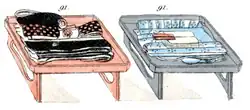
Sabre of the Bridegroom.

The Mediator delivering the Sabre.
London. ⟨Pubd. Jany. 1, 1822, by R. Ackermann, 101, Strand.⟩
Part II. Plate 3.

1. & 2. Two horses to hang clothes upon. A. The Mizoesi. B. The Koerodana. C. C. Two boxes with shells. a. The Fikiwatasi. b. The Tekaké. c. The Sousous.
Part II. Plate 4.

Sousous.


Five bunches of Nosi. Two Bream.
London, Pubd. Jany. 1, 1822, by R. Ackermann, 101 Strand.
Part II. Plate 5.

The Bridegroom send a present on occasion of the Bride’s
Visit to her parents.
The Bride, accompanied by her Mother-in-law, or other relation visits each of those
from whom she has received presents.
Plate 6.
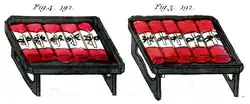
5 pieces of red stuff. 5 pieces of red gilams.

Tekaké. Packets of Sea Cat. Fikiwatasi.

Box with ⟨50 Commelmaas.⟩ 5 packets of sea lentil.
London, Pubd. Jany. 1, 1822, by R. Ackermann, 101 Strand.
Part II. Plate 7.

Part II. Plate 8.

Apartment in which the Bride’s parents entertain the Bridegroom.
London, Pubd. Jany. 1, 1822, by R. Ackermann, 101 Strand.
Part II. Plate 9.
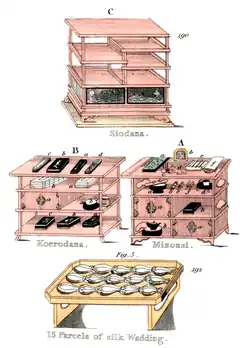
Siodana. Koerodana. Mizonsi. 15 Parcels of Silk Wadding.
Part II. Plate 10.
Different ways of folding paper.

5 Pieces of white Pelangs. 3 Packets of Money.
Part II. Plate 11.

| A. The Simaday Taka Sago | Emblems of long life. | |
| B. The Osiday Forai. |

London, Pubd. Jany. 1, 1822, by R. Ackermann, 101 Strand.
The female butterfly, b, is also adorned with fir-twigs, and three citrons which nearly resemble sweet oranges.
§ 180. In Plate 4, at the letters BB, are seen two copper vessels nearly in the shape of our tea-pots, and decorated like the jugs; but the handle is wrapped in fosio paper, tied with a siro-moto-i, or thin white string, used in dressing the hair.
In an ordinary year, this string is twisted twelve times round the handle, but in an embolismic year thirteen times, corresponding with the number of the months.
Behind the handle of each zakki jug, the male of which is distinguished by the letter a, the female by the letter b, there is a kind of tail, about three inches and a half long; it resembles the tail of the kite, on which account it is called tabi-no-o. These copper vessels, which, like the jugs, are denominated sousous, are used in the bedchamber, and sometimes also in the apartment of the bride.
§ 181. Plate 7, represents the decoration and arrangement of an apartment for a wedding.
- A. No. 1. The toko.
- A. No. 2. The kagami-motie.
- B. The room adjoining to the apartment.
- a. The tekaké.
- b. The fikiwatasi.
- c. The sosous.
- d. The simaday.
- e. The osiday.
- f. A candlestick.
§ 182. Plate 8, represents the apartment in which the bride’s parents entertain the bridegroom.
§ 183. Here the osiday and simaday may be dispensed with, unless the utmost ceremony is intended to be observed.
§ 184. At the weddings of persons of the inferior classes, no other sousous than those described above, are used: but people of quality have two other small sousous of copper, which are represented in Plate 4, marked B, § 184.
That marked a, is called tjosi-fisagé; the other, b, nagajé-tjosi.
Near the spout of the first, a paper butterfly is fastened to the handle; round the latter are nine circles of white cord, that number being considered as the most perfect; behind the handle there is also a tail.
The second has a spout on each side: in the middle is a long handle; it has also a tail, projecting from the end of the handle.
§ 185. The two copper sousous are adorned in two ways, differing but little from one another; white, gold, silver, or red paper, is used for the butterfly, and for wrapping round the handle.
That part of the handle of the nagajé-tjosi, which extends beyond the brim, is surrounded with seven bands of thin white cord, doubled, called quansin-jori, made of sougi-fara paper—an emblem of the seven planets.
In the middle, between these bands, is fastened the butterfly, and to the handle are tied small sprigs of fir and juzouri-fa leaves.
The extremity of the handle is wrapped in triple paper, and the handle, from the place where it begins to grow smaller, is surrounded with sprigs of fir, juzouri-fa leaves and paper.
The handle, from the brim to the curve, has three bands, and thence to the circular part nine bands, or, in the whole, twelve bands in an ordinary year, but thirteen in a year of thirteen lunar months.
The second copper sousou marked b, is called the male butterfly; the other, marked a, the female. There is one observation to be made respecting both.
Besides the sprigs of fir and the leaves of the tsourziba tree, tied to the spout of the tjosi-fisagé, the two butterflies have a kind of small beard, made of crisped paper, and behind a tail six inches long.
§ 186. Among people of quality, the hair of the two females denominated male and female butterfly, form a sort of flat tail, called sagé-kami, as may be seen in Plate 1, fig. 11, in the kaizoje, or assistant to the bride. In walking, they raise the skirt of their robes with the right hand, which is called kai-tori.
The male butterfly brings the nagaje in her left hand, and sets it down on the mat: but when she is going to pour, she rests her left hand on the mat, holds the sousou in the right, and pours in that position after the other has first put a little zakki into her sousou; it is for this purpose that the first, turning a little to the left, sets down the vessel upon the mat.
The second butterfly always follows the first; she enters the apartment in the same manner with her sousou, sets it on the mat, and keeps behind the other, but a little to the right.
The first never pours out zakki till the other has put a little into her sousou, which is called koewajé; this done, she sets down the vessel upon the mat.
Among people of the inferior class, the hair of these females is arranged in the usual way, and they let their robes trail along the floor.
§ 187. On the day that the bride pays a visit to her parents, they, as well as the bridegroom, send a servant in a kami-simo, or dress of ceremony, to the residence of the mediators, to express their acknowledgments, and to convey to each of them a present of exactly similar kind, and of moderate value.
§ 188. The parents of the bride, when they are at the bridegroom’s house, must remember to make a suitable present
- To the female who acted as assistant to the bride;
- To the male and female butterfly;
- To the woman who handed the tekaké.
§ 189. There are certain words which are proscribed at weddings, and which must of course be carefully avoided. Such are: to give back, to take leave, to go away, to reject, to send away, to withdraw, to change, to abolish, to divorce, inconstant, &c.
§ 190. Plate 9, letter A, represents the articles placed on the mizousi, viz.:—
On the itjé-no-tana, the first shelf, or top.
- a. A zousouri-fako, or box containing the ink-horn.
- b. A kenbio, a small lid of stone, or of some fine wood, serving as an ornament to the ink-horn.
- c. A foudé-tada, or case for the pencils for writing.
- d. A boun-tsin, or figure of an animal, of stone, copper, or other metal, which is set as a weight upon paper.
- e. A fitsouka, or box with channels for the pencils.
- f. Different sorts of paper, as o-taka, kotaka, fosio, sougi-fara, &c.
On the ni-no-tana, or second shelf.
- a. The fanzo, or apparatus used by the women for blackening the teeth.
- b. A majou-faké, or small bunch of feathers for smoothing the eyebrows.
- c. Fané, or the largest feathers of an eagle or a crane, for sweeping up dust or ashes.
- d. A ko-ban, or chaffing-dish, with its koro, or stand, for burning kalambak or some other incense.
- e. Ko-ba-si, or small tongs for burning tobacco.
- f. The gin-ban, or small piece of Muscovy glass, in a silver case, used for the same purpose.
On the san-no-tana, or third shelf, are:
- a. A small case with two doors, containing tansak, or coloured paper, for writing verses. It is also used for keeping books and manuscripts in.
- b. A fits-dai, or box for pencils.
It is also customary to put in it some taki-mono, or a mixture of odoriferous drugs. - A fay-osi or small fire-shovel of silver or some other metal, either polished or engraved with various figures. It is used to flatten or press down the ashes in the terrine.
- A fi-tori, or double fire-terrine; the outer one, of wood, is in the shape of a gourd; the inner is of silver or copper gilt: over it is a small plate, with open work figures of the same metal, which serves it for a lid.
On the si-no-tana, or fourth shelf:
- a. A case to hold zosi, or books and writings.
- b. A small varnished bowl, with its pot, for washing hands.
In the same place, letter B, are shown the articles placed on the koero-dana, viz.:—
On the itje-no-tana, the first shelf, or rather the top:
- a. A tansak-fako, or box for coloured paper, on which verses are written.
- b. A zousouri-fako, or box for the ink-horn.
- c. A naga-foumi-fako, or box for oblong letters.
- d. A foumi-fako, or box for ordinary letters.
On the ni-no-tana, or second shelf:
- a. The work kokin-ziu,
- b. The work manjo-ziu,
Both containing a collection of ancient poems.
On the san-no-tana, or third shelf:
- a. A case with two doors for the zosi-no-fan, or for a variety of books and manuscripts.
- b. A tsou-no-tarai, or small ewer with two handles on each side.
- c. A missou-tsougi, or water-pot.
On the si-no-tana, or fourth shelf:
- a. A moto-i-fako, or box to hold the strings for tying the hair.
- b. A fousi-fako, or box with a white powder, which is used by the women for polishing their teeth after they have blackened them.
- c. A fagouro-fako, or box with a composition for blackening the teeth.
The same plate exhibits, at letter C, the fashion in which the siodana, or secretaire, is made. It is shown empty, merely as a model, because each person may put into it whatever he pleases.
§ 191. Plate 10 represents the various ways of folding paper for wrapping up different articles.
There are some persons for whom paper is folded in three ways; for others it is folded in two ways; and for others in one way only.
The first manner of folding paper is called sin, which means the true, genuine; this is the most polite.
The second is called gio, or the ordinary way; it is less polite than the other, and is used between persons of the same rank.
The third, called zo, is the general and common manner, and is practised towards inferiors and people of the lower classes.
In order to qualify myself to furnish a correct idea of this matter, I procured these different kinds of paper previously to my departure from Japan.
- a.a. is the paper for nosi, folded in the first and second manner.
- b.b.b. for silks, in the first, second, and third.
- c. for towels and the following articles, in the third manner.
- d. for a band or narrow girdle.
- e. for a common sash.
- f. for a mixture of odoriferous drugs.
- g. for kalambak.
- h. for a cap or hood.
- i. for paint.
- k. for siki-si, or square coloured paper, for writing verses.
- l. for tansak, or oblong coloured paper, for the same purpose.
- m.m. for fans, in the second and third way.
- n. for plants, slips of flowers, and bulbous roots, in the third manner, as are also the following:
- o. for flowers and branches of trees in flower.
- p. for ink and pencils.
- q. for ground pepper and pimento.
- r. for a taka-no-asigai, or small lure that is fastened round the foot of a falcon. (It is usually of a purple colour, with red fringe; but when the bird has caught a crane, a red lure is given him, with fringe of the same colour.)
- s.s.s. for goma-sio, or a mixture of salt and goma-seed, which nearly resembles that of the poppy, though rather larger. This paper is folded in the three ways.
§ 192. Plate 10, fig. 1. represents the tray with the money presented by the parents of the bridegroom.
When a present is made of many pieces of silver, each piece of the value of four taels three maas, thirty, fifty, or more, are put up in each packet; and on the outside of the packet is written the number which it contains. Three of these packets are laid upon a tray. If fewer are given, two or three are put in each packet; but be the number great or small, an exact note of it must accompany them.
In the same plate, fig. 2, represents the manner of placing the white pelongs on the tray.
Plate 6, fig. 3, represents the tray with five rolls of red gilams; if they are broad, they are folded to the breadth of seven inches; they are then wrapped in double fosio-paper, and tied in the middle with a small bunch of complimentary strings. The five rolls are frequently laid beside one another, but sometimes three below and two above.
Plate 6, fig. 4, represents the tray with the five double pieces of red stuff.
Plate 4, fig. 6, represents the tray with the five bundles of nosi.
Plate 6, fig. 7, represents the tray with the three rows of packets of sea-cat.
The same plate, fig. 8, the tray with the kanbou, or sea-lentil: there are five or seven packets, each containing ten leaves.
Plate 4, fig. 9, represents the box containing fifty kommelmaas, or dried sounds of bonitoes.
The same plate, fig. 10, exhibits a couple of the best bream on a tray.
The same plate, fig. 11, represents two zakki-tubs each holding five or six gantings, surrounded with warabinawa, or thick black cord doubled, instead of hoops.
Plate 11, letter A, represents the simaday taka sago, or the white tray, with figures of a fir-tree, plum-trees, bamboos, rocks, a crane, a tortoise, and two aged persons, a man and a woman (emblems of longevity)
The same plate, letter B, shows the osiday-forai. This tray is decorated like the other: it has been already described in § 79. Besides various kinds of dainties, two small sticks to eat with, sprinkled with gilding, must be laid upon it.
Explanation
of the
Japanese Words in the Preceding Description.
- Aja, the ground of a certain stuff.
-
- Boun-tsin, a small figure of an animal of stone, wood, or metal.
-
- Condorin, a coin.
-
- Daïri, the ecclesiastical sovereign of Japan.
- Doki, or Kawarake, an earthen jug.
-
- Fagouro-fako, a box containing a mixture for blackening the teeth.
- Famagouris, muscles.
- Fanes, large plums.
- Fansi, a kind of paper.
- Fanzo, the apparatus for blackening the teeth.
- Fasami-fako, a bar or bearer for clothes.
- Fayosi, a small fire-shovel.
- Fiki-saka-souki, a kind of zakki-bowl.
- Fikiwatasi, a tray, represented in Plate 6, A.
- Fiki-demono, a sabre presented to the bridegroom.
- Firi-sara, a small, flat, round bowl.
- Firi-soei-mono, a kind of soup.
- Firo-bouta, a varnished tray.
- Fisi-aja, stuff with an aja ground. See § 19.
- Fi-tori, a double fire terrine.
- Fits-day, a box for pencils.
- Fits-ouka, a fluted box.
- Foude-tada, a case for pencils.
- Foumi-fako, a box for ordinary letters.
- Founa-mori, an imitation of a lobster.
- Fouro, a wash basin.
- Fousi-fako, a box containing a white tooth-powder.
- Fokai, a box with stewed rice cakes.
- Fonzen, a kind of board or stand.
- Fosio, a sort of paper.
-
- Gilams, silk stuffs.
- Gin-ban, a small piece of Muscovy glass.
- Go, manner of folding paper.
- Gobo, black carrots.
- Gomame, a kind of pilchards.
- Goma-sjo, a mixture of salt and goma-seed.
-
- Itje-no-tana, the top or uppermost shelf of the mizousi, &c.
- Itsib, gold and silver coin.
- Jusouri-fa, the leaves of a kind of tree.
- Izjo, the end.
-
- Kagami-motie, a cake laid in the toko.
- Kaje-obi, a toy for women.
- Kai-tori, manner of holding up the skirt of a robe.
- Kalambak, aromatic wood.
- Kami-simo, the dress of ceremony for men.
- Kanboa, sea-lentil.
- Kani-siak, measure for carpenters, &c.
- Kasounoko, fishes’ roes.
- Kawa-i-i, a box sent to near relatives who have not attended the wedding.
- Kenbio, a small stone cover.
- Kinofari, long pins.
- Koban, a coin, both of gold and silver.
- Kobasi, small tongs.
- Kobou, fresh rock-leech.
- Koumi-sin, box of dainties.
- Koura-soumi, fishes’ roes.
- Kouro-dana, dressing-table.
- Kousira-siak, measure for every thing woven.
- Kouivaje, to pour zakki from one vessel into another.
- Kogak, a small wooden platter.
- Konnemon, cucumber pickled in zakki grounds.
- Koro, a fire-terrine.
- Kotto, a kind of harp.
- Kommelmaas, the dried sound of the bonetto.
-
- Maas, a coin.
- Mai-bajasi, to play on all sorts of musical instruments.
- Majon-faké, a small tuft of feathers.
- Maki-kami, a sort of paper.
- Mame-ita, a silver coin.
- Mamori. See § 47 for the explanation.
- Mamouri-gatana. For the explanation see § 22.
- Mekan-no-ki, the orange-tree.
- Mino-kami, a sort of paper.
- Miso, small beans of which soup is made.
- Misou-tsougi, a water-pot.
- Mizousi, a dressing table.
- Moto-i-fako, a box for strings to tie the hair.
- Moto-iwi, a cord.
- Mot-rok, a list of presents.
- Motsi, cakes.
- Motsi-gome, rice cakes stewed.
-
- Nagaje-tjosi, a small zakki-pot of a particular form.
- Naga-foumi-fako, a box for oblong letters.
- Naga-mouts, a trunk.
- Namasou, apparatus for the tray fonzen.
- Ni-no-tana, the second shelf of the mizousi, &c.
- Nobe-kami, a sort of paper.
- Norimon, a palanquin.
- Nosi, dry rock-leech.
-
- Oumebos, preserved plums.
-
- Pelong, a kind of silk stuff.
-
- Quansin-jori, a sort of white string.
-
- Sagé-kami, a flat queue of hair.
- Sagi-wafies, squares crossed each way.
- Samsi, a sort of guitar.
- Sanbo, a kind of dish set in the bed-chamber.
- San-no-tana, the third shelf of the mizousi, &c.
- Santok, a portfolio.
- Sepikkes, a copper coin with a small square hole in the centre.
- Si-no-tana, the fourth shelf of the mizousi, &c.
- Sigi-famori, an imitation of the snipe.
- Siki-si, square coloured paper.
- Sima, a small block called sima, or the island.
- Sin, manner of folding paper.
- Siodana, the secretaire.
- Siro-moto-i, a small white string for tying hair.
- Sougi-fara, a sort of paper.
- Sougi-rokban, a chess-board.
- Soei-mono, various kinds of soup.
- Sousous, a kind of jugs for pouring out zakki.
- Soje-no-kasa, a small bowl.
- Solimono, fish cut very small.
- Soni, a sort of soup.
-
- Tabacco-bon, a box containing all the requisites for smoking.
- Taba-nosi, large bundles of nosi.
- Taka-mori, manner of piling up rice.
- Take-naga, a sort of paper.
- Taki-mono, a mixture of odoriferous spices.
- Tans, a common drawer.
- Tansak, coloured paper.
- Tansak-fako, a box for coloured paper.
- Taka-no-asigai, a small lure about the foot of a falcon.
- Tapies, buskins of white linen cloth.
- Tatse-kouri, or gum, a kind of pilchard.
- Tatsi-bana, the citron tree.
- Tatsi-ori-kame, the belt for the sabre for the bridegroom.
- Tatama-souri, a round plate, properly signifying slider on mats.
- Tekaké, a kind of tray.
- Tiosi-fisage, a small zakki-pot.
- Tobi-no-o, a kite’s tail.
- Tripangs, a marine plant, which serves instead of morels, champignons, &c.
- Tsou-no-tarai, a small water bucket.
- Tsoursiba, a sort of tree.
-
- Wambinawa, thick black cord.
- Womou-ita, the bottom of the platter on which konnemon is served.
- Woutje-awasi-motie, small cakes of boiled rice.
- Woetje-kaki, women’s dress of ceremony.
-
- Zakki, a kind of strong beer, the ordinary beverage in Japan.
- Zeni. See Sepikkes.
- Ziarak, ground green tea.
- Zo, a way of folding paper.
- Zousouri-fako, the box for the ink-horn.
- Zosi, books and manuscripts.
- Zosi-no-fan, a variety of books and manuscripts.
- Zoerami, sea-cat, a kind of marine plant.
Introduction
to the
Description of the Funerals
of
the Japanese.
If the Japanese, in whatever relates to the ceremony of marriage, even among farmers, artisans, and tradesmen, submit to such numerous rules of etiquette as have been detailed in the preceding pages, it will not appear surprising that funerals should be attended with formalities, every part of which is fixed with equally scrupulous precision.
In regard to funerals the people of Japan commonly follow the customs of the Chinese, a description of which is given in a work, in two volumes, intituled—Two Funeral Ceremonies, explained for the Instruction of Youth.
The first volume contains a detail of the ceremonies to be observed at funerals; the second, a description of the festivals in honour of the gods held on these occasions.
The Japanese do not exactly conform to the rules prescribed in this work, especially at Nangasaki, the inhabitants of which are considered as having degenerated in consequence of their intercourse with foreigners. The presence of strangers is almost an abomination in the rest of Japan. When, in my journeys to court, I passed through Sanagosta, and certain hamlets dependent on it, none of my retinue could procure either fire, tea, or the most trifling necessary. It will not, therefore, be amiss, before I proceed to the translation of the two Chinese works, to give an account of what is commonly practised at Nangasaki, on the death of the master or mistress of a family. Here be it remarked, that, according to the custom established in that country, a Japanese who has no son adopts the son of a friend, who is thenceforward regarded as his own child, and enjoys all the rights attached to that quality. Such adoptions also take place among those who have large families. Thus, for instance, N gives a daughter in marriage to a son of M, who then succeeds to the post or place of N, since his son has been adopted by another, whom he succeeds in like manner. This custom forms the groundwork of more solid connexions; it unites families in the bonds of mutual interest, and has a powerful influence over the state of society.
There are two kinds of funerals. The doso consists in depositing the body in the earth, and the quaso in committing it to the flames.
Most of the Japanese, either when in good health, or during serious illness, signify to their heir, or to some intimate friend, the manner in which they wish their body to be disposed of after death. The ceremonies of the doso or inhumation, are as follows:—
People of quality usually keep the body twice twenty-four hours. Those of the lower classes, from the farmer to the porter, inter the corpse the day after death; they are therefore not obliged to go into mourning; yet some of them wear it for two, three, or more days; but for the former the time of wearing mourning is fixed. It used to be for one hundred days; but was reduced by Minamotto-no-Yéyé-Yasou, first Djogoun of the reigning dynasty, to fifty days, that the business of the public functionaries might suffer the less interruption; and for the same reason Bingo, a governor, who was much hated, reduced the period of mourning to thirty-five days for all those employed at Desima.
Persons in mourning are obliged to stay at home for fifty days, and to abstain from eating animal food, fish, fowl, and generally whatever has had life, subsisting entirely on rice, vegetables, and fruit.
Though Bingo reduced the time of mourning to thirty-five days, this term is not strictly observed. People repair, indeed, on the thirty-fifth day, to the residence of the governor, to inquire after his health, but such as adhere to the commands of the Djogoun and the practice of Siaka, give out, on their return home, that they are indisposed, and continue to live fifteen days longer on fruit, rice, and vegetables.
Before they attend the corpse to the tomb the Japanese shave their heads, and cut the nails of their fingers and toes, which they are not permitted to do during the whole period of mourning. They do it again on the fifty-first day. At any other time they must not cut the nails of both fingers and toes on the same day, as the simultaneous performance of that operation would not fail to be attended with some misfortune.
Among the lower classes, a kami-simo of hempen stuff is the dress of ceremony for those who carry the body. Among the higher ranks the kami-simo of the bearers is of a light purple stuff, called fabita; the son wears a transparent hat made of rushes, which hangs like a basket from his head upon his shoulders; in this attire he never salutes any person. If the governor or any of the officers of the city were on the road, along which a funeral procession is passing, it would turn aside to spare him the sight of so dismal a spectacle.
After the expiration of the fifty days’ mourning, the Japanese may visit the temples of Siaka, but they are forbidden to enter those of the Sintos for twelve months; because, according to that doctrine, they are deemed impure for a whole year.
There are five sects, whose customs are followed at interments: those of Siodosiu, Ikosio, Foké-sio, Seniou, and Fen-daysiu. The members of the first are interred with the mitsi-nembouts, which signifies, that during the conveyance of the body to the temple, the priests sound small bells and read hymns with a low voice. This practice is not followed by the four other sects. In the first case the procession consists of,
1. The kiatats, two men carrying trestles to set the coffin upon, when it has reached the temple.
2. A metoday, or man who goes before with a large bundle of straw for the purpose of making torches to light the road during the night. This is rather a matter of ceremony than utility; since lanterns are used at funerals which take place in the night. The straw is tied with a cord of white paper.
3. Six flags.
4. Four small white cases, nearly a foot high, and about four inches square, each containing a flower of tratté, or water-lily, cut out of white paper.
5. The sioko, a small box for burning incense.
6. The ifay, an oblong tablet, on which are inscribed the time of the death and the name afterwards given to the deceased.
7. Priests striking small bells, and reading hymns aloud.
8. The quan, or coffin.
9. The eldest son.
10. The family.
11. The intimate friends of the deceased, his colleagues, acquaintance, and servants of both sexes.
12. The norimons, or palanquins; in the first, is the eldest daughter, wife, younger sister, or nearest female relative of the deceased; then come the other females of the family, and lastly the wives of his friends. The norimons of the family are distinguished by a small piece of white cloth, a mark of kindred which is not affixed to the others.
Relatives in the ascending line and seniors never attend the funerals of kindred of inferior degree. Thus, for example, if the second son should die, neither father, mother, uncle, aunt, eldest son, or eldest daughter, would follow the corpse.
The remains of persons of a certain rank are carried by their own people; those of persons of the lower classes by public bearers, who, like all other bearers employed at funerals, are habited in a white kami-simo, and carry a sabre by their side.
Those who go before with the trestles and the bundle of straw wear a kind of white shirt over their clothes.
The eldest son and his brothers are dressed in white, and wear over all a white mantle of ceremony, but without armorial distinctions; the other relatives are dressed in their usual apparel.
The females who attend funerals, whether relatives or friends, are all dressed in white; their hair is merely fastened by a comb without the smallest ornament.
As soon as the quan, or coffin, has reached the temple where the priests are already assembled, it is set down before the image of the god, and the priests immediately begin to read hymns. The ifay is placed before the quan, and before the ifay are set some plates of sweetmeats, pears and flowers, and in front of these the sioko, or small box for burning incense.
The eldest son steps up before the ifay, says his prayers, and burns some incense; when he has returned to his place all the relatives and friends do the same one after another.
The priests having read hymns for about half an hour, the bells are struck, the drums beaten, the jamabos sound their trumpets, and the komsos, the flutes. The priests then range themselves in the following manner:—
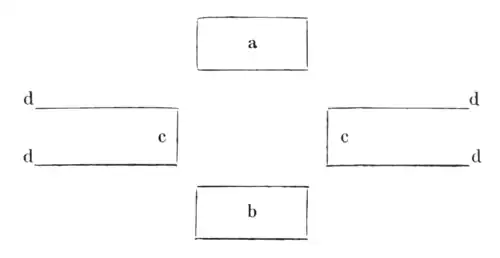
| a. | The quan, or coffin. |
| b. | The high-priest of the temple |
| c. c. | The inferior priests. |
| d. d. d. d. | The priests of the other temples. |
After reading a hymn in this position, the coffin is taken up and carried to the grave, accompanied by all the parents and friends of the deceased.
As soon as the hymn is finished, the women, the colleagues of the deceased, and his acquaintance, return home, and are complimented at the door of the temple by the relatives, who wait there for the purpose.
After their departure the relatives proceed in haste to the grave, where, in the interim, a priest reads some hymns till their arrival. The moment they are come, the tub containing the body is taken out of the quan, and deposited in the grave, which is then filled with earth, and covered with a flat stone, and this is again covered with earth. Over the whole is placed the quan, which is removed at the expiration of seven weeks, to make room for the sisek or tomb-stone, which is prepared in the mean time.
These particulars will suffice to explain the ceremonies practised at Nangasaki, on occasion of the doso, or interment.
When the deceased has preferred the quaso, that is, to be burned, this ceremony takes place on the summit of one of the two mountains, Kasougasira and Fondesi-yama; the former situated to the south-east, the latter to the north of the city.
On each of these mountains is a hut called okoubo, two ikies and a half, or about eighteen feet and a half square: above, there is a small window, and a door on the side next to the road.
The quan is previously carried, with all the ceremonies enumerated above, to the temple, where, after the reading of the last hymn, it is taken up by the bearers, and carried to the okoubo, followed by the relatives and friends.
In the centre of this hut is a large well of freestone; outside of the door the tub or coffin is taken out of the quan by the servants of the deceased, or by the bearers, and placed over this well, in which the ombos, a class of people very little better than beggars, keep up a great fire with wood till the body is consumed.
Each of them has two poles of bamboo, with which he picks the bones out of the ashes.
The first bone is taken up by two of these ombos with four sticks, which is called alibasami, or, to lift up on opposite sides. For this reason two persons will never lift up together any meat or food whatever with the sticks they use for eating: it would be an omen of ill luck.
The ombos deliver this bone with their four sticks to the eldest son, or the nearest relation, who is provided with an earthen urn, into which he puts the bone with his right hand. The other bones are collected by the servants or the porters, and poured with the ashes into the urn, the mouth of which is closed up with plaster.
While the body is consuming a priest reads hymns; the mends remain outside the okoubo in the road.
The bearers then take up the urn, and carry it in their hands to the grave, to which flowers, the sioko and the quan are likewise carried; but the flags and lanterns are thrown away, or given to beggars.
The parents, the friends, and the priest who reads the hymns, follow the
Part II. Plate 19.

Tomb of the Governor of Nangasaki.
Part II. Plate 12.

Temporary Hut in which the Quan & the Sisek are exhibited.
urn to the grave, in which it is immediately deposited. It is filled with earth, on which is laid a flat stone; this is also covered with earth, and after it has been well stamped down and levelled, the quan is placed over it. At the expiration of forty-nine days the quan is removed, and the sisek put in its stead.
People of quality and rich tradesmen cause a hut to be erected near the grave, where a servant is stationed for the purpose of noting down the names of all those who come thither to pray: his presence also serves to protect the quan and other things from being stolen during the seven weeks. (See Plate 12.) At the expiration of this time, the eldest son, or other nearest relative, calls to return thanks to each of the persons whose names are upon the list.
In case of the sudden death of a person holding an employment under the government, it is not uncommon to bury him the same or the following night in a clandestine manner. The corpse is immediately washed, put into a tub, and the vacancy filled with small bags stuffed with leaves of the tana-siba tree; a lid is nailed on, and the tub is tied round with straw-bands. People of quality who adopt this course fill up the space with cinnabar, which prevents putrefaction.
The tub, or coffin, is then put into a norimon, which is carried to the temple by servants or hired porters: the sons, relatives, and friends of the deceased, dressed in their ordinary apparel, without kani-simo, accompany the body. The procession is lighted by ordinary lanterns. On reaching the temple, the priests read some hymns; the coffin is then carried to the grave, and covered with earth; after which each returns home. When people adopt this kind of interment, which is of so secret a nature that they do not even give notice of it to the government, they must keep their doors open, and live in the usual manner.
The son then sends word to the governor, that his father is so dangerously indisposed as to be incapable of performing the duties of his office, which he begs leave to resign. The governor sends for him, accepts the resignation of the father, and gives his post to the son. In about ten days the latter announces to the governor the death of his father, after which the funeral ceremonies are performed publicly, though the interment took place in the very night of, or that following his decease.
At Nangasaki people are allowed to eat and bathe immediately after the death of one of their relatives: but they abstain from flesh and fish, and eat vegetables alone, for the cooking of which it is lawful to make a fire. One of the relations, or servants, sleeps by the side of the corpse, or in the adjoining room.
Persons of the middling class have not recourse, like the Chinese, to the officers whom they denominate the goso, the zuvin, the sisio, and the siqua. They request some relative or intimate friend to provide and order whatever is necessary for the funeral, as flags, flowers, lanterns, the tub, or coffin, the quan, the trestles, &c.; or the whole business is committed to a trusty servant. The three latter articles are made by a cooper.
Care is taken to have a greyish kami-simo of coarse hempen cloth, without armorial bearings, and called for funerals mofoukou; it is worn for fifty days.
The following articles are necessary for funerals:
- 1. The tub for the body, commonly three Japanese feet high, two and a half in diameter at the top, two feet at the bottom, and made for people of quality of a very thick durable wood: for persons of the inferior classes of ordinary wood. It is called quan-oke.
- 2. The quan, or, outer coffin; it is square, oblong, made of thin white planks, with an oblique roof, rising in the form of an arch and pointed at the top. The summit is adorned with a crescent at each extremity. The pannel in front is sculptured with images, flowers, and other ornaments. For the common people this chest is not made of wood, but of a kind of white pasteboard.
- 3. The sisek, or tomb-stone, placed on the grave seven weeks after the interment, when the quan is removed.
- 4. The kio-katabera, which will be described hereafter.
- 5. The kami-simo, which will be described hereafter.
- 6. New towels to wipe the corpse after it has been washed, and before it is dressed in the kio-katabera.
For persons of the middling class, two ifays of thin white wood are ordered of a cooper. These are sent with the flags to the temple, and carried back after the requisite inscriptions have been put on them by a priest. One of the ifays is used at the funeral, when it is placed before the quan; and at the expiration of fifty days it is burned with the latter, or given to beggars.
The other ifay is set up in the best apartment in the house of the deceased. Sweetmeats, fruit, and tea, are placed before it; and, morning, noon, and night, victuals are offered to it in small basins on a tray with legs, called liogou. Two candles, fixed in candlesticks, burn by it night and day, and a lighted lantern is hung up on each side. The whole household of both sexes, as well masters as servants, pray before it morning and evening. A servant presents the tray with the victuals, each time repeating a short prayer: and this is continued for seven weeks, or forty-nine days.
Every week, reckoning from the day of the death of the deceased, a priest attends, and in the night of that day and the morning of the next, reads hymns for an hour before the ifay. He is each time supplied with refreshments, and money is given him to the amount of five or six maas: this practice also is continued for seven weeks.
In the third, fourth or fifth week, the son, or nearest surviving kinsman, visits the relatives and friends, and the priest of the temple near which the body has been interred. After the reading of some hymns, they are regaled with zakki and several dishes, which must not have either flesh or fish in their composition. This entertainment is called fozi.
During these seven weeks, the son goes every day, be the weather what it will, in his mofouko to the temple, and says a prayer by the grave. The heaviest rain, or the most violent tempest, cannot prevent the fulfilment of this duty. On these occasions he wears a rush hat, which falls down upon his shoulders, and through which he can see without being seen, that he may not be obliged to salute such acquaintances as he meets. During this time neither he nor his people must be shaved or cut their nails. With the exception of this visit to the temple, he must remain at home with his door fastened, and abstain from flesh and fish.
At the expiration of the seven weeks, he is at liberty to shave and to cut his nails: he then lays aside his mourning, opens the door of his house, and goes in his ordinary dress to inform the government that the time of his mourning is over. He next visits and pays a compliment to each of those who attended the funeral, and who came to pray at the grave; after which he sends them a kawa-i, or small chest of motsi-gome, or stewed rice fit for making cakes.
At the end of the seven weeks two other ifays, varnished black and superbly gilt, are provided: on the back are written in gold letters the nengo, the year, month, and day, of the death of the deceased: this is called foanmen. One of these ifays is sent to the temple and there kept by the priests; and the other remains at home in the little temple, which every Japanese, from the highest to the lowest, has in his apartment, and before which he says his prayers morning and evening, and burns a lamp. Every month, on the day of the decease of his ancestors, he places before his ifay, for fifty, and even for a hundred years, a small table with victuals, sweetmeats, and fruit, and every day sets before the deity of this temple, a basin of boiled rice and another of tea.
One hundred days after the decease of father or mother, the son again invites his relatives, his intimate friends, and the priest who attended on the occasion, and gives them a good entertainment after the reading of a few hymns. This entertainment is likewise called fozi: it is repeated a year afterwards, on the anniversary of the decease, and then in the third, seventh, thirteenth, twenty-fifth, thirty-third, fiftieth, hundredth, and one hundred and fiftieth year, on the anniversary of the decease of the first ancestor, and so on as long as the family exists.
To illustrate what I have said above, I shall annex two representations of funerals. The first exhibits the funeral of a civil officer of distinction, according to the manner of the four sects of Siaka. (See Plate 13.) The procession consists of:—
- 1. The kiatats, or trestles, on which the bier is placed on its arrival at the temple.
- 2. The meto-day, with the bundle of straw, to light the road at night. This is carried merely for the sake of form, since lanterns are taken along for the purpose. He is followed by two servants of the deceased. The kami-simo of his people exhibits the escutcheon of his arms: for in Japan all servants wear the arms of their master.
- 3. The obata, or great flag, inscribed with the name of Siaka, Amida, or the deity, or with the title of a hymn, for the professors of the doctrine of the fakesjo sect.
- 4. The rengees; two flowers of tratté, or lotus (nymphæa nelumbo) of white paper. This flower is deemed the purest, as not being sullied by the contact of muddy water, which keeps up its freshness without impairing its colour.
Two servants. - 5. The ko-bata, four smaller flags, inscribed with moral sentences of ancient times.
Two servants. - 6. The foro; in which lighted candles are burned even in broad day.
- 7. Two servants of the deceased who were always in attendance on him during his life.
- 8. Two pots with flowers of white paper, the one containing the rengée, or flower of the tratté, and the other the kikou-no-fana, or flower of motherwort.
- 9. The sioko, or box of incense, which is burned by the way. It remains for seven weeks with the two pots of flowers before the sepulchral ijay: each of those who come to say their prayers there puts into it a small scented lighted taper, called sinko.
- 10. The bearer of the ifay, who is commonly a child.
- 11. His attendants.
- 12. A priest with his chaplet: he is represented as silent. If the funeral is performed according to the doctrine of the Siodosju sect, and hymns are read by the way, he carries a book in his hand. He serves as a guide to the deceased.
- 13. A young candidate for the priesthood, having in his hand a small oblong vase, into which the priest throws some incense on his arrival at the temple.
- 14. The servant of the priest with a box containing the hymn-books.
- 15. Two servants of the deceased.
- 16. His second son.
- 17. The bearers.
- 18. The quan, or bier.
- 19. The tengay, or umbrella.
- 20. The small board inscribed with the name given to the quan, as, transient brilliancy, dull light, or some other symbolical expression.
- 21. Two servants to clear the road, and to drive away dogs and cats.
- 22. The ato-tsougi, the heir or eldest son.
- 23. The near relations, who alone are habited in white kami-simos.
- 24. Their attendants.
- 25. The geigua, or surgeon. Persons of this profession do not shave the head.
- 26. The intimate friends and acquaintance. Those in kami-simos are persons holding places under government, and those without them are merchants and tradesmen.
- 27. The isja, or physician. The persons of this profession shave their heads like the priests.
- 28. The fari-outsi, or pricker with the needle. Fari signifies needle, outsi to strike. It was formerly customary to drive the needle into the flesh with gentle blows of a hammer; and though this operation is now performed with the finger, the expression has been retained.
- 29. Spectators. Those dressed in kami-simos are civil officers; the others are citizens, tradesmen, &c.
- 30. The norimon of the wife, daughter, younger sister, and some other female relative in the descending line. Those in the ascending line never attend the funeral procession, as has been already observed. Their norimom are covered with a small piece of white cloth, and their women are dressed in a siro-moukou, or white mourning robe, as well as their mistresses, each of whom is attended by a man-servant also.
- 31. The norimon of one of the female friends of the deceased, dressed, as well as her women, in her usual apparel. Accordingly, there is not a white cloth attached to her norimon.
Lastly, a number of persons assembled to see the procession.
In the annexed series of engravings, faithfully reduced from the Japanese originals, only two norimoms have been introduced, though the original represents several following one another.
The other design represents the funeral procession of Foutjeja-Sourouga-no-kami, governor of Nangasaki, called, after his death, Mitswoun-in-Siutakf-Fizin-Daykosi, who died on the 10th of gognats, in the fourth year of the Nengo Tenmio, or the 27th of June, and was interred on the 19th of the same month, or the 6th of July, 1784, near the temple of Zuntoksi. (See Plate 16.)
- 1. Two servants, each carrying a bundle of dry reeds.
- 2. The obata, or great flag.
- 3 and 4. Four small flags, carried, like the preceding, by banjos, or gentlemen to the governor.
- 5. Two bearers of lanterns.
- 6. Superior officer of a quarter directing the way.
- 7 and 8. Inferior banjos.
- 9 and 10. Subaltern life-guards.
- 11 and 12. Two bearers of lanterns.
- 13, 14, and 15. Subaltern life-guards.
- 16 and 17. Two bearers of lanterns.
- 18. A superior banjos.
- 19 and 20. Two bearers of lanterns.
- 21. The second secretary.
- 22. A superior officer of a quarter.
- 23 and 24. Two bearers of lanterns.
- 25 and 26. Superior banjos.
- 27 and 28. Two bearers of lanterns.
- 29 and 30. Two superior life-guards, each carrying a vessel for burning incense.
- 31. Two superior life-guards, each carrying a candlestick in his hand.
- 32. Two others carrying small tea-cups.
- 33. (Plate 17). The small case or chest for burning kalambak.
- 34. Two priests of the inferior class.
- 35. A superior life-guard bearing the ifay.
- 36. Two bearers of lanterns.
- 37. The high-priest of the temple of Zuntoksi.
- 38. A tratté flower of white paper.
- 39. Two fassambakos, or small travelling trunks, covered with white linen cloth.
- 40. Two bearers of lanterns.
- 41 and 42. Life-guards of the inferior class.
- 43. The quan, carried by the bearers of the norimon of the deceased, all dressed in white.
- 44. Life-guards of the inferior class.
- 45, 46, and 47. Bearers of the pike, the cane, and the long-handled parasol, who belonged to the retinue of the governor, while living.
- 48. A fassambako.
- 49 and 50. Two grooms.
- 51. The governor’s horse, having the bridle, saddle, and tail covered with white linen.
- 52. The long-handled sabre.
- 53. Two inspectors of the procession.
- 54. The governor’s physician.
- 55. His attendants.
- 56. His slipper-bearer.
- 57. (Plate 18). The municipal officers of Nangasaki, the superintendents of commerce, the interpreters of the Dutch and the Chinese, from the chief down to the lowest class, the officers of the treasury, the city officers, the physicians, surgeons, needle-prickers, principal inhabitants and tradesmen. (The multitude of high and low was immense, the governor being universally beloved for his good qualities).
- 58. The chief secretary, who closes the procession.
- 59. His attendants.
- 60. His long-handled parasol.
- 61. His pike.
- 62. His slipper-bearer.
- 63. His fasami-fako.
- 64. His horse.
- 65. (Plate 19). The sisek, or tomb-stone, twelve feet and a half high, Japanese measure.

⟨Funeral Procession of the Governor of Nangasaki.⟩

⟨Funeral Procession of A Superior Civil Officer.⟩
London. Pubd. Jany. 1, 1822, by R. Ackermann, 101 Strand.
- 66 and 67. Two stone lanterns.
- 68. The sioko, or box for burning incense.
- 69 and 70. Flower-pots.
- 71. A small stone table for the offerings.
Here are not seen any norimons with women, because a governor on his departure for Nangasaki, is obliged to leave his wife and family at Yedo, as females are not allowed to enter the public offices or government-houses. The governors to make themselves amends for this privation, indulge in an unnatural vice. This detestable practice is followed by all, from the Djogoun to the meanest Japanese. I have often seen youths kept for this depraved purpose: in delicacy of features, gracefulness, and elegance, and in the exquisite taste of their dress, they might vie with the most beautiful women. In most of the principal cities, there are brothels of males as well as females. In consequence of the exclusion of women from the public offices and government houses, many of the principal officers contrive to get out at night to amuse themselves in these brothels; but they take good care to be disguised in such a manner as not to be known.
Thus much will suffice to give the reader an idea of the manner in which funerals are conducted at Nangasaki. Such of the Japanese as choose rather to conform to the practice of the Chinese, follow the rules laid down in the work which I have mentioned above, and of which I subjoin a translation.
Description
of the
Ceremonies Practised in Japan at Funerals.
Chapter I.
When the master or mistress of a family is attacked by a dangerous disease, when all hope of recovery is past, and the patient’s end is evidently approaching, the foul clothes which he or she has on are changed for clean ones. Men are attended by men, and women by women. They inquire the last wishes of the dying person, and commit them to writing, at the same time observing profound silence. As soon as he has breathed his last, all the relatives weep for his death in an attitude of grief. The body is carried to another place and a covering thrown over it. This covering is the ordinary robe, but the skirt is placed over the head, and the sleeves over the feet. The head lies towards the north, but the face is turned to the west. Skreens are put round the corpse[1], and a piece of gauze is laid over the face, that the person may not be prevented from breathing and recovering, if contrary to all appearance, he should only be in a lethargy.
The son, or sosu, who succeeds his father, in Chinese mosu, ought, as well as his wife, children, brothers, and sisters, to manifest his profound affliction in his demeanour and apparel. The hair is commonly left untied, or at least it is very loosely fastened with a hempen cord. He must not wash himself nor take any food for three days; but, if he cannot endure so long a fast, his friends or acquaintance come to his relief, and supply him with kan-si, or steeped rice. It is upon them that this duty devolves, since Confoutsé says in the Liki, that it is not lawful to make a fire in the house of the deceased for three days after his death. If there is absolute necessity for a fire it is made elsewhere, and then carried to the door of the house where the body lies. In the night the sosu and other relatives sleep on mats near the corpse.
Chapter II.
It is necessary, immediately after death, to appoint four persons for different duties, namely:
- 1. The Gozo. This Chinese word denotes a skilful man, selected from among the relatives or friends to make all the requisite arrangements for the funeral.
- 2. The Zuvin, who receives those who come to pay visits of condolence. When any person of consequence calls, he informs the sosu, who, if it be a friend, goes to meet him, and salutes him merely with a polite bow, but without speaking: if not a friend, the zuvin receives him.
- 3. The Sizio, whose office it is to note down in a small book whatever is wanting for the funeral, and the presents sent by mends.
- 4. The Siqua, who makes out a statement of the gold and silver coin, the copper sepikkes, and likewise of the rice requisite for the funeral.
For these offices persons of known punctuality and prudence are chosen. If the sosu were not assisted by these four deputies, he would be disturbed in his meditations by incessant interruptions. If, owing to the excess of his grief, he does not appoint them himself, it is the duty of his friends to deliberate together, and each to assume spontaneously such of these offices for which he is best qualified.
Chapter III.
The third chapter contains all that relates to the arrangement of the funeral, and to the offerings in honour of deceased relatives, as well as the apparatus and instruments requisite for the occasion, as
- 1. The external coffin or bier, called quan, described in the next chapter.
- 2. The sinsu, a tablet of hard wood, on which is inscribed the name of the deceased, and which serves for a mark of honour. The Chinese and Japanese fix it up in their houses in memory of the death of their parents or relatives. In Japan this tablet is called ifay: the description of it is given in Chap. V.
- 3. The sisek, a monument erected over the grave. (See Chap. VI.)
- 4. The kosodés, the upper and under garments, with the upper and under sashes, the first of which is called wouvei-obi, and the other sita-obi.
- 5. The kami-simo, or complete dress of ceremony; kami signifies above, simo, below. The cloak which is without sleeves is called by the Japanese kata-ginou, and the breeches, vakama.
- 6. The tapies, linen buskins, or a kind of shoes with thick soles of cotton.
- 7. The ukata, a robe of fine linen; it is put on in coming out of the bath to dry the body. They have two of them, and likewise two towels.
- 8. The vekbokin, a piece of silk, to cover the face of the deceased, twelve Japanese inches square, double, with cotton interposed, and small ribbons at the four corners to tie at the back of the head. The Chinese use for this purpose a black stuff with a red lining. Among the Japanese it is of white silk.
- 9. The aksukin, a piece of white silk doubled, and stuffed with cotton, one foot two inches long, with small ribbons at the four corners: there are two which serve to envelop the hands.
- 10. Zuuzi, or purified cotton, to fill the ears.
- 11. Mokjokgou, or utensils for washing the body, as tubs, buckets, &c.
- 12. Falamis, or mats.
- 13. Makous, or flags of white canvass.
- 14. The tankin, a piece of canvass, five or six lés in width, and about ten feet long, which serves for a sheet to cover the corpse, and a description of which will be given hereafter.
- 15. The menkin, nearly of the same size as the tankin; it is a coverlet of doubled silk or linen stuffed with cotton.
- 16. The sanbouts. Under this appellation are comprehended three things, namely, lime, sand, and red earth. After they have been sifted and mixed together, water or zakki is poured on them. With three hundred gantings of lime are mixed one hundred of sand, and one hundred of red earth. This compound is employed together with very finely-powdered charcoal to make a plaster to put over the coffin about two inches thick, in the manner described hereafter.
- 17. Tanmats, or very fine charcoal to cover the grave, round about the quan.
- 18. Drinko, aromatic wood, burned as incense.
- 19. The kigou. 20. The kaivalaque. The first is a kind of tray or small table of white wood, not varnished or japanned: the other an earthen bowl not varnished for drinking zakki. These are for the use of the deceased. After his death no change must be made immediately in regard to him, but he must be supplied every day with a dish of such victuals as he was accustomed to take in his life-time.
- 21. The bosia, a flat dish full of sand, with a small wisp of straw underneath, called by the Japanese kaja; it is sprinkled with zakki, or some other liquid; and this serves the deceased for a sacrifice of thanksgiving.
- 22. The stougé, or bamboo cane for the sosu; he holds it by the small end, while the thick one is next to the ground. Sometimes this cane is made of the wood of the kiri-tree.
The goso and the siqua must take care to have all these things provided beforehand for the funeral.
Chapter IV.
The quan, or external coffin, is made of very smooth blocks of yew, each one foot two inches thick, fastened together at the four corners with pegs of some hard wood, and not with nails. It is made in proportion to the body, so that the legs may be stretched out straight: the breadth is regulated by that of the shoulders: the depth is such that the corpse when laid on the back shall not be compressed; at the end where the head is, it is higher and broader, and towards the feet it becomes gradually narrower and lower. Care is taken that it should not be made either too wide or too narrow, so that the kosodés, the tankin, and the menkin, may go into it with ease. The lid is fastened also with wooden pegs, because iron nails by rusting would rot the wood. The bottom all round is furnished with iron rings, through which are passed ropes, for the purpose of managing the quan with greater facility.
The construction of this coffin differs much from that adopted by the Japanese, who will not follow the Chinese fashion in this particular. The general custom of the former, therefore, is to have a round tub, or a high square chest, in which the deceased can be placed on his knees: sometimes this chest is made rather oblong, to hold the body in a halt recumbent posture. If such a chest were to be ordered at the death of any relative, it would be made of green unseasoned wood, and not readily take varnish: for tins reason, when parents or relations become advanced in years, their children or kinsfolk have the coffin secretly provided, that it may be properly varnished in time. There have been instances of persons living upwards of sixty years after the chest or other apparatus has been prepared for them. It is considered as essential that these arrangements should be made with the utmost secrecy.
Formerly the coffin used to be enclosed in another of thin boards two inches wider, and seven or eight higher than the other, furnished with a lid, but without bottom, and called by the Chinese quay-kak, or separation. It was used for packing up the sanbouts, as will be seen in Chapter X.
Some persons have double coffins made, and fill up the space between the outer and the inner with melted rosin: the outer coffin is called quak. The ancients held it to be useless; but without it the rosin cannot be poured about the other. Yet, as the sanbouts, after it has been for a long series of years under ground, acquires the hardness of stone, there is no occasion for rosin, and the outer coffin also may be dispensed with. The opulent may have both these articles, while the poorer classes can very well shift without them.
Chapter V.
The sinsu, or ifay, was in use among the ancients. A mere description cannot convey a just idea of the fashion in which it is made. For this purpose ocular inspection is absolutely necessary. At Meako there are dealers, who keep stocks of them for sale. The following description will be useful to those who live at a distance from the capital and wish to have ifays made.
It is one foot two inches high, three inches broad, and an inch and one-fifth thick, Chinese measure, called in Japan zinsiak. It grows gradually narrower to the top, where it terminates in a circle. An inch below the place where the circle commences, it is sawed to the depth of four-tenths of an inch, a little obliquely towards the top, which the Chinese call gan, and the Japanese otogay, or jaw. From the depth of this notch the ifay is sawed in a right line to the bottom, and thus divided into two pieces; one of these pieces, having the circle at top, is four-fifths, and the other two-fifths, of an inch thick: the latter serves for the front, and is rubbed externally with white lead. In the thickest or hinder piece is made a small channel, an inch broad and two-fifths of an inch deep, the length being in proportion to that of the inscription to be put on it. This channel the Chinese term kan-tju, which signifies, hollowed out in the middle. On each side of the hinder piece, in the middle of its thickness, or two-fifths of an inch from the edge, is bored a small round hole for the admission of the air, and also for the admission of the soul of the deceased; after which these two pieces are again joined together and inserted in a pedestal, four inches square, one and a half high, and hollowed to half its depth, according to the measure of the ifay. The Chinese call this pedestal fou; it is made of chesnut-tree wood; but for want of that, other wood may be used.
Besides the ifay, a double case must be prepared to put it in. The Chinese call the inner zakay, the outer fok. Application must be made to a scholar to furnish the inscription; the books which treat of that subject must be attentively read, and there will be found drawings of every thing relating to it.
As there is a great difference between the manner of writing the name of the deceased on the founmen, and that of writing it on the kan-tju, or channel of the ifay, it is requisite to be thoroughly conversant with that matter. When the funeral procession sets out from the house of the deceased, one of the principal members of the family carries the ifay to the grave; the inscription is put on it during the interment; it is taken out of the fok and placed on a table. For this operation there must be a celebrated writer, pure water, a new pencil, and fresh-made ink.
As soon as the inscription is finished, the sosu falls down before the ifay, and bows his head thrice to the ground, at the same time burning some kind of fragrant wood in a small censer: in a very low tone he entreats the soul of the deceased to be pleased to pass into the ifay, which is then shut up again in the case and carried back to the house. Sometimes the inscription is previously written on it at home, and it is thus carried to the grave, which is considered more decorous.
Chapter VI.
The sisek, or tomb-stone, is formed of two slabs, two inches thick, of oblong form, of equal dimensions, proportionate to the length of the inscription, perfectly smooth, laid close to one another, and kept in that position by two strong iron cramps. On the inner surface of one of the stones are engraved the names of the deceased, the place of his birth and residence, and any other circumstance that it may be thought fit to record. It is in general a learned moralist who furnishes the characters for the inscription.
The corpse being interred, the sisek is erected over the grave; it is sunk for the purpose to the depth of three feet in the ground, and kept steady by means of gravel, stones, and burnt tiles thrown round it. This stone, placed over the grave, and on which are inscribed particulars of the life of the deceased, is called fi both by the Chinese and Japanese.
The sisek cannot be dispensed with. In case it should not be ready, it must nevertheless be placed at some future time on the grave. All things here below being very uncertain, if it should happen that the place of sepulture be destroyed, and uncovered after a long series of years, in laying the foundations of a town, or mansion, or in digging a canal, a pond, or a well, then the inspection of the sisek will make known the country, ancestors, and family of the deceased. In such case the coffin must be decently interred elsewhere, and the sisek erected afresh over the grave. This obligation imposed on posterity to erect anew the siseks of their forefathers, must convey a high idea of the extreme love and respect of the ancient Japanese for their progenitors.
Chapter VII.
If the deceased expires in the morning, the corpse is washed and cleaned in the evening; if he dies in the evening, that operation is deferred till the next morning. The water used for this purpose is not warmed by the usual fire; a new fire-place being constructed on some spot of ground belonging to the house, known for cleanliness and purity. The washing of the body is performed in the hall, by the most trusty of the servants, and him to whom the deceased was most attached, a tent being spread over it. The front of the corpse is first washed, and then the back; each part being carefully wiped with a towel, and afterwards with the tikatas, or bathing-gowns. The sosu, his wife and children, sit, overwhelmed with grief, outside the tent.
If the family profess the doctrine of the Sintos, the whole apparatus employed by the deceased to arrange his hair is carefully cleaned and used for his toilet: the nails of his fingers and toes are cut; the clothes which he wore previously to and during his illness, as well as the coverlet of his bed, are tied up in a bundle: a rug is then carried to the place of washing; over this is thrown the tankin, and the corpse, after being washed, is laid upon it. The body is dressed, according to the season, in two or three kosodés: in summer, merely a katabera, or robe of thin hempen stuff, such as is used in very hot weather, is taken; the sita-obi, a kind of under sash, the woewa-obi, or upper sash, the zunzi, the vekbokin, the aksukin, the tapies, the fakama, and the hatagenou, all which garments have been described in Chapter III.
On the death of a female, the corpse is dressed in her best clothes, but the robes of both sexes are folded the left side underneath and the right above, the contrary way to that practised by persons in their life-time. Thus too the sashes and ribbons are not tied in a bow, but strongly fastened with two knots, to indicate that they are never more to be loosed. Then the body is covered on both sides by the tan-kin, but also contrariwise to the fashion customary during life. It is then carried on the mat into the middle of the hall, with the head turned towards the south. There a small tray covered with victuals is offered to the deceased, and his death is deplored with a mournful countenance. Care is taken not to use the dining apparatus of the deceased, either gilt, silvered, varnished, or decorated in any manner whatever.
Chapter VIII.
In putting the body into the coffin, the following points must be observed:—The deceased being laid upon his back in the tankin, the arms, legs, and other parts are so completely wrapped up, that the whole forms but one uniform surface. The two sides of the tankin are turned upward in the manner that is customary for the dead; the upper and lower part meeting across the abdomen; a piece of hempen cloth, a lé, or a foot, broad, is then torn into three bandages, with which the tankin is fastened over the corpse in five places.
The coffin is then brought, and over it is spread the menkin, which, owing to its breadth, hangs down on each side. All those who bear a part in this ceremony, must first wash their hands clean: they then put in the body in the proper position, and fill all the vacancy with kosodés, or wearing apparel.
If, agreeably to the doctrine of Siaka, they cut off the hair of the deceased, they place it in the four corners of the coffin, together with the parings of his nails. They then turn up the menkin, first over the feet, then the head, next on the left side, and lastly on the right, so that the corpse is completely enveloped in it. Over this they lay a great quantity of wearing apparel—a practice which is considered as the height of luxury.
The garments used to fill up the coffin are given by the family: some are thickly wadded, others slightly, and others again are of single calico. They give also robes unlined or lined, without wadding, each according to his circumstances or his pleasure.
Persons of the inferior class, who have not garments to spare, substitute to them pieces of silk, linen, and cotton; and the common people, the best clothes worn by the deceased in his life-time, hempen stuff, and paper.
The contents of the coffin being made perfectly smooth, the lid is put on; after which an offering is made of zakki, tea, and sweetmeats, with doleful lamentations and expressions of sorrow.
The body is not deposited in the coffin till the expiration of twice twenty-four hours. Siba Onko, an esteemed Chinese author, insists that people should wait three days, because, if the deceased does not revive in that time, he will never recover: this is accordingly done at present. It very rarely happens, that a person apparently dead, proves to be only in a lethargy: nevertheless it is customary for people to keep talking a certain time longer to their relatives before they put them into the coffin. To talk in this manner before the body has quite lost its natural heat, would indicate great hardness of heart, and be in some measure a rebellion against nature.
Chapter IX.
Before the procession quits the house of the deceased, the sosu steps up to the coffin, and in a low tone, and an attitude of grief, acquaints the deceased, that he is about to be conveyed to the grave. The quan is then carried to the ifays of his ancestors. Here the family and friends take leave of the deceased; the quan is placed on a mat in the middle of the apartment; and in their presence it is carried out of the house.
The sosu, dressed in mourning, and holding the stougé, or cane, in his hand, walks, as well as his younger brothers, on the left of the coffin: but after the interment they all return in norimons, or kangos. The relatives follow the coffin; after them come the friends of the deceased, who sometimes go on before and wait at the grave, which is considered as more decorous. The sosu’s mother and wife, and the other females, walk on the right side of the coffin; and women of quality follow the men in norimons, or kangos. The same order is observed by those of inferior rank; if any obstacle prevents them from walking, their women servants go on foot in their stead. All those who attend the procession manifest grief in their looks and demeanour.
Chapter X.
If the body is to be buried on a hill, in a wood or in an orchard, a suitable place is first chosen; if such an one cannot be immediately found, it is interred, ad interim, in a cemetery, whence it is afterwards removed to a better situation. But, if it is intended from the first to be buried in the cemetery, it is not subsequently removed to any other place. The grave must not be dug in the remote recesses of the mountains, for fear of rapacious animals, which would profane this last asylum of death for the purpose of appeasing their hunger.
When a suitable situation has been fixed upon, a member of the family carefully washes and purifies himself, and repairs to the place. On the right of the spot chosen for the grave, he presents an offering of victuals, burns incense in a small vessel, and, in a respectful prayer, acquaints Dozin, the god of the earth, with his intention of making a grave there, imploring him to preserve it for many years from all calamity.
He then falls to work and digs a square hole, two feet deep, then another of the same depth, but a foot less in diameter, and then a third, a foot less than the second. Thus the first hole, gradually narrowing, is six feet deep, and has three steps of two feet each; the fourth, or last square, must be three inches deeper than the height of the quaykak. In this manner the earth can be easily thrown out, and these three steps are useful for placing the coffin properly, and for introducing the tanmats and sanbouts.
If the soil is wet, the grave is not dug deep; the bottom of it is covered with a bed of tanmats, three inches deep; the quaykak is placed upon it, over it is poured the sanbouts to the depth of five inches, and this is wetted with water and zakki. After well stamping it down with a rammer, it is covered with very thin boards, and at the same time the vacancy of three inches between this case and the side of the grave is filled with tanmats, which is closely rammed in; and in this manner the grave is prepared.
When the whole is finished, and the quaykak properly placed, the quan is put into it: the space between the two is filled up with sanbouts, which is rammed down hard: the same is done over the lid of the quan, to the level of the edge of the quaykak, the lid of which is then nailed on, and covered to the depth of five or six inches with tanmats. Earth is afterwards thrown over to the depth of two feet; on this is erected the sisek, or tomb-stone, round which more earth is thrown and levelled: thus the base of the sisek is buried about three feet in the ground. The quan is so placed, that the head points to the north, and the feet to the south, which is the front of the grave; but in case of want of room these two points need not be strictly observed.
Chapter XI.
The eleventh chapter contains a description of the offerings to be made to the deceased.
As soon as the sosu and the relatives have returned from the grave to the house of the deceased, they wash and purify the whole body. The ifay is then placed on a small table in the best apartment, and before it they set a very small table, at the same time uttering a few words. The Chinese call this offering geasay. Meanwhile one of the company, seated on the right of the sosu, recites a fervent prayer to the deceased—a practice customary in offerings on mournful occasions, but on joyful ones the person takes his place on the left of the eldest son.
When the funeral is over before noon, the geasay takes place in the afternoon: if the funeral is in the afternoon, the geasay is made in the evening; but if the corpse is not interred till night, this offering is deferred till the next morning. The Chinese call it siogou, which signifies the first offering. The next day victuals are again set before the ifay; this is called the saygou, or second offering. The same thing is done the day after; and this is called sangou, or third offering; but all of them are comprehended in the term geasay.
After this there are set before the ifay for fifty days, morning and evening, some victuals on a small table, and in the night a little vase in which incense is burned: tea and sweetmeats are likewise placed before it. The victuals are cooked with less care than those used for the geasay, only they are made somewhat better on the first day of every month, when the morning offering must be left till evening, and the evening offering till morning. In summer it is taken away sooner, because the victuals spoil more speedily than in cold weather: but sweetmeats, and other articles, which keep better are left longer than cooked dishes.
After proceeding in this manner for fifty days, there is made another great offering, called in Chinese and Japanese, zukok-no-matsouri, but which is commonly termed, at Nangasaki, fika-nitje, which signifies the celebration of the hundredth day, and is derived from a practice of the ancient Chinese, who were accustomed to keep the corpse in the house about three months, or one hundred days, after which they held this festival, and deposited the body in the grave; hence this offering is made on the hundredth day after the decease of relatives. The method of proceeding is the same as at the geasay, with this difference, that the person who reads the prayer sits on the left of the sosu, since it is considered as the first fortunate or lucky offering, one hundred days having elapsed since the death of the person for whom it is made.
Chapter XII.
The manner of erecting a tomb-stone, according to the custom of China, is as follows:—A small oblong heap of earth, called in Japan tsouka, is thrown up: the front, towards the south, is about four feet, of the Chinese measure ziuisiak; but, according to the present Japanese measure, rather more than two feet five inches and a half high. In the direction from south to north it becomes gradually lower and narrower, and at the northernmost extremity it is narrowest above, but rather wider below. Every one is at liberty to make it as large as he pleases, and to follow the custom of the place where he lives. The width at the bottom serves to prevent the falling down of the earth, and the narrowness at top to hinder people from walking over the grave. In the middle of the south-side or front, is erected the sisek, which is four feet long, one broad, eight inches high, and terminates in a point at the top.
On the front of this stone are engraved the name and condition of the deceased. It the inscription is so long as to require a great number of characters, they begin on the left, and run all round the stone. The sisek is placed on a pedestal, and the hillock is surrounded with pointed stakes, entwined at top and bottom with cross branches, to prevent their being pulled up. In front of this fence a small gate is made for admittance.
Such is the mode of constructing the grave, according to the custom of the Chinese. Those who do not choose to imitate them follow the practice common in Japan.
Chapter XIII.
On the death of a relation, the survivors subsist for three years on the same kind of food, namely, pulse and all the productions of the garden generally; but no fowl, flesh or fish, or any thing that has had life. It is not only necessary to keep the heart and body pure, but to be very abstemious in living. From the commencement of mourning, people must not, according to what has been said in the first Chapter, eat any thing during the first three days after the decease of father or mother; on the fourth day, they may take a little cansy, or decoction of rice, or some rice boiled soft; and from that time a handful of rice only, as the quantity which suffices to appease hunger, must be boiled morning and evening, for each person, without any other mixture than that of a little salt. At the expiration of fifty days, they may eat as much rice as usual.
It was formerly the custom in China to eat nothing but rice boiled soft for ninety days. At present the people of that country follow the practice of the Japanese, eating boiled rice as usual, with pulse and other vegetables, even before the expiration of the fifty days; because they are often obliged before that time to take long journeys, which they could not perform if they ate steeped rice only; they, therefore, add to this rice pulse and vegetables, but must not take any other nourishment; nor even that in greater quantity than is necessary for appeasing hunger: when thirsty, they drink as much tea as they please. The use of other food is allowed at the expiration of twelve months; but for three years they must abstain from flesh, fish, and zakki.
An exception, however, is made in favour of the sick, invalids, weakly persons, and those past fifty years of age: such are permitted to take flesh, fish, and zakki, if they are not strong enough to subsist on the prescribed diet. Persons of a weakly constitution may have fish or fowl broth, but the aged and sick are excepted.
Such is the manner in which mourning is observed by the Chinese. Among the Japanese it is fixed at fifty days, during which people abstain from shaving themselves, and keep at home with the door shut.
If the sosu is in another province at the death of one of his relations, and the intelligence is communicated to him by one of the family, either by letter or by messenger, he deplores the loss of the deceased, inquires of the messenger the cause of his death, how he was attended, the name of his surgeon, physician, &c. He then returns home without the least ostentation in his appearance or apparel: he travels in haste, but not at night, to avoid danger and trouble: he must above all take care that no accident retards his progress. If this journey, whether by land or sea, lasts six, or even more, days, he must take no food whatever, as has been observed, in the first three.
If he does not arrive till after the funeral, he must, according to an ancient Chinese custom, repair immediately to the grave. At present he must first go home, and sit down with his family in their ordinary apartment, and there deplore the loss of the deceased with a sorrowful look; after which he repairs to the grave. This mode of proceeding is considered as most decorous.
Chapter XIV.
Should the sosu, however, be in the service of a master, and thereby prevented from returning, he must put on mourning at the place where he happens to be. In the best apartment of the house he places within the toko, (see Plate 7, to the Description of Marriage Ceremonies), two small tables, and on one of them a little box of odoriferous wood, likewise a candlestick with a lighted candle, on the other a small censer and incense, with which, morning and evening, he pays homage to the celestial and terrestrial gods, that, in consideration of his humble devotion, they may be the more propitious to the deceased.
Such is the practice of the Chinese. In Japan, according to the genuine doctrine of the Sintos, it is not lawful in an ordinary year of three hundred and fifty-four days, or in an embolismic year of three hundred and eighty-four, to pray to any of the deities of heaven or earth, of water or fire, of the mountains or the rivers, nor even to any of the ecclesiastics or laymen, who after death have been classed among the saints, such as Fatsman-sama, Osin-ten-o-sama, Gongin-sama, Tensin or Kans-josjo-sama, or any other, since this requires perfect purity, and during that period persons are deemed impure.
If a person happens to be in another province at the death of a relative, and has neither brother, son, nor any kinsman to make offerings to the deceased, he must daily offer to him a small table with victuals, and other articles in the inn or house in which he resides, and do his utmost to pay him in every point the suitable respect. If women are in another province on such occasions, they have no need to return.
Chapter XV.
If a father, travelling with his son to another province, happens to die there, the son must strictly observe all the ceremonies detailed in the first and other chapters, place the body in a coffin, cause it to be carried home, and follow it on foot.
But if the son be at home at the death of one of his parents in a distant place, he repairs thither immediately, without the least ostentation in his exterior or in his apparel, and carries the corpse back in a coffin. The opulent use for this purpose a double chest, and fill the space between the two with melted rosin: if this precaution were neglected, the effluvia would penetrate through the chest, which would be an extreme disgrace to the son. To prevent this inconvenience, the son remains some days at the place where his relative expired, that the case may be duly prepared.
The day before his departure, he sets a small censer, a lighted candle, a kind of pulse, resembling peas, sweetmeats, tea, zakki, and other victuals, on a table before the coffin, and acquaints the soul of the deceased with his intention, in these terms:—“To-morrow, at this hour, I shall set out with thy coffin for thy province, and follow it on foot.”
On leaving this place the son walks on the left of the coffin for a league. If the place of decease is too far distant from that to which the corpse is to be conveyed, the son, after thus going a league on foot, may use a horse, a norimon, or a kango, which is not allowable if the distance is not great. The morning and evening sacrifice is prepared every day, if possible, in the inn where he stops, and set before the coffin.
When he approaches his own province, he informs his family, by letter or by a messenger, of the day and hour at which he expects to arrive: his relatives then go two leagues to meet him. If they are in easy circumstances, they cause a neat new house to be erected in haste to receive the coffin; if not, they hire the house of a farmer for this purpose. Here they stop and offer incense, lighted candles, tea, and sweetmeats. As soon as all the relatives are assembled at this place, they sit down before the coffin and weep for the loss of the deceased.
If the person resides at or near the palace or mansion of his lord, he cannot, out of respect for him, have the coffin carried home: it must be carried straightway to the grave which is to enclose it for ever; and in this case every requisite for the funeral must be previously provided.
Some Chinese resident in another country made a practice of preserving corpses with salt and zakki, to prevent putrefaction. The Japanese consider this method as indecent, and believe that it was invented in China, for the purpose of conveying the heads of enemies, or criminals, to great distances untainted.
Other Chinese, when in foreign countries, burned the body, and, after reducing it to ashes, carried away the teeth and the few bones that remained, for interment; which might be done without much trouble to a considerable distance. Siba Onko says, that if a corpse cannot be carried to the country of the deceased, it is better to inter it at the place where he died than to preserve it with salt and zakki, or to consign it to the flames.
Chapter XVI.
This chapter states the time fixed for mourning, according to the precepts of the Chinese.
Mourning is worn, for a father, mother, uncle, aunt, brother, sister, wife, children of the eldest son, cousin, male or female, grandchildren, and for a mother repudiated by the father and expelled from his house, for thirteen months. The garments are of white undyed hempen stuff. The Chinese and the Japanese call this period of mourning boukou, which signifies clothing.
In the deepest mourning, the Japanese wear white garments only fifty days for their parents, and a shorter time for persons less closely allied to them; but they must not wear clothes of a red or any other glaring colour, or any ornament for thirteen months: neither may they enter the temples of the Sintos during that period.
The Chinese were formerly accustomed, agreeably to an ancient precept, to keep corpses in their houses for three months, or from ninety to one hundred days, abstaining, it is said, during that time from zakki and animal food: hence at present they eat neither flesh nor fish for fifty, sixty, seventy, eighty, or ninety days, according to the degree of kindred of the deceased.
For a step-father, or the man who marries a person’s mother, he wears mourning nine months, abstaining from flesh and fish as long as he pleases.
For his great uncle, or the great uncle or great aunt of his brother’s wife, the children of his sister, the brother of his step-father, the children of his cousin, his father-in-law, and the uncle and aunt by the mother’s side, he wears mourning five months, and eats neither flesh nor fish for three days.
For a nephew by the mother’s side and the children of a nephew, father-in-law and mother-in-law by the husband’s side, a daughter by a husband’s former wife, and the children and grand-children of such a daughter, people wear mourning three months, and abstain from flesh and fish three days.
The mourning of a wife for a husband lasts three years; the same formalities are observed on such an occasion as at the death of a father or mother.
For children from the age of eight to eleven years, parents wear mourning five months; from twelve to fifteen, seven months; and from sixteen to nineteen, nine months.
For children under the age of eight years, mourning is worn thirteen days.
The work intituled Kary, gives circumstantial particulars of the mourning of the Chinese.
Among the Japanese the following rules are fixed for mourning:
When a person has the misfortune to lose his father or mother, he keeps boukou for thirteen months, and imi, or ala-imi for fifty days; which signifies, that during that time he remains at home, dressed in mourning, with the door shut, without shaving and abstaining from fish, flesh, and zakki.
For a step-father or step-mother, he keeps boukou one hundred and fifty days, and ala-imi thirty days; and the same for a grandfather and grandmother: but if he succeeds to the post of his step-father he wears mourning as for one of his parents. The term step-father, here denotes him by whom a person has been adopted, or his adoptive father.
For a father-in-law and mother-in-law, he keeps boukou thirty days, and ala-imi ten.
A wife keeps boukou for her husband thirteen months, and ala-imi thirty days.
A husband keeps boukou for his wife ninety days, and ala-imi twenty days; a wife does the same for her father-in-law and mother-in-law, and parents for their eldest son.
For younger children parents keep boukou thirty days, and ala-imi ten.
For an uncle by father or mother’s side the boukou lasts one hundred and fifty days, and the ala-imi thirty.
For an eldest brother or an uncle, the boukou is for ninety days, and the ala-imi twenty:—the same for an aunt on the father’s side.
For an elder brother, or an elder sister, the boukou lasts ninety days, the ala-imi twenty,—the same for a great-grandfather or great-grandmother.
For a great great-grandfather or a great-great grandmother, the boukou lasts thirty, and the ala-imi ten days,—the same for an aunt on the mother’s side.
Thirty days boukou and ten days ala-imi are kept for the eldest grand-child, and seven days boukou and three days ala-imi for the others—the same for a cousin of either sex, and their children.
For a brother-in-law or sister-in-law the boukou is thirty days, and the ala-imi ten days.
For children, under the age of seven years, there is neither boukou nor ala-imi.
Gentlemen and great dignitaries must wear mourning for the Djogoun; the other officers, civil and military, must wear mourning for their princes, and whoever derives his subsistence or income from a grandee, must wear mourning for him fifty days as strictly as for a father. The same must also be done for a preceptor; since a pupil is thought to owe his fortune to the education which has been given him; but the time for such mourning is longer or shorter, according to the greater or less degree of affection that he feels for his master.
- ↑ This is done to preserve it from cats. It is asserted that if a cat springs upon a corpse, the person revives; that if he be then struck with a broom, he sinks lifeless again; but that if he be struck with any thing else he still continues to live. For this reason it is strictly forbidden to drive away cats with brooms.
Funeral Festivals
of the
Japanese;
Containing a Description of the Sacrifices for the Souls of the
Dead, According to the Custom of China.
Chapter I.
After wearing mourning for father or mother for three years, a person must afterwards make an offering in honour of them four times a year, or once in each season. The Chinese call it zisay, which is synonimous with the season offering.
When people keep the ifays of their ancestors in the front room or in the side room, called by the Chinese zido, and by the Japanese bouts-san, and add to them that of the last deceased member of the family, they make an offering for all at once, choosing for this purpose the second, fifth, eighth, and eleventh month.
The day for the offering is fixed in the following manner:—
The sosu consults the soul of the deceased on this subject a month beforehand: to this end he seats himself before the ifay, burns some incense in a small vessel, and informs him of his intention to present to him an offering on such a day in the following month, which he trusts will have his approbation, adding, that otherwise he will fix upon another day. He then takes two famagouri shells, which shut exactly one upon another, and drops them from a certain height on a small table; if they lie one with the concavity, the other with the convexity upward, in the manner which they naturally do when shut (which is considered as a symbol of union between heaven and earth), it is a favourable sign, and shows that the soul of the deceased approves the day mentioned; but if both fall the same way, it is considered as a sinister omen, and a proof of disapprobation, in consequence of which another day is chosen for the offering.
In this manner it is necessary to consult the soul of the deceased: but if a person has no success at the beginning, or in the first ten days of the month, he takes one of the ten days in the middle or at the end, which is shown to be approved by the manner in which the shells lie upon the table.
In case people do not think fit to consult the soul of the deceased, they take the fifteenth, or the middle day of the second, fifth, eighth, and eleventh month, for the offering; first burning some incense before the ifay, and addressing the soul of the deceased in these words:—“On the fifteenth of next month, I will make a thanksgiving offering to thee.” If persons in the employ of others are prevented by their masters’ business from communicating their intention a month beforehand, it is sufficient if they give notice of it two or three days before the sacrifice.
Chapter II.
During the three days preceding this offering, the sosu must not quit the house, unless obliged to go abroad by the business of his lord or employer; for the house must first be thoroughly cleaned; he must keep quietly in his usual apartment, put on a clean change of clothes, have no communication with his wife, abstain from fish, flesh, and the five highly seasoning plants, eschalots, onions, garlic, horse-radish, and long pepper: the Chinese call them gosin, or the five tastes that set the teeth on edge. It is not lawful, during this time, to play on any musical instruments, or to cause them to be played upon; to visit sick persons; to pay compliments of condolence; or to pollute one’s self with such like impurities. This external purification is termed in Chinese sanzay.
The internal purification must be in the heart: from which every impure desire, propensity, and recollection, every passion, as anger, sorrow, joy, &c., must be banished. A person must be on his guard, during these three days, against all affections of the soul: this internal purification the Chinese call fi-zay. During this time, his mind must constantly dwell on the way in which his parents lived, and on the benefits received from them, and lie must remember both with feelings of profound gratitude for the affection which they showed him.
These two purifications are denominated in Chinese saykay.
In building a house, it is necessary to provide a separate apartment for the ifays, which must be carefully finished; and, in furnishing it, whatever is requisite for the offerings must be first purchased. A wedding, or the birth of a child, is celebrated with sacrifices to the ancestors of the family; promotion to a higher office and all joyful occasions are likewise motives for offerings, whereby children express their gratitude and affection to their deceased parents for the benefits which they have received from them.
Chapter III.
When the day of sacrifice approaches, the requisite utensils must be arranged in due order; such as are wanting must be borrowed of friends; or the family must use its ordinary utensils after they have been well cleaned, which is preferable to borrowing.
Fish, fowl, sweetmeats, pulse resembling peas, and such other vegetables as are most forward in the different seasons, are used for the offering; and people must take pains to procure for their parents all such dishes as they liked best when living. These articles are cooked with as much care as they themselves used to prepare them for extraordinary occasions, and entertainments which they gave to their friends.
Were a person to conform to the customs of the Chinese, he must observe an infinite number of ceremonies which, in the opinion of a Japanese, may be dispensed with. He follows only such of these practices as give little trouble, and rejects the rest, as well as the flesh of wild and domestic animals: he therefore cooks the dinner in the manner usual for the living.
The articles requisite for offerings are as follows:—
1. A small table for the ifay;
2. A larger table for the small censer, and for the little box of incense, with the things belonging to them.
3. Some bosias, flat bowls, already described; there must be as many of them as there are ifays;
4. Two candlesticks;
5. A sinkvan, or small board, about a foot long, and five inches broad, on which the prayer is written;
6. Two skreens;
7. A basin and towel for washing hands;
8. Three dinner trays, or small tables, with terrines, dishes, plates, bowls, and sticks;
9. A small table of white or varnished wood, for the kawarakés, or zakki bowls;
10. Some kawarakés, of which mention has been already made in the Description of the Marriage Ceremonies;
11. Some varnished kawarakés;
12. A bowl, called by the Chinese tetsuki, by the Japanese sitami, into which the drink for the offering is poured;
13. One or two sousous, or small zakki pots. (See the Description of the Marriage Ceremonies.)
14. The apparatus for making tea, and some other trifling articles.
Chapter IV.
The day preceding the sacrifice, the house must be carefully cleaned. A small table is set out in the best room, or any other apartment in which the ifay is to be placed: if there are several ifays, and the space is small, the ordinary mats are covered with double or thick mats, and upon these are put the small tables with the ifays, according to the degrees of relationship: each of the deceased having a separate table, ifay and bosia.
Before these small tables is set a larger, with a censer in the middle and a candlestick on each side.
In the contiguous apartment there is a closet, in which are kept all the articles requisite for the sacrifices; the whole covered with a white cloth, to protect them from dust and dirt.
There are also two basins, one for washing hands, the other for cleaning the things used for the sacrifice. This business belongs exclusively to the sosu and his wife; and they are even obliged to clean the kettles and other culinary utensils.
The sosu procures a complete suit of new clothes, breeches, a sash, a mantle, a robe of ceremony, and tapies, or buskins.
All these articles are indispensably requisite for the performance of the sacrifice with due decorum.
Chapter V.
On the day of the sacrifice, the sosu takes two of his cleverest servants to assist him, and another to recite the prayer. The first are called in Chinese sitsouzi; the latter siuk: but whatever else is requisite for the sacrifice should be done by himself and his wife, unless she have then upon her one of those periodical infirmities during which women in the East are accounted impure.
There must likewise be two other persons thoroughly conversant in all that relates to the ceremonies of the sacrifice, for the purpose of instructing the sosu. If he is still but young, he consults them on every point, that he may perform his part with strict exactness, which he could not do without their assistance.
Chapter VI.
The victuals should be dressed with all possible cleanliness. A person would not show the deceased that respect which he ought, if he were to set before them a profusion of refreshments; for this reason it is better to offer a less quantity, but to cook them with the utmost attention.
On the first little table are set a bowl of rice, other bowls containing soup, and three sorts of meat.
On the second there are a bowl with soup, and bowls with two kinds of meat, and the same on the third.
It was formerly requisite to have seven kinds of dishes on the first, five on the second, and three on the third. A moralist of Meako has been since consulted, and agreeably to his advice the ceremonial has been fixed in the manner described above, which has been for many years universally adopted.
In winter the dishes soon grow cold, and for this reason they must be served up very hot. In summer they soon spoil from the heat, and on this account the sosu and his wife must rise at midnight and cook them: and, they are not allowed to take any refreshment themselves till the dishes are placed before the ifays. If the victuals were to be touched by dogs, cats, rats, or other animals, they must be thrown away, and others prepared: and the accident would be imputed to their idleness and inattention.
As, in ancient times, princes were accustomed to cook the victuals with their own hands, persons of inferior rank are still obliged to do so: for, to have recourse to the assistance of strangers would be the most flagrant proof of disrespect to the manes of parents and ancestors.
If a person rises at né-no-toki, or kokenots, which is nine o’clock with the Japanese, but twelve at night with us, he must wash his whole body and chancre his clothes at ousi-no-toki or jaats, two o’clock in the morning. The offering commences at fora-no-toki, or nanats, one o’clock with them, and four with us. On this occasion they abstain from flesh and fowl, but take any other ordinary refreshments.
Chapter VII.
In the offerings eighteen things, hereafter described, with their Chinese names, are to be observed.
1. The sosu goes with his wife into the apartment of the ifays, takes that of his father with the zakay, or inner case, out of the fok or outer case, and carries it into the best room on the table. The wife does the same with the ifay of the mother. They proceed in this manner with all the ifays, which they remove with the greatest care. This first part of the ceremonial is called sutsu.
2. The sosu, his wife, his children, and the members of his family, make at four different times a profound obeisance before the ifays, kneeling down and touching the floor with their heads: this is called san-sin.
3. The sosu places himself before the ifays: one of his assistants brings a sousou, or small zakki jug, the other a bowl, which they set down before the ifay on a little table, the sousou on the left, the bowl on the right. He immediately takes up a small quantity of incense in his fingers, throws it into the censer, then takes up the bowl in his left, and the sousou with his right hand, fills the bowl, and hands the sousou to the assistant on his right.
He then makes a respectful obeisance to the ifay, pours the zakki on the bosia, gives the bowl to the assistant on his left, steps back a little, touches the floor three times with his head, and announces to the deceased the celebration of the offering, which is called gosin.
4. Boiled rice and other dishes are set before the ifays on small tables: the first is carried by the sosu, the second by his wife, the third by the eldest son; but if he has no children, by one of the assistants, who, in this case follows the wife: this is called sinzen.
5. After the dishes are set on the tables, the wife removes the covers from the rice, soup, &c., places two small sticks in a right line in the middle of the dish of rice, steps back a little, and makes an obeisance. This is called juu-siok.
6. When a zakki bowl has been offered on a small table to each ifay, the Sosu places himself before his father’s, fills the bowl, pours a little on the bosia, and places it with what remains on the small table, recedes a few steps, makes an obeisance, then goes to the ifay of his mother, and afterwards to those of the other deceased, and does the same before them as before that of his father. This is called siokon.
7. After once offering zakki, he causes the prayer to be read by the siuk before the ifay; it is then placed on the table on the left of the censer. This is termed tokou-sinkou.
8. The zakki left in the bowl is poured into a pot or small tub, after which some fresh zakki is offered. This is the second offering, and is called akon.
9. The third and last offering is made by the wife only, but in the same manner as the two former, and is called snukon.
10. In this last, she does not pour the zakki on the bosia, but offers a little more of it to each: skreens are set round the ifays, or the sliding-door of the room is shut: and this is called katsmon.
11. The Sosu having left the apartment with his wife, children, and assistants, and having closed the sliding-door, they remain some time without, then open the door, and place themselves near the ifays. This is called keymon.
12. The Sosu bows twice before each ifay, and pours the zakki out of all the bowls into a small tub or other vessel: each of the assistants drinks a little with great devotion: this is named inpoukou.
13. The sticks are removed from the dish of rice; and each uses them to take a small quantity, which he eats very respectfully: this is called zuso.
14. All the small tables are removed, and before each of the ifays are set a kind of cake, and a thick mixture of ground tea: this is again removed to make room for laksay, liquid tea, pulse resembling peas, and several kinds of sweetmeats. All these things are brought successively by the sosu, his wife, his children, and the members of his family: as they bring them in, they each time make an obeisance as before; then the whole is carried away and locked up: this is called tetszen.
15. The members of the family make all at once four obeisances before the ifays, then sit down and respectfully offer them their services; after which they withdraw: this is called zisin.
16. The prayer is burned on the table in the censer, which is called fan-siù-kou.
17. The ifays are carried back to the place where they are kept, which the Chinese call zido, and the Japanese, boutsdan, and each is replaced in its tok; this is called tosu.
18. The sacrifice being finished, all the victuals are emptied into ordinary dishes, or such as are daily used, and eaten by the relatives with profound respect: none of the rice and soup must be left; it must be all eaten; but should any of the zakki, fish, flesh, and raw vegetables remain, they are sent to such of the family as, from indisposition, have not been able to attend the offering: this practice serves to keep up family connexions.
Such is the ceremonial observed by the middling class. Persons of quality and the wealthy make much greater preparation. The lower classes are not tied down to any fixed rules, but may act in this respect just as they please.
Chapter VIII.
On the death of an uncle, brother, sister, or any other member of a family, leaving no person to make offerings to them, their ifay is added to that of the parents, and sacrifices are made to them at the same periods, observing this rule, that if the ifays of the parents are placed to the south, theirs is placed to the west; if the former are to the east, theirs is put to the south: those of the men are on the left or most honourable side; those of the women on the right. The most distinguished are placed toward the west, the others toward the east. When there are a great number of ifays in the family, they are placed on both sides, according to the degree of relationship.
Having first set small dinner-tables before the ifays of his parents, a person does the same in regard to the other members of his family, offering zakki three times to those who are nearest akin to him, and only once to the rest.
Chapter IX.
Besides the four offerings in the different seasons, there are two others, the first called dayno-mat-souri, and the second kinitje.
The former takes place every year in the ninth month: notice is given of it to the deceased a month beforehand. During the three preceding days care is taken to keep the heart and body pure. This ceremony is solemnized by the father and mother only, or by such one of them as is still alive, without the eldest son participating in it.
The latter is held on the anniversary of the decease. During the preceding day the heart and body must be kept in a state of purity, and the offering is made to the ifay of the deceased only. For twenty-four hours afterwards zakki and animal food must be abstained from.
All that has been said respecting the four great offerings, must be observed also in regard to these; but none of the victuals or drink offered may afterwards be eaten or drunk.
Chapter X.
For the offering or festival at the grave, a lucky day is chosen from among the first ten days of the third month, which, in Chinese is called bosay, in Japanese faka-matsouri. After preserving the heart and body in a state of purity from the preceding day, the parties repair to the grave, clear it of grass, herbs, and dirt, spread over it a clean mat, on which they offer victuals in the manner described in the seventh chapter, strictly observing all the details there given in Numbers 2, 3, 6, 8, and 9. They afterwards present an offering of thanksgiving on the left side of the sisek or tombstone, to the god of the earth.
Chapter XI.
In the Chinese work, Ly-ki, it is said that the second and third son are not bound to make offerings. In all the provinces of China the sacrifice is made by the sosu only. In Japan the Chinese mode of sacrifice is not strictly followed, but those who choose to conform to it must, at the same time, observe the customs of Japan. In case the sosu should not observe what is practised in China, the second and third son ought to do it: but, if he performs the sacrifice of the Chinese, they ought to attend, and to do all that is described above. If a person is in a distant part of the country, and chooses to celebrate the sacrifice, he does it at his inn, only writing in this case, for want or ifay, the name of the deceased on a piece of paper, which is burned after the sacrifice.
Chapter XII.
Most of the Japanese are very strict in saying their prayers on rising in the morning. They first wash the face and hands, arrange their hair, put on their clothes, then bring the boutsdan, shut the sliding-door, and burn a little incense in a censer before the case of the ifay, at the same time bowing their head twice or thrice to the ground, in token of respect.
When a person has been on a journey, at his return, he informs the ifays of his parents of his arrival. The day before the first of each month or the new moon; before the fifteenth day or full moon; before the third day of the third moon, or the Feast of Dolls; before the fifth day of the fifth moon, or the Feast of Flags; before the seventh day of the seventh moon, or the Feast of Stars; and before the ninth day of the ninth moon, or the Feast of the Fair; (see the description of the five great festivals subjoined to the Memoirs of the Djogouns); the apartment in which the ifay is to be placed must be cleaned, and the heart and body preserved in a state of purity from the evening of the preceding day. On the day of the sacrifice, the parties offering it rise very early, go to the boutsdan, take the ifay out of its tok, carry it to the place prepared for it, set before it a small vessel with incense, and two lighted candles, and afterwards fruits of trees, and of the ground, or other eatables of the earliest kinds in the four seasons, but not more than one sort at once; at the same time bowing down respectfully.
If any accident, fortunate, or disastrous, befals the sosu or any of his family, it is communicated to the ifays of his parents. In the first case, he or they consider themselves indebted for it to the kind intercession of the latter; in the second, as punished by them for some neglect of filial duty, or for having violated their commands.
On the birth of a child, the day and the name of the infant must be communicated to them. In floods and fires, the ifays must be removed before any thing else to a place of safety, lest they should be carried away by the torrent, or consumed. The loss of the ifays is regarded by the Chinese as the greatest of calamities: they dread the anger of heaven, and are apprehensive of being visited, on that account, with the severest punishments.
Account
of
the Dosia Powder,
and of
Kobu-Daysi, Its Inventor.
The Japanese have, as we have shown in the Description of their Funeral Ceremonies, a method of interment peculiar to themselves. Instead of enclosing corpses in coffins of a length and breadth proportionate to the stature and bulk of the deceased, they place the body in a tub, three feet high, two feet and a half in diameter at the top, and two feet at the bottom. It is difficult to conceive how the body of a grown person can be compressed into such a space, when the limbs, rendered rigid by death, cannot be bent in any way.
The Japanese to whom I made this observation, told me, that they produced this result by means of a particular powder called dosia, which they introduced into the ears, nostrils, and mouth of the deceased, after which the limbs all at once acquired astonishing flexibility. As they promised to perform this experiment in my presence, I could do no other than suspend my judgment, lest I should condemn as an absurd fiction a fact which, indeed, surpasses our conceptions, but may yet be susceptible of a plausible explanation, especially by galvanism, the recently discovered effects of which also seem at first to exceed the bounds of credibility.
The experiment accordingly took place in the month of October, 1783, when the cold was already pretty severe. A young Dutchman having died in the island of Désima, I directed the physician to cause the body to be washed and left all night, exposed to the air, on a table placed before an open window, that it might become completely stiff. Next morning, several Japanese, some of the officers of the factory, and myself, went to examine the corpse, which was as hard as a piece of wood. One of the interpreters, named Zenby, drew from his bosom a santock, or pocket-book, and took out of it an oblong paper, full of a coarse powder resembling sand: this was the famous dosia powder. He put a pinch into the ears, another into the nostrils, and a third into the mouth, and presently, whether from the effect of this drug, or of some trick which I could not detect, the arms, which had before been crossed over the breast, dropped of themselves, and in less than twenty minutes, by the watch, the body recovered all its flexibility.
I attributed this phænomenon to the action of some subtile poison, but was assured that the dosia powder, so far from being poisonous, was an excellent medicine in difficult labours. In such cases, a cup of hot water, in which a little of the dosia powder, tied up in a bit of white rag, has been infused, is administered to the patient, who is then sure to obtain a safe and speedy delivery.
The dosia powder is likewise recommended as the most efficacious remedy for diseases of the eyes. An infusion of this powder, taken even in perfect health, is said to have virtues which cause it to be in great request among the Japanese of all classes. It cheers the spirits and refreshes the body. It is carefully tied up in a piece of white cloth and dried, after being used, as it will serve a great number of times.
The same infusion is given to people of quality when at the point of death: if it does not prolong life, it prevents rigidity of the limbs; and the body is not exposed to the rude handling of professional persons—a circumstance of some consequence in a country where respect for the dead is carried to excess.
I had the curiosity to procure some of this powder, for which I was obliged to send to Kidjo, or the nine provinces, to all the temples of the Singous, which enjoy the exclusive sale of it, because they practise the doctrine of Kobou-Daysi, its inventor. It was after the death of this Kobou-Daysi, in the second year of the nengo-zio-wa (A. D. 825), that this sand came into general use in Japan. The quantity obtained in consequence of this first application was very small, and even this was a special favour of the priests, who otherwise never part with more than a single pinch at a time.
At my departure, in 1784, however, I carried with me a considerable quantity of the dosia powder. Part was put up in lots of twenty small packets each, with the name written on the outside in red characters; the rest was in small bags: this was only a coarse powder, in which were to be seen here and there particles of gold, and which probably was not yet possessed of the requisite virtues. One small packet only had undergone the chemical operation which ensures its efficacy; and this was a powder as white as snow[1].
The discovery of the dosia powder is ascribed to a priest named Kobou-Daysi: he became acquainted with the properties of this valuable mineral on the mountain of Kongosen, or Kimbensen, in the province of Yamotto, where there are many mines of gold and silver, and carried a considerable quantity of it to the temple to which he belonged, on the mountain of Kojas-an.
The priests of this temple continue to chant hymns of thanksgiving to the gods who led Kobou-Daysi to this important discovery. When their stock is exhausted, they fetch a fresh supply from the mountain of Kongosen, and carry it away in varnished bowls. In all ages the common people are apt to attribute phænomena surpassing human comprehension to the agency of celestial spirits; and accordingly, the priests do not fail to pretend that the dosia powder owes all its efficacy to the fervour of their prayers. As soon as the new supply arrives, it is put into a basin, varnished and gilt, and set before the image of the god, Day-nitsi, or Biron-sanna. The priests, ranged in a circle before the altar, and turning between their fingers the beads of a kind of rosary, repeat for seven times twenty-four hours a hymn called Guomio-Singo, the words of which are:
On o bokja Biron sannanomaka fodora mani
Fando ma, zimbara fara, fare taja won.
The priests assert that, after this long exercise, a kind of rustling is heard in the sand; all the impure particles fly out of the vessel of themselves, and nothing is left but the purified dosia powder, which is then divided among all the temples of the Singous.
Kobou-Daysi, they say, brought this hymn from China, where it was introduced by a priest of the sect of Siaka, who came from Malabar. The only explanation that I could obtain of it was this:—The sun, according to the Sintos, or the professors of the primitive religion of the Japanese, is called Fonsio-Daysin, Daysingou, and O-Firoumé-no Mikotto; but the Singou priests give him the Malabar name Maka-Biron-sanna-bouts, which signifies the God who dispels the great darkness. This denomination is synonymous with the Japanese Day-Metz-Nio-ray, which signifies the great god of light.
When fishermen are engaged in their occupation on the sea-shore, they keep humming this hymn, convinced that if they did not, they should be in a manner bewitched, and catch nothing.
The Japanese, whom I consulted respecting the signification of the other words, candidly acknowledged, that they did not understand them, with the exception of the concluding zimbara-fara fare taya won. When people, fond of the pleasures of the table, have made a very hearty meal, it is common for them to use this expression, which signifies: my full belly makes me heavy. There must certainly be supposed to be some impiety in it, since children are taught to believe, that if they were to repeat these words, their mouths would be instantly turned awry.
Kobou-Daysi, like all the heroes of the oriental legends, changed his name several times during his life. For the greatest part of it he was called Siokou-no-Koukai. He was born at Fodo-no-kori, in the province of Sanou-ki. His father, named Denko, was descended from Sajeki; his mother, of the illustrious family of Ato, dreamt one night that she admitted a strange priest to her bed. Becoming pregnant in consequence of this mysterious connexion, she brought forth a son at the end of twelve months, in the fifth year of the nengo-foki (A. D. 774), during the reign of Konen-Ten-o, the 49th Daïri. The child received the name of Fato-Mono, which signifies precious stone.
On attaining the age of twelve years, he was taught arithmetic and learned to read all sorts of Chinese and Japanese books. So early as his eighteenth year he had read the principal works of Confutzée[2].
His preceptor was his maternal uncle, Fiosan-Daybou-oto-no-Otari. Under so able a master, his progress was surprising; but he conceived an ardent desire to study the works of Siaka[3]. A learned bonze of that sect, called Samon-Gouso, who resided at Iwaboutji, furnished him with an opportunity of gratifying that desire.
From this same Samon-Gouso he obtained an explanation of the hymns to the god Kokouso-Goumousi. By way of reward for his diligence, his master granted him the favour of shaving his head[4], as a mark of his initiation at the early age of twenty, and at the same time enjoined him to observe the ten following commandments:—
- 1. The sessjo; not to kill any thing that breathes.
- 2. The findo; not to steal.
- 3. The sajieng; not to commit adultery.
- 4. The moko; not to cheat any person.
- 5. The onsjou; to abstain from strong drink, and particularly from zakki.
- 6. The singi; not to be in a passion.
- 7. The tonjok; to abhor avarice and covetousness,
- 8. The goutji; to cultivate the sciences with assiduity.
- 9. The ako; not to speak ill of any one.
- 10. The riositz; to avoid all falsehood.
By the name of Koukai, which he soon changed for that of Siokou, he attained a thorough knowledge of the Sanron doctrine[5]. About this time Gonjo set out for the province of Isoumis, and retired to the temple of Maki-no-wo Jama-Dera. In the 14th year of the nengo-jen-riak (A.D. 795), Kobou-Daysi was elected high priest of the temple of Fodaysi at Meaco, and assumed the name of Siokou-no-koukai.
On attaining this dignity, he represented to the god of this temple, that he had applied himself with zeal to the study of all that related to his worship, but that, notwithstanding his endeavours to make himself thoroughly acquainted with the subject, he had still many doubts which the deity alone could remove. The god listened to his prayers, and sent to him in a dream a spirit who uttered these words:—
“The great book of hymns, Day-Biron-sanna-sienben-Kasi is genuine: thou wilt there find numberless wonderful things.”
The difficulty was to find out this book. The Japanese saint long sought it in vain; at length he discovered it in the province of Yamatto, near the Todo, or great tower, on the east side. In the intoxication of his joy, he read it with avidity, and there found the solution of several of his doubts; but many of the passages still remained obscure, and to obtain an explanation of them he determined to visit China.
We learn from the Nipon-o-day-tche-lan, that Kwan-mon-ten-o, sent to China, in the 23d year of the nengo-jen-riak (A.D. 801), an embassy, consisting of Fousawara-no-kado-no-maro, first ambassador, Isigawa-no-mitzé-masou, second ambassador, and Sougawara-no-seiko, third ambassador. They had Asano-no-katori for their secretary of legation. All three were scholars of the first eminence, and they took with them two priests, Tengou and Koukai, to study the religion of the country.
According to the author of the Life of Kobou-Daysi, he accompanied another ambassador, who was sent to China by Kwan-mou, in the fifth month of the twenty-third year of the nengo-jen-riak. The name of the minister plenipotentiary was Korok-Daybou-Fousiwara. They embarked to the west of Osaka, and reached the coast of the province of Kosjou in the eighth month. China was at this time governed by the emperor Tet-zong, and it was then the twentieth year of the Chinese nengo, feigin (eching-yuen). After a long journey by land, they arrived, in the twelfth month, at the imperial residence, Tjoan, and were lodged by the emperor’s command in the street Sinjobo, where they occupied a palace destined for that purpose.
Kobou remained in China after the departure of the ambassador. The emperor assigned him a lodging in the temple of Sai-mi-josi, and gave him permission to visit all the temples of the capital. After long seeking a scholar capable of instructing him in what he wished to know, he at length met, at the temple of Sjorusi, with a priest named Kygua-Asari, the most eminent of the disciples of Kotzi-Sanzou. This worthy priest kindly met the wish of Kobou to be initiated into the doctrine of Siaka; and he recommended to his disciples to treat him with all the consideration and respect due to a descendant of the god, Sansi-Bosat-sou.
At the expiration of six months, according to the same author, Kobou read in the temple the hymn Dayfi-Tysou-Mandera, and threw into the air flowers, which all flew and alighted on the image of the god Day-nitsi-Gakouwo. The venerable Asari concluded from this miracle, that the origin of Kobou was really divine: he immediately ordained him a priest by an aspersion resembling baptism, and made him a present of the vessel used for the ceremony[6].
In the seventh month he explained the hymn Kongo-Kay-Day-Mandera, and was found to have attained so high a degree of perfection, that in the eighth month he was named Denbo-Asari. He was then made high-priest, and gave, on the occasion, an entertainment to five hundred of his companions. Asari made him a present of the Kongo Tiogio, Daynits-gio, Zositsgio, and several other books of hymns. He also gave him the images of the gods (Mandera) drawn on long rolls, and all the utensils requisite for the performance of the religious rites.
Asari then addressed him thus:—“There was in ancient times a god called Bierou-sanna Sesson Siaka, who taught his disciple, Riumio-Bosats, many wonderful things, which he again communicated to other disciples, and their doctrine was perpetuated till the time of Foukou-Dayko-tgi[7], of the dynasty of Foo (Fang). The latter baptized (or consecrated by aspersion) three emperors, namely, in the eighth year of the nengo (A. D. 720), on his return from India to China, the emperor Gen-zo, (Hiuen-tsong), and afterwards the emperors Ziuck-zo and Tay-zo (Sou-tsong and Tay-Tsong).
“Since you are a man of great knowledge, and assiduous in study, I make you a present of all my books of hymns, of all my manuscripts, and of all my sacerdotal ornaments.”
Kobou accepted these gifts with the warmest gratitude, and in the sequel carried them with him to Japan, but not till he had prayed to God to protect him in that dangerous voyage, since upon this depended the happiness of the empire; adding, that he only regretted that he was too far advanced in years to acquit himself duly of the obligations which he owed to the beneficent divinity.
Asari took care to inform Kobou, that the oral explanations which he had given him respecting the rites he ought to practise were not sufficient for the thorough understanding of them, and therefore recommended to him to solicit the assistance of the emperor’s painters. Liesson, the painter, and ten of his colleagues, furnished faithful representations of the principal ceremonies. Jotjusin, brass-founder to the emperor, made the utensils necessary for the temple. More than twenty of the most renowned writers set about copying all the books of hymns, both public and private; and these valuable materials were presented to Siokou-no-Koukai.
One day, when he was paying a visit to Faujo-sanso, the high-priest, the latter related to him, that, when young, he had left his own country, called Kaifinkok, or properly Fannia, to the north of India, and had travelled over Hindûstan, praying Siaka to spread his doctrine through the whole world. He had already seen success crown his efforts in China, and had conceived the design of passing over to Japan with the same views. Now that he had met with Siokou-no-Koukai, he relinquished this plan as unnecessary, since the Japanese saint was intent on undertaking that mission. He, therefore, offered him the book Keigan-rok-fara-mietskio, translated from the Hindu into Chinese, and all the manuscript works composed by him in the course of his travels. Koukai accepted these fresh presents with the warmest gratitude.
In the third month of the first year of the Chinese nengo (A. D. 806), our saint returned to Japan, and arrived there in the first year of the nengo-daydo, in the reign of Fysjo-ten-o, the fifty-first Daïri. He was accompanied in this voyage by Fatjebana-no-Faja-nari renowned, even in this remote country, for the beauty of his writing.
It was then that he assumed the name of Koubou, or Kobou. Historians relate, that all the priests having been summoned to court to preach in turn, Kobou took for the subject of his first sermon the immortality of the soul, on which the Japanese had till then but very confused ideas.
“Since our body was created by God,” said Kobou, “my opinion is, that the soul of the just man must ascend to heaven, and return into the bosom of its Creator.”
The other ecclesiastics denied the proposition, and raised all sorts of objections against him. Kobou then developed his idea, and explained his sentiments in the most precise terms. The Daïri, who listened to him with attention, said, that he perfectly comprehended the proposition and the explanations given by him, but he denied the very groundwork of the argument. Kobou then raised his clasped hands towards heaven and passed some time in profound meditation. All at once five resplendent rays were seen around his head. The Daïri, in deep emotion, prostrated himself with his face to the ground, and all the courtiers followed his example. The priests, thunderstruck at the sight of such a miracle, fell on their knees before Kobou, and ceased to dispute with him.
This event occurred during the reign of Saga-ten-o. As soon as the old Daïri was informed of it, he took Kobou for his master, and was, at his desire, baptized according to the rite of Siaka, a thing till then without example, and which has since fallen into disuse.
The new doctrine having quickly spread all over the empire, the Daïri conceived, that the translation of the books of Siaka into the Japanese language would be an inestimable benefit. Kobou in consequence published successively the book of hymns Day-mets-gio, next the Boday-sinron, which treats of the state of the soul after death, and then the Siu-siu-sinron. From profound meditation on all the writings, both of his own sect and others, he discovered that the greatest scourges of mankind are:—
- Sigokf, or hell,
- Gaki, woman,
- The tjikusio, the man with a perverse heart, and
- Sjoura, war.
Kobou composed the book intituled Siou-Tiou-Sinron, containing the ten fundamental tenets of the doctrine of Siaka, namely:—
1. Izjo-ty-jo-zin, which teaches that the souls of the wicked pass, after death, into the bodies of sheep.
2. The Goudo-ji-zay-zin. This chapter teaches that the wisest men should not fail to be thankful to the gods for the advantage they enjoy.
3. The Joda-no-ji-zin. This chapter lays it down as a principle, that, in order to be happy in this life and in that to come, the righteous must keep his heart as pure as that of a child.
4. The Ju-joen-mouga-zin. Man must keep his heart as pure as he received it in the womb of his mother: and as he grows older, he must carefully preserve it from all stain.
5. The Batsou-go-in-sjou-zin. The soul of him who breaks these commandments will pass into the body of the basest villain.
6. The Tajin-dai-zjo-zin. The reward of him who applies with ardour to the study of the Day-zjo; that is to say, of all that is most sublime in the doctrine of Siaka, will be, the transmigration of his soul into the body of one of the most virtuous priests of that sect.
7. The Cakf-sin-fou-zio-zin. It is necessary during this life to satisfy the heart respecting the state of the soul after death.
8. The Niosits-itji-do-zin. Every person who is well founded in the doctrine of Siaka, ought to stifle in his heart every impure desire, and to keep devoutly the divine commandments.
9. The Gokoumou-si-zjo-zin. It is expressly recommended not to take up any particular opinions, but to place perfect confidence in the doctrine of Siaka.
10. The Fi-mits-ziogou-zin. The rich man, who has studied the nine preceding commandments, ought to found temples, and to provide them with all the utensils and ornaments necessary for divine service.
Such are the ten commandments on which is founded the doctrine of Siaka, that still continues to be taught by the priests of that sect.
During the reign of Zjun-wa-ten-o, the fifty-third Daïri, in the first year of the nengo-fen-tjo, (A. D. 824), and in the third month, there was an excessive drought through the whole empire. The Daïri ordered Kobou to offer up prayers for rain in the garden of Sinzenjen. An old priest, named Sjubin-Fosi claimed the preference, which was allowed him on account of his great age. He accordingly began his prayers, and assured the people that there would be rain at the end of seven days. On the morning of the seventh day, the sky became overcast, and there was a violent storm, which gave the Daïri great joy; but the rain extended no farther than the capital, not a drop fell in the provinces.
Kobou then promised to procure by his prayers a general rain throughout all Japan in seven days. Notwithstanding the fervour of his prayers, the atmosphere continued perfectly dry. He thence concluded that Sjubin-Fosi had, by his prayers, drawn all the deities of the waters to a single point, and in consequence told one of his disciples that Anno-Koudasti-Ruwo, the god of the waters, dwelt in a pond near the temple, directing him to watch to see whether he could perceive any traces of that deity on the surface of the water, which would be an infallible token of rain. The disciple repaired thither with Zinga, Sitsoujé, Zinkjo, and Zinsing. All five distinctly perceived the figure of a dragon, nine feet long, and of a gold yellow colour. Kobou lost no time in communicating the circumstance to the Daïri, who ordered Wakinomatsouna to offer a sacrifice to this deity. In the evening of the seventh day, the sky was all at once overspread with thick clouds; the thunder rolled on all sides, and the fall of rain was so heavy, that the pond overflowed, and it was feared that the altar itself would be carried away by the violence of the inundation. The rain continued throughout the whole empire for thrice twenty-four hours. The Daïri, highly pleased with the result, loaded the saint with valuable presents.
About the same time the pond, situated near the temple, in the province of Kawatje, having suddenly become dry, to the great regret of the priests, Kobou betook himself to prayer, then touched a rock with his finger, and a stream of pure water gushed from it. On this occasion the temple received the name of Rio-sen-si, which it still bears[8].
It is related that, one day, when he was addressing his prayers to Fondo, the god of heaven, a brilliant light, which seemed to proceed from Kobou’s body, suddenly shone around him. Another time, while he was praying, according to the rite of Soui-so-quan[9], the room in which he was seemed to be full of water. This shewed, according to the doctrine of Siaka, that his thoughts were fixed on the waters, while those of the priests of the other sects being engaged with terrestrial things, their prayers are consequently without efficacy. He had other manners of praying, which tradition has not preserved.
In the seventh year of the nengo-korin (A. D. 816), he travelled to the province of Kinokoune, to seek a situation suitable for the erection of a temple. Mount Kojusan appeared the best adapted for this purpose, and he there built the temple of Kongo-Bousi.
In the eleventh year, (A. D. 820), the Daïri conferred on him by a solemn edict the title of Dento-day-Fosi, and made him a present, in the first month of the fourteenth year (823) of the temple of Fosi at Meaco. The Japanese saint erected within it a quantjo-in, or chapel, for aspersions. Every thing in it was arranged in the same manner as at the temple of Syriosi, in China, and two days in the year were specially fixed for the baptism or aspersion of the people. The sacerdotal garments, which were given him by his master, Ky-qoua, and the rosary which he commonly used, form part of the treasures of this temple.
In the first year of the nengo-fan-tjo, (A.D. 824), he was honoured with the title of Zosou.
In the second year he changed the name of the temple of Singuansi, situated on the mountain Fakawo, in the province of Yamassiro, to that of Singo-kokso-singousi. The Daïri made him a present of that sacred edifice.
In the first year of the nengo-zjo-wa, (A.D. 834), he solicited and obtained permission of the Daïri, Nin-mio-ten-o, to build in the interior of his court, the temple of Singou-in, after the model of that in the imperial court of China. The Mandera-Dosjo, an edifice occupied by the inspectors of the public accounts, was appropriated to this purpose. Here prayers are offered for the happiness of the people, from the eighth to the fourteenth day of the first month of every year.
On his application also there were appointed, in the first month of the second year, three teachers, the first to explain the book Day-mets-gio, the second, the book Kingo-tjokjo, and the third the book Siomio.
Kobou closed his honourable career on the twenty-first day of the third month at the temple of Kongo-Gousi, after passing seven days in prayer with his disciples to the god Mirokf. On the twenty-first, his speech failed him, and he closed his eyes.
The body of Kobou was not immediately interred, but deposited in the temple. His disciples, dividing themselves into seven parties, watched by him forty-nine times twenty-four hours, performing divine service according to the rites which he had instituted. His beard and his hair continued to grow, and the body retained its natural warmth. In this state they left him fifty days, then shaved his beard and head, and consigned his mortal remains to the grave.
Kobou’s disciples prayed without ceasing at his grave, over which they erected a sepulchral stone. Four days afterwards, the Daïri sent the officer of the funeral ceremonies of the court to make offerings, and took upon himself all the expenses of the obsequies. The funeral oration composed by the old Daïri, Fysjo-ten-o, paid a due tribute to the virtues of the deceased.
It is asserted that, by taking a pencil in each hand, two others between his toes, and a fifth between his lips, Kobou produced five different kinds of writing at once. One day he undertook to renew the Gakf[10], a sort of inscription over the west entrance of the Daïri’s court: the scaffold was removed, before he perceived that he had omitted a point or dot in the inscription: he then threw his pencil at the spot where the point was wanting, with such address, that the omission was supplied, to the great astonishment of the Daïri and all his courtiers.
This holy personage composed several works, the principal of which are: the Fifouron, the Songo-Siji, and the Zio-rio-sin. The latter teaches another way of studying the tenets of Siaka.
On his return from China, Kobou brought with him eighty fragments of his favourite deity, several utensils employed by the Hindûs in their temples, two hundred and sixteen sacred articles, four hundred and sixty-one volumes, and a multitude of curiosities.
In the tenth month of the twenty-first year of the nengo-inji (A. D. 921.), Daygo-ten-o, the sixtieth Daïri, sent an embassy to the temple of Kongo-bousi, for the purpose of honouring Kobou with the title of Daysi. Ever since that time he has been called Kobou-Daysi. His memory is held in such veneration, that, at the time of my departure from Japan, in the month of November, 1783, an edict was posted at the O-fa-to, or great stairs of the port of Nangasaki, enjoining the celebration of a great festival in honour of him throughout the whole empire. The day appointed for it was, the twenty-first of the third month of the following year, which was the nine hundred and fiftieth from the death of Kobou.
Notes.
Note 1.
In the Dutch possessions in the East Indies, the small medicine chests which come from Halle in Germany are held in extraordinary estimation. Each chest is accompanied with a book, containing a list of the articles and directions for using them. Among these articles are small packets of a powder called Elixir of long life, which are in great request, on account of the wonderful properties attributed to them. The composition of this elixir is said to be a profound secret. I had one of these chests in Japan, in 1782. One day, having dissolved some of this powder in a silver tea-spoon full of water, I observed an oily matter forming round its edges. Having repeated this experiment with the dosia powder, I obtained the same result, whence I conclude that the principle of the two powders is nearly alike.
Addition by the Editor.
A French traveller, M. Charpentier-Cossigny, has the following observations on the dosia powder, in a work published in 1799, intituled Voyage à Bengale, where he met with M. Titsingh.
“The only Japanese medicine not belonging to the class of vegetables, and which, nevertheless, I cannot affirm to be either mineral or animal—the only one, I say, of this kind mentioned to me by M. Titsingh, is a grey powder, with a few packets of which he had even the goodness to favour me.
“It is called dosia. The finest portion is an impalpable powder, which may, perhaps, be ashes; it is of a greyish colour: the rest consists of small stony irregular fragments, the largest of which are of the size of a pin’s head. Some are as transparent as crystal, others only semi-transparent, having a milky appearance, and others again are variously coloured. Nearly one-tenth of the whole of this powder is composed of small laminated fragments, blue, or a dull green on one side, encrusted on the other, and mostly sparkling like mica. On examining them with a good magnifier, they appeared to me to be fragments of pyrites, charged in their fractures with a saffron-coloured efflorescence, which I take to be of an ochrey nature.
“This powder has no perceptible effervescence with the most highly concentrated acids: but the bits, which I consider as of the nature of pyrites, are cleared by vitriolic acid of the tartar which hides their metallic lustre, and assume, in a short time, all the appearance of gold dust. The finest part of the powder seems to be dissolved by oil of vitriol. As to the other fragments, they remain in the menstruum without any apparent alteration. I suspect them to be a compound partly sparry, partly quartzose, reduced to powder by art. I exposed it for a considerable time to the focus of a good common burning-glass, which communicated to it a fire heat, and it was merely turned a little black; on examining it afterwards, I found no trace of fusion in the smallest particle.
“Be the nature of this powder simple or compound, it produces, according to the Japanese, effects which, if verified, would be truly wonderful. . . . . I was curious to make experiments with it. I, therefore, tried the dosia, in double and triple doses, on bodies already cold, and I must confess as rigid as they ever would be. Truth, however, compels me to state, that all my efforts could not impart flexibility to the joints, after waiting in vain fifteen, thirty, and even sixty minutes. . . . . . . I can affirm, moreover, that I have taken a whole dose of the dosia without experiencing the slightest effect either for better or worse. It is without smell, nor have I found in it any more taste than in the most insipid sand.
“Whatever may be the virtues of the dosia, which, in my opinion, reside rather in some point of Japanese superstition than in itself, M. Titsingh asserts, that, throughout the whole empire, great and small, rich and poor, purchase and employ it on all occasions to which it is applicable: this is an ample source of wealth to a family which exclusively possesses the secret of its composition, residing alone upon a sequestered mountain, abounding in minerals, which belongs to it, and where it prepares and sells this drug. This almost mysterious origin seems to confirm my opinion, that the use of this powder has its source in some religious notion.”
Note 2.
The books which the Japanese class among the works of Confoutzée, are called Ziu-san-kio, (Chy-san-king), or the thirteen books. They were collected by Kojo-datsou (Kong-yng-ta), one of his descendants and preceptor to the emperor, Fono-fayzo (Fang-tay-tjong); and are as follows:—
1. The Yek-jo (Y-king), a collection of enigmas.
2. The Zi-kjo (Chi-king), a collection of ancient poems.
3. The Ziokjo (Chou-king), history of the Chinese emperors, from Gou (Ya) to Ziu (Tcheou).
4. The Ri-ki (Li-ki), description of all the ceremonies which took place during the reigns of the emperors Ziu (Tcheou) and Roo (Lou).
5. The Zius-sio (Tchun-tsieou), history of the princes of the dynasty of Roo (Lou).
The three succeeding articles are commentaries on this history of the house of Lou.
6. The Ziun-sio-su-sidin (Tchun-tsieou-tso-chy-tchouen), by Sak-jumé (Tso-kieou-ming), a disciple of Confoutzée, and private secretary to the prince of Roo (Lou).
7. The Ziun-sio-kou-jodin (Tchun-tsieou-kong-yang-tchouen), by Kou-jo (Kong-yang), a disciple of Sika (Tse-kia) another disciple of Confoutzée.
8. The Ziun-sio-ko-klio-den (Tchun-tsieou-ko-leang-tchouen), by Ko-klio (Ko-leang).
The three preceding articles form but one work with No. 5.
9. The Ron-go (Lun-yu), or maxims of morality, with comments by his disciples.
10. The Ko-kjo (Hiao-king), treatise on the duty of children to their parents.
11. The Ziu-zy (Tcheou-ly). This work is like the Ri-ki (Li-ki), No. 4. It contains nothing but the ceremonies of the court of the emperor Ziu (Tcheou), by Ziu-ko-tan (Tcheou-kong-tan), first emperor of the dynasty of Roo (Lou), a descendant of Ziu (Tcheou), but corrected by Confoutzée.
12. The Giry (Y-ly), an extract from the Ziu-zy, No. 11, with an explanation of the daily ceremonies, by Confoutzée.
13. The Zi-gu (Eul-ya), an explanation of the ancient characters, by Ziu-ko-tan (Tcheou-kong-tan), corrected by Confoutzée.
To these has been added another work, intituled Mosi (Meng-tse), or Commentary on the Morals of Confoutzée, by Mosi.
Note 3.
There are eight different sects, or sub-divisions of the doctrine of Siaka.
1. The Riets. They are not allowed to have intercourse with women, and are bound to observe five particular commandments.
2. The Kousja.
3. The Ziosits.
4. The Fosso.
5. The Sanron.
6. The Singon, who properly form the sect of Kobou-Daysi.
7. The Tenday, whose tenets resemble, in many points, those of the preceding.
8. The Keigon.
We find in the Nipon-o-day-tche-lan, that in the third year of the reign of Kin-mei-ten-o, the thirtieth Daïri, the king of Fiaksai sent an embassy for the purpose of carrying as a present an image of the god Siaka, the tofans, or flags, borne on the right and left of the high-priest, a tengai or parasol, and a book of hymns. Such was the origin of the introduction of the sect of Siaka into Japan.
Though it is spread over the whole empire, it has lost much of its consequence, and is upheld only by political considerations. Thus, for example, a Daïri, having several sons, ought, by right, to give each of them a province; but such an establishment not being in his power, he appoints them high-priests of the principal temples of Siaka: they are, in consequence, debarred from marriage, but enjoy all the means of making a great figure. Several princes assign considerable revenues to these temples, on condition that the priests shall abstain from draining the people by pretended miracles and other artifices.
This reason induced Matsdayra-syntaro, prince of Fizen, at the beginning of the last century, to order all the temples of Siaka in his dominions, excepting eight, to be destroyed. The lands dependent on them were granted to the priests for their subsistence. The idols of metal were melted, and those of wood thrown into the sea. Two of the latter, being carried by the waves to the coast of Pangasak, were picked up with great veneration, and are still preserved in the temple of Auzensi.
There was one of the metal images that at first it was found impossible to melt. The people conceived the notion, that it was a god who would punish the prince for his sacrilege. The prince, being apprized of the circumstance, ordered urine to be poured on the image, which done, it instantly melted.
Koumasawa-rioki, the wisest of the courtiers of this prince, urged him to take this resolution, saying, that so great a number of idols and priests was pernicious to the state, and consumed the rice of the people.
Note 4.
The priests of the Sintos, who follow the primitive religion of Japan, do not shave the head: those of Siaka are entirely shorn, and they are ironically called Kami-naga, long-haired men. They are not allowed to enter the court of the Daïri. If they wish to visit the temple of Izé, they must first perform their devotions by the side of the river Mijagawa, and put on a kind of wig, without which they would not be admitted.
Such is the contempt in which this doctrine is held, that, when mention is made of its professors at the court of the Daïri and in the temple of Izé, it is necessary to employ particular expressions by way of derision.
Thus the nickname of Nakago is substituted instead of Siaka.
Instead of Kio, the name of their books of hymns, the term Some-gami, which signifies painted paper, is employed.
The To, a kind of tower or steeple to their temple, is called Araragi.
The Dera, or temple, is called Kawari-boutsi, that is, a tiled roof. The temples of Siaka and the prisons were formerly covered with tiles, while the temples of the Sintos and all the other buildings were covered with boards.
The words zo, zukke, or bonsan, which signifies priest, are replaced by the ironical epithet kami-naga, long-haired man, because they have no hair. The ama, or bekouni, priestesses, are likewise called kami-naga-foki.
Zin-mourou, the dead, are called Nawarou, the displaced.
Instead of nikou, meat, they use the word také, which signifies mushrooms.
Instead of janna-i, the sick, they say jassoumi, those who stay at home.
Nakou, to weep, is rendered by this circumlocution, zhuvo-tarourou, to wet with a saline liquid.
Tje, blood, is changed to azee, sweat.
Instead of saying that a Siaka has been struck, outsou, or takakou; they say, that he has been kissed, nazourou.
The word faka, grave, is superseded by tsoutsji-koure, heap of earth, &c.
Note 5.
There are three sects of the Sanron doctrine: 1. the Tjuron; 2. the Sjunimouron; 3. the Fiakron. There is a small difference between the tenets of these three.
Note 6.
Baptism, or aspersion, is called quan-tjo. The high-priest of the temple, holding a copper vessel, pours a little water on the head of the new convert, at the same time pronouncing certain words. This ceremony is performed in a dark place, so that the eye of no person whatever can penetrate into it.
Sigok-Daysi informs us, in his book Zorzets-kikjo, that all the gods are invoked in this ceremony. Whenever the order of priesthood is conferred on a member, kanro, water, or dew, is poured upon his head, with a prayer to heaven to preserve him from san-go, that is, from all sin before, during, and after, this life, that he may be able to pray to the gods with a pure heart.
Note 7.
The priest Day-ko-tji died in the ninth year of the nengoday-rek (A. D. 774), the time of Kobou’s birth. At his death the emperor Tay-zo (Tay-tsong), took Kyqua-Asari, the priest, for his preceptor.
Note 8.
Rio-sen-si is composed of three words: rio, which signifies a dragon; sen, fresh water; si, temple. Rin, or Riosen, means sea-god.
Note 9.
Soui-so-quan is composed of three words: soui, water; so, to think; quan, manner. This mode of prayer consists in squatting on the ground with the legs crossed under the body, and the hands clasped over the breast. In this posture the devotee must abstract his thoughts from every object but water, and in so doing, he is considered as exalting himself above humanity. This kind of prayer was brought from Hindûstan.
Note 10.
The gakf is a small board, on which characters are made. At the court of the Daïri, there is one over each entrance. They are also to be seen before temples, and even some private persons set them up over their doors.
It is related in the Nipon-o-day-tche-lan, that in the fourth month of the ninth year of the nengoko-nin (A. D. 818), Saga-ten-o, the fifty-second Daïri, ordered all the gakfs of the court to be renewed. Tatjebana-no-faga-nari wrote that on the east. The inscriptions for the south and the Datsou-tenmon-in were written by Kobou.
Supplementary Note
on the
Works of Confoutzee.
It is believed by the Japanese, that the original of one of the most celebrated works of this philosopher, the Kokjo (Hiao-King) was discovered in the seventh year of the nengokjofo (A. D. 722,) in the temple of Asikaga, in the province of Simotské. The following works have in like manner been recovered:—
1. The Rongo-gi-so (Lun-qu-y-sou), an explanation of the book Rongo, by Kouo-kan (Hoang-kouang);
2. The Sitsi-ke-mo-si-ko-boun (Tsy-king-meng-tse-koa-ouen), or seven works of Confoutzée, with comments by Mo-si, namely, Ye-kjo, Zi-kjo, Zio-kjo, Ri-ki, Ziun-sio, Ziu-ry, and Gi-ry;
3. The Zio-sio-ko-din, or Zio-kjo (Chang-chou-kou-tchoen-yeou-chou-king).
The word ko-din signifies explanation: thus, this title is: Explanation of the book Zio-sjo, by Senan-Foukou-sé (Tsy-nan-fo-seng).
These works were reprinted in Japan, and the Chinese took off a considerable number of copies.
I shall subjoin a translation of the preface to the Ko-bouen-ko-kjo, which I presented in April, 1803, to the Royal Library at Paris.
“The Sin-o, or first emperors, reckoned among the most important duties the respect owing by children to their parents, according to the precepts given by Confoutzée on this subject, in his sixth work for the instruction of posterity.
“Filial piety is there represented as the first of virtues, since, in no place in the world, could children be brought up without the support of their parents.
“Two different commentaries on this work are extant. The first, formerly called Kokanwo, is divided into eighteen chapters; it is now called Kin-boun. The second was discovered by prince Roo-no-kowo; it was written on bamboo-leaves in very ancient characters, denominated quato-no-mou. This manuscript owed its preservation to the circumstance oi its having been concealed in a hole in a wall, during the reign of Ziki-ne (Chy-hoang-ty), when most of the then existing books were seized by command of that emperor, and when learned authors themselves were burned together with their works. This commentary, divided into twenty-two chapters, is called Koboun. Koankok (Kino-agan-koué), a descendant of Confoutzée, transferred these ancient characters into modern writing, and thus formed the work, intituled Koboun-kokjo.
“The Kin-boun, in eighteen chapters, is full of errors, both in the form of the letters and in the phraseology. After Kokanwo had found the lost manuscript of the Kokjo, copies of it were dispersed all over China. The emperor Kan (Han) ordered an examination to be made, for the purpose of ascertaining which of the two explanations was the genuine. The preference was given, out of prejudice, to the Kinboun, and though Koan-kok had given the true explanation of the text of the Kokjo in twenty-two chapters, his commentary was rejected.
In the sequel, Kiba-kito also gave an explanation of these eighteen chapters, during the reign of the Emperor Kan: Tykosée made use of it for his commentary, considering it as accurate, and it was adopted by all China. Some persons, however, still adhered to the other explanation in twenty-two chapters.
“Tono-myzo (Tang-ming-tsong) employed both versions for the work which he produced in the year 926; but he chiefly followed the first, for which reason, in his time, the other was entirely neglected.
“In the time of Zoo (Song) an author, named Kyfée, declared the explanation of Myzo to be the only accurate one, and this recommendation caused it to be adopted throughout the whole empire. Fault was found with that of Tykosée, and it was not long before the Koboun was, in like manner, rejected. The consequence was, that in the end that work was entirely lost, and copies of it were scarcely to be found. Siba-onko was the only one who continued to profess a high esteem for that text. From the time of Si-ty, to that of the philosopher Zi-ki, doubts were raised respecting the authenticity of the Koboun, and discussions on the question whether it was not by some other author than Koankok.
“Zi-ki (Se-ky), having composed a book on divination in eighteen chapters, struck out two hundred characters, absolutely contrary to the precepts of Confoutzée, who insists that the ancient annals ought to be believed. All his disciples rejected the Koboun, which ceased to be read either by youth, or by persons of mature age.
“This disdain was really to be regretted, inasmuch as, in all ages, and even under the emperors of the very first race, filial piety was considered as the first and most important of the injunctions of Confoutzée.
“We recommend, therefore, the perusal of this excellent work. Zi-ki and his followers have been unfortunately misled by the vile priests of Siaka, who disapprove the Koboun. We pray, that this book may continue to be venerated, since, at all times it has been highly esteemed in this empire, and the meanest envy has not been able to discover any faults in it.
“Let us be thankful for the lucky accident which has preserved to Japan a book totally forgotten in China[1].
“During the reign of the Emperor Zoo (Song), there lived one O-Joosi, who composed a piece of one hundred verses in praise of the sabres of Japan. Fouenen, the priest, went to China, in the time of the emperor Zin-zo-ko-té (Tchin-song-koang-ty), and presented the Kinboun to him, according to Kokanwo. The emperor gave it to Siba-onko or Kouni-fitz, who expressed the warmest gratitude for the favour. Seven centuries have since elapsed. A great number of other works besides the Kinboun have been lost in China, and among the rest the Koboun, which, by a very remarkable coincidence, was likewise recovered in Japan.
“Dazayziung has closely examined this work, and found that its contents exactly agree with what is said by the ancient philosophers concerning the explanation of the Kokjo by Koankok. The explanations of the Emperor Myzo and of Kyfee likewise accord with it. There are, however, one or two obscure characters in it, which may be attributed to inaccuracy in the manuscript, or inattention in the printer: and yet, on this slight ground, the learned thought fit to question the authenticity of the Koboun. Dazayziung positively asserts, that this work is the genuine production of Koankok. These trifling obscurities are not a plausible reason for its rejection, since the text perfectly agrees with the quotations from it that are to be found in ancient authors.
“For instance, in the Kokjo there is this maxim: ‘As all the parts of our body are derived by us from our parents, we ought to take the greatest care of them, filial piety makes self-preservation a duty.’
“The commentators found great difficulty in explaining this passage. How, said they, can there be any filial piety in taking care to avoid accidents and injury to our own persons?
“Here follows the very plausible interpretation given by Koankok:—‘We ought to take great care not to disobey the laws; for the violation of the emperor’s commands is punished with the loss of some member.’
“It was actually customary under the Emperors Ka-in and Ziu, in the period called san-day, to cut off the nose, the ears, or some other member, according to the nature of the crime committed. Sometimes the culprit had only his hair pulled up by the roots, or a mark made on his body by scarifying it with a sharp iron, and covering the wound with a blackish substance. These punishments were termed sin-day-fa-pon.
“After this explanation it cannot be doubted that the true meaning was hit upon by Koankok.
“Another commentator, named Ozzu or Tjusin, has given a still more luminous elucidation of this passage. ‘Criminals,’ says he, ‘are punished by the mutilation of some part of the body; and it is always owing to their disregard of the wise precepts of their parents, that they incur this punishment.’
“Other authors differ widely from one another in their explanations; but the quotations made by ancient philosophers from Koankok’s Commentary on the Kokjo, correspond with the substance of this passage. The manner in which they understand it is this:
“ ‘If any person wounds himself, or occasions his being hurt by another, it is a proof of disobedience.’
“Koankok says: ‘If any misfortune befal your rather, your mother, or your preceptor, or if they be in danger of falling into the hands of the enemy, fly to their assistance; risk your life, if necessary, rather than be deficient in filial piety.’
“The ancient annals record an extraordinary circumstance connected with this subject:—A virtuous female was left a widow while yet very young. Her family wished her to marry again; but she declined it on various pretexts. As they became more and more urgent, she positively declared, that in marrying a second husband she should deem herself guilty of infidelity to the memory of the first. They still continued to teaze her, on which she cut off her hair, and, as her parents nevertheless persisted in their importunities, she cut off her nose.
“The philosophers have regarded this conduct of the young widow as an act of disobedience, and a wilful dereliction of filial piety. It is justified on the other hand by Koankok. ‘By this action,’ says he, ‘the young widow preserved her fidelity to her first husband inviolate, and her parents could not have failed to be proud of it.’ The explanation of Koankok is universally approved.
“An author has observed, that the book Ziokio is written in too ancient characters: it is difficult to read, and the style is obsolete: but Koankok’s Commentary on the Kokjo is easily understood. The Ziokio was composed for the use of the learned, and for persons belonging to the court, who were all people of education. It contains nothing but precepts or axioms. The Kokjo with Koankok’s Commentary is on the contrary of general utility: as all the maxims that are expressed with the utmost brevity in the Ziokio are there fully developed and illustrated. ‘Filial piety,’ says the text, ‘is incontestably the foundation of all the social duties: whoever, from the emperor to the meanest of his subjects, disregards the lessons of his parents, proves that he is unworthy of the existence he has received from them.’
“When the doctrine of Zi-ki had spread during his life-time over all China, the Kokjo was lost there, because that philosopher was enthusiastic in behalf of the tenets of Siaka. Dazayziung never ceased to regret this loss, till a copy was discovered in the temple of Asikaga. In the opinion of that sage, this was an invaluable treasure, since no clear notions of filial piety could be formed in Japan from the morality of Ziki. All were eager to obtain copies, which were made in such a hurry that many errors crept into them: for instance, the character stupid was introduced instead of that which signifies fish. Dazayziung spent ten years in preparing a correct edition of it; for which purpose he was obliged to examine with care all the characters one by one.
“During the reign of Zin-zo-no-te (Siuen-tsong-Hoang-ty, A. D. 843), a certain philosopher composed a very different explanation of the Kokjo, which was rejected. The commentary of Koankok is the only pure and genuine one; he was related to Confoutzée in the eleventh degree. There are, indeed, as we have already observed, two or three obscure characters in his text; but they are likewise met with in all the others, and they have not been changed. It is to be hoped that enlightened persons will some day discover their true interpretation.
“The Kinboun was originally without any punctuation. This omission was supplied during the reign of the Emperor Tono-ny-zo (Tang-ning-tsong, A. D. 1195), by Lak-fok-my, who was thoroughly conversant in the learned languages.
“The Koboun also was without points. Dazayziung supplied the want of them by Japanese signs, calculated to prevent all mistakes in the reading. When he had completed a copy that was perfectly accurate and without fault, he had a small number printed for his disciples alone. Atsado-siko, a very opulent man, considered his country as interested in the publication of so valuable a work, and took upon himself all the expenses of printing, in order to place it within the reach of every individual. Dazayziung[2] was accustomed to say:—‘I never performed my duty to my father and mother so well as I ought to have done: henceforward I will be a faithful disciple of Koankok.’
“Nipon, the eleventh month of the sixteenth year of the Nengo-kjo-fo, (1731).”
- ↑ Before my final departure from Japan, I procured from Meaco several works containing the Koboun-kokjo. In translating the preface I was much struck by the omission of a fact recorded in the Japanese work intituled Remarks on Chronology. It is there observed, that “this sacred work has been preserved in Japan in its primitive purity, because, from the most remote ages, that empire has been governed by the same race of emperors, whereas China had been subject to several successive dynasties, and the modern princes, rejecting the genuine explanation of Koankok, are still attached to the false doctrine of Zi-ki.”
These remarks were suggested to me in 1782, by the learned Ko-sak, a passionate admirer of the Koboun. Zinbi, the interpreter, to whom I communicated them, told me that the passage in question is really to be found in the edition of 1731, but that it was omitted in subsequent editions, to avoid giving offence to the court of Pekin, and that those who carried copies of the work to China, might not be obliged to tear out the preface.
- ↑ This philosopher was born in the province of Sinano: he was surnamed Yayemon; but his real name and that which he assumed in his works was Dazayziung.
Appendix
to
the Second Part.
Catalogue
of the
Books and Manuscripts, Japanese, French, English, and Dutch, and
of the Paintings, Engravings, Maps, Plans, Drawings, and
Coins of Japan, Collected by the Late M. Titsingh.
- Copies of Letters in Dutch, addressed to different persons by M. Titsingh, from 1790 to 1797, written at Batavia, Canton, Nangasaki, &c., MS., small folio, 204 pages very closely written.
- Forty-six Autograph Letters, addressed to M. Titsingh by Sigé-Senoski, Nagawa-Sjun-nan, Koozack-Monsuro, Fesi-Bzinby, Matsutsna, Nisi-Kijemon-Namoera-Montojsero, Nisi-Kitsrofe, Ima-Moera-Kinsabroo, Motoji-Enosin, and other Japanese interpreters, or public functionaries, and by Fathers Chassé, Riccard, &c., dated Batavia, Desima, Yedo, Nangasaki, &c. MS., folio.
- Journal of Travels from Canton to Pekin, in Dutch, in M. Titsingh’s hand-writing, small and close; folio; 58 pages.
- Exposition of the Official Conduct of M. Titsingh, or extracts from different letters; MS., 88 pages.
- Thirty-five Autograph Letters, in French and Dutch, addressed to M. Titsingh, among which is a very long letter from M. de Guignes, senior, and the answer, four letters from M. de Volney, M. Titsingh’s credentials for his embassy to China, and those of Lord Macartney in Latin.
- Observations of the Japanese, on the alleged high antiquity of the Chinese. MS., fol.
- Inquiries concerning the Origin of the Japanese, and Sketch of their fabulous History. MS., fol.
- Regular Chronology of the Chinese and Japanese, from the year 841 before Christ to the year 1796. MS., fol.
- Nipon-o-day-tche-lan, or abridged Annals of the Daïris: a manuscript in the hand-writing of M. Titsingh, translated by him from the Japanese, with notes and comments. Seven parts, folio, 450 pages; which would form three thick octavo volumes.
The same in Dutch, one volume, folio. - Secret Notes relative to the Djogouns of the present Dynasty, or the real Sovereigns of Japan. MS., in the hand-writing of M. Titsingh; 156 pages, small folio: translated from private Japanese MSS.; to which is annexed a Sketch of the Ceremonies constantly practised at the court of the Djogoun throughout the year. M.S., in the hand-writing of AI. Titsingh; 49 pages, small folio.
The same in Dutch. - Description of the Marriage Ceremonies practised in Japan, among farmers, artisans, and trades-people, translated from the Japanese work Kesi-Foukouro; and preceded by an Introduction. MS., in the handwriting of M. Titsingh, small folio, accompanied with original coloured Japanese engravings.
The same in Japanese, in two parts, oblong 8vo., with the engravings.
The same in English.
The same in Dutch. - Description of the Funeral Ceremonies practised in Japan. MS., small folio, in the hand-writing of M. Titsingh, translated from the Japanese, and accompanied by the two following rolls, painted by Japanese artists.
- Funeral Procession and Tomb of the Governor of Nangasaki, Fout-jeja-no-kami, who died June 27, and was buried July 16, 1784, near tlie temple of Zuntoksi. A roll, 17 feet 6 inches 7 lines long, and 9 inches 6 lines high, containing upwards of 130 figures, 3½ inches high, in water-colours.
- Funeral Procession of a Civil Officer of distinction, according to the manner of the four sects of Siaka. A roll, 13 feet 6 inches long, and 9 inches 6 lines high, exhibiting 105 figures, 3½ inches high, in water-colours, and the norimons of the relatives and friends of the deceased.
- Funeral Procession of an Emperor, very coarsely engraved on wood, printed in Japan, with printed explanations in Japanese. A roll, 28 feet long and 10 inches 6 lines in height. Some tints of colour have been laid with the pencil on certain parts of the dresses of some of the figures, which amount to upwards of 300.
- Particulars concerning the Whales in the seas of Jesso and Japan, in Dutch. MS., folio. Accompanied with twelve sheets of thin paper, 2 to 3 feet long, and 11 inches broad, on each of which is represented a whale of different species in India ink.
- Particulars concerning the Dosia Powder and Kobou-Daysi, its inventor, accompanied with the Preface to the book Kokjo, on Filial Piety, by Confoutzée. MS., 26 pages, small folio, in M. Titsingh’s hand-writing.
The same in Dutch. - Imperial Almanac of Japan. In 4 vols. small 12mo, printed in Japanese. It contains the names and titles of the emperor, of his family, of the other princes, their households, and servants, the judges, placemen, &c., the whole very neatly printed. Several articles are accompanied with tolerable engravings, some of them representing the arms of the families mentioned. After the names are marked the revenues, from the highest sum to ten thousand kobans inclusively.
- Dialogues in Japanese, French, English, and Dutch, with the Japanese pronunciation on the opposite page. Very narrow folio.
- On the Japanese Acupuncture and the Moxa; very large folio, with twenty designs, and a coloured doll, on which are shown, by dots, lines, and characters, the parts on which those two processes may be performed efficaciously and without danger. This image of the human figure was a present from the emperor’s chief physician; it is about 30 inches high, made of pasteboard, and painted with a flesh-colour, and varnished: the ribs, the spine, the muscles, and the principal protuberances of the body are well defined. The characters or numbers upon it refer to a book of particulars, in 16mo., in Japanese, containing engravings and explanations, in which are found, at the number indicated, the name and description of the part, the diseases to which it is subject, the manner in which it ought to be pricked, when needful, and the number of times; and, lastly, the remedies that should be applied to it. An ebony case, containing different kinds of needles and prepared mugwort for the moxa, belong to this article.
- Thirty-eight species of Fish and Shell-fish, some of which are unknown in Europe, and among others the tortoise with blue and green hairs, called minogame, exquisitely painted. A roll of strong Japanese silver paper, 35½ feet long, and 11 inches high. Over each subject is the name in Dutch. This roll is mounted on a roller with ivory ends, and covered with a piece of black satin, embroidered in gold and green silk.
- One hundred and forty different Shell-fish, painted with great care, the Japanese, as well as the Chinese, excelling in the representation of inanimate nature. A roll on the same paper, of the same dimensions, and having a like covering with the preceding article.
- Continued View of Landscapes along a River, upon which the spectator is supposed to be sailing; showing several wooden bridges as seen from below. A roll of strong Japanese paper, 43 feet 9 inches long, and 9 inches 2 lines high, three feet of which consist of text in Chinese. The name is written in Dutch over every town or village that appears on unrolling this long coloured engraving. Fire-works are seen on the water, opposite to Famatsjo-saccai-zin-rino-daïboe. At the back of the engraving is a satin paper, sprinkled with squares of metallic leaf.
- Continued View of the Scenery along a River, which occupies two-thirds of the height of this long engraving. A roll on strong Japanese paper, 26 feet 11 inches long, and 9 inches 2 lines in height. It exhibits a great number of barks, boats, barges, and craft of all kinds. At a place called Quacht-hui-sliogoe-vasi is represented a bridge, covered with upwards of sixty persons, of all ages and professions, and in different costumes. Over each town and village is the name in Dutch.
- Continued View of Scenery, painted on satin; a roll of worked satin of an olive colour, 55½ feet long, and 10 inches high.
- A Japanese Lady, standing, with flowing hair. A roll, 6 feet long, and 1 foot 5 inches wide. This beautiful painting, in a border of silk stuff worked with gold, is on very fine gauze, pasted upon strong paper, and mounted on a roller.
- Japanese Fishermen, in nine boats, engaged in the whale fishery, for which purpose they have thrown out an immense net. A roll of thin paper, 4 feet 4 inches long, and 10 inches wide.
- A Whale which has broken the Net, and is struggling to disengage himself from the harpoons of a number of fishermen on board of four barks. A roll of the same paper as the preceding, 2½ feet long and 10 inches wide.
On the subject of this fishery Father Charlevoix observes:—“The most useful species of fish is the kudsuri, or whale. It is caught on all the coasts of Japan, especially on that of Khumano, and the whole south coast of the great island of Nippon, round the islands of Tsussima and Gatto, and on the coasts of Omuza and Nomo. Whales are commonly taken with the harpoon as in the northern seas; but the Japanese vessels appear to be better adapted to this fishery than ours, because they are smaller and narrower, with one end terminating in a sharp point, and have each ten men at the oar, which causes them to move with incredible velocity. About the year 1680, a wealthy fisherman, of the province of Omuza, named Gitai-jo, invented a new method of catching whales in nets, made of strong ropes, about two inches thick. This practice was soon adopted in the islands of Gotto. It is said, that as soon as the head of the whale is entangled in this net, he cannot swim without great difficulty, and may then be easily dispatched with the harpoon; but this mode of fishing is too expensive for ordinary fishermen.” - A Roll of thin paper, 4 feet 5 inches long, and 10 inches 3 lines high, representing a vessel of rude construction and seven Aïnos, with curly hair and black skin, wearing a kind of white waistcoat without sleeves, which reaches no lower than the navel, and a white cloth round the waist; the ears adorned with fish bones. Two of them have a vest made of leaves.
- Two Rolls of thin paper, one of them 6 feet 5 inches long, and 11 inches 6 lines high, the other 4 feet 6 inches long, and of the same height, exhibiting models engraved in the line manner of the largest vessels that the Japanese are allowed to build. The number of planks, pieces of timber, and copper nails, is marked with the utmost accuracy, and any shipwright who should not adhere closely to this plan, and presume to add but a single nail, or exceed the dimensions ever so little, would be doomed to die, together with his whole family.
- Nine Engravings printed in colours, on the same number of separate sheets, 10 inches wide, and 1 foot 2 inches 9 lines in height, representing Japanese ladies in various dresses.
- Three Engrarings printed in colours, on three sheets of the same dimensions as the preceding, probably representing Aïnos, one of whom is throttling a bear, and another making monkeys dance in grotesque dresses.
- Four Engravings printed in colours, on Japanese paper; one representing two children amusing themselves with a swing; the second, a person with a long sabre, and partly covered with a cloak, on which is his coat of arms; and the other two, Chinese.
- A folio volume, 1 foot 3 inches high, and 10 inches broad, covered with blue satin, opening like the leaves of a fan, and containing fifteen engravings printed in colours, representing Japanese ladies, either walking abroad or at home. There are also servants holding parasols over the heads of their mistresses.
- A folio volume, of the same dimensions, and covered as the preceding, containing fifteen engravings printed in colours, representing Japanese ladies with their daughters, either walking abroad or at home. In this volume there is not to be seen a single male figure.
- A small white paper bag, containing thirty sheets of Japanese paper, folded and sealed in the various ways customary in Japan for letters, according to the rank of the person to whom they are addressed.
- Two folio volumes, covered with blue silk, one foot two inches three lines in height, and eight inches and a half wide, the one containing forty-one, the other, thirty-six plants, exquisitely painted on very fine Japanese paper, with Japanese explanations on the opposite page; in a paste-board case, covered with purple satin.
M. Charpentier-Cossigny, in his Voyage au Bengale, mentions this article in the following terms:—“It was a present made to M. Titsingh by the wife of the chief physician to the emperor. I doubt whether any thing more perfect in its kind exists: the stalks, flowers, fruit, roots, all have the appearance of nature itself: opposite to each plant its name and properties are rather drawn than written. The whole is the work of the Japanese lady by whom it was presented.” - Five books in quarto, eleven inches high and eight wide, covered with brown silk, containing two hundred and thirty-four different flowers, painted with great truth on thin Japanese paper, with the names in Japanese and Dutch; among these are many new species.
- An octavo volume, bound in Japan, eleven inches by seven and a half, containing one hundred and five engravings, printed in colours, of various persons male and female, from the emperor to the lowest public officer, to which are prefixed seven pages of explanation in Japanese: there is also a Japanese inscription over each figure. This volume is highly valuable for the variety of civil and military costumes.
- An octavo volume, bound in Japan, ten inches four lines by seven inches, containing seven engravings printed in colours, representing ladies at home, and twenty-eight pages of Japanese text.
- Two Japanese volumes, nine inches and a half by seven.
- Two volumes on Funerals, 8vo., in Japanese.
- A volume, oblong folio, one foot six inches wide, and one foot two inches high, half bound, green morocco back and corners, containing fifteen Japanese engravings printed in colours. The first represents the street inhabited by the public prostitutes at Nangasaki; the second, a battle of a Japanese sovereign who encouraged licentiousness of manners; and the others persons of both sexes in not very decent attitudes.
- General Map of Japan, printed on Japanese paper, five feet two inches long and two feet six inches wide; washed with a yellow tint to mark the land, and pink for the different buildings, of which an engraved birds-eye view is given. The explanations in Chinese are engraved in circles, squares, or parallelograms, of larger or smaller dimensions, according to the size of the towns, villages, and hamlets. On the coasts are represented vessels of singular construction.
- Plan of the Palace of Yedo, washed in colour, on Dutch paper, by Europeans, 1 foot 7 inches long, and 1 foot 3 inches broad. The explanations are in Dutch; and there are numbers of references to an explanatory sheet, likewise in Dutch.
- Plan of a small Town, washed in colour, on thick Dutch paper, 1 foot 8 inches long, and 1 foot 4 inches broad, with references to a sheet of manuscript explanation.
- Plan of the Interior of the Palace of the Emperor of Japan at Yedo, made by a Dutchman on European paper, 2 feet 7½ inches long, and 8 inches broad.
- Plan of the Port, the Road, and the Islands near Nangasaki, executed by Europeans, on thick Dutch drawing paper, with explanations in red ink, 2 feet 3 inches square.
- Plan of Yedo, printed on paper, 2 feet 7 inches 6 lines long, and 1 foot 10 inches high, with more than 1,500 references made in red ink by M. Titsingh. The streets and public places are marked by yellow and grey tints.
- Plan of Nangasaki and the adjacent Islands, drawn on very thin yellow paper, like Bank paper, and coloured, 4 feet 6 inches long, and 2 feet broad. The references to the temples and buildings are in red ink, those to the streets in black; the names of towns, temples, and islets, as well as the distances, are written in Dutch.
This plan, from the minuteness and accuracy of all the details, cannot but be considered as highly valuable by European geographers. - Plan of Nangasaki, printed on paper, 2 feet 8 inches 3 lines in height, and 2 feet 11 inches in breadth. The houses are marked with a grey, and the sea with a bluish, tint. A circumstance worthy of notice is, that the references are printed in Arabic ciphers by the side of the Japanese ciphers. Several Dutch vessels are lying off Desima, and there is one in tow by sixteen Japanese boats.
- Bird’s-eye View of the Island of Desima. A drawing on Japanese paper, 2 feet 5 inches 6 lines in height, and 2 feet 2 inches 6 lines in width. This plan seems to have been executed at an earlier period than the following article. The Dutch flag, indeed, is here seen flying as in the latter; but the houses are not so numerous, nor are any persons represented in them.
- Bird’s-eye View of the Island of Desima, printed in colours, 1 foot 8 inches 8 lines in length, 1 foot 3 inches 3 lines in breadth. Dutch and Japanese are represented in the streets and in their shops. The bridge communicating with Nangasaki is shown. At the end next to Desima is a house where Japanese sentinels are stationed. An enormous folding gate, furnished with strong iron bars, converts this little island into a prison, and prevents the Dutch from going out or in but at the good pleasure of the governor of Nangasaki.
- Plan of the Island of Desima, painted on gauze, pasted on canvass, and mounted on a roller, 3½ feet wide and 5 high.
- Plan of Osaka, printed on paper, 2 feet 9 inches long, and 2 feet 6 inches 9 lines wide. The canals and river are marked by a greenish tint. There are upwards of five hundred numbers in black, and some letters in red by M. Titsingh, referring to a manuscript explanation.
- Plan of Meaco, printed on paper 3 feet 8 inches 8 lines in length, and 2 feet 8 inches in breadth. There are 729 numbers, written in red ink by M. Titsingh, referring to a book of manuscript explanations. The streets are marked by a yellow tint. The temples, palaces, and shops are represented in elevation in the city and environs.
- Plan of Mijako, printed on paper, 2 feet 1 inch long, and 1 foot 6 inches 9 lines broad. The principal streets are marked with yellow tint.
- A Manuscript Map of the Island of Yesso, coloured, on thin paper, 1 foot 6 inches by 1 foot 2 inches, with the names in Dutch; and a great number of references.
- A Map of the Island of Yesso, coloured, 1 foot 2½ inches long, and 11½ inches broad, with Dutch and Japanese explanations.
- Plan of the Island of Seringapatam, coloured; and a coloured view of the same. Two sheets of European paper, 1 foot 4 inches long, and 9½ inches high.
- A Volcano in Eruption, a coloured drawing, on very thin paper, 3 feet 3 inches 6 lines in length, and 2 feet 1 inch in height.
- Volcanoes in Eruption, a coloured drawing, on paper, 2 feet 2 inches long, and 1 foot 8 inches broad. Red, yellow, and grey tints seem to indicate an earthquake over a whole island.
- An Island. A drawing in colours on strong Japanese paper, 2 feet 6 inches by 1 foot 8 inches, with the names written very small in Dutch. On the middle of this sheet is fixed a piece of thick paper, coloured on both sides, representing a lofty volcano, the top of which is in eruption.
- Summits of Volcanoes in Eruption, drawn in colours, on a sheet of 1 foot 2 inches 9 lines, by 10 inches 3 lines, with Dutch explanations on a paper that folds down over it.
- A Volcano in Eruption, a painting on gauze, pasted on thick Japanese paper, 3 feet 3 inches long and 2 feet wide, with a border of red paper, having patches of silver paper folded down on it in several places, with manuscript explanations in Dutch. There are many numbers, written in black, referring to an explanation in the Dutch language. This painting is executed on a ground sprinkled with gold.
- Several Volcanic Mountains, sketched on a sheet of paper, 1 foot 3 inches by 1 foot, with explanations in Dutch.
- Volcanic Eruption and Earthquake, a drawing in colours, on thin paper, 4 feet 2 inches 6 lines in length, and 11½ inches wide, with Dutch and Japanese inscriptions.
- A small folding Map, 1 foot 1 by 11½ inches, printed on paper, and apparently a reduced map of Japan. On the title are the Dutch words, Kiezjo af de neege Lannden.
- Designs of the Temples of Nikko or Jama, printed on Japanese paper, with 231 numbers, marked in red ink by M. Titsingh, 1 foot 4 inches long, and 1 foot broad.
- Guide to Yedo and its Environs, a thin sheet, printed, 9 inches 6 lines high, and 1 foot 4 inches long. There are 123 numbers of reference in red ink.
- Another Sheet, 1 foot 2 inches by 10 inches, with 17 numbers of reference.
- Representation of the Banian, a remarkable tree, which sometimes covers several acres of ground, and is very common in Hindûstan. A wood engraving, 1 foot 4 inches long, and 10 inches high.
- Representation of Rokausi, in the country of Tiesen, a wood engraving, on thin Japanese paper, 1 foot 4 inches long, and 11½ inches broad. It exhibits temples and colossal idols on the mountains, with devotees going to pay adoration to them.
- An Engraving on Wood, 1 foot 6 inches long, and 10 inches 9 lines wide, exhibiting figures mostly of a monstrous kind, such as hairy men, men in the shape of scissors, cutting off the arms or legs of others, and such like caricatures.
- A thin Sheet, 1 foot 6 inches long, and 1 foot wide, on which is a plan with apanese characters.
- A Wood Engraving, on thin paper, 1 foot 3 inches long, and 8 inches 8 lines wide, exhibiting the plan of some village or small town.
- A Wood Engraving, on thin paper, 1 foot 4 inches by 11½ inches, being a plan of the Chinese factory at Nangasaki.
- A Wood Engraving of the same dimensions as the last, on thin paper, being a miniature plan of a large city.
- Drawings of Coats of Arms, on a thin sheet, 1 foot long, and 7½ inches wide.
- Plan of the City, Port, and Road of Macao, taken in 1792, by Manuel de Agote, agent of the Royal Philippine Company; an India ink drawing, on strong Dutch drawing paper, 2 feet 9 inches 4 lines long, and 2 feet 3½ inches broad. The explanations are in Portuguese.
- Plan of the River between Macao and Canton, by the same, taken in 1792; an India ink drawing, 5 feet by 2½ feet; on strong Dutch drawing paper.
- Chart of Formosa and Part of the Coast of China, 2 feet 2½ inches, by 1 foot 6 inches, executed by Europeans. It is on strong paper of the country, and washed with India ink.
- Plan of the Imperial Palace and City of Pekin, executed in the capital, on strong Corea paper, 2 feet 2 inches 4 lines high, and 2 feet 3 inches long. Part of the buildings of the palace and the walls of the Tartar and Chinese city are here represented in elevation. The names, as well as the marginal explanations, are in Dutch.
- Bird’s-eye Plan of the Imperial Palace of the Djogoun, a coloured drawing on strong Japanese paper, 5 feet long, and 3½ wide.
It is impossible for a drawing to convey a better idea of the whole of a palace. - A Corean Fisherman and his Wife, a coloured drawing, on a sheet of thin paper, 1 foot 9 inches, by 1 foot 2 inches 6 lines.
- Another Corean Fisherman, harpooning a seal, a coloured drawing, on paper of the same dimensions as the preceding.
- A Coloured Engraving, executed in Japan, representing a lake with a causeway and a bridge, leading to a large mansion standing in the middle; 2 feet 1 inch 6 lines long, and 9 inches wide.
- View of Tolonomon, a small coloured copper-plate engraving, 5 inches by 4.
These two attempts at engraving, in the European manner, by Japanese artists, afford some idea of their aptness for imitation. - A Coloured Drawing of a Species of Camelopard, with the following explanation in Dutch and French:—
“On the 6th of signats, the servants of the lord of Matsumai arrived with the following paper:
“Near the island of Yesso there are several more islands, discovered at the same time, situated to the north, and called Kara-fou-te-si-ma. Here two animals were discovered at night by moon-light, in the mountains; one of them was shot with a pistol. The description of it is as follows:—Height from head to foot, 8 feet; length of the body 5 feet; it has very soft hair, and feeds on grass and the leaves of trees.” - A Travelling Map, 6 inches high, 7 feet long, opening like the leaves of a fan.
- Another Travelling Map, of the same dimensions. On the subject of these maps Father Charlevoix has these remarks:—“Neither men nor women ever go abroad without fans in their hands. When they travel, they have fans on which the roads are marked, as well as the best inns, and the prices of provisions. Those who have not such fans may purchase small books, which are every where to be bought of little boys, who make a trade of begging on all the roads.”
- Two Views of Coasts, crayon drawings, a view of Matsuma, on the east coast, taken at the distance of a furlong: and view of the Bay of Nangasaki, 3½ Dutch miles distant.
- A Collection of nearly Two Thousand Japanese and Chinese Medals and Coins, of gold, silver, copper, and iron, formed by the late M. Titsingh, with infinite trouble and expense. Among them are the rare Japanese pieces, called obans and kobans; a series of the Japanese and Chinese emperors, from the remotest ages to the present time; and several medals employed as idols by the Chinese in their pagodas, or domestic oratories, to repel evil genii.
Mr. Klaproth, a gentleman well acquainted with the Chinese language, has arranged these medals in chronological order, and begun a descriptive catalogue of them. As no cabinet whatever possesses so valuable a collection, we wish by this note to awaken the public curiosity, in hopes that some government, friendly to the sciences, may purchase it, and enable the learned of all countries to consult it with benefit to chronology and numismatics.
In the loner list of maps and plans in M. Titsingh’s collection, the following are particularly worthy of notice:—
1. The great Map of the three Japanese Islands, which contains twice as many names as any map known in Europe. The provinces are distinguished, as in our maps, by different colours, indicated at the bottom of the map by corresponding tints, which, as well as the principal places, are accompanied by numbers referring to a descriptive list. The authors of this map are Japanese.
2. A Plan of the City of Nangasaki and its Environs, drawn, washed, and coloured, exactly in the style of ours, by an engineer to the Emperor, who made a present of it to M. Titsingh. According to this plan, Nangasaki, situated in the first of the three islands, on a river of the same name, is a very large city: its figure is irregular next to the river, the windings of which it follows; towards the land it is semi-circular. In front of this city lies the islet on which is the Dutch establishment, and which may be called their prison.
3. The coloured Drawing of a Volcano, by the recent eruption of which upwards of three thousand persons perished. A castle situated in the centre of the scene of devastation escaped uninjured.