Greenland by the Polar Sea/Chapter 11
AUGUST 4th-5th.—Fortunately we had gradually carried up so much baggage to the edge of the glacier that the remainder could be taken in one load. The distance from the river to the sledges was 7 kilometres, which we covered in five hours. I must admit that none of us is in the condition in which he ought to be when he faces a walk of 400 kilometres. Especially Wulff and Koch are very tired after the comparatively quick walk and complain of the smallness of the food ration which, because of our critical situation, I had been forced to distribute to the expedition. But they fully agree with me as to the necessity for this temporary period of starvation. We are now in possession of provision, divided in half-rations, for twenty days, besides musk-ox meat and some blubber and seal meat reserved for the dogs.
Because of the strenuous march upward we therefore cook not merely a panful of oat-gruel, but also a solid meal of seal meat. The pemmican is not yet touched, although the temptation is great; we must economize, for the position is not without seriousness. We must remember that it was only from a distant height that we had a view of the homeward route which, so far, has led us to this place; only in a couple of days will it be proved whether we are on the main glacier itself. Because of the weather, we had had to abandon any thought of reconnoitring during the time we spent by the great river.
We ascended Daniel Bruun Glacier at a steepish point, and after a march of 2 kilometres we had reached a height of some 900 metres. There was no river, and with surprising rapidity we got on to "dry snow." We then camped, and Inukitsoq and I drove the two sledges with half-loads further in on the inland-ice for the purpose of reconnoitring. Early in the morning of the 5th of August we succeeded in penetrating 5 kilometres further in through deep, heavy snow, and at a height of about 1,400 metres we obtained a view which revealed to us the inland-ice as far as we could see. Due north-east, nearly 4 kilometres off our course, stretched a big cleft with high mountains on both sides, but as far as could be seen from our look-out, it was completely filled with snow further in, and merged into the glacier. By the head of the fjord, on the southern side, shot in a long narrow stretch of land which, furthest away, more and more took on the appearance of Nunatak, but later on it merged entirely into the inland-ice. Between this tongue of land and the cleft we could discern a bridge which, without break, appeared to run onto the main glacier. Here the attempt must be made. The ground was somewhat hilly, and masses of loose snow were heaped up after the many days of bad weather. Although nothing could be decided with certainty, we agreed to continue inward, and with this conclusion we returned to our comrades, whom we roused to a feast of pemmican, oats, biscuits, and coffee.
The temperature to-day in the various places we have passed has been as follows: The river by the fjord was 5° (Cent.); the inland-ice, at a height of 760 metres above the sea-level, was minus 12° (Cent.); and at our look-out, 1,140 metres above sea-level, minus 4° (Cent.).
(1,300 metres above sea-level).
August 6th.—We succeeded yesterday in working our way 10 kilometres in on the inland-ice, but it is tough and slow going through the snow. It is a good help that we have over-runners to the sledges, for the dogs quickly grow tired.
In spite of all our reconnoitring, we have not yet succeeded in getting a clear view of the route, but the mere fact that we are now so far in that our return to St. George Fjord is improbable is a great stimulant. Yesterday we lost sight of the dead fjord; in spite of all its beauty we parted from it without sadness. The sea-ice, with its thousands of greater and smaller water-holes, looks from the glacier like a large mosaic, until the distance becomes so great that it all disappears as a small bluish lake.
The land behind St. George Fjord extends very far. Ahead of us the route which we must follow is unfortunately already cut by the dark clouds, which always indicate land and not ice. Possibly we may meet with more glacier bridges to make a passage between the cleft-land on our north side and the large new land to the south-west. If, however, we should happen to meet with land, we must get across it with the baggage on our backs.
We are toiling in the heat; the thermometer registers between minus 2.3° and minus 4° (Cent.).
(Distance, 13 kilometres).
That which we have feared the whole time has now happened: Daniel Bruun Glacier is merely a local glacier-of great extent, true enough, but nevertheless bordered by land on all sides.
In the afternoon, about four o'clock, we sighted land right across our course. A quick reconnoitring convinced us that it was the cleft which we had already had for a couple of days to the north-east of us. At the point where, from the look-out the other day, I had believed it to be filled with snow merging into the inland-ice itself, it suddenly trends to the south-west, uniting with the land behind St. George Fjord. The cleft, which has a depth of between 600 and 700 metres above sea-level, is everywhere edged by naked, steep mountains which appear to debar any possibility of descent. Inukitsoq, who has often proved himself in possession of a sure instinct with regard to the finding of a road, is now sent out to reconnoitre. He has an uncommonly independent nature, makes his dispositions wisely and with a sure instinct for doing just the right thing. He succeeds also in solving this fateful problem as after a run of a couple of hours on skis he finds a place which later on proves to be the only way down on the whole extent of the cleft. This result, so significant for us in our present position, was something in the way of a pathfinding miracle, which saved us from turning back to the fjord, where we should have been reduced to living on small, lean sea-scorpions and rattlewort.
It was obviously not with enthusiasm that we, from the sorely-gained height of 1,300 to 1,400 metres, drove down into a wild and desolate mountain cauldron, where once more we had to start from the beginning, bearing upwards on some snow-bare mountains where driving is impossible. But the thought of the return journey instantly revived our spirits: we could at last see quite plainly the main glacier ahead, which was to be our road home.
August 7th.—The distance was only 3 kilometres, but, as everyone knows, one cannot measure work according to the distance covered; the transport was difficult and of long duration. We found a camping-ground on the other side of the cauldron, and a sledge was sent out with a double team to reconnoitre and to freight part of the baggage along.
In spite of the obstacles of the land, it did not seem too difficult to pass. Partly across firns, partly across snowdrifts, to-day we got out of the cauldron. Later on we reached a mountain where we ourselves in several journeys had to carry the baggage across to another firn on the north-east side of the cauldron, and here we stayed for the time being to await the result of the two men's reconnoitring.
The sun is shining and we have the mildest of summer weather with a temperature of upwards of 4° (Cent.). It is as if, after an evil dream, one approaches a new day with the gleaming light of the inland-ice ahead. The road to the white glacier leads homeward, to all that for which, our work accomplished, we are now longing. Home-sickness has appeared suddenly now when the day is no longer swallowed up by the fight for food; for it is a blessing to know that every day there will be something to eat, even though the rations are small.
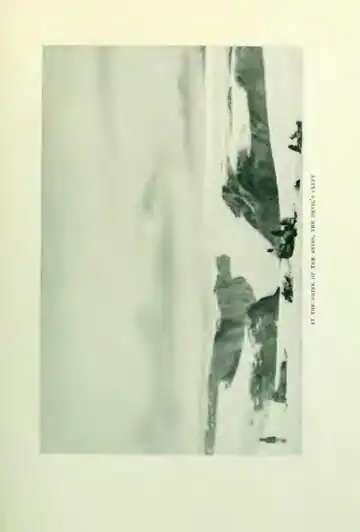
To-day we wearily struggled on to the mountain, from which we had a mighty view across a wild canyon which we named "The Devil's Cleft." On both sides 500 metres high mountains fall steeply down into a barren, brownish valley, through which a melancholy little brook winds; the glacier hangs out over the ravines like waves stiffened in horror over the mute uncanniness which rests over this eerie landscape in the midst of eternal winter.
No sign of life, not a bird, not a plant, softens the impression of this utmost desolation, where nothing but a few lichens have sucked strength enough from the warmth of the sun to clothe the sharp stones with a grey, modest cover. Never, it appears to me, have I experienced anything so distant and isolated as this wild landscape, fighting its lonely, stubborn fight against the glaciers which from all sides threaten to pour down over it.
Thus, whilst century follows century, everything changes. Even this desert has had its adventures, for we find great, beautiful branches of coral, bearing witness that even here in this heart of winter was once a tropic climate, where the waves of a living ocean, driven by mild breaths of wind, merrily lapped across the stubborn remains of a bygone period.
There is a peculiar atmosphere in the tent to-day. Perhaps it is the bright prospects, and the weather, which at last seems willing to put an end to the nervousness which, under eternal changes between rain, snow, and fog, has endured for the last three weeks; both the internal and external disquiet have given way to a restful security, and when we are calm for a little while idyllic feelings abide in our tent. During the forced daily marches there somehow is no time for quiet communion; but in an afternoon like this one draws breath and plans the work of all the collections which now we struggle to get safely in harbour. The inland-ice is never a safe route; if anything happens here all results disappear without a trace, and all our toil and stubborn fights for food have then been to no purpose whatever. The precious articles have now been freighted through water and whirlpools, through clefts and over glacier edges, and immediately another aspect of the problem must be faced. The collections must be brought forward to mankind, and all this makes them doubly precious to one.
Outside the tent Wulff is sitting preparing the only vegetation we have found so far here in the Devil's Cleft, grey lichens covering some of the stones. These plants, which grow right on the very stone blocks, are surely unique in contenting themselves with so little, and I therefore get Wulff to tell me something about their biology.
Lichens are organisms consisting of an alga and a fungus which have united for the benefit of mutual housekeeping. The alga is that shareholder in the limited company which is the sole possessor of an ability to create organic substance out of inorganic matter. The fungus, on the contrary, forms the small aerial roots with which the lichen clings to the substance. The colour of the lichens, as we see it, is a result of the respective colours of the alga and the fungus.
The lichens are highly impervious to drought, warmth, and cold, and are only able to vegetate in turgid condition, but are at rest when it is dry. In this climate they probably vegetate merely a few days in the year, and a patch as big as a penny can often be more than a hundred years old in this neighbourhood, where vegetation is at rest for 350 days of the year. Their chief nourishment they get from the stone through its slight crumbling, and that cannot be much. The lichen thus is a plant which in all its meanness has eternity before it.
August 9th.—We broke camp on the 9th in the morning, and drove slowly up the great firns of the Devil's Cleft to the north-east. We ascended at an even gradient, groaning under a temperature of 4° (Cent.) and dazzled by the light, which, reflected from the newly-fallen snow, hurt our eyes. At a height of 1,000 metres we took an observation. We now have a beautiful and grand view across the remarkable canyon and Nunatak—land which, during the last few days, we have discovered across our course. It stretches like a brim of 20 to 30 kilometres broad from the land behind St. George Fjord, with great local glaciers on one side and the inland-ice itself on the other. In an enormous arch it bars our way also in the direction of Sherard Osborne Fjord, and we therefore give it the name of the Midgard Snake. There is no way outside; after a short reconnoitring, we take a bite of the sour apple and once more leave the glacier to drive down on the brim. We find a fine, even ascent and immediately after a cup of tea commence transporting the goods to the inland-ice.
The land was dry and even to walk on, but barren and naked as a desert; not even a tiny river enlivened it—everything was completely dried up despite the great glaciers with their inclines towards the country on both sides. It was one of the so-called karst landscapes where all water oozes down into the soil. The vegetation was accordingly. We found a few poppies, some of which were yet in bloom, small stunted grasses, mosses and lichens, but no animal life. Only a wolf had a long time ago left his imprint in the clay near the place where we pitched our tent to cook a ration of pemmican gruel.
After the meal three men returned to our point of descent, while Koch and I continued to transport the baggage to the glacier.
On our walk we found the jaw-bone of a musk-ox, which appeared to be more than a hundred years old. Close to this was a fossilized piece of an octopus from the Silurian period. These two proofs of former life, the musk-ox and the octopus, have between them a period of probably at least ten million years—a good mouthful on which to exercise active imagination.
After twenty-four hours of toil with the transport we were once more gathered by the tent, sleepy and hungry, but all in good spirits and with a good conscience, knowing that in spite of the difficulties we had made 22 kilometres forward, half the distance having been traversed twice.
Sleep is sweet as honey and milk after such a day!
Seven hours later we were again in harness. We were in for a race where the lives of the dogs were the stake, for we had only two feeds left and the country south of Humboldt's Glacier was yet 350 kilometres away.
Seven hundred metres above sea-level with the inland-ice on all sides, and notwithstanding this we have 3° of warmth (Cent.) at three o'clock in the afternoon! Some time elapsed in getting properly going again, for tender were our feet after the many small, sharp stones, and stiff were shoulders, neck, and back after the heavy burdens. But I must admit that every man accepts it all cheerfully, and we try to stimulate each other by poking fun at the miserable appearance which many of us present. There is nothing for it but sucking nourishment from one's humour during these days; home-sickness turns us into giants forcing our way through all difficulties, and we do manage surprisingly well. On our meagre rations we toil like Icelandic ponies, or perhaps rather like hunger-hardened coolies. For it cannot be denied that we get hungry all too soon after the meals which we now eat with an almost religious solemnity.
We must try to get out of this desert as soon as possible. A depressing and barren land where the deep silence is unbroken even by the little chirp of a bird or the low murmur of a brook; a remarkable piece of snow and ice-bare karst which might be moved into the midst of the Libyan Desert without causing a break in the unity of the landscape.
We have almost reached the edge of the inland-ice; in a couple of hours this toilsome transport will be a mere memory, and then at length the journey across the next and last big desert will commence in earnest.
(588 metres above sea-level).
August 10th.—We reached the edge of the inland-ice at half-past one, after crossing a last turbulent moraine river which we had to bridge with the sledges.
This moment, so significant for the expedition, was celebrated with an additional meal, outside the rations, and an extra strong cup of coffee.
Dead calm, a clear sky, sun, a temperature of 1° (Cent.), satiated men, sun-gleams in our souls!
During the meal we recalled in memory that American National-Economist who proposed that food and not gold should be the standard of value in life. As far as I remember he proposed that edible money should be made out of wheat, for what is a millionaire with all his gold in a desert like this, and what would we be without food?
(900 metres above sea-level. Distance, 4 kilometres).
We make camp at ten o'clock in the morning after the longest day's journey we have had; 10 kilometres of it went across land bare of snow, wherefore we had to make the distance twice. We got to rest at one o'clock too tired to write.
We awake at half-past seven. After the rest, the soreness of our bodies is apparent with a vengeance. Our loads had an average weight of 70 to 80 pounds, and we carried them incessantly from four in the afternoon until one in the morning, when the inland-ice was reached. So to-day every little movement is painful, but the sky is clean as newly-fallen snow, not a cloud, beautiful travelling, everything once more ready for a long day's journey homeward, so that we may reach the ship and Denmark before the winter.
The Midgard Snake now lies far behind us, and the height we have reached assures us that we have passed all difficulties. The glacier is an ideal one, even and bare of snow, entirely free from the system of crevasses which forced Peary and Astrup to set their course further in on the inland-ice.
Temporarily we make a line towards south-west, following the back of the glacier along the land which has just turned up, stretching from the head of St. George Fjord in towards Petermann Fjord. A wild and riven country where deep ravines intersect mountains and little glaciers, obstinately and defiantly contrasting its broken and disquiet lines to the dead monotony of the inland-ice.
We give it the name of Nyeboe Land.
(1,200 metres above sea-level. Distance, 43 kilometres).
August 11th-12th.—During this time, when we are often in activity for from twenty to twenty-four hours at a stretch, we have, in order to keep our capacity for work somewhat near to the mark, been forced to introduce a slight meal in the middle of our day's march. It consists of a cup of oat-gruel with a few pieces of pemmican, and is subtracted from our regular morning and evening rations and does us extraordinarily well.
With a start at 9.30 in the evening, we make camp at 10.30 in the morning, after having covered 43 kilometres of fine going. It is really a considerable distance. The sledges ran somewhat heavily and we men used skis and snowshoes. In the eternal white surroundings the long walking tour seemed somewhat monotonous, although not really tiring except for the first three or four hours. As soon as one has walked off the soreness of one's body, a good and increasing speed is developed as we gradually approach the time when we have our meal. Thus we adopt entirely the habits of the seal. We have now reached such a height that the rise of the inland-ice is no longer felt; the horizon about us is without a change; only casually do we pass a small ice-clad mountain-top. There is somewhere near 1 metre of softer snow down to the ice," but the surface carries the dogs fairly well so that it does not trouble them.
We are excitedly speculating as to how long we may keep this good going.
The first dog fell to-day in the middle of our day's march, and we drove it to the camp, where immediately it was distributed as food for the other dogs. We do not attempt to hide the fact that the very difficult conditions of the ground and of the transport on Daniel Bruun Glacier, the Devil's Cleft, and the Midgard Snake, have taken it out of us; our faces show that we have become very thin. But our spirits and our will to endure are unshaken.
It is a great boon that we have plenty of paraffin, but of real provisions we possess merely enough for six days. It is therefore desirable that the weather should favour us; it will be awkward if we have to help the remaining dogs to any considerable extent to eat those that fall out. We are forced to exploit as largely as possible the advantage of the feed which the dogs had yesterday, and for that reason we must be content with a short sleep, and we break up after only five hours' rest. Before we start, we put ice under the sledge-runners, as the temperature is now sufficiently low for this purpose. The thermometer registers minus 65° (Cent.).
During the march yesterday we were quite suddenly surprised by the visit of a young gull which had strayed in to us. For a long distance it fluttered feebly to and fro in front of the dogs until the wind seized it and carried it further in towards the waste and death. A storm blew it in here, and it was unable to find its way back to the sea again.
(1,100 metres above sea-level. Distance, 34 kilometres).
August 12th-13th.—To-day we again put ice under the sledge-runners, after first having put skis beneath them. The barometer is falling; in the clouds there is a strong drift from the south-west, and we have a temperature through the day of between 0° and 2.1° (Cent.).
The first 20 kilometres offered even and firm going, so that in six hours we covered 28 kilometres. Later on the Föhn, which we had expected since the morning, came over us; then the snow rapidly grew soft, the sledges went heavily, and the dogs sank through and soon grew tired and unwilling to push on, although three of us walked in front. After a day's journey of 34 kilometres we were forced to stop.
The ski-ing had been excellent all through the day, and the surface of the glacier was so even that the sledges had difficulty in keeping up with those of us who wore skis. Under circumstances like these, for one who is used to them, the skis are far preferable to the Canadian snowshoes, which merely carry one without at the same time giving the gliding speed across the snow.
About two o'clock we sighted the land inside Petermann Fjord, and our course is now abreast of it. It is very stimulating to have a landmark, but unfortunately we shall scarcely be able to pass 80 degrees to-morrow as we have been hoping for the whole time, for with this high temperature going will be bad. Otherwise we have fine, clear, windy weather with summer warmth in the tent.
The gathering clouds from the south-west carried out their threat. Just as we had taken down our tent in order to continue the journey, a sudden change in the weather occurred, with low clouds drifting with great velocity, so that, fearing the approach of a snowstorm, we pitched our tent once more and awaited developments. It turned showery, alternating between snow and drizzle, and we resigned ourselves to it, deciding to take advantage of the storm for a rest—the first since the ascent from the river in St. George Fjord.
Our involuntary stay unfortunately leads to the slaughter of two dogs, partly as food for ourselves, partly for the other dogs. It is midnight, and I am writing these lines whilst the smell from the pot affects me not at all disagreeably. Never before during my fifteen years of travel have I been forced to eat my dogs, wherefore I have always with discomfort, and not entirely without criticism, looked upon the expeditions which wore out their dogs to the last rag, later on to eat them. It appeared to me not only unaesthetic and unappetizing, but also akin to cannibalism. It seems entirely different now when we ourselves have to save our lives with dog-flesh! The unæsthetic and unappetizing aspect no longer exists.
The snowstorm whistles round the canvas and, with our scanty provisions, we feel infinitely far away from humanity. We are hungry, and have been hungry for the last month. So we are merely longing for the meat to be cooked so that our hunger may be assuaged. The flesh looks light and delicious though very thin and sinewy; but as the steam arises from the pot and fills the tent we imagine that we are going to eat mutton—the smell is similar. And the prospect of every man being satiated, instead of merely "sticking it" on a sixth of a ration of pemmican gruel, highly invigorates and pacifies us. What the Devil! The dog is merely a domestic animal, and all the world over one eats one's domestic animals!
We are all fighting for life here in this desert; we toil regardlessly in order to reach the better hunting-grounds, and as we and not the dogs possess the right of the stronger, it is we who eat the dogs. In a position like ours there is no room for sentimentality. Soon or late they would have to die by our hand. On this expedition where they have served us so faithfully in life, let them then also serve us and their comrades after death.
Maybe someone will turn up his nose at this argument. But through half a year we have now got accustomed to accepting our food with gratitude, in whatever form we might receive it; wherefore, perhaps to a greater extent than man generally, we have had an opportunity of revising our estimation of what a formidable factor an empty stomach is: it does not acknowledge many considerations.
The meat is cooked now, and maybe the meal is a plebeian one, but no appetite in the world is more royal than ours!
(765 metres above sea-level. Distance, 44 kilometres).
Yesterday we at last got clear fine weather with a mild breeze from the south-east and only minus 19° (Cent.). One cannot recognize the glacier at all in this summer temperature. During the first Thule Expedition we found further in on the inland-ice, at the same time of year, a temperature of between minus 20° and minus 5° (Cent.). This heat, which in various ways is very acceptable to us, is of course due to the fact that we are so near to the coastland. In strong cold our lean dogs would surely have frozen to death in their thin summer coats.
With a start at 7.30 in the afternoon we succeeded in making 44 kilometres by a fair and even pace until six o'clock in the morning. Unfortunately we have had to give up our small midday meals out of economic considerations; we can no longer afford them. We content ourselves with a cup of tea.
The glacier was firm like the floor of a room, the sledges slipped along easily and without any friction worth mentioning, and our eleven dogs with the two sledges occasionally went at a pace which made it difficult for us to keep up with them. Off the inland Nunatak of Petermann Fjord we passed a somewhat complex system of great crevasses which were connected by wide bridges so that they did not represent much difficulty; we merely had to alter our course slightly in order to get outside. For the present our tent is open with a wide view to the Nunatak which on the eastern side merges evenly into the glacier, but outwardly forms a high and split-up foreland towards the fjord, which we see in a glorious bird's-eye view with blueing cliffs far out in the western horizon.
(1,010 metres above sea-level. Distance, 41 kilometres).
August 15th.—We had to clench our teeth in order to cover our 40 kilometres to-day. A rough south-wester blew right against us, and the snow consisted of fine little needles which hurt us right through the kamiks, breaking under our weight. A wearisome walk! In addition, the journey was at an even upward incline, and as soon as we encountered the slightest rise we felt in our knees that we were exhausted.
As the paws of the dogs began to bleed, we had to sacrifice all our gloves, wrapping them round their feet as kamiks. That was a help.
At a height of 900 metres above the sea-level we came to a lot of great and small lakes, the largest of which had still open water, rippling deep blue and beautiful in the white surroundings. It seemed peculiar here in the midst of the glacier to see these basins of living water, of seas which could be up to 300 metres long and 100 metres broad. We also passed some smaller crevasses and little frozen rivers.
Due west, we had Washington Land in sight all day, with its high steep mountains standing like a wall against the inland-ice. Beautiful white glacier tongues intersected and slit the reddish-brown and yellowish cliffs like mighty waterfalls. Through dips in the land we could occasionally discern the pointed alps of Grinnell Land like fine, violet banks of clouds—a view which encouraged us on the march, and broke agreeably the monotonous plane which everywhere surrounded us.
This voyage across the inland-ice, which has loomed threateningly in the horizon during the last few months, now appears in the light of a pleasant surprise, a final spurt, a reward for all our adversities.
(1,100 metres above sea-level. Distance, 35 kilometres).
August 16th.—Immediately after the beautiful journey of yesterday a south-wester came up with thick weather, blowing us quickly to sleep. Towards evening it dropped somewhat, and we tried to set off; but after making 14 kilometres we had to call a temporary halt because of the fog and snow, and we took the opportunity to kill a dog which was too exhausted to travel any further. In the course of the night we had a temperature of minus 7.5° (Cent.), and the result of this cooling was that the sky once more cleared up, so that we could continue immediately after taking a noon observation which showed us that we were on N. Lat. 75° 45'. After 20 kilometres' march we had again to stop because of thick weather and snow, so we definitely made camp for the day.
Over a Pipe of Tobacco.
August 17th.—It blew bravely last night, it beat and whipped across our thin canvas tent, which has now the appearance of a veteran; and as we have no sleeping-bags and our clothes are wet with the perspiration of the long marches, our sleep was interrupted by little shudders of cold and frequent stamping of the feet.
In the middle of the night, after only two hours' sleep, I light my pipe to think seriously about the position. Apart from our dogs, which are no longer in the best condition, we have provisions merely for two or three days. The only thing we possess in abundance is paraffin; therefore another week will be possible on boiled dog meat—if one can really call that thin bony food by the name meat. A more serious thing is that, in a couple of days, we ourselves must pull the sledges when the dogs can carry on no longer and are reduced to being food for man. We yet possess nine, but their number speedily decreases. Also other circumstances contribute to the desirability of reaching land quickly. Harrigan carries a swollen hand in a sling; Koch has just got over an awful gumboil which closed entirely one of his eyes, and he has now acquired a choicely vicious boil under the nail of the big toe. Wulff is walking, to speak plainly, with a boil on his behind, which I am daily doctoring, and all these little painful incidents, in addition to the daily semi-starvation which gradually develops into a downright feeling of hunger, necessitate that we should as quickly as possible find land and hunting. We had hoped to be able to reach the land behind Marshall Bay, but it now seems improbable that we can cover the remaining 200 kilometres. I therefore decide, after this night's communion with myself, to try a descent in the neighbourhood of Cape Agassiz. From there it is only 250 kilometres to Etah, the country of hares and reindeer.
As a light in the distance shines the possibility of meeting my ship, the Cape York, at Etah in the beginning of September, and the thought of getting home to Denmark this autumn undeniably stiffens our energy considerably.
(1,130 metres above sea-level. Distance, 21 kilometres).
August 18th-19th.—At eight o'clock in the morning we set off, but it was soon apparent that it would not be a good day. With the wind half a point abeam we walked heavily through a very strong drift of south-south-west. Now and then the gusts would be so violent that we tottered on our skis, but on we must go, the knife at our throats! I was on the point of being overwhelmed by tiredness a few times during the fight against the rough snow-showers, but there was nothing for it but to swallow the pain and forge ahead. With our decreasing provisions this was an uncanny race. Stubbornly we toiled ahead for five hours until one o'clock; then suddenly the drift increased to a storm which swathed us all in white layers of snow. We stopped on the spot, as all resistance was in vain.
To pitch the tent in weather like this proved both a fight and an art, but we did succeed. It was impossible to clear anything of snow, and all baggage was quickly thrown into the tent in its snow-covered state, whereafter we ourselves sat down in a circle like perching hens and let the storm blow. Such is the situation whilst I am writing this. The Föhn has thawed the snow in our clothes and we are wet through. The fine "snow-sand" of the glacier drifts in through the seams of the tent and covers us; but we try to take it all in good spirits, singing American football songs which we remember from McMillan's gramophone whilst we cook a panful of pemmican gruel.
A few hours later the violent showers, which threaten to rob us entirely of our old tent, cease, and the wind becomes a steady and persistent gale. Having eaten the gruel, we lie down to sleep, leaving the storm to its own moods.
Eleven o'clock in the evening. The same weather, the same wind. To sleep again.
We turn out again, but find the same weather and the same wind. Despite our hurry, then, we are weather-bound for another day; and whilst previously we have been starving on days when we did not travel, we dare not do this again, as in our present condition it would weaken us too much. So we cook our cup of coffee, the last but one, and a cup of thin pemmican gruel. Our entire provisions now consist of a pound of pemmican for each man, and the distance to land must be at least 100 kilometres. But the barometer is rising, and we pin our faith on a speedy change in the weather.
Twelve o'clock noon.
The same weather, the same wind, but less violent, and the snowdrift is decreasing. We have had to kill two dogs for a meal for ourselves and the seven animals we have yet left. Once more we are squatting on our heels in a ring in the tent, gathered about the warming Primus, which will soon make the pan boil.
Three o'clock.
The barometer, which had risen somewhat, falls again, and the thickness about us prevents us from setting a course for the time being.
One o'clock, morning.
August 19th.—Same weather, same wind, and despite all impatience to get away whilst we have yet a couple of dogs left, we are forced to hibernate like bears as long as the storm lasts, sleeping as much as possible. Even if we could keep a fair course by the aid of the wind, we dare not set out in the thick snow, as we cannot be far from the edge of Humboldt's Glacier. Unfortunately we possess neither the bear's capacity for sleep in our cool den, nor its capacity for doing entirely without food; so we often wake up from dreams which maliciously emphasize our situation. Thus I now woke up after the following dream:
I am at my father's vicarage at Lynge, standing with my mother in the larder, where is to be found a drawer which is always full of cakes. Mother has just finished baking and put two lovely warm Christmas cakes into the drawer, sweetly fragrant with delicious ingredients, bristling with raisins and citron. She cuts a couple of thick slices for me, saying in her gentle voice: "There you are, my boy; eat as much as you like!" As I raise the delicious cake to my mouth, I wake up to all our misery.
My comrades are lying asleep, the wind is whipping the drifting snow around our tent, and an exhausted dog is lying out in the drifts, whimpering pitifully.
Four o'clock in the morning.
There is hardly any wind now, but the snow is falling more heavily and our little camp is quite wrapped up in a white thickness. Again I awake from a mocking dream, and as compensation we make coffee from the old grounds and distribute half a rye biscuit to each man. The coffee pours like a warm wave through our bodies, and with pipes between our lips we meet the day in good spirits. It will all come right in the end! It was from our own free choice that we left the comforts of home; but how keenly we shall appreciate it all when once we return!
Half-past six o'clock.
Half an hour ago a gleam of sun penetrated the canvas. We immediately arose from the different postures in which we had attempted to rest, and gave vent to our jubilation. The teapot was put on, and a sixth of a ration, exactly a mouthful of pemmican for each, was distributed together with one of the small biscuits. The horizon is yet hazy, but above our heads the blue sky is breaking through, and we may hope for travelling weather towards noon. There is once more a fresh note in our voices, and bright prospects for the coming day.
(800 metres above sea-level. Distance, 35 kilometres).
August 19th.—Thanks to the excellent going, we are now 35 kilometres away from our bad weather camp. The snow was so firm after the storm that we required neither skis nor snowshoes. We walked from ten in the morning until half-past eight at night. One of the sledges was pulled by three dogs and the other one by four, and the persevering animals managed very well during the day.
When we began to move after the days of rest occasioned by the snowstorm we felt very weak in the knees, but we quickly beat the weakness down, putting our best leg foremost, especially as the clouds still looked threatening and a fresh storm might interrupt our journey at any moment. Fortunately it proved to be merely a threat. With great velocity the clouds raced above our heads before a south-west gale; later in the day their speed decreased and the sky assumed a more quiet aspect.
The last 15 kilometres of the journey we were much hampered by crevasses, presumably local ones, as they were all situated in the vicinity of an elevation where the ice appeared to have cracked through its own tension. They were of an unusually deceitful kind, merging entirely into the surface of the glacier and in most places covered by thin bridges, so that it was difficult to notice them in the hazy atmosphere. Once Wulff was on the point of falling through, but fortunately he hung by the arms, so that I was able to get hold of him and pull him up. The crevasse was narrow at the top, but widened out downward into a dark, bottomless abyss. After this dreadful experience we tied ropes round our waists and continued our march without further obstacles.
We have had to kill another dog.
At the beginning of our day's journey we sighted land due north-west—probably Cape Forbes and its westward continuation. About half-past three more land became visible, and we thought we recognized Cape Webster. From our point the land inward looked like a multitude of little seas in a frozen ocean.
August 20th.—It was one o'clock when we went to rest, and already by seven o'clock we had to set to, cooking our last cup of coffee and the last but one portion of pemmican gruel. A person who has not been starving is unable to understand how wonderful food, real food, tastes under such circumstances. The small dry biscuits which for the last few days we have used as sugar for coffee and tea possess an aroma and a savour which one does not notice at all when one has access to plenty; and the oaten porridge, which during our wintering we looked at with contempt, affects us like caresses; we are agreed that we would all be happy for life if we could only have sufficient Avena oats.
The weather is continually disturbed, but as the sun breaks through at eleven o'clock we set off. The entire journey of the day goes across slippery ice covered by a layer of new snow; we often fall and the dogs, which continually walk in kamiks, find it difficult to get a foothold. We pass some small crevasses and a number of dried-up sea-basins and river-courses. The first great river-course is passed 16 kilometres from our previous camp at a height of 750 metres. The inland-ice during our journey to-day appears to have been subjected to a severe process of melting; the surface consists entirely of tiny, fine grains which inflict considerable pain on the dogs. Our route lies across an even terrain faintly sloping towards Peabody Bay, where all rivers find their outlets.
(600 metres above sea-level. Distance, 30 kilometres).
The sky threatens us constantly with Föhn clouds. The minimum temperature of the night was minus 5° (Cent.), whilst during the forenoon it rises to 1° (Cent.). A ring forms round the sun, gleaming viciously with parhelions. It looks beautiful, but our thoughts centre round the evil meteorological promises which it gives.
To-day we still drove two sledges, each pulled by three dogs. Although we had to assist, the dogs were yet an invaluable help. We made good speed all during the journey, and by seven o'clock we were able to camp with a view of Peabody Bay, mostly ice with occasional holes of open water. We are probably 25 kilometres from the edge of the glacier, and Washington Land has been visible almost through the entire day.
Again a dog has to be killed.
It was the best dog we had yet tasted, despite which I was seized during the meal by a sudden feeling of discomfort, so strong that, notwithstanding my hunger, it was impossible for me to eat any more. According to our calculations we should now be some 30 kilometres away from the land round Cape Agassiz—"the great land without mountains," as the Eskimos call it and here we hope our bad experience will have an end. Just think of tallow and fragrant reindeer meat, and probably a delicious autumn hare!
(600 metres above sea-level. Distance, 12 kilometres).
August 21st.—The day begins with the cooking of the last portion of pemmican gruel, and a thin one at that, for there must be sufficient to go round. But however thin it may be, it lies like cotton-wool round our vitals, refreshing us with its substantial taste. At the same time the last biscuits are distributed, four to each man. If only the weather will last things do not seem too black, for we have five dogs, which constitute sufficient provisions if unforeseen obstacles do not delay our descent to land. The weather does not promise well; we have a positive temperature of 3°, which is never a good sign on the inland-ice; furthermore, the clouds are coming up with the velocity of a storm from the south-west. We leave behind us everything that is unnecessary, both skis and snowshoes, and hasten forward.
The glacier is firm and bare of snow; it consists of little sharp needles which hurt us and the dogs, and as the animals wear out their kamiks we tie up their paws in bits of an old towel.
At twenty minutes past one the great moment of the day and of the journey arrives: Land ahead! Involuntarily we all hail the saving coast with loud cries of joy. The dreadful tension of the journey seems at an end. The expedition is once more on the safe side, and we can see a happy finish to the death march of the last few days.
What matters it that our joy is very quickly interrupted by bad visibility and pouring rain? We have seen the land and we know that we have the strength to reach it! At four o'clock in the afternoon we pitch our tent and again kill a dog. It all seems to us merely a small trial for the exercise of our patience; there is land ahead where men live—the blessed land of reindeer!
Four o'clock in the morning.
The violent rush of a river suddenly bursts through the ice-cover right by the side of our tent, frothing and roaring to a breadth of 30 metres. We rush out in the belief that we ourselves will be swept away, but fortunately it is only a temporary outbreak, which quickly subsides.
It has been raining hard all night, but now it has ceased. We will attempt to continue.
(620 metres above sea-level. Distance, 20 kilometres).
August 22nd.—The rain and the continuous mild weather seem to threaten us with calamity. In all dips of the ground great and deep rivers break out, causing us the greatest difficulties. These rapid, broad glacier torrents are surely the greatest danger with which a glacier traveller can meet; for if he slips during the crossing, or loses his foothold when he jumps, he will without fail be carried along the shiny bottom and swept to perdition as the river pours out into the ocean itself.
There were three great courses which caused us especial difficulty, as in several places the run divided into as many as eight rivers. Wherever practicable we made a bridge of the sledges, experiencing during these crossings some of our most exciting moments, particularly when the collections had to be brought across. Often these had to be thrown with a sure aim from one side of the river to the other, and seized on the other side with the same accuracy. A slight twist of the hand, a wrong step of the foot, and the result of all our five months' toil would have been irredeemably lost. After twelve severe hours, during which we zigzagged and often made great detours, we found ourselves 20 kilometres away from our last camp, so that we really ought to have been down on land if only through the day we had been able to keep a straight course. On a dry elevation. we rested, intending to continue about an hour later; but unfortunately we found that Dr. Wulff could not go further on this day. All through the day he had felt exhausted and looked ill, but I had hoped that a few hours of rest and a little dog meat would before long enable him to continue; for we had only three lean dogs left, and there was no knowing what obstacles the rivers or the descent to land might confront us with. We faced the situation openly and without attempt at camouflage. When we struggled with the sledges we felt dizzy and weak in the knees, and all sudden exertion made the blood retreat from the brain.
The fog has once more settled on the land which we must cross, and for the moment we do not know where we are. All through the day we have waded through water, and our feet are cold and wet. Numerous little pools have formed on the surface of the glacier, and the bottom of these consists of sharp, painful grains of firn. It is a comfort that we now discover everywhere quantities of land-dust." A small sea-king swims merrily on a frothing river from the inland-ice and seems quite pleased with the slide it has found towards the sea. Further, we have seen two ivory gulls. Once more we must kill a dog and, without pitching our tent, as it is calm, mild weather, we eat it with a good appetite.
Eight o'clock in the morning.
To ease the load, we threw away a few days ago all our ground-skins, and now, so that we shall not lie on the bare glacier, we spread out the tent and lie down on it. Through the night a heavy fog has hidden all surroundings from us. It still hangs about, and although we are unable to find our bearings we must continue. A great frothing river is visible ahead of us and, to begin with, we make for that.
2.30 afternoon.
The glacier river, which proved to be a frothing ice-stream of 60 metres breadth, nearly destroys all our hopes; for at the point where we struck it it was so deep that there was no possibility of fording it. After a long reconnoitring I succeeded in finding a place where the water reached us merely to the hips, and as the current seemed to be less violent here we made the attempt. We succeeded, and in the course of a couple of hours our instruments and diaries were safely deposited on the opposite shore.
This bath, with its accompanying strain and excitement, told on us so much that once more we had to prepare a meal, so we killed our third dog. The one which we killed yesterday provided merely one poor meal for the six men and the three dogs. The fog which has all day been lying clammy and close around us now seems to lift. The sun is on the point of breaking through, and a blissful warmth begins to stream through our bodies, which are icy-cold under the wet clothes. We now attempt to set a course straight on land towards the south-west.
(525 metres above sea-level. Distance, 15 kilometres).
After a day's journey of thirteen hours we had to make a halt by a great river, which we have not had the strength to cross to-day. Comparatively soon after we broke up from the place where we took our meal yesterday, we sighted land. Our course is straight and the remaining distance must be scarcely 20 kilometres. But a mighty net of rivers so far separates us from it. About eight o'clock yesterday we had to wade across a deep river which was some 40 metres broad, and where the water reached us to the waist. The cold water told chiefly on the muscles of our knees. We have to pull the sledges ourselves now. In the evening another dog is killed, as we prefer to transport its flesh on the sledge; we have now only one left.
(430 metres above sea-level. Distance, about 10 kilometres).
August 23rd.—The new river which yesterday completely unnerved us was crossed with surprising ease. Only the fog seems disinclined to leave us, but we hope that our course is the right one. A number of smaller rivers are passed in alternate drizzle and sleet.
At five o'clock in the afternoon, in the midst of fog and hopelessness, we see the first sign of life from land-a small fly buzzes past us right up on the ice! It affects us like the olive-branch of Noah's Ark, and this enlivening experience is a good pace-maker.
We follow an incline leading towards a dark bank of fog, which has the appearance of land. We advance quickly until we reach a large, very beautiful glacier lake, with an affluent river forming a deep canyon in the glacier. The sea has wonderful colours—green along the shore and dark blue in the middle; along the shore lie big ice-blocks, tall as a man. The crossing of this river required all our strength. Furthermore, the fog grew so heavy that we dared not continue our course. The snow fell closely and we had to seek the shelter of our tent. Our wet clothes feel like cold compressions round our limbs, but fortunately we are so tired that we quickly go to sleep.
The glacier has during the whole of our day's journey been very porous, with large pointed ice crystals and deep round Cryokonite holes.
August 24th.—Twelve o'clock noon.
During part of the night I was awake, as I had to keep an eye on the weather; for as soon as it clears the least bit we must continue in order to get down to land and safety.
Wulff's increasing exhaustion is a source of great anxiety to us; when, after a rest, we have been walking for three hours, he lies down and declares that he can go no further. We then stop, make him a strong cup of tea, and refreshed by this once more he quickly continues in good spirits. But he is as thin as a skeleton and the expression in his eyes becomes weaker and weaker. As long as we had the small rations of pemmican and Avena oats he kept up surprisingly well and nearly always was to be found with the foremost. But apparently he cannot digest the dog-flesh, and he gives away the better part of his ration in spite of our protestations. The rest of us can manage for a few days more. If only the visibility were better—we are really quite close to land!
After short, refreshing sleeps I start up to look at the weather—I have merely to put my eye to the canvas, which is full of holes—but every time I meet only the same heavy fog and sleet; only the uncanny rush of rivers can be heard around us.
At length weariness overcomes my watchfulness, and I sink into a good sound sleep, during which my dreams, as is usual at this time, carry me away from the seriousness of the moment and towards the longings which alone prevent me from falling into complete exhaustion. When I wake up it is beautiful weather; the fog has lifted and the sky seems to be clearing up. I arouse my comrades and make a cup of tea. Then at half-past nine in the morning we start. We speed ahead as well as we can with our sledges and our goods, and after a good hour's walk we sight the land towards which we are rushing. We keep our constant course straight on to it; many details are now visible and the distance cannot be great—perhaps merely a good six miles. The distance is nothing, but the great rivers may prove severe obstacles in our way. It may take us several days yet in the worst case, but only a few hours if we are in luck and do not meet with difficulties when we descend.
Our excitement is intense. Every hill of the glacier which we ascend gives us a sure view of the land; then the fog once more rolls up from the horizon in the west, and in a few minutes the land we are steering towards has disappeared in grey banks of fog.
Once more we must stop and sit inactive on our sledge, hungry as wolves. What good is it to sit here in glorious sunshine when we are robbed of our view ahead! I consider our position and decide to kill the last dog. For if we become too exhausted we shall be unable to hunt when we do reach land; so let us stake everything on one card and eat the poor animal. Merely one tube of glycerine is now left to us.
Three o'clock in the afternoon.
We have reached land, we have returned to food and to life! We have escaped from the terrible embracing of the inland-ice! The expedition and all its results are saved! Only one who has experienced excitement similar to that of the last few days will be able to realize the feelings which flow through us!
Ajako's reconnoitring took the following course :
After a couple of hours of absence his form appeared out of the fog, and at a distance we could see from his walk and from the movement of his arms that he brought good tidings. He was wild with joy. Not merely had he found a place of descent to land, but he had also been on it, seen a hare, and found tracks of reindeer! We received him with loud shouts of rejoicing and in a moment we were all on our way down through the fog.
The place of descent was steep, and we had to retard the sledge with straps fastened under the runners; but after a daring descent we landed on the steep cliff to which a narrow little tongue of glacier led across like a bridge. For miles on both sides we saw the steep edge of the inland-ice; thus half blindly we had found the only place where descent was possible. With an indescribable feeling of happiness and relief we jumped on to land and soon after all the baggage was in safety.
Only the sledge remains on the inland-ice, its snout turned towards the cliff walls; standing there alone and abandoned, in this landscape it looks like a wrecked ship.
We yet possess a spoonful of tea, and hurriedly we boil a kettle of water. There is loud good-humour in our little camp, for in half an hour all men will be hunting.
First we call a council, as we are accustomed to do on serious situations like the present. We all agree that our arrival on land means salvation, for on this very land where now we set our feet the inhabitants of Etah are hunting hares and reindeer every autumn. On the other hand, it is clear to us that the remaining 200 kilometres to Etah is a serious distance for men so exhausted as we are.
Dr. Wulff immediately declared that he cannot continue at once. Koch also is of opinion that he requires a couple of days' rest before he will be able to undertake the long walk. But, on the other hand, various circumstances make it essential that we should reach men as speedily as possible. First of all we do not possess ammunition for a prolonged stay here. Secondly, because of the water, our clothes are so far gone that our lives will be endangered unless we fall in with people before the approach of the first cold of autumn.
So we agree that Ajako and I must go to Etah for relief; we are both of the opinion that we are able to set out for the long walk without a preceding rest. Harrigan and Bosun remain in order to hunt for Wulff and Koch, who have no longer strength to pursue the game.
Ajako and I reckon that in this stony and cleft land, intersected by a number of great rivers, we shall hardly be able to make the journey in less than eight days, considering the bad weather. Then the relief sledges have to be fitted out, and this will take at any rate twenty-four hours. At this time of the year people have not yet their sledges ready for use, and these preparations require time, so that the relief sledges could hardly be here for twelve or fourteen days.
None of us consider it advisable to remain here for such a long period. The neighbourhood will be quickly exhausted of game, so the best thing is to move the camp towards Etah in short daily journeys. For other reasons also this arrangement is desirable.
Ajako and I reckon on the probability of being so completely exhausted by the time we find people, that neither of us will have strength enough to return with the relief sledges. These will have great difficulty in finding our comrades' camp in this moraine tract, full of seas and knolls, so that one point looks just like another. We must therefore agree upon a point where those who are to be saved can be found without delay. In the near neighbourhood it is impossible to point to such a place: but behind Cape Russell, in the immediate vicinity of the inland-ice, there is a big lake known to Harrigan from previous reindeer hunts, and with which all the inhabitants of Etah are familiar. We decide that our comrades must move by short journeys to this spot. If the place is not reached by the time the relief sledges are expected to arrive, the two Greenlanders can easily be sent ahead to communicate with the relief party.
I advise my comrades not to take too long a rest; when in our exhausted condition one suddenly omits to keep the body in motion, the weariness with all its pains will be felt doubly when once more one has to continue the journey. The ammunition is distributed so that Dr. Wulff's party gets eighty cartridges of small shot and forty rifle cartridges, which should be sufficient for the period of waiting, whilst I myself take a Winchester and thirty cartridges. As soon as all the details are arranged the three Eskimos set out hunting whilst we others remain to arrange the baggage. . . .
Early in the morning of the 25th I go up into the mountains to look out for the hunters, and meet Ajako some distance inland with a first bag of five hares. The next few days again seem lighter to us. May Ajako and I have strength to get quickly into communication with people and get speedy relief for our comrades!
The fog has been lying thickly across the land since we arrived, but about six o'clock in the afternoon it clears up somewhat, and in order to make the most possible out of our opportunity to get a view of the land, which neither Ajako nor I know, we set out on our walk. We bring merely the strictly necessary things-our kamiks, my diaries, and nothing else.
We part from our comrades in the best of spirits after a feast of newly shot hares. The camp on the steep cliff seems like a fairy tale; the glacier rolls towards it like a frozen ocean, and we ourselves jump about on the stones like shipwrecked men just flung on land. Dr. Wulff has made for himself a comfortable little sleeping-place on a moss-clad shelf; smilingly he waves good-bye, calling to us: "Now don't forget to send some pancakes with the relief sledges!"
Harrigan and Bosun have not yet returned from their hunt, and this long absence is not merely a good proof of their stubborn endurance, it also gives us fresh hope that perhaps they have succeeded in shooting a reindeer; and reindeer tallow is the article of which we are most in need.

(Upload an image to replace this placeholder.)


(Upload an image to replace this placeholder.)

(Upload an image to replace this placeholder.)