Granny's Wonderful Chair/Chapter 7
Chapter VII.
The Story of Fairyfoot—(continued).
“When they were gone, Fairyfoot could sleep no more with astonishment. He did not wonder at the fairies admiring his feet, because their own were much the same; but it amazed him that Princess Maybloom’s father should be troubled at hers growing large. Moreover, he wished to see that same princess and her country, since there were really other places in the world than Stumpinghame.
“When Robin Goodfellow came to take him home as usual, he durst not let him know that he had overheard anything; but never was the boy so unwilling to get up as on that morning, and all day he was so weary that in the afternoon Fairyfoot fell asleep with his head on a clump of rushes. It was seldom that any one thought of looking after him and the sickly sheep; but it so happened that towards evening the old shepherd, Fleecefold, thought he would see how things went on in the pastures. The shepherd had a bad temper and a thick staff, and no sooner did he catch sight of Fairyfoot sleeping, and his flock straying away, than shouting all the ill names he could remember, in a voice which woke up the boy, he ran after him as fast as his great feet would allow; while Fairyfoot, seeing no other shelter from his fury, fled into the forest, and never stopped nor stayed till he reached the banks of a little stream.
“Thinking it might lead him to the fairies’ dancing-ground, he followed that stream for many an hour, but it wound away into the heart of the forest, flowing through dells, falling over mossy rocks, and at last leading Fairyfoot, when he was tired and the night had fallen, to a grove of great rose-trees, with the moon shining on it as bright as day, and thousands of nightingales singing in the branches. In the midst of that grove was a clear spring, bordered with banks of lilies, and Fairyfoot sat down by it to rest himself and listen. The singing was so sweet he could have listened for ever, but as he sat the nightingales left off their songs, and began to talk together in the silence of the night—
“‘What boy is that,’ said one on a branch above him, ‘who sits so lonely by the Fair Fountain? He cannot have come from Stumpinghame with such small and handsome feet.’
“‘No, I’ll warrant you,’ said another, ‘he has come from the west country. How in the world did he find the way?’
‘How simple you are!’ said a third nightingale. ‘What had he to do but follow the ground-ivy which grows over height and hollow, bank and bush, from the lowest gate of the king’s kitchen-garden to the root of this rose-tree? He looks a wise boy, and I hope he will keep the secret, or we shall have all the west country here, dabbling in our fountain, and leaving us no rest to either talk or sing.’
“Fairyfoot sat in great astonishment at this discourse, but by and by, when the talk ceased and the songs began, he thought it might be as well for him to follow the ground-ivy, and see the Princess Maybloom, not to speak of getting rid of Rough Ruddy, the sickly sheep, and the crusty old shepherd. It was a long journey; but he went on eating wild berries by day, sleeping in the hollows of old trees by night, and never losing sight of the ground-ivy, which led him over height and hollow, bank and bush, out of the forest, and along a noble high road, with fields and villages on every side, to a great city, and a low old-fashioned gate of the king’s kitchen-garden, which was thought too mean for the scullions, and had not been opened for seven years.
“There was no use knocking—the gate was overgrown with tall weeds and moss; so, being an active boy, he climbed over, and walked through the garden, till a white fawn came frisking by, and he heard a soft voice saying sorrowfully—
“‘Come back, come back, my fawn! I cannot run and play with you now, my feet have grown so heavy;’ and looking round he saw the loveliest young princess in the world, dressed in snow-white, and wearing a wreath of roses on her golden hair; but walking slowly, as the great people did in Stumpinghame, for her feet were as large as the best of them.
“After her came six young ladies, dressed in white and walking slowly, for they could not go before the princess; but Fairyfoot was amazed to see that their feet were as small as his own. At once he guessed that this must be the Princess Maybloom, and made her an humble bow, saying—-
“‘Royal princess, I have heard of your trouble because your feet have grown large: in my country that’s all the fashion. For seven years past I have been wondering what would make mine grow, to no purpose; but I know of a certain fountain that will make yours smaller and finer than ever they were, if the king, your father, gives you leave to come with me, accompanied by two of your maids that are the least given to talking, and the most prudent officer in all his household; for it would grievously offend the fairies and the nightingales to make that fountain known.’
“When the princess heard that, she danced for joy in spite of her large feet, and she and her six maids brought Fairyfoot before the king and queen, where they sat in their palace hall, with all the courtiers paying their morning compliments. The lords were very much astonished to see a ragged, bare-footed boy brought in among them, and the ladies thought Princess Maybloom must have gone mad; but Fairyfoot, making an humble reverence, told his message to the king and queen, and offered to set out with the princess that very day. At first the king would not believe that there could be any use in his offer, because so many great physicians had failed to give any relief. The courtiers laughed Fairyfoot to scorn, the pages wanted to turn him out for an impudent impostor, and the prime-minister said he ought to be put to death for high-treason.
“Fairyfoot wished himself safe in the forest again, or even keeping the sickly sheep; but the queen, being a prudent woman, said—
“‘I pray your majesty to notice what fine feet this boy has. There may be some truth in his story. For the sake of our only daughter, I will choose two maids who talk the least of all our train, and my chamberlain, who is the most discreet officer in our household. Let them go with the princess: who knows but our sorrow may be lessened?’
“After some persuasion the king consented, though all his councillors advised the contrary. So the two silent maids, the discreet chamberlain, and her fawn, which would not stay behind, were sent with Princess Maybloom, and they all set out after dinner. Fairyfoot had hard work guiding them along the track of the ground-ivy. The maids and the chamberlain did not like the brambles and rough roots of the forest—they thought it hard to eat berries and sleep in hollow trees; but the Princess went on with good courage, and at last they reached the grove of rose-trees, and the spring bordered with lilies.
“The chamberlain washed—and though his hair had been grey, and his face wrinkled, the young courtiers envied his beauty for years after. The maids washed—and from that day they were esteemed the fairest in all the palace. Lastly, the princess washed also—it could make her no fairer, but the moment her feet touched the water they grew less, and when she had washed and dried them three times, they were as small and finely-shaped as Fairyfoot’s own. There was great joy among them, but the boy said sorrowfully—
“‘Oh! if there had been a well in the world to make my feet large, my father and mother would not have cast me off, nor sent me to live among the shepherds.’
“‘Cheer up your heart,’ said the Princess Maybloom; ‘if you want large feet, there is a well in this forest that will do it. Last summer time, I came with my father and his foresters to see a great cedar cut down, of which he meant to make a money chest. While they were busy with the cedar, I saw a bramble branch covered with berries. Some were ripe and some were green, but it was the longest bramble that ever grew; for the sake of the berries, I went on and on to its root, which grew hard by a muddy-looking well, with banks of dark green 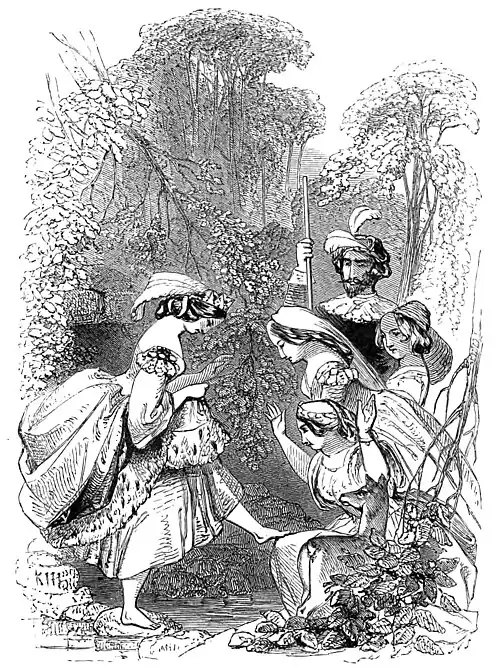
Page 96.
THE PRINCESS MAYBLOOM AT THE FOUNTAIN.
“Up rose Fairyfoot and Princess Maybloom, and went together till they found the bramble, and came to where its root grew, hard by the muddy-looking well, with banks of dark green moss in the deepest dell of the forest. Fairyfoot sat down to wash, but at that minute he heard a sound of music, and knew it was the fairies going to their dancing ground.
“‘If my feet grow large,’ said the boy to himself, ‘how shall I dance with them?’ So, rising quickly, he took the Princess Maybloom by the hand. The fawn followed them; the maids and the chamberlain followed it, and all followed the music through the forest. At last they came to the flowery green. Robin Goodfellow welcomed the company for Fairyfoot's sake, and gave every one a drink of the fairies’ wine. So they danced there from sunset till the grey morning, and nobody was tired; but before the lark sang, Robin Goodfellow took them all safe home, as he used to take Fairyfoot.
“There was great joy that day in the palace because Princess Maybloom’s feet were made small again. The king gave Fairyfoot all manner of fine clothes and rich jewels; and when they heard his wonderful story, he and the queen asked him to live with them and be their son. In process of time Fairyfoot and Princess Maybloom were married, and still live happily. When they go to visit at Stumpinghame, they always wash their feet in the Growing Well, lest the royal family might think them a disgrace, but when they come back, they make haste to the Fair Fountain; and the fairies and the nightingales are great friends to them, as well as the maids and the chamberlain, because they have told nobody about it, and there is peace and quiet yet in the grove of rose-trees.”
Here the voice out of the cushion ceased, and two that wore crowns of gold, and were clothed in cloth of silver, rose up, and said—
“That’s our story.”
“Mamma,” said Princess Greedalind, “if we could find out that Fair Fountain, and keep it all to ourselves!”
“Yes, my daughter, and the Growing Well to wash our money in,” replied Queen Wantall: but King Winwealth said—
“Excepting yesterday’s tale, and the two that went before it, I have not heard such a story since my brother Wisewit went from me, and was lost in the forest. Silverspurs, the fourth of my pages, go and bring this maiden a pearl necklace.”
Snowflower received the necklace accordingly, gave her thanks, made her courtesy, and went down on her grandmother’s chair to the servants’ hall. That night they gave her a down pillow, and next day she dined on a roast chicken. The feasting within and the clamour without went on as on the days before: King Winwealth fell into his accustomed low spirits after supper, and sent down a message for Snowflower, which was told her by the master-cook. So the little girl went up in her grandmother’s chair, with red shoes, the clocked hose, the white satin gown, and the pearl necklace on. All the company welcomed her with joyful looks, and no sooner had she made her courtesy, and laid down her head, saying—“Chair of my grandmother, tell me a story,” than the clear voice from under the cushion said—
“Listen to the story of Childe Charity.”
