Florida's Great Hurricane/Chapter 8
Like Rats in a Trap
THE EVERGLADES, some times designated in geographies as terra incognita, or unknown land, is a vast territory of extremely fertile country covering an area of 4,000 square miles (2,560,000 acres) south of Lake Okeechobee, which, next to Lake Michigan, is the largest body of fresh water wholly within the United States.
Some twenty years ago the State of Florida set machinery in motion to drain this region by cutting a number of canals from tide water into the lake. The problem of drainage was considered simple from an engineering viewpoint, since it is a well accepted principle that water runs down hill. The level of the lake was nearly 22 feet above sea level, and the original project was to lower the level four feet, this being deemed sufficient at the time to keep the lake from overflowing. This would have reduced the level to about 18 feet. Though drainage operations progressed slowly, being hampered by the lack of sufficient funds to push the work more rapidly, they attracted nation-wide attention. The superlative fertility of the
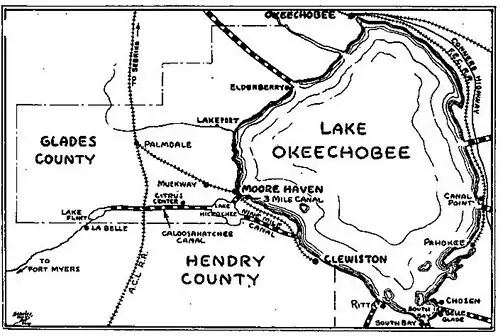
MAP SHOWING LOCATION OF MOORE HAVEN, THE EVERGLADES TOWN WHICH WAS SWEPT AWAY WHEN THE DIKE AROUND THE LAKE BROKE.

WHAT REMAINED OF MOORE HAVEN'S MAIN STREET AFTER THE STORM.
Many thousands of acres were reclaimed, and it followed naturally that the land bordering the southern shores of the lake were at once the most fertile and the first to be ready for cultivation. Here the elevation was highest and the rich muck was deepest. By looking at any recent map of Florida it may be seen that a number of towns have been settled on the southern and eastern shores of Lake Okeechobee, among them Canal Point, Pahokee, Chosen, Belle Glade, South Bay, Okeelanta, Ritta, Bare Beach, Clewiston, and Moore Haven. Each of these was a small but thriving agricultural community. The claim was made during the last trucking season that the deposits in the Bank of Pahokee were greater per capita to the population than those of any other bank in the country, the average being about $5,000 for every man, woman and child living in the village. This indicates the prosperity which rewarded the labor and hardihood of these pioneers when seasons were favorable and prices for winter vegetables were good. It also explains the attraction which had brought people to settle in this region from every part of the United States.
The drainage operations had progressed far enough to demonstrate the value of the land, but in spite of the run-off through the numerous canals which had been opened, it became clear that other works would be necessary to protect the inhabitants near the lake from overflow during the wet seasons, which last from June till October. In view of this discovery, a dike was built around the southern shores of the lake several years ago. This dike was neither very high nor very substantial and consisted only of a bank of the native muck. It was observed at Moore Haven twenty-four hours before the storm that the dike was not more than two feet above the lake level.
Moore Haven, the largest town in the Everglades, was almost totally destroyed in the hurricane of September 18. It was the seat 
FISHING BODIES OUT OF THE WATER IN MOORE HAVEN. MANY OF THEM WERE UNRECOGNIZABLE.
Warning of the hurricane was posted in the Moore Haven post office Friday, September 17, but no signal was hoisted and there were many who had no knowledge of it. At least nobody left the town, and it is assumed that such a warning, if it had been generally known, would have created consternation, because the town had been flooded several times, and it was well known that its situation was precarious because of the danger that threatened it in event of overflow.
Lake Okeechobee is about 37 miles long at its greatest length and about 35 miles wide at its greatest width. It covers an area of some 450,000 acres. In 1913 a survey of the lake was made by Isham Randolph, a noted engineer of Chicago, who had been employed by the Florida Board of Drainage Commissioners to investigate conditions in the Everglades and recommend a comprehensive plan for draining that region. Randolph reported, as others had before him, that the lowering of the lake was the key to the situation, and went into an exhaustive study of the subject in which he calculated the effect of wind upon its waters. He also pointed out other factors that should be

AFTER THE FLOOD AT MOORE HAVEN HAD PARTIALLY RECEDED.
It appears that those who directed the drainage operations paid little attention to the Randolph report though the sum of $40,000 was paid for it. The painstaking calculations Randolph made concerning the action of wind upon the expansive bosom of the lake, might as well have been lost. Indeed it was not necessary for any one familiar with the lake to have any knowledge of the Randolph report to know that a strong wind blowing across the lake for many hours from the north would cause the water to overflow at the south. In July of the current year a storm of much force caused an overflow. At that time water was four feet high in some of the houses, and much damage resulted.
The wind that caused the lake to flood Moore Haven September 18 was from the northeast, and the region southwest of the lake was deluged. Perhaps the consequences would not have been so destructive had the storm struck in daylight, but it came upon the unfortunate town like a thief in the night. At two o'clock of the morning of the 18th the fire whistle was sounded. There was a somewhat general response from the residents, and they began reinforcing the dike with sand bags, and raised it about two feet. Probably this was the worst thing that they could have done, because it had the effect of impounding the water, giving it increased force and volume when eventually the dike broke.
Again at three o'clock the fire whistle was sounded, and the number of frenzied workers at the dike was increased by many who had not responded to the first call. All night these valiant men labored. When grey dawn came they gave up hope. They were exhausted. The water continued to rise, and by 6 o'clock they saw the dike break at several points. Panic seized them, and they fled for their lives, but too late. Some escaped in automobiles, others climbed to places of safety, but hundreds were drowned like rats in a trap.
The Everglades News tells how one J. E. Chestnutt saved his wife and five children and himself by cutting a hole in the roof of his house after the rising water had forced them to seek the attic for safety. They crawled through the hole and from the room swam till they were able to catch hold of taut communication wires, where they clung desperately until the water receded. Others were lost in attempting to escape in a like manner.
Hal Leyshon, who visited the Moore Haven district for the Miami Daily News, reported the following heart rending story, which no doubt was typical of many others:
H. H. Howell, city marshal of Moore Haven, sat on a lounge in the Nan-Ces-O-Wee Hotel here (Sebring) and told me how his wife, with four children tied to her, all of them supported by inflated inner tubes, had floated for seven hours and how she had fought through, with rare presence of mind, to save two of the children.
"I was at work on the levee when it crumbled that morning at 9 o'clock," Howell related. "A six-foot wall of water came over and I tried to reach my little home not far from the edge of the levee. My wife had prepared for just such an emergency. She had tied an inflated inner tube about each of our four children and two about herself. Using a pair of silk stockings, she bound them all to her. When the wave came they floated out the front door.
"For an hour and a half they drifted west before the wind. Then the wind and current changed and they were carried down the bank of the canal. They floated another hour and then were swept through and over a barbed wire fence. The tube that supported my six-year-old boy, George, was punctured and he drowned, but my wife would not then cut him loose. After another hour the baby, little three-year-old Eleanor, died of strangulation. My wife couldn't keep the waves out of her face. And still they floated on. For two hours more my wife swam with the four children, two of them dead. Realizing that her strength was almost gone, she finally freed the two drowned children

WHY RAIL COMMUNICATION TO MOORE HAVEN WAS IMPOSSIBLE.

BURYING THE MOORE HAVEN DEAD IN TRENCHES WAS A SORROWFUL CEREMONY
"About 4 o'clock in the afternoon a current carried my wife to the home of a neighbor named Steers. She and 7-year-old Laverne, the only child remaining with her, were taken in and made as comfortable as possible. That night Oliver, who had floated to a high spot on one of the canal banks, waded back after the water had gone down and found his mother."
"Marshal Howell dabbed at his eyes. 'It's mighty hard to lose almost half of your little family, but I'm mighty proud of that wife of mine,' he concluded. Mrs. Howell, Laverne and Oliver were taken to LaBelle where they are staying with relatives. They are none the worse, physically, for their harrowing experience."
A few of the more substantial structures were standing after the storm, including the court house, school house, the Odd Fellows Hall, the Masonic building, the hotel and a few residences.
Relief expeditions were sent out from Tampa, Fort Myers, Orlando, Avon Park and Sebring. Red Cross established headquarters at Sebring where several hundred refugees were given shelter.
The number of dead was estimated by the editor of the Everglades News, who viewed the scene and had first hand communication with survivors, at 300, though he added that the total number of victims probably would never be known. The official count of those who perished was 150. Some of the bodies recovered were so decomposed that it was impossible to determine if they were black or white.
Such is the tragic story of Moore Haven. Frequent complaints had been made to the State Drainage Board that the locks should not be kept closed but it seems that no heed was given. The water released probably would have reduced the lake to a point where the disaster of September 18 might have been averted. The flood raised a commotion among the inhabitants of the lake towns with the result that a letter was sent to President Coolidge asking that the control of the lake level be placed under the War Department.
As a direct result of this activity following the storm, the Secretary of War directed the United States engineer who has supervision of this district, Lieut. Col. Mark L. Brooke, to make a survey of the Caloosahatchee River with a view to establishing flood control measures. It is another case of fastening the stable door after the horse has been stolen. Congressman Herbert L. Drane of the First Florida District, in which lies the affected territory, secured the passage of an act in February, 1925, authorizing such a survey, but there had been no action. The Fort Myers Chamber of Commerce is credited with taking the initiative which led up to the recent War Department order.
Senator Duncan U. Fletcher has announced that he will introduce a water control measure at the next session of Congress. Such widespread publicity followed the Florida storm the hope is now indulged that Congress will pass an act to serve the desired end.
Not only have Everglades residents been wrought up over conditions but the large land owners are now demanding a change in the plans for draining the region. They will urge that a board of expert drainage engineers be placed in charge of the Everglades enterprise with sufficient funds to do what is necessary to reclaim the territory and make it safe and fit to live in.
There is no question of the extreme fertility of the soil. It is said to be the richest agricultural area in the world-not excepting the famed valley of the Nile—and there is every reason to believe that such claims are well founded.
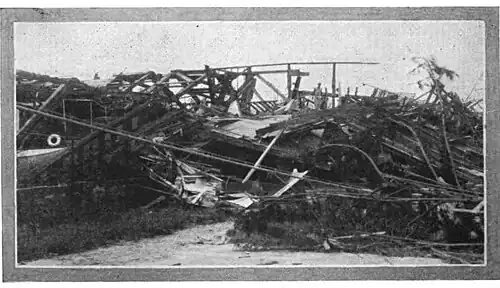
JUST A TANGLED MASS OF WRECKAGE.