Florida's Great Hurricane/Chapter 4
A View of the Storm-Swept District
THE exact hour we were rescued I do not know, but it was about 12 o'clock noon Saturday, and I brought coffee from our kitchen and eggs and other food, and soon the famished children and adults were fed. I had a great thirst and drank three cups of Mrs. Sutherland's excellent (dripped) coffee, but I could not eat. Fear or anxiety, whatever it was, had effectually checked hunger, and I had eaten nothing for twenty-four hours. While we were having coffee, the occupants of two other houses that had been wrecked came in. One was a former Rabbi who was sorely undone over his loss, but refused to break his fast, and though I was in the same boat physically, I marveled at the man's resolution, for I had no desire to eat and it was easy to see that he had. It was here that we heard of many narrow escapes, but as there were no fatalities in our immediate neighborhood it was some hours before the news of these began to come in.
At the first opportunity I walked all the way to town from Fortythird Street, N. W., and viewed the wreck and ruin present on every hand. There seemed to be few exceptions to the rule of destruction until I reached the older part of the downtown section which had been built some fifteen or twenty years before. When first I came to Miami (in 1909) I was struck and impressed with the generally low structure of houses, and inquired the reason, for I found many living in such who could afford more pretentious domiciles. I received the reply, (which seemed sufficient) that diminutive structures were favored because of hurricanes. Now, it was interesting to notice how many of these old time structures had passed through the storm unharmed when demolition was somewhat general. This was not true absolutely throughout the city, for nothing would have been left had it been so, but a citation of the damages in my own neighborhood is sufficient to demonstrate how general was the destruction. Our own house was unroofed, and the entrance was blocked by a pile of concrete blocks and coping that had been blown off. The awnings which had hung above the windows had been whipped into shreds and the metal frames upon which they were stretched had been broken and twisted beyond repair. The screening had been broken in and beaten full of holes, and the plastering had been rended into seams and seemed imminently likely to fall. Mr. Sutherland's 
CLOSE-UP OF MEYER-KISER BANK BUILDING. WHICH 1S BEING RECONSTRUCTED. INSURANCE WAS $900,000. THE REPORTED FIRST COST OF THE BUILDING WAS $3,000.000.
front porch screens were wrecked, but only recently his roof had been tarred and this, with its protected position saved his property. Some rather prided themselves upon the superior construction that exempted them, whereas, it was due in many cases to protected position, though this cannot be set down as invariable. It was so in the case of our own garage, which stood between our home and Mr. Sutherland's, for while the roof was taken off and several concrete blocks were dislodged it was otherwise unharmed, and the garage of our neighbor, down the street, that had no protection, was a complete and hopeless wreck.
My first trip to the down town section was quite the reverse of a triumphal entry. I had only recently undergone a surgical operation and my locomotion was considerably impeded by the pain which I still felt. This of itself was enough to discourage one but when I viewed the wreckage on every side my heart sank, and I wondered at the hardihood of those energetic and strong hearted persons whom I saw clearing away the debris and making the way for a new start in life. This was particularly sad when I reflected that some thus engaged were fully sixty years of age, and more. Yet, it gave me courage, for I lack much yet of being of that age, and though I felt depressed I could not fail to draw a lesson in optimism from those who were going ahead so bravely to recoup their fortunes.
As I passed through Buena Vista it was sorrowful to see the damage that had been done there. Moore's handsome furniture store had been badly dealt with, the entire top story had been taken off of Shackelford's garage, the Biltmore theatre was in ruins and among the most ghastly wrecks was the home of our dear friend, Mrs. Sarah R. W. Palmer. I was to learn later that their escape from personal injury had been miraculous. But such instances were too numerous to recount. One illustration is sufficient to show how near to death many were and yet escaped. In the home of one of my neighbors, R. D. Stephens, two concrete blocks fell through the roof upon a bed, where lay Mr. and Mrs. Alex Helgren and their two-year-old daughter, Dorothy; a block rested at the head and one at the feet of the child with not enough space between blocks and child to place one's hand, and yet not one of the occupants was hurt, not even scratched.
Down town I met Morris Singleton, son of the poet, Stephen Cochran Singleton, who told me that his brother, Bert, and wife were out in a launch somewhere among the Keys, and he was starting a search for them. Morris visibly was worried, which was natural, for we knew no one could have weathered the storm in a launch. It turned 
IMAGINE THE WORK AND COST OF RECONSTRUCTING LIGHT AND POWER SYSTEMS FROM SUCH CONDITIONS.
out, however, that Bert had a barometer with him and knew how to read it, and when he saw the mercury dropping he had the prudence to seek shelter. He and his party were saved at Cocolobo Cay, but their parents spent an anxious night and day while waiting for news of them.
I had it in mind to send telegrams to our relatives, whom I knew would be uneasy concerning our welfare, but upon arriving at the telegraph offices I received information that all wires were down. The Postal offices were closed, and the Western Union was accepting messages to be sent whenever service was resumed. I declined to file any message and went to my office, and wrote a letter to my mother, which reached her about as quickly as a telegram would have under the circumstances.
I didn't expect to find much left at the office, but in this I was agreeably surprised. I found that papers had been blown about and books had been water-soaked, and the furniture had been considerably damaged, also the plate glass panels had been broken, but otherwise the rooms were in fairly good condition. When I looked over the down town district and observed the damage to some of the best buildings it seemed to me that our own offices had escaped in a most remarkable manner.
The Meyer-Kiser building, 18 stories high, was probably the most notable wreck. On the side facing the bay, from which the most powerful wind attacks had come, the building was laid open in many places, the outer walls entirely gone, and the inside bared. The upper stories had the appearance of careening, and this seemed to be more accentuated as the days passed, and city authorities condemned it. The entire block between First and Second Avenues on Northeast First Street was roped off and for many days no one was permitted to enter the danger zone. The Roosevelt Hotel, being built at the corner of Fourteenth Street and Northeast Second Avenue, was another sky scraper to suffer great damage. It was rumored that this structure had been condemned prior to the hurricane, but whether this is true or not does not appear to be of any great moment at this time, because clearly it was condemnable after the hurricane. The walls were crushed in, the windows broken, the scaffolding badly damaged and in numerous other particulars it presented a dilapidated appearance.
It did not seem, as I walked down Flagler Street, that a solid plate glass window had been left in the town. I thought of those
fellows who sell plate glass and tornado insurance and wondered how 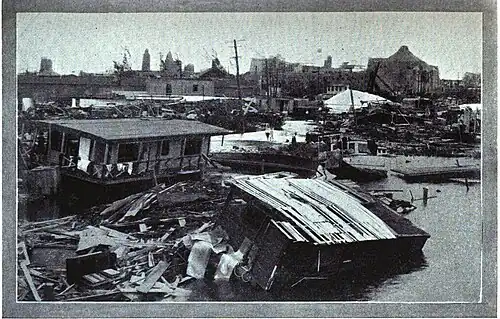
VIEW OF THE MIAMI RIVER AFTER THE STORM―CLEARING THE STREAM WAS A GARGANTUAN TASK.
many owners had been wise enough to protect themselves. Figures which have been published later reveal the percentage to have been comparatively small.
As I passed through the business district I was impressed with the destructive force of the storm as never before, because here were solid walls of masonry buttressed against each other, which had not withstood the ravages of wind and rain. Nearly every store front had been crushed in and the stocks ruined or damaged. The electric sign on the First National Bank Building had been twisted out of shape, as if it had been a toy, and the great electric signs of the Olympia theatre and the Cromer & Cassel department store had been torn off and demolished. The wisdom of permitting the erection of such signs is seriously questioned. In times of such stress and suffering it seems quite needless, if not absurd, that human life should be endangered by such ornate appendages.
Soon after reaching the down town section I met Floyd Williams and his brother, Orris. They were looking for a place where they might get coffee. I had been so absorbed in my sight seeing that I had not been conscious of hunger and when the Williams brothers suggested coffee it occurred to me that there was hardly a place where it might be had. Drinking water was hard to get and consequently few places were serving coffee. Neither was there water for flushing toilets. These inconveniences existed for several days, due to crippled electric power plant and lines.
Upon the whole, however, I was surprised at the strength with which the down town section had stood up. The McAllister, the Alcazar, the Everglades and other large hotels on the Bayfront were intact with the exception of crushed in windows and other minor damages. I noticed that the weather vanes on the Everglades and Daily News towers were bent in the direction of the northwest, which was the case with every pine and palmetto tree and with every other stalk and bit of living foliage which had spine enough left to bend in any direction whatever. Bay Front park was a sight. At least a dozen barges and large vessels had been cast up by the waters and were stranded hundreds of yards from the bay.
I was surprised at the excellent manner in which the arcade shops passed through the storm. Those near the street entrances were rather badly damaged, but those inside were not hurt to any extent and their stocks apparently were not damaged.
I could not fail to observe that the Roman Catholic Church and the school building immediately to the east of it were unharmed. Either this shows that the Catholics are in high favor with the fates or they know how to choose their contractors. It is in order to remark also that Frank T. Budge's hardware store, which has stood the storms of many summers, also was solid as a rock. Indeed, there were many of the larger buildings that suffered little damage. Burdine's department store, which seemed intact from the north, was battered in from the south and many days following the storm there were sales of damaged goods at cheap prices. This was common all over town.
By little and little information concerning the damage at Coral Gables, Hialeah, Hollywood, Dania, Fort Lauderdale, Pompano and West Palm Beach floated in. Hollywood and Fort Lauderdale, with Dania in between, seemed to have felt the full force of the storm, though the Weather Bureau officially located its center over Miami. It would be difficult to imagine more frightful scenes of wreckage than those in the Hollywood-Fort Lauderdale area. Hollywood, seventeen miles north of Miami, had sprung into being like magic under the genius of Joseph W. Young, but it was mowed down like grass before a scythe, and so was Fort Lauderdale. In all of the subdivisions that had been sold and settled during the boom period, Coral Gables seemed to have been the least damaged. The total loss there was estimated at $1,500,000, consisting largely of the injury to ornamental trees and foliage plants.
West Palm Beach was north of the storm track, but there was loss in the breakage of glass and also to the Ocean Boulevard, but the damage there was reported less than had occurred in the July storm.

TOURIST CAMPS WERE RAZED LIKE THIS

AN OVERTURNED HOUSEBOAT, BUT THE OCCUPANTS ARE CAMPING ABOUT.