Florida's Great Hurricane/Chapter 16
Historic Hurricanes
Numerous hurricanes have visited the southern and southeastern coasts of the United States during the past few years, and nearly every South Atlantic and Gulf port has suffered from one or more, Galveston, New Orleans, Mobile, Pensacola and Tampa being the principal sufferers on the Gulf, while Miami and Key West have been chief among the Atlantic ports to suffer from such visitations. The following summary was compiled from records of the United States Weather Bureau:
SEPTEMBER 8, 1900
Measured by losses of life and property and the depression of the barometer at Galveston, Texas, the hurricane of September 8, 1900, was the severest storm to that time ever to occur in the United States. On Galveston Island upward of 6,000 human beings were drowned or killed by falling buildings or flying debris, and property to the estimated value of $30,000,000 was destroyed. Enormous losses of life and property were also reported in the inland coast country. The barometer reached a minimum of 28.48 inches at Galveston and was lower by .10 inch than any reading previously made at a station of of the Weather Bureau. The greatest recorded wind velocity for a five-minute period, was 84 miles an hour at 6:15 p. m., and two miles were registered at a rate of 100 miles. At that time the anemometer was blown away. It was estimated that a velocity of at least 120 miles was attained between 6:15 and 8 p. m. Excepting Mount Washington and Pikes Peak, the record for high winds in the United States was established at Cape Lookout, N. C., August 18, 1879, where a velocity of 138 miles an hour was registered before the anemometer was blown away and the wind reached an estimated velocity of 165 miles an hour. During the tornado of May 27, 1896, at St. Louis, Mo., an extreme velocity of 120 miles an hour was recorded. The devastation at Galveston was caused principally by a storm wave, which swept in from the Gulf in advance of the hurricane's vortex. This wave, four feet in depth, struck the already submerged island, and destroyed the south, east and west portions of the city for a distance of two to five blocks inland. In other parts of the_city many houses were destroyed, and none escaped injury.
OCTOBER 18, 1906
Origin over eastern Caribbean Sea. On the morning of the 18th the storm had reached near and to the eastward of Key West, where at 3 a. m. a minimum barometric reading of 29.30 inches was registered. It moved eastward to a point opposite the South Carolina coast, the center recurved to the westward and was then forced southward over the Florida peninsula by an area of high barometer that covered the North Atlantic coast districts. The lowest barometer reading in Florida was at Sand Key, 29.25 inches, and wind velocities of 75 miles an hour were recorded at that station. The highest velocity at Key West was 54 miles an hour, at 7:20 a. m. of the 18th. The revenue cutter Fessenden at Key West was the only large vessel in that port to be damaged. The quarter boats of the East Coast Extension were carried out to sea and many lives were lost. Forty-nine men were picked up by the Austrian steamer Jenny and returned to Key West, 24 were landed at Savannah, Ga., and a number were picked up by other steamers. The number of lives lost on the Extension was placed at 135 and the property damage there at $200,000. Many orange groves and pineapple plantations were destroyed, and six lives were reported lost on farms. An old river packet, the St. Lucie, with 80 people on board was swamped near Elliott's Key and 23 lost. Thus the reported loss of life in that hurricane was 164. The property loss at Miami was estimated at $ 160,000. No estimate of the general losses at Key West and through the hurricane district was given. It is said that Flagler seriously considered the abandonment of the overseas railroad enterprise after the storm, and that work was resumed upon it through the initiative and courage of his general manager, the late James R. Parrott, which Mr. Flagler later approved and commended.
OCTOBER 11, 1909
Barometer at Key West fell to 28.52 inches at 11:40 a. m. At Sand Key the minimum was 28.36 inches. At that time this was believed to be the lowest atmospheric pressure ever observed in the United States, the lowest previous record being 28.48 inches during the Galveston hurricane of September 8, 1900. At Key West 6.13 inches of rain fell in two hours and fifteen minutes. The maximum wind velocity was 83 miles an hour from the northeast at 10:05 a. m. with an extreme velocity of 94 miles for one minute. At 11:40 a. m. the wind suddenly shifted from northeast to northwest and the barometer began to rise rapidly. At Miami the maximum velocity of the wind (about 60 miles) and the lowest pressure (29.22 inches) occurred at 5:30 p. m. In extreme southern Florida the rainfall at several places exceeded 8 to 10 inches in 24 hours. Damage at Key West was estimated at $1,000,000. About 400 buildings were destroyed. The tide rose into the streets in the northern part of the city and the lifting power of the water combined with the fury of the wind caused many buildings to collapse or moved them from their foundations into the streets or vacant lots. A portion of a large concrete cigar factory was blown down. More than 300 boats were totally destroyed. At Miami the damage was much less, but several buildings were unroofed and flooded. The New March Villa, a hotel nearly completed, later known as the Plaza, was razed to the ground. Thousands of fruit and shade trees were blown down. The Key West Extension of the Florida East Coast Railway suffered considerable loss, portions of the track, trestles and floating equipment being carried away.
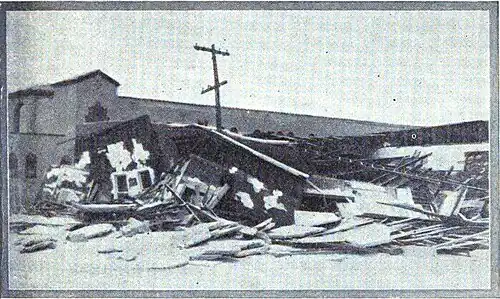
WHAT WAS LEFT OF CASINO AT HOLLYWOOD.
OCTOBER 14, 1910
Barometer fell to 29.95 inches at 5 p. m. as recorded at Sand Key Much rain fell the night of the 13th and the wind velocity steadily increased. At 3:30 p. m. the waves began to wash over the island, carrying the sand from under the light house and shifting to a position farther north. The barometer remained at about 29.60 inches till 8 p. m. on the 16th. High winds and heavy rains occurred at Key West on the 14th but at that point also the barometer began to rise on the 16th. This was a storm of much severity but without any loss of life reported. At Miami persons who happened to be caught out in the storm were forced to take shelter wherever they could and there spend the night. There was considerable damage of minor consequence―roofs were taken off and trees were blown down, but individual losses were not great. No estimate of the damages appears of record. The full force of the storm was felt on the keys, which are populated by only a few people―mostly fishermen.
OCTOBER 17, 1910
The barometer was lowest at Sand Key at 1:50 p. m., reading 28.40 inches. Estimated velocity of the wind 125 miles an hour. The boat house went to pieces and was washed into the sea. After then storm the island was covered with water about two feet deep akin its shallowest point, and about 5 feet deep under the light house. At Key West the wind velocity was 90 miles an hour with gusts reaching 110 miles. The storm lasted 30 hours. The tide and sea swell were unusually high. The United States army dock and marine hospital were swept away. The damage at Key West was estimated at $250,000. The destruction was mostly limited to marine property and to houses along the beach. The French line steamship Louisiane went ashore at Sombrero Light, but 600 passengers were safely removed by the revenue cutter Forward. A number of small schooners were wrecked. By midnight the barometer at Tampa had fallen to 29.30 inches, the wind velocity was 60 miles an hour. Forty vessels were grounded in the Hillsboro River. The Citrus Exchange estimated the damage to the crop at ten per cent of the total. Seven men were drowned in the wrecking of four fishing schooners at Punta Gorda; a negro was drowned in attempting to cross the Peacefar River near Nocatee, and a one-armed man and baby were drowned in the vicinity of Thousand Islands. Dwellings and property were destroyed at Chokoloskee, and aid was required to feed and clothe the sufferers. The keys and islands south of Cape Romano were swept by great waves from the Gulf that reached far distances inland. Survivors could escape only by climbing trees. At Jupiter the lowest pressure was 29.21 inches at 3 a. m. of the 18th. A man was killed at Lemon City by falling timber. The American schooner Harry T. Hayward, from Baltimore to Knights Key, was blown ashore at Boca Raton. Three seamen were drowned; the rest of the crew were saved after clinging to the rigging for 12 hours. The vessel and cargo valued at $110,000 were lost.
AUGUST 16-17, 1915
A great storm swept over the coasts of Texas and Louisiana. In Louisiana no loss of life was reported and the property loss in that state did not exceed $1,000,000. The greatest loss of life and property was at Galveston and thence northwest and westward for a considerable distance. The total loss of life was 275, to which the city of Galveston contributed 11; Galveston Island 42; and the dredges Houston and San Bernard and the tug Helen Henderson 69. The number of missing reported was 102. Twenty blocks of buildings were destroyed in Galveston and this was after the seawall had been built, though there can be no doubt that the seawall saved the city from destruction, for this storm is recorded by the Weather Bureau in some respects a storm of greater force than that of 1900 which visited Galveston with such staggering loss of life and property. Total losses were estimated at $50,000,000 to which Galveston gave about $6,000,000. The damage at Houston was $1,000,000. Other losses were spread over a wide territory. Fully half the crops of Texas were destroyed, eleven large vessels and hundreds of smaller ones were lost and there was much damage to railroad and telegraph property. The barometer at Galveston was 28.63 inches, .15 of an inch higher than that in the storm of 1900, which was 28.48 inches. The lowest barometer reading at Houston was 28.20 inches, .28 inch lower than the lowest barometer reported at Galveston in 1900. At Galveston the wind velocity was 52 miles an hour from the northeast, and at Houston the wind was 80 miles an hour from the southeast. The greater damage in both Galveston storms was due to high water.
SEPTEMBER 29, 1915
This is known as the New Orleans storm. The barometer reached the lowest point ever observed at an office of the U. S. Weather Bureau prior to the recent (September 18, 1926) hurricane. The reading was 28.11 inches at 5:50 a. m. This hurricane was equal to and possibly exceeded the second Galveston storm in intensity. The maximum velocity of the wind was 130 miles. For one mile it blew at the rate of 140 miles an hour. The number of lives lost was 275, and the property loss was $13,000,000, to which New Orleans contributed $5,000,000; shipping interests $ 1,750,000; in the country outside of New Orleans, buildings, railroads, small craft, crops and communication lines about $6,500,000. The damage to municipal property in New Orleans was estimated at $500,000. This amount recently was announced by the City Manager of Miami as approximately the dam

A TUMBLED DOWN SHACK AT MIAMI BEACH.
SEPTEMBER 9 AND 10, 1919
Barometer at Key West 28.81 inches. The anemometer caps were blown away at 7:30 p.m., on the 9th in gusts ranging between 75 and 80 miles, and at 3:16 the following morning the collector of the recording raingage was blown off. Winds of gale force lasted from 7 a. m. of the 9th to about 9:30 p.m. of the 10th. The apex of the hurricane was reached at midnight of the 9th. Damage estimated at $2,000,000. Three lives were lost by drowning. Rainfall 13.13 inches. The lowest barometer recorded was at Sand Key, 28.30 inches, with wind velocity 84 miles.
SEPTEMBER 10, 1919
The severe tropical disturbance which passed through the Florida Straits and several days later caused such an appalling loss of life and destruction of property at Corpus Christi, Texas, was central during the afternoon of September 10 over the extreme southeastern Gulf of Mexico. The high winds that had prevailed over extreme southern Florida in connection with the tropical storm had diminished by the morning of the 10th, but a moderate gale was still blowing and the wind continued at this force at Goulds, a small town 20 miles southwest of Miami, until just before the occurrence of the tornado, when there was a lull for probably 15 minutes. The tornado developed either over the ocean or Biscayne Bay, and its original form undoubtedly was that of a waterspout. It moved in a west, northwest direction, directly with the strong southeast wind that prevailed at the time on the southeast coast of Florida. After leaving the Bay it crossed a three-mile stretch of marsh land and entered a pine wood immediately east of Goulds, where the path rapidly widened. At Goulds the path was about 600 feet in width. After passing over Goulds the storm moved over a cleared area of about one-half mile in extent and entered another pine wood. The path here was 100 feet or less. Nineteen buildings were damaged and six were demolished. There were no deaths but five persons were injured from falling debris. Occupants of buildings that were demolished heard the storm approaching and saved themselves by rushing out and throwing themselves upon the ground. Hundreds of trees were uprooted and blown down, and many of them were wrapped around with large pieces of tin and sheet iron roofing.
SEPTEMBER 13, 1919
At Corpus Christi, Texas, 284 lives were lost in the city and district, and $20,000,000 of property damage was reported. Twenty-three blocks of homes were destroyed by a tidal wave which reached a depth of 15 feet in places. The number of missing was reported at 174. The lowest barometer pressure was 28.65 inches at Corpus Christi at 3 p. m. September 14; 29.73 at Brownsville, Texas, at 1 p. m. September 14, and 29.65 inches at Galveston, Texas. at 12:30 a. m. September 14. The lowest barometer was that of the steamship Fred W. Wells, 27.36 inches, which was lower than that in the recent storm at Miami, but the Weather Bureau explains that barometer readings in hurricane weather always are lower over water than over land. The low barometer of 27.61 inches at Miami is the lowest ever recorded by a Weather Bureau office in the United States. Lower barometric pressure has been recorded in the Eastern Hemisphere; at Vohemere, on the coastal lowland of Northeastern Madagascar, on February 3, 1899, 24.76 inches, probably established the lowest pressure ever observed in the world.
APRIL 5, 1925
While this narrative has to do especially with hurricanes, and all other storms to which reference has been made were disturbances of that character, except the tornado at Goulds, it is not out of order to include mention of a disastrous tornado that visited the Miami district on Sunday, April 5, 1925, because of its unusual intensity and for the very circumstance that it was different from the usual type of storm which more commonly visits this part of the country. The storm developed over the Everglades near Hialeah, four miles northwest of Miami. The funnel cloud was first observed by golf players on the municipal golf links at Hialeah at 1 p. m. The tornado developed immediately following the union of two dense cloud masses. After the tornado had been in progress about 20 minutes it stopped its progressive movement for five minutes. Its location at this time was over the White Belt dairy near Lemon City. One person was killed at the dairy, one was fatally injured and 20 others were hurt. The loss at the dairy from the destruction of buildings, motor trucks, automobiles and livestock was estimated at $100,000. The funnel cloud rose and descended twice during the stationary period, causing many to think that a second tornado had followed closely behind the first. After the storm resumed its northeastward course, it moved over several suburban communities, causing other deaths and damage. The total number killed was five, the injured 35, and the damage $300,000.
OCTOBER 20, 1926
The people of Miami were thrown into a flurry of excitement by receiving warnings of a storm approaching by way of Havana and Key West from the Caribbean Sea. Many stores were closed and people began to make their several ways home. Thousands remained down town. The Red Cross reported that it had cared for 20,000. No doubt the nervousness was due to the recent devastating hurricane of September 18. Very little damage was done at Miami, though the wind attained a velocity of 50 miles, estimated at 70 miles at Miami Beach. Losses at Havana were estimated at 650 killed and $100,000,000 property damage. Both estimates probably were exaggerated. No official report is available at the time this is written.

THE MCALLISTER HOTEL WAS NOT DAMAGED TO ANY GREAT EXTENT, BUT THE STORM LEFT SUNDRY CRAFT BEACHED ABOUT IT.