Florida's Great Hurricane/Chapter 13
How the News Was Given The World
AN UNUSUAL opportunity for the exercise of courage and ability under trying conditions came to newspaper representatives upon the wings of the hurricane. The first to get a story out was Alfred P. Reck, United Press correspondent at Miami. This he managed with the assistance of the staff of the Tropical Radio station at Hialeah. In order to transmit the message it was necessary to rig up a temporary sending apparatus, because the storm had wrecked the radio plant and dismantled the towers. Communication was established with the Ward line steamer Siboney off the Florida coast, and the message was relayed to East Hampton, L. I., and then telephoned to New York. The message read as follows:
"Miami, Florida Via SS Siboney and East Hampton, L. I. N. Y., N. F. T. 18th (Saturday) , United Press, New York or Washington, D. C.—Miami in ruins after worst hurricane in history of country. Seventy-five known dead, property damage one hundred million dollars. More than two thousand injured. Help needed badly. Hurricane hit first about two o'clock Saturday from northwest (?) then changed and blew from the south until three o'clock in afternoon. Barge with thirty-five on board sunk in harbor. Huge freighter driven high and dry in Royal Palm Park. Huge twenty-story MeyerKiser bank building wrecked. Miami Tribune wrecked. City docks completely destroyed. (?) All boats in harbor sunk, including Nohab formerly owned by ex-German kaiser. Food, medical supplies and troops needed. (Signed) RECK. "
(Author's note—The interrogation points indicate inaccuracies. The wind was from the northeast. The Meyer-Kiser building is 18 stories, and the city docks were not destroyed, though warehouses on them were.)
This message was received in New York at 1:45 Sunday morning which enabled Sunday papers to carry the news. Considering everything it was a remarkably correct story. After sending his radio message the correspondent went to West Palm Beach, accompanied by four assistants, who carried axes, which they truly anticipated would be needed in cutting trees and the obstructions out of the road to permit their car to pass. They arrived at destination Sunday afternoon, and from West Palm Beach Mr. Reck telephoned a more extended account of the disaster to the Atlanta office of the United Press.
Not far behind its competitor, the Associated Press received news of the storm from its Miami correspondent, Reginald P. Mitchell, who is only a youngster, 24 years old. Mr. Mitchell had experienced good training, however, having worked for the Savannah Morning News and Nashville Banner. He is a graduate of Vanderbilt University, and did newspaper work between semesters to aid in getting through college. That of itself shows pluck, and the ingenuity and courage which he brought to bear in making the difficult journey to West Palm Beach from Miami in order to file his first account of the storm is additional evidence of his quality. He was accompanied by Reese Amis, telegraph editor of the Miami Daily News. They began their journey Saturday afternoon (the day of the storm) in a delivery truck. A short distance south of Fort Lauderdale their vehicle mired and they were forced to abandon it and walk to Fort Lauderdale, where they spent the night. The next morning they procured an automobile and reached West Palm Beach at 11:30, where they transmitted their stories, Amis sending a special to the New York Times. The Associated Press sent staff men, R. S. Pickens and M. B. Alexander, from Atlanta by airplane to the storm area. They started from Atlanta Sunday afternoon. Their plane was piloted by Beeler Blevins of Candler Field, stopping at Tifton, Ga., and Palatka, Florida, for refueling. They reached Miami Monday in time to send a story back that day.
There was great rivalry among the picture concerns to get photographs of storm damage. Pacific and Atlantic Photos are credited with having had five airplanes working at the task, and they also claim credit for delivering the first photographs in New York, September 21, three days after the storm. Rival concerns were only a few hours later.
The Chicago Herald and Examiner, Hearst paper, sent a special relief train to Miami, loaded with a hundred persons, doctors and nurses, under the direction of Dr. Herman N. Bundesen, city health commissioner of Chicago. They brought supplies to sustain their party for ten days, and a large amount of emergency medical materials and milk. The Herald-Examiner also contributed $10,000 to the relief fund. The Chicago Daily News used its radio for the benefit of storm sufferers, and raised $15,000 the first evening.
The Editor and Publisher, of New York, in its issue of September 25 carried full and detailed accounts of how the news was carried, and the part that newspapers and newspaper workers had in spreading the news and assisting the work of relief.
Miami newspapers achieved notable things during the days following the storm. It was impossible to issue papers from their own plants for the lack of electric power, but the Miami Daily News never missed an issue, printing a bulletin upon a job press Saturday, in which brief storm news was given, along with the announcement of its contribution of $5,000 for relief work. The News must have the credit of opening the relief fund. The Miami Herald issued its paper from the press of the Palm Beach Post and the Miami Tribune was printed from its sister press of the Palm Beach Times, until power service was resumed in Miami which was only a few days, so far as concerned newspapers and certain downtown sections. Many weeks will pass, however, before service is resumed throughout the city. The power company has done remarkable work in reconstructing its prostrate poles and lines, and making repairs to its plant. The loss to this company alone must run into millions.
The Miami Post building which had been completed only a short time before the hurricane, was the most thorough wreck that came under the observation of this writer. It crumpled completely, and as the machinery in it was practically new the loss was heavy. the Post lost no time in reconstructing a shelter for its plant, however, and again is at home to its friends on the same spot.
The printing plant at Miami Beach which publishes Miami Life and the Miami Beach Beacon, suffered severe damage, but Life didn't miss an issue, though its storm edition was only a handbill. Alton Little, associated with Editor Kent Watson, of the Beacon, was one of the first victims of the storm. He was killed by a falling beam in the Wofford Hotel and Watson also was hurt, though not seriously.
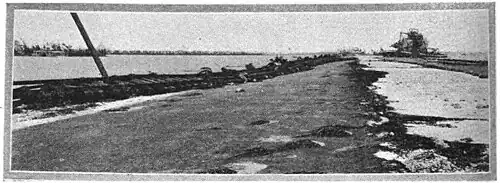
VIEW OF THE COUNTY CAUSEWAY—OBSERVE THE STREET CAR TRACKS WHICH FORMERLY WERE IN THE CENTER.