Florida's Great Hurricane/Chapter 1
The Great Hurricane
WHEN first I thought of writing a story of the Great Hurricane, which left a wide path of destruction across the Florida peninsula the morning of Saturday, September 18th, 1926, it seemed that such a book might have a large sale, provided it could be published upon the heel of the storm, but the obstacles in the way of doing this were so obvious that I did not entertain the idea.
In the first place it was impossible to collect data sufficiently complete to make such a story valuable as a permanent record, and I could not bring myself to view the enterprise in such a mercenary light as to publish a hurriedly written account.
I do not wish it to be inferred from this that I am setting up any claim to absolute accuracy or completeness for the story herewith presented. Even as I write, two weeks after the disaster, I am conscious that there is much of interest, no doubt, that has not come to light. The Citizens' Relief Committee, which was organized immediately following the storm, has turned affairs over to the Red Cross, and that organization itself has terminated what is termed "bulk relief," and all requisitions for individual relief are now being made in regular form. So the Florida storm has passed definitely into history, though Red Cross probably will not complete its work for several months. More space is being given at this time in the newspapers to the World Series than to the hurricane, and yet, so far as I know, no comprehensive narrative has been published.
Newspapers and magazines hardly could undertake such a task, though many writers performed creditable and courageous service during and after the storm. They deserve the highest praise for their daring and painstaking labor. Yet withal, the manner in which their accounts were published caused them to be fragmentary, hence there is a hiatus to be filled if the Great Hurricane is to have its proper place in history as one of the most destructive attacks ever visited by angry elements upon the lives and works of men.
I do not hesitate to say that estimates of damage probably have been the veriest guess work. It is likely, also, that the full number of those whose lives were lost never will be accurately known. The best that can be done under the circumstances is to accept such re ports as are available. The agencies for gathering information could not be, in the very nature of things, thoroughly efficient. It is necessary to cite only one instance in proof of this opinion. Moore Haven was a town of about 1200 persons. The exact population was not known, and it is necessary to rely upon speculation to arrive at an estimate of the number lost.
The Everglades News, edited by Howard Sharp, the most painstaking journalist that ever I knew, states that at least 300, probably more, lives at Moore Haven were taken by the storm. The official report accounts for only 150.
It is certain that the population of that great territory bordering the southern shores of Lake Okeechobee was not definitely known though it is placed doubtfully at several thousand. "Several" is a very nebulous word. Generally it is accepted to mean more than two, which also is indefinite. So far as reports show the greatest loss of life was at Moore Haven, but there was no loss of life north or east of the lake. Many persons scattered through a broad area south of the lake lived in the veriest shacks that could not have withstood a storm of such violence, and it is easy to imagine that scores might have been killed without any record being made of their deaths. The hazards that persons take who live in such sparsely settled regions are emphasized, if not magnified, by such occurrences. It was difficult to reach or get out of some of the centers that were known to have been severely damaged, such as Moore Haven and Miami. The first intelligent accounts of the damage at Miami reached the outside world Saturday night and the manner in which the news was carried has been made the subject of a heroic story, so there is no cause to wonder if many in small communities and isolated places perished where they were, or while seeking the shelter and succor that their more substantially housed neighbors might have given. I have no doubt that the future will reveal that many died thus, and it is possible that there were others, self-effacing beings, intent only upon making a living in some remote place, without friends or relatives, who also were victims of the storm. Only slight mention has been made of those who were lost at sea and in the turbulent waters of Florida's great lake. In spite of the admirable service of the Weather Bureau, there were those who received no warning and had no means of being advised of the approaching storm. There were probably hundreds of fishermen who farmed the waters of Lake Okeechobee and hundreds of others who sought the harvest of the sea in small boats, who had no warning. As a rule such persons do not attract much attention in a community. They lead hermit lives and little if any notice is taken of their comings and goings. How many of these went down may never be known.
I believe the Florida hurricane will be ranked among the most frightful of natural calamities. For this reason the story appears to be of sufficient importance to have a permanent place in public and private libraries all over the land. If it is given such a measure of reward and appreciation, I shall be satisfied that I undertook the labor, though it was performed under difficulties.
These words are written by candle light in the living room of my residence which was riddled by the storm. The roof was taken off, every awning was shattered and shredded, the screens were crushed in, the concrete coping was blown off in chunks and blocked the doorways, the ceiling and the walls were ruined, the whole house was flooded and we were left without shelter. At this time my wife and six children are away, having accepted the hospitality of relatives until necessary repairs can be made. I make mention of these things because I am not writing from hearsay or casual observation. We were in the midst of the storm, and though I had witnessed, or experienced, other hurricanes, I assert unreservedly that no storm of such fierce intensity ever has visited this region, and I believe it well within the realm of verity to say that never before has this country experienced any disturbance of a more terrifying character. This opinion is substantiated by Weather Bureau records.
I have made particular mention of Moore Haven because the mortality was greater there than anywhere and the loss of human life is more to be mourned and considered than property damage.
Miami was the greatest sufferer in property loss, but the number of dead from the storm in Miami was 115; not inconsiderable nor inconsequential, and not to be passed over without sorrow, but, comparatively speaking, Moore Haven's loss was nearly two hundred times greater. The sternest reproach to come out of the storm is probably that the demolition of Moore Haven might have been averted, for it was destroyed by flood waters from Lake Okeechobee rather than by force of the wind. Of this more will appear in the following pages.
THE AUTHOR.
Miami, Florida, October 5, 1926.
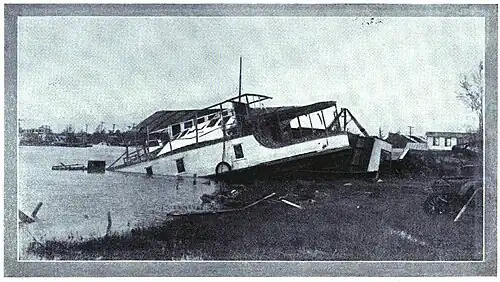
SCENES LIKE THIS ALONG THE WATERFRONT WERE THE RULE RATHER THAN THE EXCEPTION.