Familiar Indian Flowers: with Coloured Plates/Thunbergia Laurifolia
THUNBERGIA LAURIFOLIA.
NATURAL ORDER, ACANTHACEÆ
THERE are numerous plants of this order in our Indian gardens.
They have all lovely, showy flowers, and deserve a conspicuous place in every parterre.
The mode of treatment is much the same for all the varieties, that being, according to Ferminger, "frequent renewal, transplantation to fresh soil every fall or so, and close cutting in when the flowering season is over.”
All the varieties of Thunbergia are essentially climbers, and are very luxuriant and dense in their growth, sometimes covering "the loftiest trees with a curtain of foliage so dense as when seen from a distance to present the appearance of some ivy-clad ruin.”
The plant before us is a native of Burmah, but is now quite acclimatised to this country.
The white variety is very common, and may be found in hedges in an uncultivated state. None of the varieties of this plant have any scent.
The capsules of the seeds are all of a remarkable beak-like shape; the seeds germinate quickly.
The soft lavender tint of these flowers is their great beauty, the lower lip being marked with a darker shade; they are very short-lived, and fade immediately on being plucked.
"Thunbergia Laurifolia” is too rampant to be placed anywhere but in a garden, but the buff-coloured variety with a dark puce centre often forms a pretty and effective decoration to the verandah, when planted in a small tub with a bamboo circular trellis for it to twine amongst.
If the seed is planted at the beginning of the rains the young plants will blossom well that year, though in a cultivated state it can be induced to blossom all the year round. 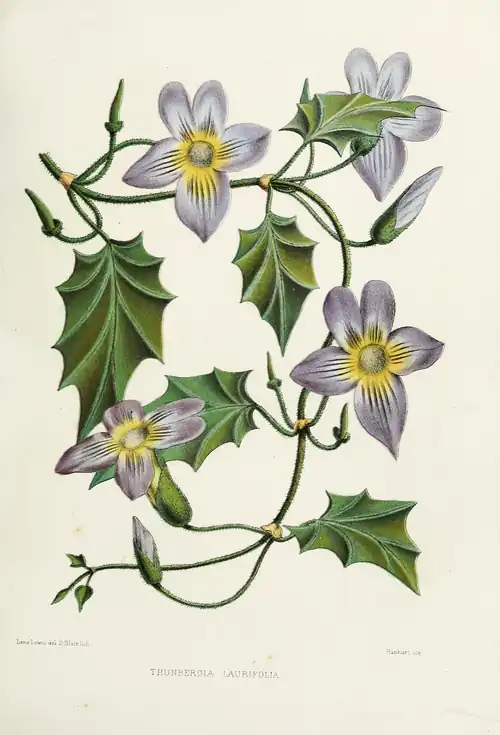
THUNBERGIA LAURIFOLIA.