Familiar Indian Flowers: with Coloured Plates/Thevetia Nereifolia
THEVETIA NEREIFOLIA.
NATURAL ORDER, APOCYNACEÆ.
THE Hindustani name for this flower is "Zurd Kurnel,” which probably originated in the strong resemblance between its foliage and that of the Oleander, for that is also called by the natives "Kurnel.”
The specimen in the illustration is the only one met with in India. It is now a very common shrub in this country, but South America is its native land.
Ferminger describes this plant in the following manner: "It is a small, handsome, spreading tree, from eight to ten feet high; the flowers are thimble-formed and bright yellow.” Owing to the leaves and flowers growing at the extremity of the boughs this bush shows to greater advantage if placed in a shrubbery, where its bare stems are hidden by low bushes, and over which it can droop its clusters of shining bright leaves and brilliant flowers.
Being very like a willow in growth, and having no trunk to speak of, each bough appears to spring from the ground separately; like the willow, also, it is often found on the banks of tanks, or overhanging water.
There is a powerful but rather sickly scent from the flowers, which is unbearable to many people, and may account for the Thevetia being seldom seen in a garden and considered only fit for a hedgerow.
Like all the plants of this order, a thick milky juice exudes from any part that is cut or broken; it is sticky and most disagreeable to the touch.
The flowers are very short-lived; expanding one day, they seem to droop and fall off the next, covering the ground with their bright, golden blossoms.
Young shoots are continually springing and shooting up, so that propagation is very easy; and, in fact, if these young plants are not thinned out or removed, a small forest soon arises. It bears seed abundantly, in the shape of nuts, and may also be raised by them.
From these seeds a clear yellow oil is extracted, but its uses and properties are not yet determined.
In Major Drury’s valuable book on the “Useful Plants,” &c., he mentions that “the bitter and cathartic bark of the Thevetia is useful as a febrifuge, having the same properties as cinchona.” 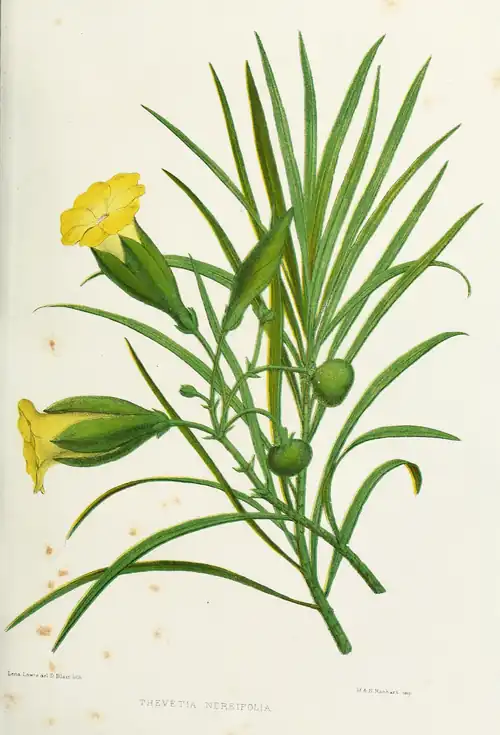
THEVETIA NEREIFOLIA.