Familiar Indian Flowers: with Coloured Plates/Quisqualis Indica
QUISQUALIS INDICA.
RANGOON CREEPER.
NATURAL ORDER, COMBRETACEÆ.
PERHAPS one of the most striking features in Indian horticulture is the number and variety of climbers that are to be found growing in the greatest luxuriance and profusion all over the country.
In the accompanying plate is exhibited one of the commonest and, at the same time, one of the loveliest of these climbers.
It is very luxuriant and rampant in its growth, and requires a strong support, as well as constant and severe pruning.
To all Anglo-Indians this specimen will be well known, used, as it often is, to form a screen to an ugly wall or offensive paling, on account of its being always green and possessing dense foliage.
It is at its hest during the hot season, when it affords a beautiful spectacle with its masses of bloom, which, hanging in clusters of rich profusion, completely conceal its trunk and branches. The clusters droop a long way from the parent stem.
This climber, when left long unchecked, will grow to a great height, and has been known to cover the tops of high trees, where the loveliness of its blossoms, mingling with the foliage of those trees over which it roams, becomes greatly enhanced by force of contrast.
From the plate it will be seen that the leaves grow in pairs down the stems, the end ones being of a dark brown or chocolate colour, whilst the general tint of the leaves is that of a heavy, dull green. They are also rough and slightly hairy to the touch.
One of the great. peculiarities and sources of beauty of the plant is that the flowers vary in tint. When first open in the early morning they are a creamy white, but as they fade they turn crimson scarlet, so that when the two are combined the beauty of the whole may be more easily imagined than described,
A young tendril or shoot has also been represented in the illustration, and it is worthy of notice that the young leaves have the same reddish hue before alluded to.
The scent of the Quisqualis is very sweet, but it is not always agreeable near a house, and many persons on this account object to the cultivation of it in their gardens It is very powerful and is perceptible at a great distance.
Chinese Honeysuckle or Rangoon Creeper are both names by which it is known.
In the neighbourhood of Calcutta the flowers are much larger, and wear a handsomer appearance than in other parts of India, which proves that a damp, moist climate is conducive to its perfection,
The seeds of the plant are often used as a medicine. 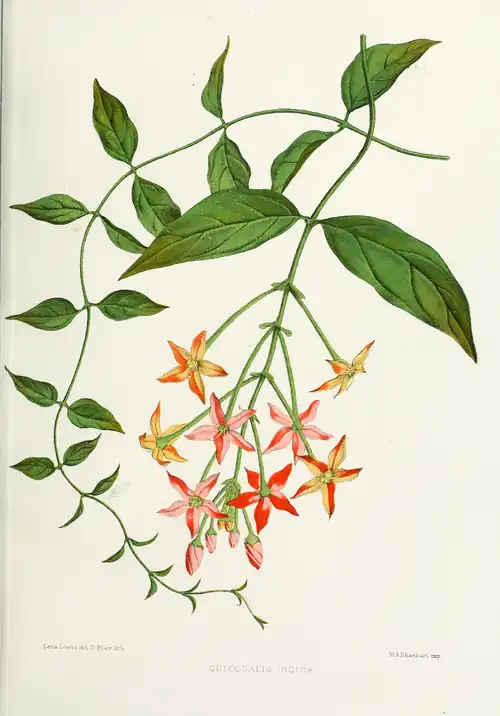
QUISQUALIS INDICA.