Familiar Indian Flowers: with Coloured Plates/Quamoclit Pennatum
QUAMOCLIT PENNATUM.
NATURAL ORDER, CONVOLVULACEÆ.
THIS climber, which becomes almost a weed when once introduced into a garden, is an annual. During the rains it is in great beauty, and its bright green, feathery foliage is spangled over by the cheerful starlike flowers.
It is of a twining, grasping nature, and woe betide any unfortunate sapling or tender bush which comes into its clutches, for it will be completely smothered in the embrace of the Quamoclit.
The slender stems are of a bright green colour and succulent nature, the leaves of the same bright green colour and very finely divided, while the flower is of a vivid scarlet or pure white; for there are two varieties.
When these two varieties are growing together, the beauty and brightness of the combination may be imagined.
“When trained up a pole,” remarks Ferminger, “this plant, as seen from a distance, has somewhat the effect of a Cypress.”
“Quamoclit Phœniceum” has very similar flowers to those of our picture; but the leaves are totally different, as they are thick and heavy, and of a heart shape. This species flowers during the cold weather. It is also a vigorous and aspiring climber.
Students of Roxburgh and Willis will find this plant classed as “Ipomeea Quamoclit,” and the Natural Order given as "Lettsomiæ”; but to the general botanist, I think the mame at the head of this paper will be the most familiar.
This delicate, fragile-looking plant is found almost in every part of India, and is so easily propagated by seeds scattered by the wind, that it has often to be pulled up as a weed.
I cannot find it alluded to in Drury, Ainslie, or other authorities as useful, either medicinally or economically, and so conclude it is only ornamental to our gardens. 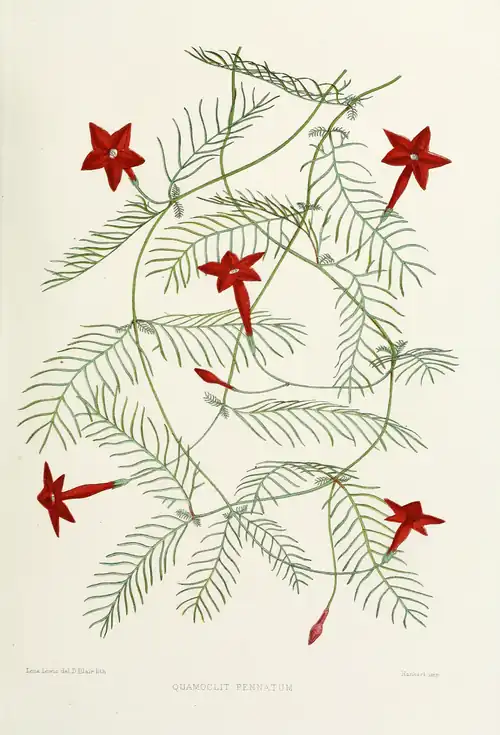
QUAMOCLIT PENNATUM.